So Green, So Serene


It is an unusual client that opts for a green garden.  I doubt I have the discipline this requires-though the front of the shop is grey, green and white this year.  Truth be told, I love flowers.  All manner of flowers, all shapes, all sizes.  Little flowers-fine. Subtle flowers-I see.  Daisies-no matter that I see them everywhere, I love them.  The flowers that grace my summer-I love them one and all.   Giant flowers-what fun. Blooms-I am besotted by them.  But a green garden does have that aura of  serenity about it.
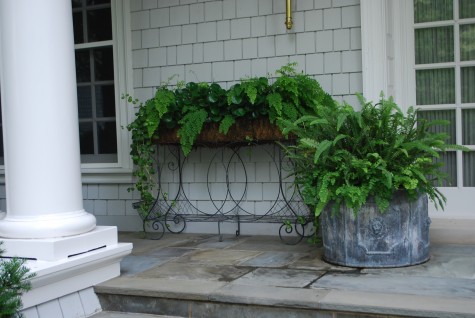
Serene does not necessarily mean sleepy. The infinite variation in color, shape, texture and mass of green plants is astonishing.  Green plants of singular form populate this planet such that one could plant any number of green schemes and never repeat oneself. These containers with ferns and pepperomia are lush growing, content on this porch.   
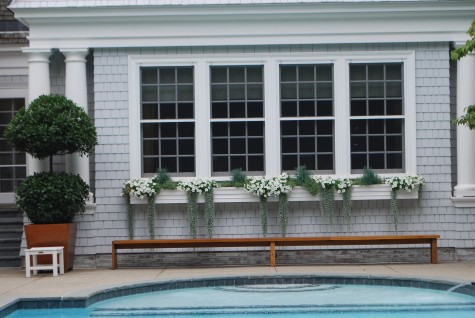
An old bay tree in a varnished Belgian box provides solid company to a long narrow window box. 
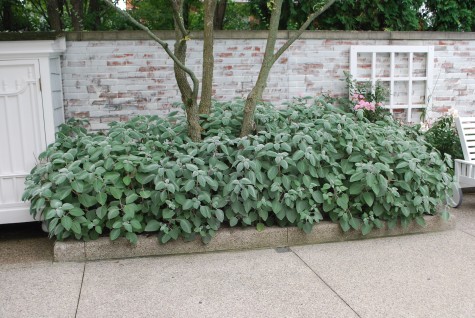
Plectranthus Silver Shield makes a swell, densely growing summer ground cover in a small space.  The thick felted grey green leaves are quite handsome.  That frosty green color persists in the sunniest and hottest spots you have, and is easy on the eyes. Its billowing habit of growth is very attractive.
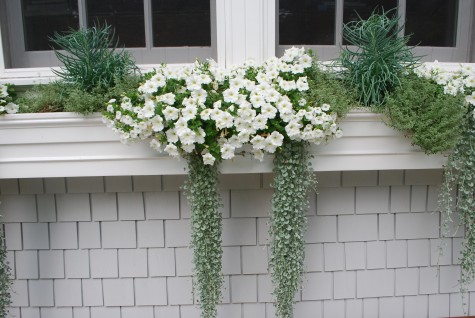
The plants in the window box look like bunting casually draping over the window box rail.  Those needled succulents are quite blue-green, and look great with the dichondra.  There is no brass band blaring here, just a plant string quartet quietly playing a simple melody. 
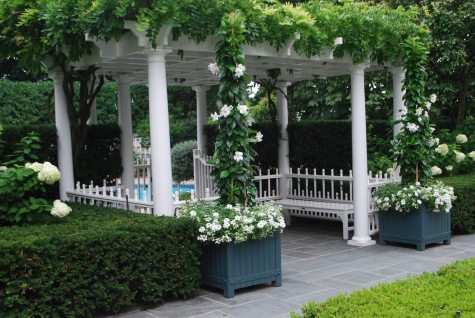

This white pergola with its wisteria roof is beautiful; there is no need to introduce a competitve element.  The mandevillea in the the boxes repeats the vining of the wisteria; the white flowers echo the white wood of the pergola.  Getting a planting to sit down and blend in seamlessly with all and any other garden elements makes for a serene space.  When plants talk too much, bicker, or compete with one another, the space will take a much more lively turn.  Deciding how high you like the volume outdoors can help you decide what and how to plant.   
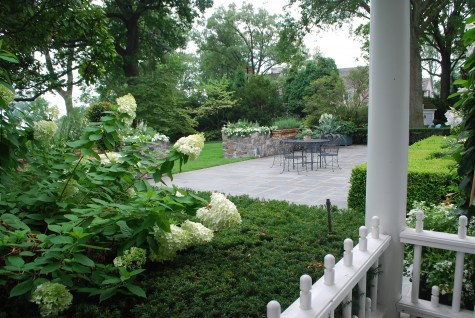
Green spaces have an added attraction;  most shades and textures of green look great together.  When you use materials that are all the same color, it encourages you to see the differences.  What textures compliment or enhance each other? Big leaves look great with little leaves.  Shiny leaves look great with hairy leaves.  I am surprised I do not see more groundcover plantings that mix vinca and baltic ivy.  The contrast of leaf size and texture is subtle, and interesting.  
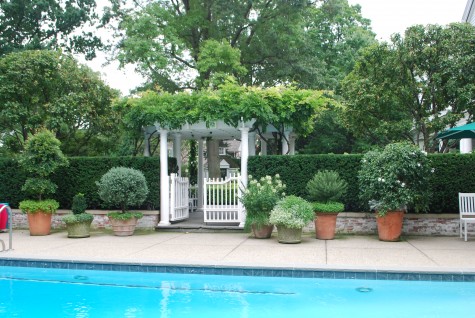
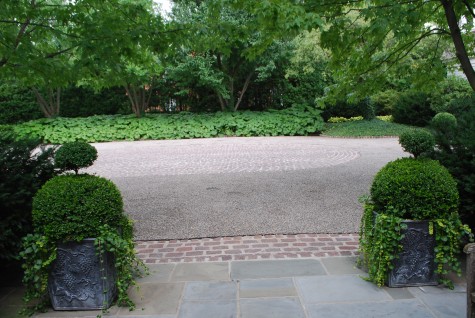
Topiary plants are a natural in a  green garden.  Many plants can be trained to grow in formally or informally clipped shapes.  The common denominator to all-the hand of the gardener, clipping and training towards an overall shape.  The effect of these groupings of pots is restful.  The formally pruned yews make a beautifully dark green backdrop for this collection of topiary. 
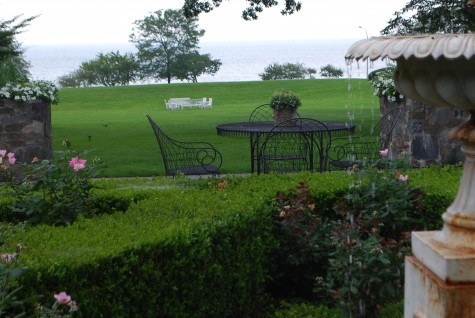

Lovely.

Red, Pink and Light


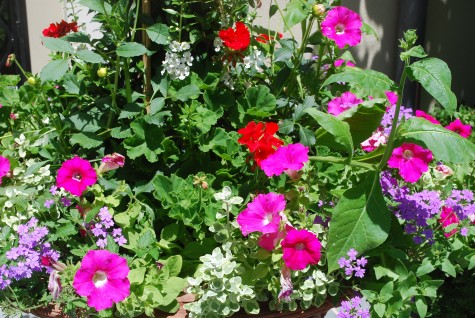
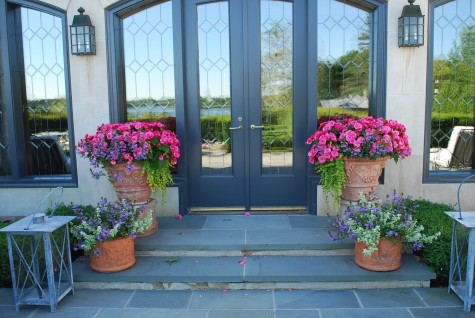
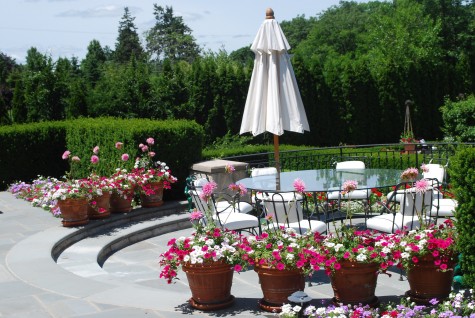
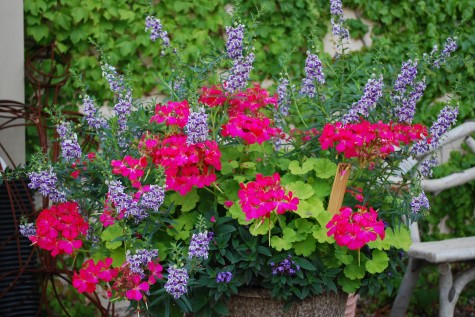
Reams have been written about the science and psychology of color. I doubt I have much to add to that discussion beyond saying that no small amount of the pleasure I take in gardening involves tinkering with color.  One of the best parts of annual gardening is that my committment to a composition is for one season only.  I so like the chance to start over.  My annual plantings are a brand new party dress for my garden-the color of which gives me lots of pleasure.  There are few colors I do not like; though I am not a fan of grey, I planted the front of the shop last week with lots of silver grey foliage.  Planting a scheme which has a good possibility of not appealing to me is part of the fun it. OK, maybe my idea of fun is a little offbeat-but so be it.  Strong color has always appealed to me; how I express strong color depends on the effect I hope to achieve.  Pink and red make a great color combination.  The above pictured pots are based on a pink and red scheme, but the effect is formal and elegant.

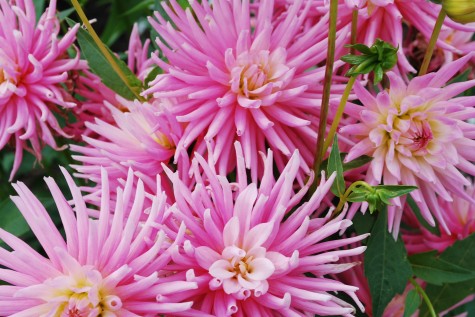
Park Princess dahlias are as big a statement about pink as one could hope for.  Were I to pair this plant with orange geraniums and yellow boston daisies, or red cannas, the effect of the color would be hot and tropical.  As I was after a more formal and restrained expression of color in the planting, the pink and red I have leavened with lavender and pale pink.  Light colors have the added property of reading well front a distance; these front porch pots make as much visual sense from a distance as they do up close.

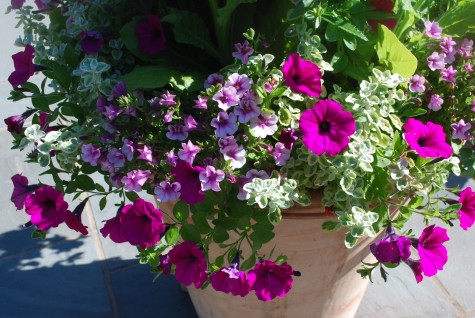
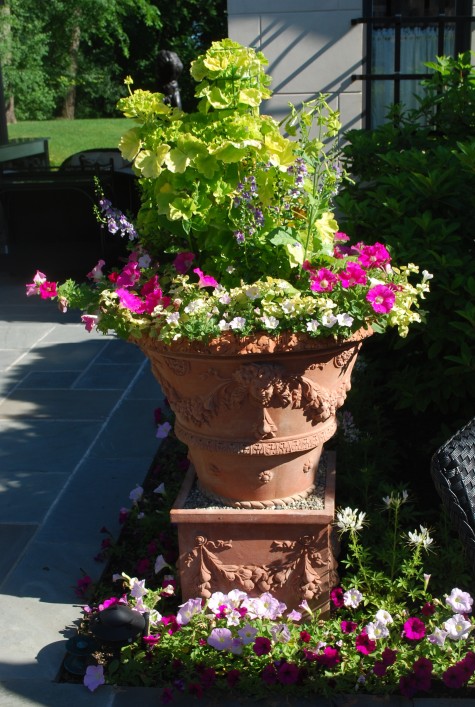
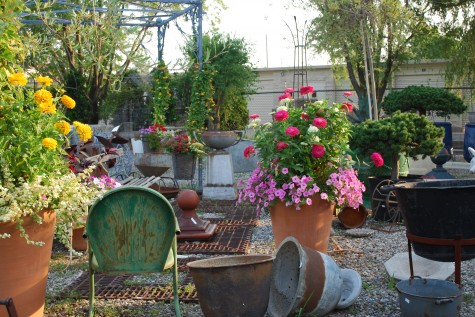
Tickled Pink million bells are a strong red violet at the throat, but the overall color reads as light, almost white, and airy.  They help to take some of the heat out of the purple wave petunias in this pot.  The variegated licorice acts like lots of ice cubes in this big drink of magenta red violet.  Had I used lime licorice here, and orange millions bells, the effect of the color would have been much different. The color is there, but expressed in a more restrained way.   

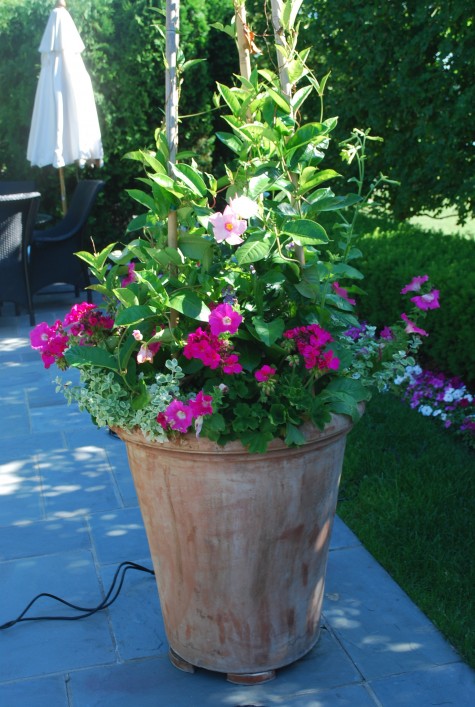
Once the pale pink mandevillea and lime nicotiana in this pot gets going, it will read in cool contrast to the cherry red geraniums and pink petunias.  Hot and light colors mixed together is visually lively.  Considering some of the ways in which color works will produce better and more satisfying containers.

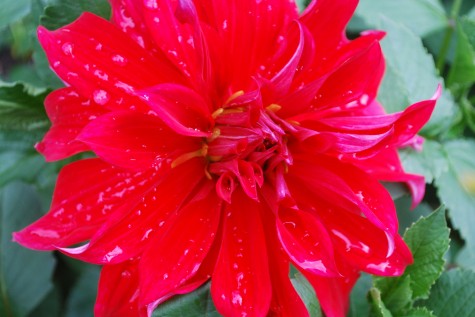
Red flowers can be dramatic in a landscape, as red and green contrast sharply.  Red is most effective when viewed up close, or when the dose of red is a big dose.  Red tulips, poppies, dahlias, geraniums, solenia begonias-they represent the color red effectively.  Red mandevillea grows vigorously, and blooms heavily.  Should red be your pleasure, any of these plants can deliver.  Red caladiums are a different experience of red.  The red color is overlaid on a green leaf; the visual effect is muted. 

I plant lots of geraniums-they are the little black dress of the annual world.  It is no wonder so many people plant them-the color is striking.  But pairing red geraniums with pink petunias, or strawberries, yellow dahlberg daisies or lavender star trailing verbena can make that red look like a fresh idea.
The big shot of bold color from these solenia pink begonias is the star of the show on this side porch. All the other plants lay low, in support of the dominant scheme. 

Persian Queen geraniums are so versatile in a container planting.  The lime green leaf is electric when paired with red; the flower is an equally electric pink. This discussion of pink is entirely different than the neighboring pots-but all the pots are friendly to one another.

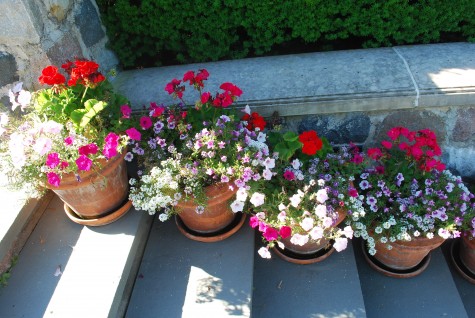
Pink and red geraniums alternating in the series of pots on a flight of steps get an alternating underplanting as well.  I like garden ideas that are expressed clearly.  Once I make a decision about where I want to go with color, I try to express that decision in as many subtly varying ways as I can.  This endows individual pots with  distinctively different compositions that still work well together overall. The planting has a rhythm and visual interest that helps make the flight up or down an interesting one.


Red, pink and light, coming up.

Green, please.

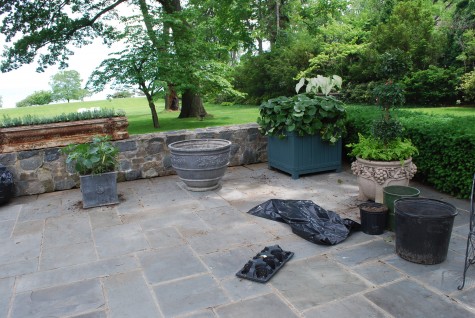
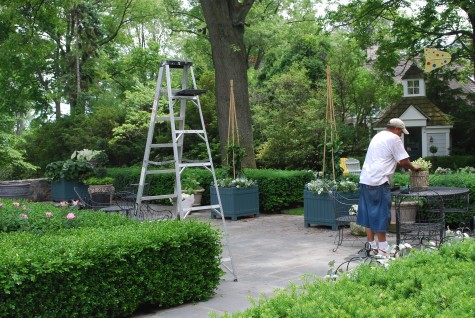
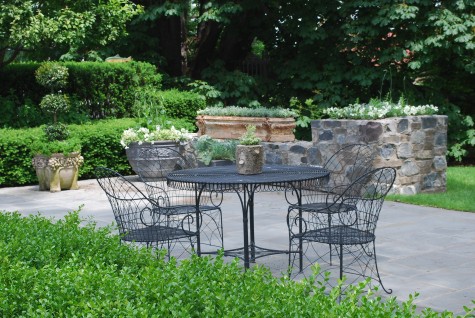
A client with whom I have had a relationship spanning many years-how can I describe her point of view about the landscape?  She was never interested in showy, always in stately.  Her color palette-quiet.  She oversees an amazing collection of old yews, and older trees. Her landscape, gardens, and containers clearly reflect her understated taste. Many years ago I added touches of pale pink, blue and lavender-and of course the white.   

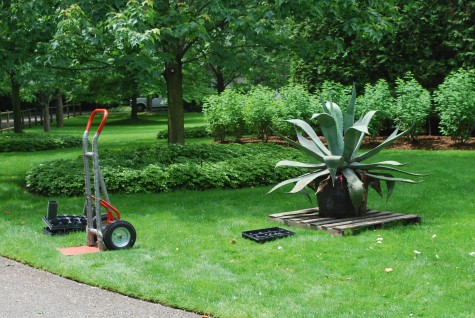
In recent years her taste has evolved such that I plant her containers with green plants of all different textures and habits. I store her collection of green topiary plants every winter; many have considerable age.  The agave of hers pictured above is many years old.  We plant it in a Bulbeck lead egg cup every year.  Each and every one of her garden containers have a history of note.  It took no small amount of time to put that collection together. Her plants-a collection of considerable age. 

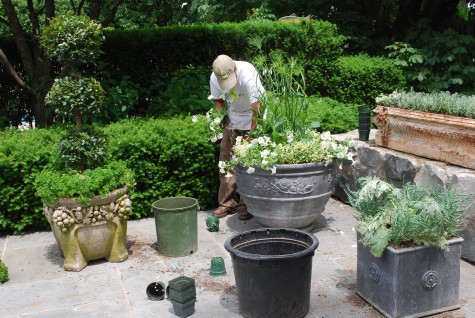
This years annual planting of course involved the planting out of her topiary collection. The underplanting this year-green, more green, white and grey.  The triple ball eugenia topiary pictured above on the left I underplanted with parsley.  The Bulbeck egg cup-a king Tut papyrus, and white nicotiana alata.  The lead square is home to a cardoon, and some blue pencil succulents. 

The thriple ball eugenia on the shady side of the terrace gets a ruff of ferns.  The big Belgian oak box-a mass of farfugium.  The small lead square-a mass of white datura and variegated sage.  The empty Bulbeck egg cup-waiting for the old agave.

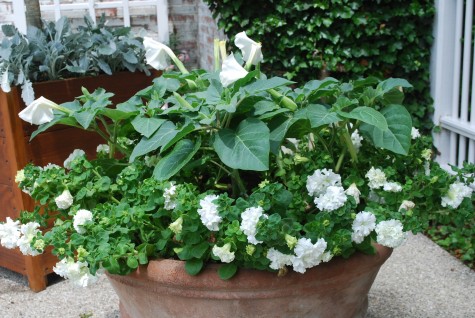
White datura-spectacular.  Though every part of the plant is poisonous, I plant it whenever I can-with strong instruction.  When you touch this plant to deadhead it, wash your hands afterwards.  Gardening is all about the work-is it not?   The underplanting of this double white petunia-this I like.  They grow long and lanky-I am hoping for sideways growth under the datura.  The pairing of simple white datura flowers with ultra double white petunia flowers-this is my idea of an interesting conversation. 

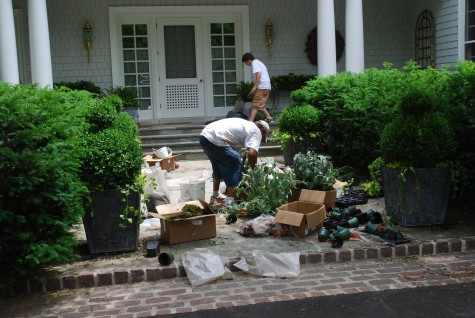
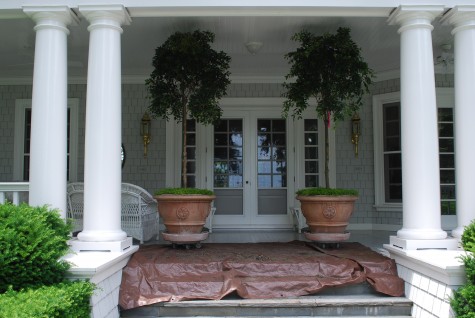
These old eugenias-I will need to replace them next year. In an effort to keep the grime off the painted porch floor, we replanted them, and underplanted them with lime selaginella on a tarp.  A dirty business, gardening.  No small amount of what I do is to be efficient about the cleanup.    

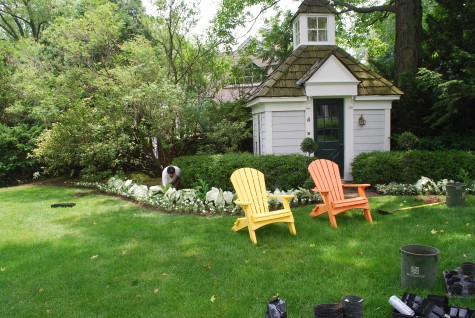
We planted the playhouse for the first time this year.  White nicotiana, white Christmas caladiums, white polka dot plant, white impatiens.  As this area is some distance from the rear terrace, I called for lots of white.  White-what it does I could write a book about-but not this week.  Ask me later.  White reads beautifully from a distance.  My idea here is to connect the playhouse visually with the rear terrace-so lots of the white that will bring the two spaces closer. A second pair of triple ball eugenia topiaries flank the front door.  I try never to treat a space on autopilot.  So many shady annual plantings- routine.  Who needs routine? 

We have big boxes to plant, and small containers to plant.  Each and every pot may have its planting, but the existing landscape, the relationship of the big planter boxes to the small containers-everything needs to work with the neighbor. My idea-be friendly.    

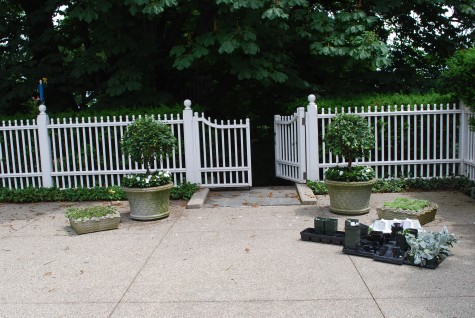
These single ball eugenia topiaries are but 2 years old.  I am pleased about how they are coming along.  I underplanted them with white new guinea impatiens; come August, these pots should be more than beautiful.  Patience-you and I know all about this.  My client-she knows about patience better than anyone else I have ever met. 

The long troughs planted thickly with lavender-they will be incredibly beautiful with some time. The walls we built to enclose the terrace have a considerable space to plant-on top.  My work is not so much about the actual, physical work.  It is much more about the evolution, the building, the communication and interaction.  When I wake up in the middle of the night anxious-it is not about her.   My green please client-she is a keeper.

Some Like It Hot

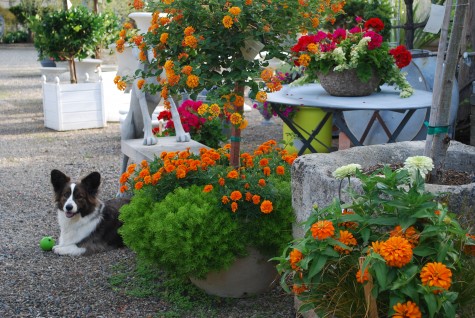
I have been a fan of orange, and every related warm, hot and striking color, my entire gardening life.  A client who once remarked that orange was a color that symbolized hysteria-I am sorry to say she had no appreciation for for sheer exuberance.  Some of us-including me-like it hot.  As I have said before, I love annual gardening for the fact that I can plant differently every season.  

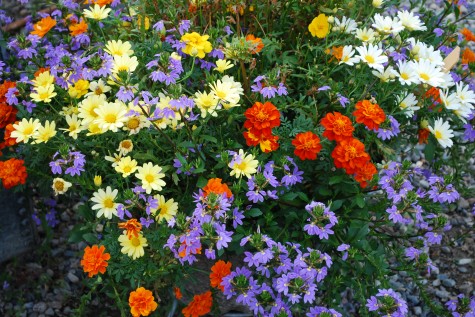
This combination of plants-Rob’s own.  Stellar-the syncopated beat of his color combination.  The idea of rhythm is very difficult to discuss in words-but so easy to photograph.  Hot and cool colors in graphic contrast will get attention from a long ways away.   Striking color contrast is but the first sentence from a  paragraph about what constitutes hot.  Looking to be blazing?  Think about orange, orange and hot pink and lime.  Think about any color, intensely represented.  

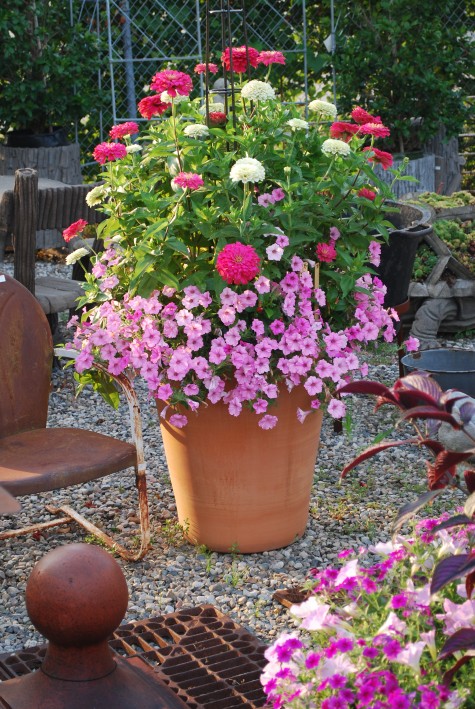
Hot pink and white zinnias, pink cotton candy petunias-these three plants can get a party going on.  I have been a fan of zinnias since was a kid. There is something boldly charming about their big flat faces.   Cannas, dahlias, bananas and other tropicals-all of these can bring loads of color to a planting.

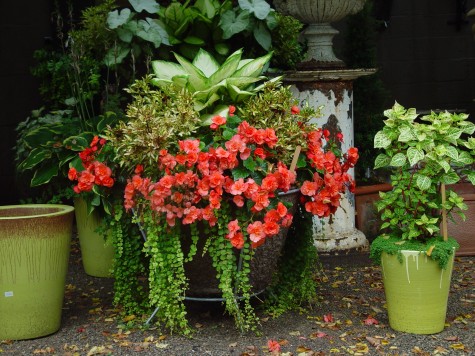
Solenia orange begonia is a great performer.  Properly watered, they will bloom heavily the entire summer.  They have succulent juicy stems that will rot if they are overwatered.  If you put your finger in the dirt-and the dirt sticks, wait to water.  Lime green is represented in the pots, creeping jenny, and the irisine in the right hand pot.  Lime and orange is a combination guaranteed to wake you up.

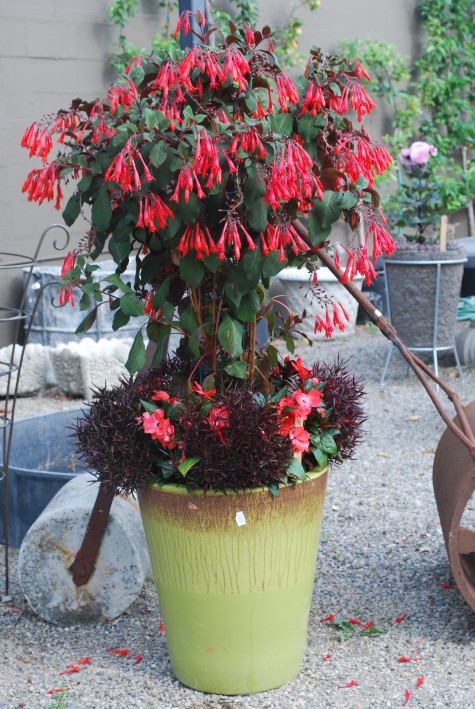
Gartenmeister fuchsia grows vigorously enough to make a great show as a flowering topiary.  As it is a lax grower, it needs secure staking from the beginning.  The dark red threadleaf amaranthus and orange New Guineas finish the arrangement.  Though that orange dominates, the overall impact is as much about form as color. 

Bicolor angelonia and Persian Qeen geraniums make a lively a color statement.  I plant lots of pots for the shop-when I see a combination grow up to make a beautiful bouquest, I try to make a note of it.  These two plants just seem made for each other.  The angelonia loosens up that stiffly growing geranium.  The geranium provides mass and substance to that wispy growing angelonia.  Hot pink, purple and lime-delicious.  That little bit of white in the angelonia keeps all the other color reading loud and clear.


A gardener has no end of plants to choose from.  How to organize what to choose?  I recommend as a first step-ignore what is in bloom May 10.  Too many people restrict their exposure to plants by insisting on “color” right off the bat.  There are other flowering plants in this world besides impatiens, wax leaf begonias, and red geraniums.  Big growing annuals do not make any kind of show in mid May; it takes time for them to mature.  Increasingly I see growers producing big plants in large tubs early.  I buy them when I am planting a client late-the tubs enable me to catch them up. But the pleasure of large growing plants has much to do with the patience to grow them on. Though it is June 3, I have no idea what I will do in my own pots. Maybe some hot color-maybe not.   I have time to dream it up-an entire season is still out there,  ahead of me. 

 No small part of the fun of gardening is planning, putting it all together, and  watching it grow up to be something.