Taking A Test Drive


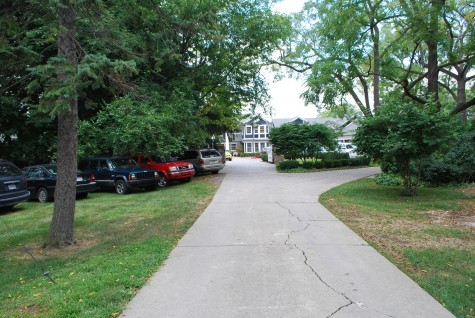
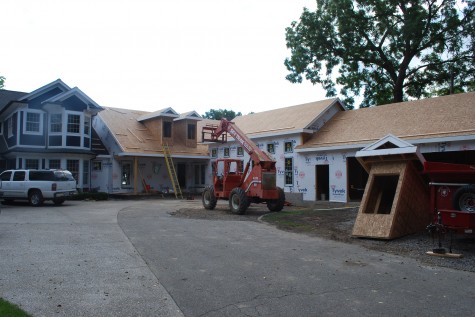
Finishing up a long project feels great.  This time, I was invited back for a Sunday afternoon reception along with every other contractor that had been involved in the design and construction of the addition, and the landscape that followed.  Lake houses tend to have lots that are deep and narrow, which places homes in close proximity to one another.  My clients had the opportunity to buy the property next door to them, and decided to add onto their house.  Driving up yesterday I was pleased the most about the driveway.  The old drive curved off to the right, to the neighboring property. In the course of the project, it was redone in such a way that the approach leads physically and visually to the front door.     
The white concrete aggregate pavement you see here on the left belonged to my client.  The asphalt drive swinging to the right-the original road.  This surface had to be redone not only for aesthetic reasons, but for circulation.  I did not want a drive that led vistors to choose the addition/side door in lieu of the proper front door. 
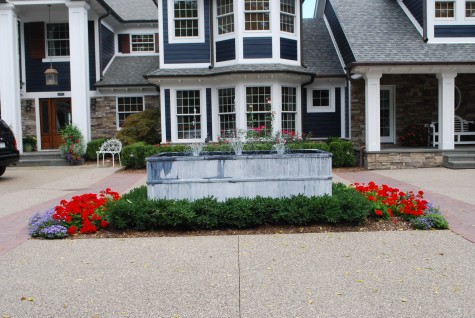
The stripes of brick set in the concrete aggregate run on either side of a 4′ by 8′ fountain cistern. This describes on the ground plane what is now the center section of the house. This landscape/driveway element divides the drivecourt space into three distinct areas, and additionally provides for a good amount of parking.  A large drivecourt was a necessity; the house is beyond walking distance from the main road. The driveway approach actually services three homes, so onsite parking was a must.
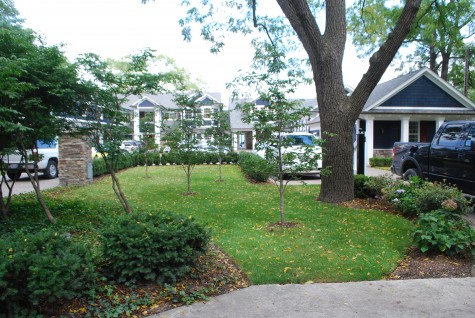
To the far right in this picture is a short run of decomposed granite that connects to the main drivecourt, so there can be parking and circulation in and out when they entertain. No one could tell from here that there were 12 cars parked on the drivecourt.  I like landscapes that are good looking as much as I like landscapes that work. 
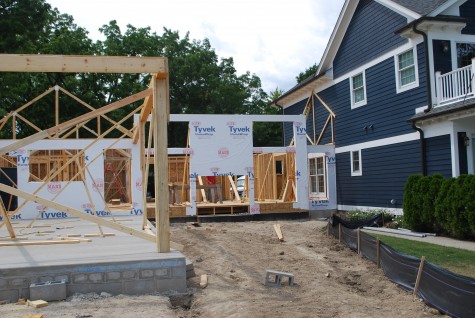
On the water side, the main job of the landscape was to integrate the two properties and make them feel as though they had always been one. This requires taking a lot of the existing landscape apart, and relocating it.  A previous post I wrote on this project detailed a flat plane of grass bisected by granite X’s and boxwood dots.  This elements extends across the entire width of the property.  Both the repetition and size of this feature help to unify the two spaces.  I was so pleased-Buck had a hard time spotting what was original, and what was added.
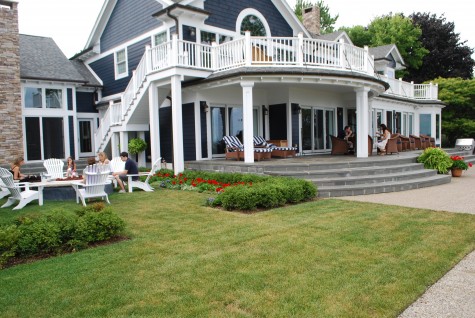
What had been the end of the house is now a backdrop for another seating area on a level different than the original bluestone terrace. The firebowl set at seat height provides a dining table for larger gatherings.
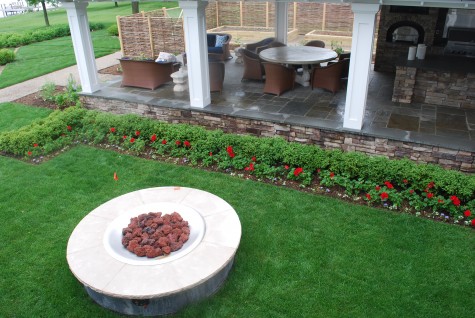
The covered porch terrace is set at the same height as the original terrace.  The stainless steel firebowl has its own cozily enclosed space.  I am sure it will be comfortably out of the wind on a chilly fall day. The covered porch with an outdoor kitchen is immediately adjacent to a large fenced vegetable garden.  

The enormously and formidably talented Jeffrey King was there with his partner and kids in tow.  He was responsible for all of the interior design-which is fabulous by the way. Don’t ask for pictures-that story is for him to tell. He was involved in every facet of this project from start to finish-he has a gift for encouraging the best from others. The house and garden was full of people.  There were places to visit, and sit for a while, eat, converse-both inside and out. It was a delightful party; a house and garden full of people is a good thing. 
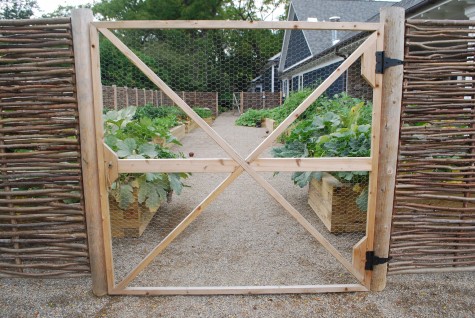
The vegetable garden is the hit of the landscape. The raised beds are filled with Steve’s soil recipe-which includes a generous percentage of worm castings. Everything she made for the reception except the chicken came out of this garden-much to everyone’s delight. The food was out out of this world. They have not only given away scads of vegetables, but they have played a version of bocce here, and held two dinner parties set at a pair of long wood tables that have been in the family a long time.  My favorite part-the wood gate is an exact replica of my client’s father’s vegetable garden gate in Italy.  Design development and installation that works its way around to what is personal, and matters to a client -this is the point at which a design relationship gets to be thick, substantive, lively-and good all around.
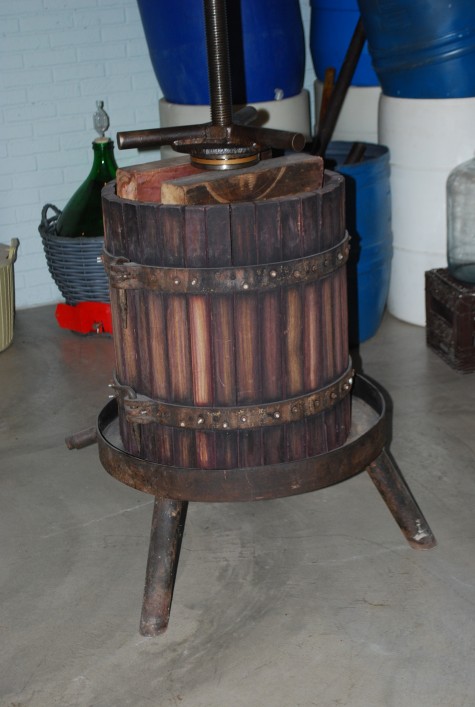

Little did I know that the basement has a room which houses wine making and sausage making equipment passed on to them from family.  Apparently father and son will be making wine.  All the way home, all I could think about was where to plant some grapes.
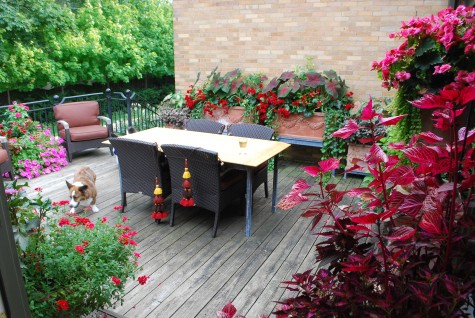
Late Summer

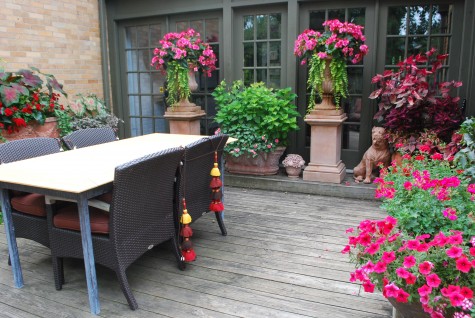
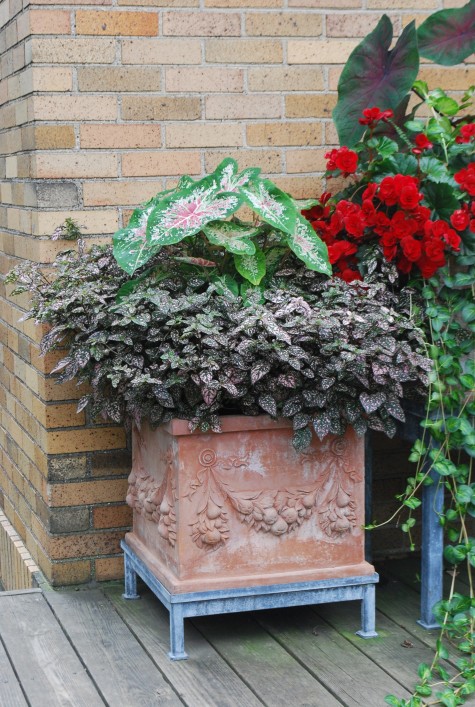
The view out onto my terrace right now is lush and loud.  really loud. I like to plant this group of containers with a different color scheme every year.  This year’s  pink and red spectrum runs the gamut from light to dark, from moody to electric. But the overall effect is definitely on the rowdy side.  Sometimes you just have to get certain things out of your system by giving them a try.  Having never planted anything red at home before, I scratched the itch.  The Mital Italian terra cotta rectangles are on a north wall , so they demand a planting that is shade tolerant.  The red caladiums provide a lot of a rich red/green mix in the leaves- which I like. The tropical ferns and the vinca maculatum are essential to the look.  The red solenia begonias are brilliantly red.  Since red and green are opposite one another on the color wheel, the combination makes for a lot of visual action.  Had I the chance to do it over again, I would plant lime irisine in the back; that very tall lime green with carmine veins would make the caladium red read more dramatically.  The big empty wall behind those pots-wouldn’t you think I could sort that out?

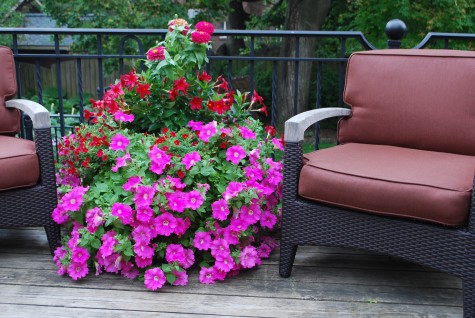
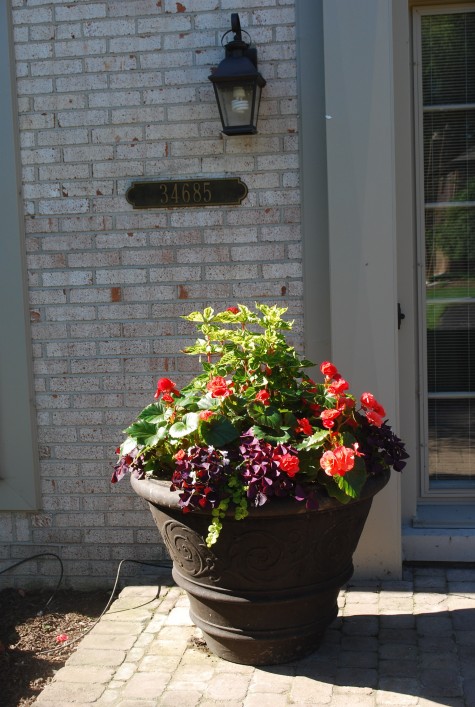
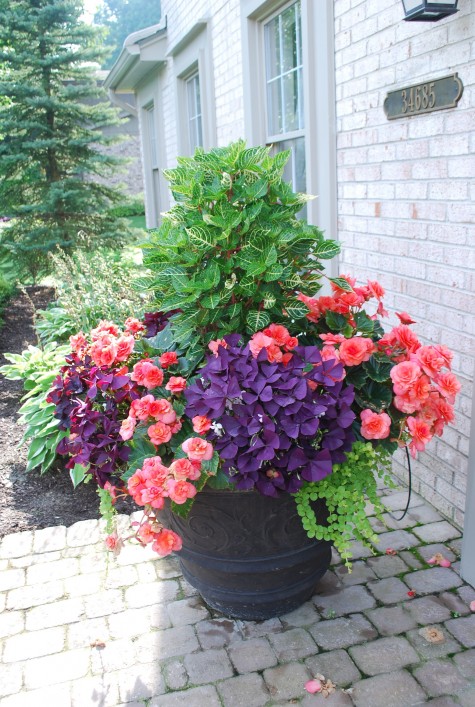
There is nothing particularly fancy in this pot-red mandevillea, cherry sun zinnias, cherry million bells and giant pink petunias.  What is of interest is the vigor with which this planting has grown.  These plants like being neighbors, and they like this pot size and location.  Everything observed in the garden will come in handy the next time around.  Where’s my journal?

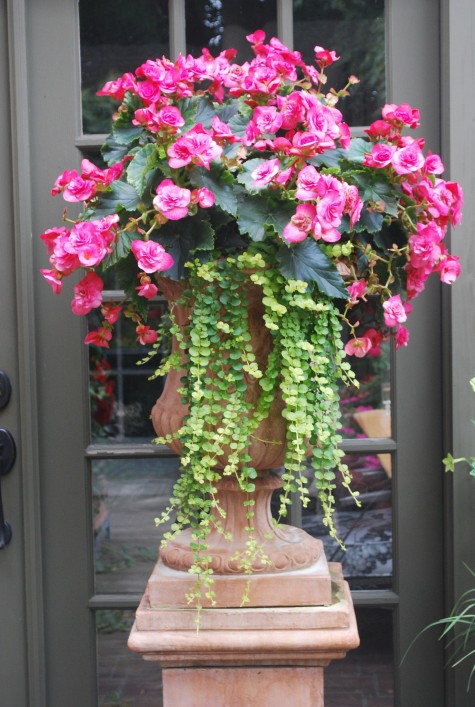
My pink begonias have suffered some from sun burn.  This has never been the case with the apricot or orange solenias.  It made me study the sun on this wall more carefully.  It turns out there is a lot more light here than what I thought; what I assumed was an eastern exposure is actually south easterly.  How I could have planted these pots 14 times for part sun and done ok is a testament to every plant’s will to live; they suffer me kindly. The red irisine has tried its best to grow luxuriantly, but the top leaves bleached from the sun during our long run of hot sunny weather.  I am hoping for a better fall. 

You can spot the sunburn on the pink solenia begonia in this picture. That orange solenia shrugs off the hot sun is called varietal variation.  This series of begonias is the easiest of all to grow, in my opinion. The pink apparently needs more protection from direct sun. I am sure there will be no pink begonias here in 2011; I am a quick learner.  I don’t mind trying to grow things that are tough to cultivate, but I have to balance that interest aginst how much time I actually have to put to any aspect of my garden.    


Though the botanical name is not part of my vocabulary, I do like polka dot plants. Available in white, pink, and rose, they remind me of a choir.  A big and coherent voice generated from a cast of thousands. They thrive on pinching; they thicken up, and represent.  This moody pink and green foliage plant compliments this rose pink and green caladium better than I could have hoped for.    

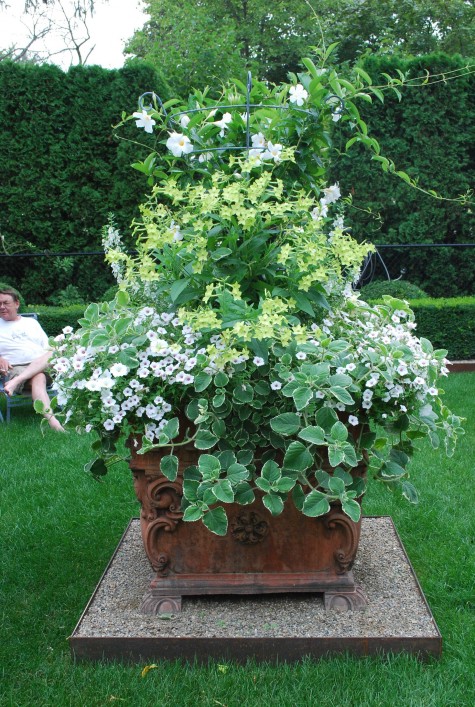
Last year this English concrete square of classical Italian design was home to a homeless ancient agave.  That agave went to a client this spring; I was on my own with a planting scheme.  Though I planted a white mandevillea, white angelonia, lime nicotiana alata, gobs of silverberry mini petunias and variegated plectranthus, I worried that the planting would never grow up into and spill over this massive pot.  It may be mid August, but I like what I am looking at now.   

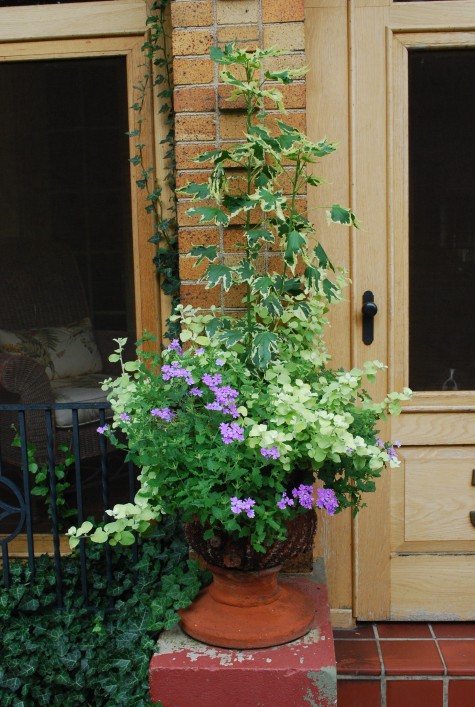
I have never had pots on the limestone pillars integral to my front door.  My idea to move these antique English terra cotta log pots to the front, from the rear deck-capricious.  I so love the look of these pots here-but keeping water on them given a merciless exposure to western sun has been a challenge.  This variegated abutilon is great looking-I plan to have plenty of them for spring.  The verbena and lime licorice tolerate a hot spot.  How these small pots dry out has been a lot of trouble-worthwhile trouble.

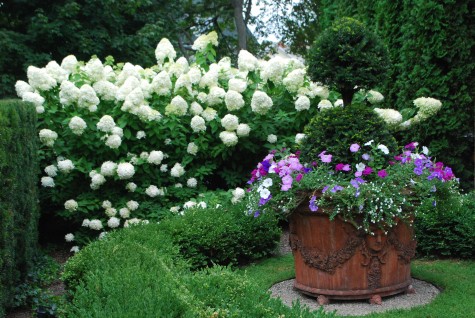
I am so happy with my English concrete pots fabricated in the classical color and style reminiscent of Italy. This is my third season with them-and I think my most successful planting.  Taxus topiaries-I had never seen them before a visit to Mori Nurseries last year.  These double ball yew topiaries rule the garden just outside my front door.  They seem quite happy in these enormous pots-the soil moisture is steady.  The generous skirt of mixed petunias, cerise pink verbena and white bacopa-a perfect foil to that seriously dark green form.  I am delighted.      


My late summer garden views-I like them.

Generating Curves

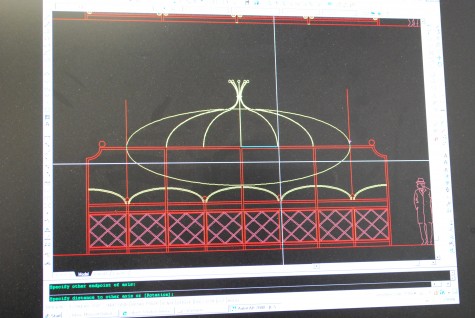
I have a big love for formally conceived and planted landscapes.  Nature does wild, asymmetrical  and completely unexpected far better than I could ever hope to.  A client with whom I have been in negotiations for three years regarding her irrigation system flooding and killing her plants finally came around this spring.  “I see that the trees in the parks do just fine, though no automatic irrigation is in place.”  A client who is observing nature at work-what could be better?  I like to observe nature at work, and create spaces for people based on those observations.  Though I have a big love for the intersection of horizontal and vertical lines, I am the first to admire spaces with beautiful curves.  This design of mine for a steel pergola is organized around the elliptical shape you see in the drawing above. Should it ever be built, the bottom part of the ellipse will be implied, not represented.  Beautifully curved landscape beds imply circular shapes, though all of that circle may not be represented.       

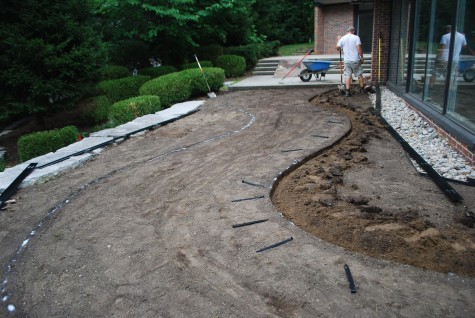
A recent project was all about compound, curving shapes. I generate these shapes by hand; I spray dots on the ground to start.  Should you be generating curved beds, I would recommend the following.  A curved bed needs to be curved from start to finish.  Once even a small portion of  a curve goes flat, it looses impact. Some have luck dragging a hose-this method has never worked for me.  For large curves, a stake set on a proper radius, with a string attached can generate the portion of a circle you need.

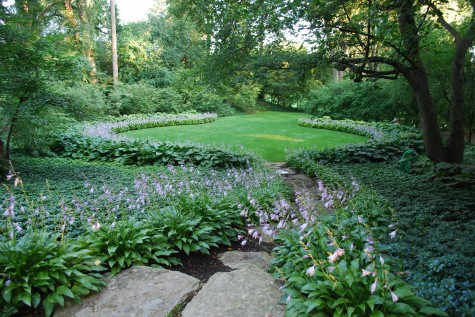
Though this lawn panel appears elliptical from this angle, it is clearly circular when you are in the space.  Finding the center of the space took some trial and error, but I was finally able to wrap the string around my landscape paint, stretch it tight against the centering stake, and dot it in.  Circular shapes, and circular sculptures or spheres are visually very strong and stable.  Several cultivars of hosta fringe the lawn panel.  The relationship between this very geometric garden and the naturally planted surrounding landscape provides visual interest. 

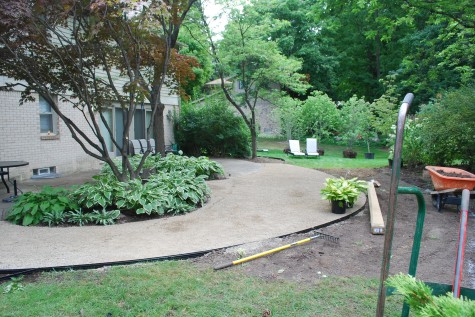
Big swooping curves can relieve the feeling that a space is small and stuffy.  The placement of this house on its property means a very large front and public space, and a small back yard.  The addition of a curved granite terrace makes the rear yard feel bigger, more airy.  I know there are those gardeners who edge their beds by hand, but I am not good enough to hand generate a good curve with an edging spade; I invariably go off.   An investment in some edger strip pays off in the long run by keeping lawn out of a bed or terrace. 

For curves to read well, they should be simple and large.  The best way to assess if your curved beds have the impact you are after is to look at those spaces left over when you are done with your curve work. Whether they be the lawn, a pathway, or the property line, those spaces should look graceful too.  Any bed needs to work in conjunction with what is not the bed in order to be visually striking.  

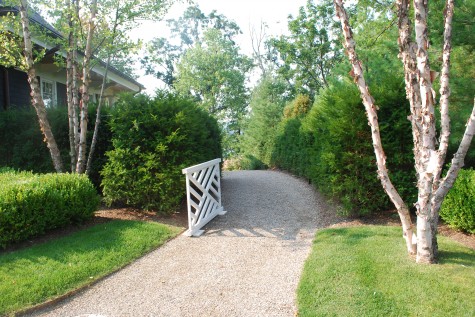
Curves provide opportunities to screen views, or provide a sense of anticipation about what will come next.  This gravel path reveals little of what is to come, as it both curves and drops out of view from outside the gate.  Transitional spaces such as this one are very important in giving a landscape a sense of continuity as you move through it.  Even the smallest yard cannot be properly experienced all at once.

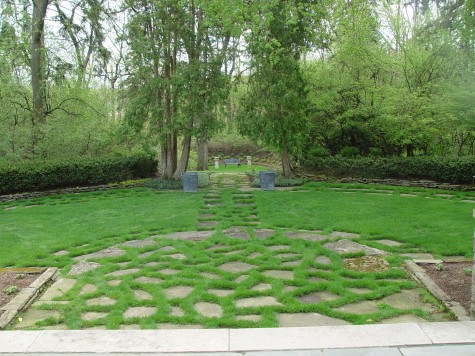
This old flight of stairs and lawn terrace were designed on a very large radius.  All of the attendent plant material was planted in concert with this shape.  In the distance, a circular garden whose center of interest is an antique garden bench flanked by a pair of Georgian pedestals.  This is a very formal but understated design based on the circle. 

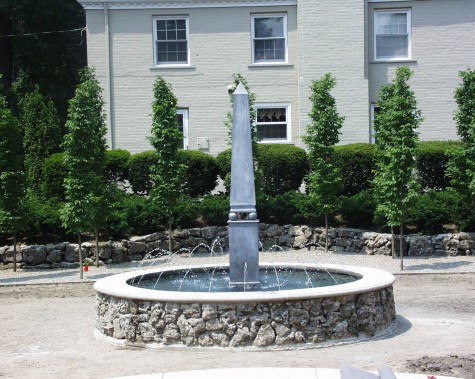
This circular fountain is the dominant element of the landscape under construction here.  Curving the retaining wall in the background away from the fountain is a response to the importance of that fountain.  Any gesture that gets repeated emphasizes the importance of that gesture.   


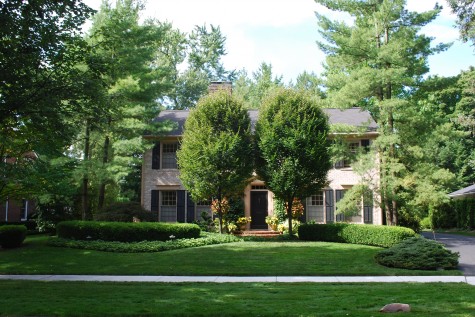
Though the view in to this landscape presents a formally constructed sunken garden in a circular shape, the choice of plant material keeps that formality from seeming out of place with the style of the house.  Gold vicary privet is a plant one saw routinely in suburban landscapes 50 years ago.  It was usually planted as an accent plant, given its astonishly bright leaf color.  In this application, the vicary gives weight to a curved shape located in a space shaded by the surrounding mature spruce. Choosing the shapes of places in a landscape ahead of choosing the plants-a good idea.

Rearranging What Is Already Yours

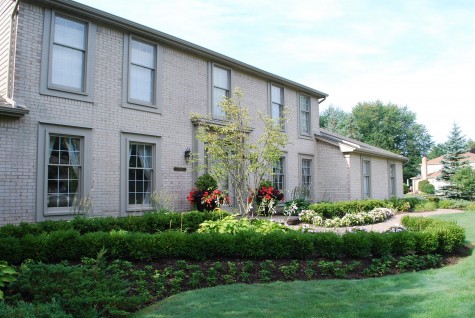
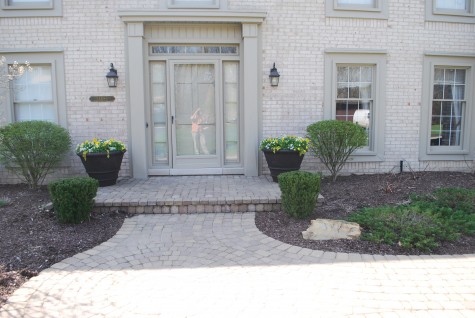
Even the most carefully planned and planted landscapes can go awry, given enough time and circumstance. So no wonder that landscapes that were planted without regard to mature plant heights and sizes, eventually suffer and decline from that reactionary style of pruning that turns every green plant into a shadow of its glorious self.  The person who decided to plant euonymus alata compacta-burning bush-in front of a house with windows that are only inches off the ground, and in spaces scarcely 3 feet from walkway to wall, or 6 inches from the foundation of the house- this person knew only enough to be dangerous. A spectacularly grown compact burning bush is every inch of  8′ by 8′.  This would be 64 square feet of loosely structured shrub whose charm lies in its casual ability to densely screen a large space, and its brilliant red fall leaf color.  There is no sign of such in the above landscape; the burning bush have been bit back to the quick by an electric hedge trimmer with an unlicensed person at the helm.  In this case, a lawn cutting crew moved on to landscape maintenance without one shred of knowledge about proper pruning.  Landscapes thus maintained age very quickly.  

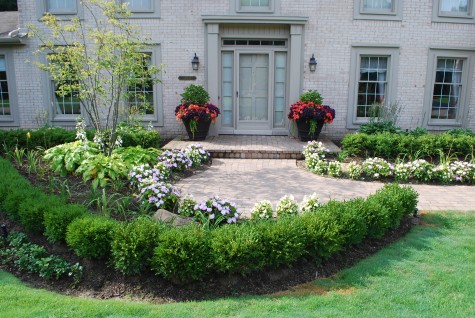
Given that this client has a sizeable property, we found a home for the burning bush where they could spread their wings, and live in peace.  Existing boxwood was dug and replanted in a more generous and informal curve.  New boxwood across the front of the home can be maintained at a height that features rather than obstructs the windows.  Unseen as well they should be-variegated hostas were collected from 5 different locations on the property, and planted in mass behind the boxwood.  Thery will mature at a height well below the bottoms of the windows.

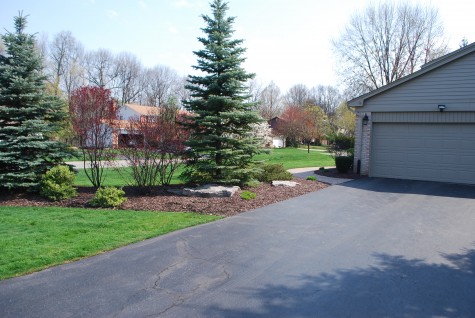
Plants die-from disease, from physical damage, from drought or overwatering, from poor placement-or from old age.  Barked landscape beds give the impression of neatness and care, but eventually the empty spaces outnumber the planted ones.  The red leaved sand cherries in this bed have reacted to their yearly flat-top buzz cut with long leggy and unattractive stems.  The spruces which 10 years ago had plenty of space are further putting the squeeze on those badly pruned shrubs.  We moved these stick bushes to better pastures, and moved in some of the same species that had been languishing in another bed in the shade.  

The yews from the front of the house-pruned exactly like the burning bush, were moved and grouped so they could grow together as a mass.  They hide the bare legs of this new group of sand cherries-by nature a very short lived and disease prone shrub.  I would guess that by the time the spruces close in on one another, the cherries will be at the limit of their lifespan.  Shrubs and perennials can fill these awkward gaps in a landscape which inevitably occur when you place plant material with enough room to grow.  

The hydrangeas now underneath the spruce skirt were moved where they had light and room to grow.  The two oddly placed variegated euonymus were dug from a number of spots, and planted in a mass that will grow out in a pleasing way.  We filled the rest of this bed with existing plant material that needed a more friendly home.

It will take time for all of the plants to grow out of their hot air balloon shapes, and have a a natural and relaxed look.  Annuals and perennials do a great job of filling the gaps, so the bed looks fully planted.  A landscape renovation is not always about introducing new material.  It can be about moving, dividing, rearranging, relocating what no longer works.   

New pots on the porch was the first step in revising this entrance planting.  The picture above tells more than you ever wanted to know about bad placement, worse pruning, and bark.  This landscape was much about what was performingly poorly, and missing.   

Most of the plant material you see here came from someplace else on the property. Recycled plant material, some new boxwood, and some annuals make this porch a far more inviting spot. I am the first to suggest when something just needs to go, but I do try to imagine what it would look like, or how it might better perform in another location.    

Newly planted plants have that fresh out of the nursery look. But plants will settle down and grow, given proper siting, planting, and care.  As for the rest of what you have, there may be a new landscape sitting there, waiting for a new arrangement.