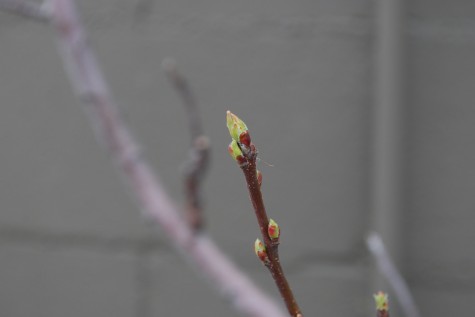
Budding

I am writing this Friday post late Saturday afternoon; sorry, it has been a busy week.  The warm weather has brought in  friends and clients -for a spring hello, and for spring work.  I am so glad to be back to work designing. Every project has its own 3″ by 5″ card-they go on my bulletin board wall.  This way, I can see everything I have going on at a glance. I get messages; “please put me on the board for….” -I like this. Green cards for design.  Blue cards for design going into the build phase.  Lavender cards for spring plantings.  Pink cards for summer plantings.  Yellow cards for parties and events. This may seen archaic to most, but it works great for me.   Having a stack of design and build cards-each design project benefits the other.  Design is very much about rhythm and regular engagement, and I am engaged on a number of fronts.  Everything is budding-I am sure you have noticed, as I have.     
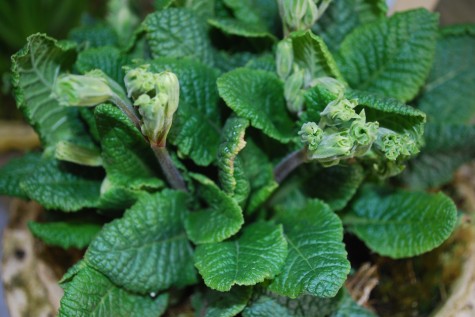
This green flowered primula “Francisca” was discovered by Francicsa Dart on a traffic island in Canada in 1995. Green flowers look good for a long time-as their petals photosynthesize just like leaves-the info from the new issue of “Gardens Illustrated”.   Many older green flowered primroses have been propagated too long, with attendant viruses that weaken them. This primula is an exception- remarkable for its robust growth.  Budding is about anticipation, and expectation; people and plants share this come spring. This late wait- just one of a list of rewarding things a gardener has to look forward to.  This late winter wait is a vast improvement over the post holiday wait-I’ll take it.
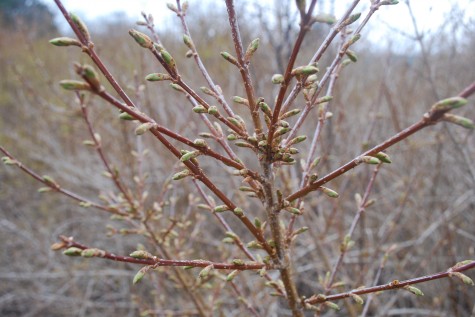
The forsythia in the outlot has budded and swelled in the twinkling of an eye; this is its habit.  The recent night temps in the twenties has not damaged the emerging flowers, but it has thrown them into a cryogenic state of inanimation.  I am sure this terminology would make any biologist laugh-but whatever.  These buds are at a standstill. If I cut and brought these branches inside, they would pop overnight.  Watching them move ahead, and then screech to a halt outdoors-a good lesson about how good timing helps any new venture.
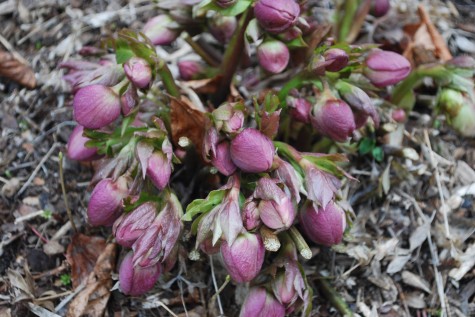
My hellebores have sent up buds very cautiously-there is something in the hellebore internal clock which hedges the bloom time bet. How plants interact with weather is incredibly interesting, and beautifully complicated.  No stalks will push these buds skyward until conditions seem optimal.  After all, the purpose of the flower is to make itself available for pollination, set seed, and thus insure the survival of the species. An inauspicious start out of the box doesn’t speak well for a good finish. That those flowers thoroughly enchant me; I am sure nature is rolling her eyes.  Make what she will of my naivete, I like the enchanting part of spring blooming.    
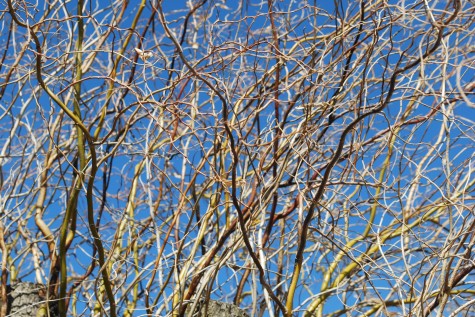
I am so fond of willows-in any and every form.  Their most amazing moves come right about now.  Their branches tell you when the spring sap is rising-branches dulled and browned by winter come alive-before the leaves bud.  Willow tree branches will go intensely yellow green, and glow, in early spring.  These trees light up, when the season turns-like no other plant.  This is a gift to the garden.
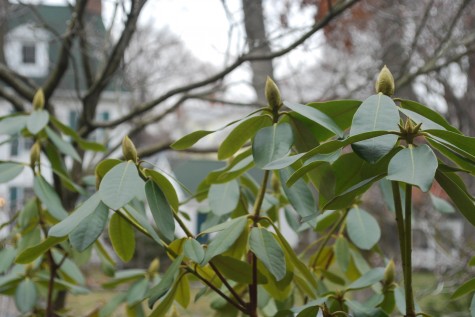
My rhododendron flower buds have been in place since last season. All winter they impassively withstood every insult the Michigan winter had to serve up. They are still tight and tightly closed.  It is much too cold for opening day. A few 60 degree days does not impress them-they need to be sure winter has let go-before they let go.   
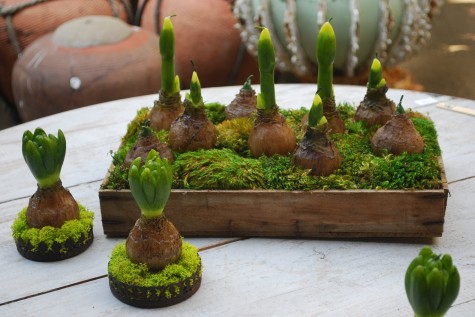
No one could fault Rob for lacking a sense of humor.  These budding bulbs are made of wax, and have wicks.  Planting them in wood trays and candle holders in natural and preserved moss; this represents a wickedly funny hope for budding.  I have seen a lot of second takes at the shop this week.  This budding out is all about how just about everyone is searching for any sign that the winter is over. Some have succumbed-and taken them home for spring dinner parties; our warm weather is dicey at best, until June 15.

On every gardener’s mind- is it time?
Finally, Spring Plants

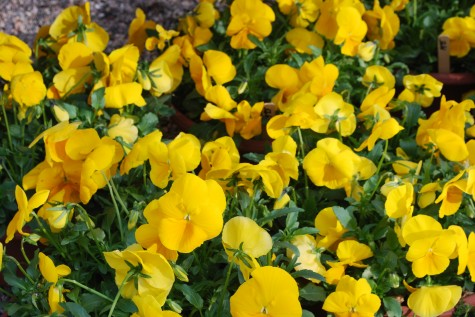
I laid eyes on my first batch of spring plants today-I was ridiculously pleased.  I could not take my eyes off these yellow pansies-nor could my nose.  Living plants have that most divine life-smell;  it was as if I got my first deep breath of saturated oxygen in months. This first contingent of plants I have special appreciation for-every sense I have is the better part of starved.  The spring plants deliver. I am not so much a fan of pansies with blotches-frequently called faces-I am not interested in anything remotely resembling black in the spring.  I love and welcome these big clear faced pansies. 

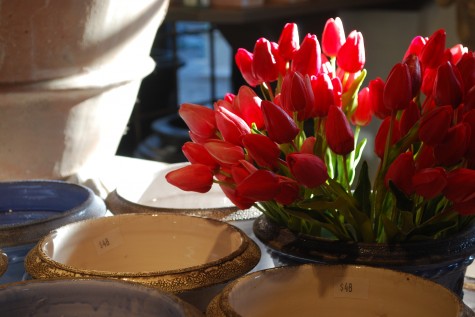
It is much too early for tulips-mine are 4 inches out of the ground, thanks to the very mild March we are having. These are fakes.  Though I value my plants like other people value their kids, I am unabashed about having these.  Made from some rubbery material with a decidedly tulip-like sheen, they cheer me up every time I walk by them.  So pink, they are!  The decision to carry fake plants is twofold-very few places carry them anymore-though the technology, appearance and feel of them is incredibly good now.  Those rayon tulips I saw 15 years ago were hard on the eyes, and dreadfully tough to take. These tulips bring spring to mind; this is enough to ask.  More importantly, I like to plant pots for spring-I am ready now.  The chilly spring weather is great for my bulbs and woodland flowers-they last and last, going into nature’s cooler every night.  But planted pots don’t gain much weight until the night temperatures really warm up.  A few fakes can give some needed heft and scale to a spring pot. Planting pots for spring-try it.  You may really like it.

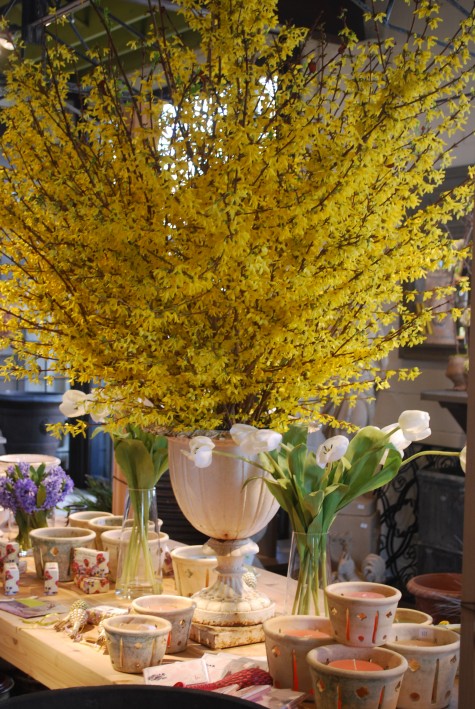
I maintain the traffic island across the street from the shop-all the township does is mow the grass every so often.  As I prune the forsythia and honeysuckle, and look after the crabapples, I have no guilt about cutting and forcing some branches for the shop.  The masses of forsythia bloom heavily in the spring, given that I prune them properly after they bloom.  You are looking at 20 cut stems here-I would say the shrub planting from whence these stems came is happy.  I would not want forsythia in my landscape-not enough summer, fall,  and winter interest to warrant a spot on my small property.  But if I had land, I would plant them in rows, like radishes, and marvel at their glorious moment.  Have you seen Forsythia Hill  in bloom at Beatrix Farrand’s garden at Dumbarton Oaks in DC-truly glorious. 

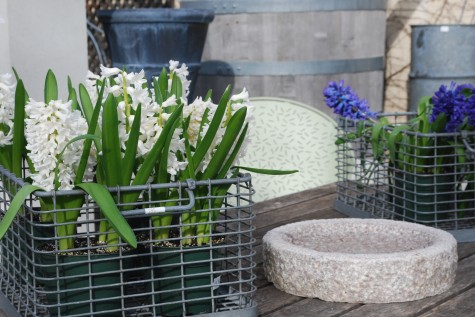
Plants soften the edges and hard surfaces that make up much of the natural world. If I were able, I would plant every container I have; the plants bring so much to the party.  A crate is a crate-a crate full of hyacinths, smelling fresh and fragrant, is a spring moment.  

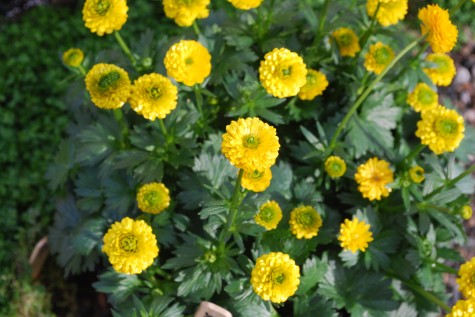
Amongst Rob’s plant choices today-what I call ashcan flowers.  I have not seen them in 30 years.  Ranunculus acris-a spring blooming perennial ranunculus, grew wild next to my trashcans, in the alley of my first house.  They like a low spot and don’t mind water-I so like plants that are happy in tough spots.  Yellow in the spring-this is a good look.

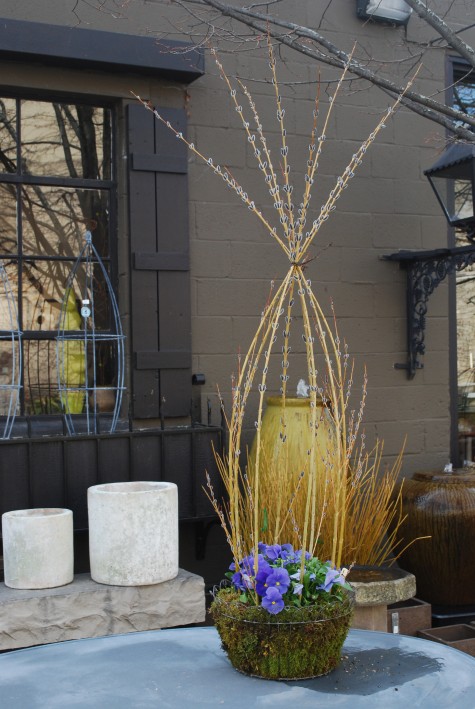
Rob designed and planted his first spring pot-a wire basket lined with moss got a mass of blue pansies-and a tuteur of prairie pussy willow. Belgium, England, and Oregon do much with plant towers from natural materials-he likes them.  I have to admit, these yellow stems against those china blue blooms says early spring loud and clear. I am waking up.  

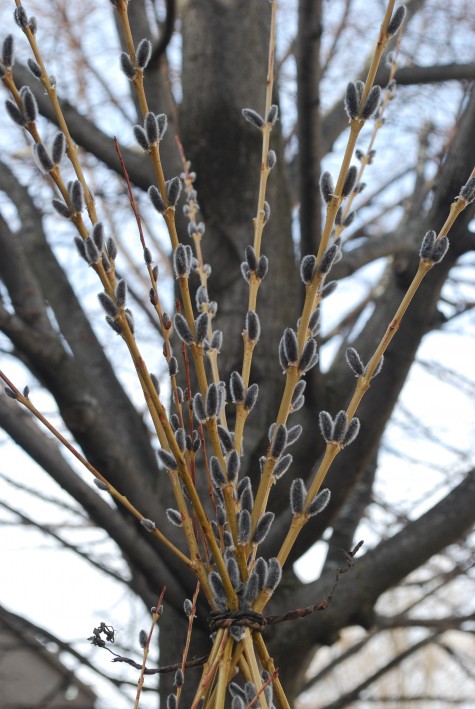
This pussy willow is a new one to me; prairie pussy willow, I am told.  I plan to call for the nomenclature.   The best part of a love for horticulture-no matter how many years it has been on your mind and heart, something new is bound to come your way. regularly. I had Rob move this pot 10 times before I found this spot to photograph it.  Those grey fuzz balls on their yellow stems are worth a good look.  That spreading topknot of willow I photographed in front of my old linden.  This visual relationship makes the most of each element.   I have a mind to learn about this salix. 


Inside, my greenhouse roof provides the necessary light for lots of plants.  I could do without a lot of things-but not the plants.  I share this in common with gardeners from sea to shining sea-and beyond.

At Close Range


I have talked every which way, and in every language I am familiar with about composition and space; can you tell it is a topic close to my heart?  My space has been very limited the past six weeks-so I am more than familiar with what goes on at close range.  I can describe in every detail what I see out the one window at home where I spent the lion’s share of my time the past 6 weeks.  The rhodies right outside that window were a green version of a thermometer. If I had my way, what would be up close to my view, every day?

What is up close and important for Buck is his kitchen-and everything else that goes on at the dinner table.  People sitting down, relating over a meal-this may be his idea of life’s most important moments.  Everything gets discussed and decided-at close range.  In his work life, his eyes are focused, via a magnifier in his welding helmet, on laying down via his mig welder, a perfect and smooth bead of E-70s silicon bronze wire-that perfectly laid bead welds one piece of metal to another.  He is twelve inches from that work. The Englishman Phillip Thomason, arguably the most influential garden pot maker of the twentieth century, could not have been far from his work, when he carved this green man and affixed it to the wall of one of his garden boxes. Were it mine, I would want to be able to be at close range-a view like this is a good one.�
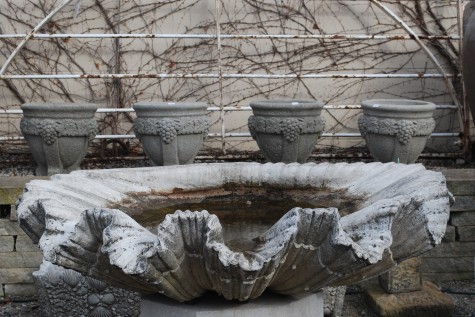
This photograph says a lot about near and far.  The front edge of this shell basin is in sharp focus. That front edge is parallel to the lens of the camera. Any object or plant, or combination thereof, which presents at close range, and at eye level, gets to be really important. That importance has nothing to do with the object or plant-it has to do with placement.  The background-how will you handle it?

Some pots can weigh in visually just fine, placed on the ground.  Others need a socle, or a gentle lift up, or a pedestal.  A pot at eye level is the visual equivalent of a finial. I define a finial as any beautiful finish to a pedestal, a garden, a space, or an entrance.   Plant that pot set at finial eye level or not, its beauty is at close range.  What you see, near and far, is all about good garden composition. Almost anything I see up close, I marvel at.  Should you want my attention far away, make that happen.    

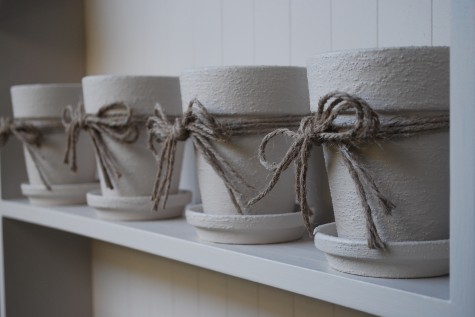
These small terra cotta pots, waterproofed with masonry waterproofing paint and painted white, with their associated paint soaked bows, would not get a passing glance-but for their placement at eye level on a shelf.  Given a good chance to look at them, your idea about them being insignificant may take a back seat to what you see.

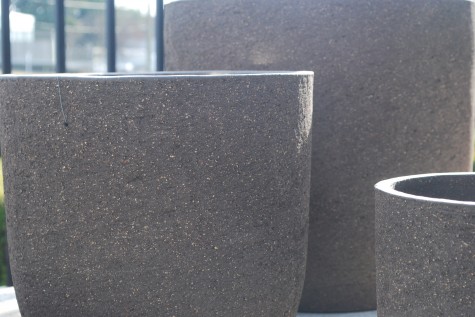
Contemporary garden ornament is much about shape and surface. Shape and surface up close has a much different feeling than shape and surface at a distance.  That placement within a space orients a viewer-no revelation here.  But placement is at your discretion- move things around.  Go far, get closer-move up to close range; see what you like best.  

Some plants, some garden objects, some gardens and landscapes, are best viewed from above eye level.  You can sort that out-just look, and see what view makes your heart pound the most.  If the light doesn’t go on, don’t worry.  I have been looking up and down, down and out, at a distance and up close, at my little property for 15 years-I do not have it sorted out.  I like this about gardening-Every year I bring something new to my approach.   

My garden tolerates me-amicably.  Should I bring something new home, chances are good that somewhere the landscape will invite the newcomer to dinner, and eventually ask them to stay on.  Where, how, and under what circumstances-this is your job.  Is this not a good job? 


Anything you cannot live without, and think to add to your garden-it may be more useful to ditch the idea of where, and think about its placement-relative to your eye, in the composition in question.  I know lots of gardeners that create based on instinct, and not idea. Those that create based on a genuine love and caring do just fine. There is really no need to give words to, or explicate the creative process. I only write about design in hopes of explaining my process. I greatly admire lots of gardeners that do things differently than I would-why wouldn’t I?     


Up close, every gardener gets engaged-yes?

Layering

I spent the better part of this week walking from one end of my property to the other- watching Rob and a crew haul out everything he had ordered for spring, tear the entire existing space apart, and put it all back together.  I could not even guess how many thousands of pounds of terra cotta, stone, wood, lead, were involved all told-but I would guess many.  I thought his method was smart-everything got moved into the driveway lane, leaving each side ready to be cleaned up, and re-raked.  Though our all over surface is compacted decomposed granite, it doesn’t feel like spring until it every vestige of last year gets raked out. Those of you who know of the late Allen Haskell-he took up, washed, and relaid all of the gravel in his nursery every spring.  Think of it.  Beyond relevelling the gravel, even more interesting was how he put things together. 

I would not have a word for this, but for Pam.  She designs, plants, and maintains gardens, so she has a point of view about it.  She was telling me she admired another desgner she knows for her ability to “layer” in plants.  By this she means plants are paired or grouped so while one is going quiet, another is coming on.  Daffodils with daylilies, or oriental poppies with phlox, or phlox with Japanese anemone.  Skilled perennial garden designers are adept at arranging plants to avoid what I call a gaposis. I like treating these perennial spaces with big growing annuals, but some like to handle this perennially. A large clump of oriental poppies going dormant is not such a pretty sight-something needs to be coming on strong in the spot in front of that poppy-otherwise a gaposis. 

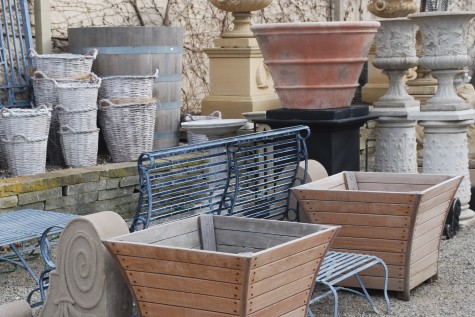
I think this is a good description of how Rob has arranged the outdoor spaces. He packed materials in close quarter that seemed to like each other or play off each other.  In this case, the steel striped bench echo the wood stripes; its scrolls recalls the scrolling corbel detail.  Surfaces and colors are different, but friendly. Lots of materials and styles are represented here.  His arrangement is a conversation about choices.   


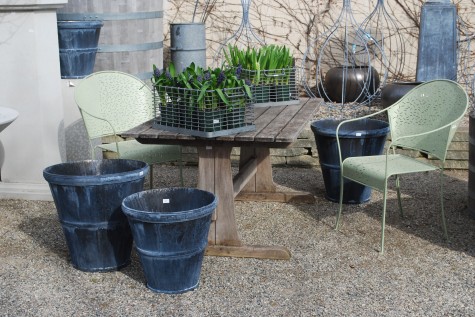
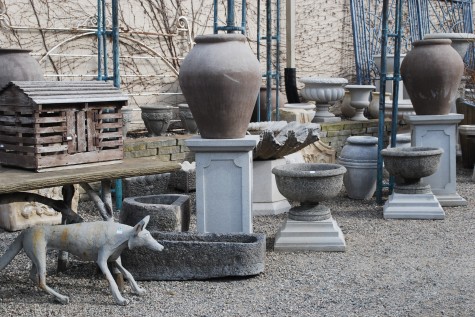
Contemporary garden ornament can include a wide range of objects. This early twentieth English wood trestle table is clean lined enough to be quite comfortable with some galvanized steel wire crates, and some painted French garden chairs. The round acid washed steel pots are finished with a nod to traditional forms, but have a subtly more modern shape.  

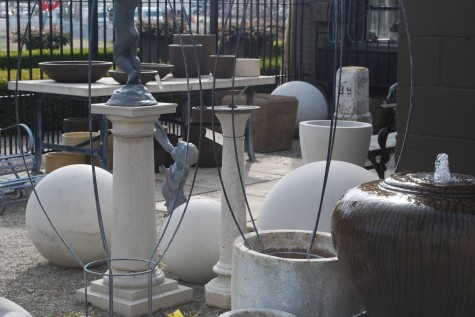
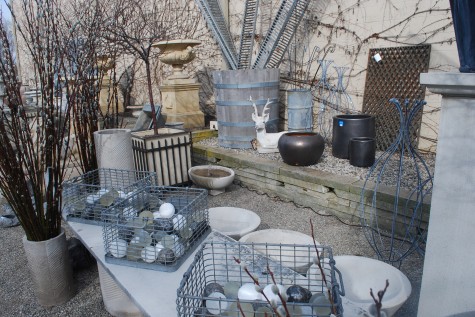
This space is densely populated.  On the table, below the table, in the air, on the ground-everywhere you look, something is going on.  I am surprised how amiable the contemporary limestone balls are to the modern lead sculptures of classical design.  I do not see any argument about to erupt.  I suppose any object for a garden implies that partnership-all of these things have a landscape to come in common.  Maybe this accounts for how they all get along. 

A pussy willow stem and a trench drain have almost nothing intrinsically in common.  What they do share is how they are arranged in a similar V-shaped fashion.  The color of the iron repeats the stems of the still dormant Boston ivy. What a different view will present itself once that wall is green. But given the early spring season, I like the bouquet shapes.

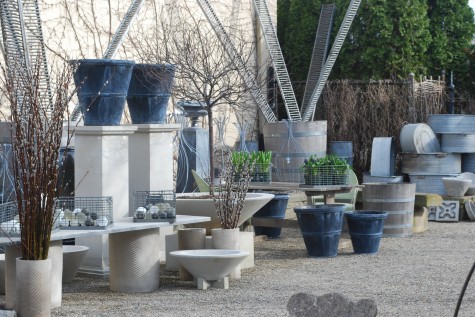
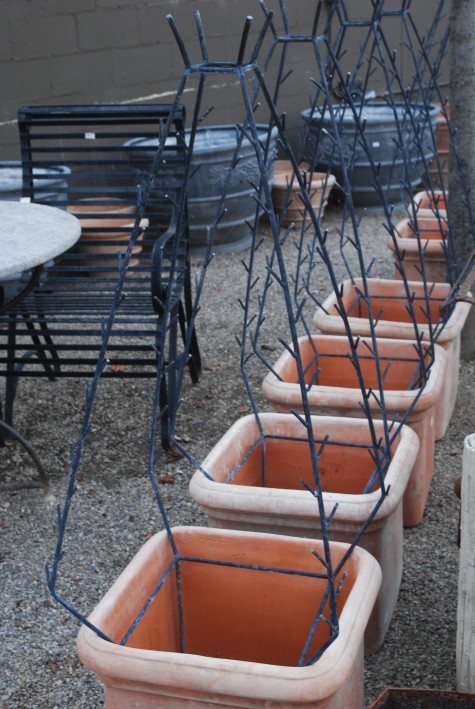
These steel tuteurs are Rob’s interpretation of some formally trimmed yews at Versailles.  I have already been scheming about what could be planted inside them, that would still reveal the outer form.  But it is the multiple forms in multiple pots that makes for such a big impact.  The blue/grey and terra cotta color scheme is repeated in the background in a very rhythmic way, alternating pots of different shape and height.  

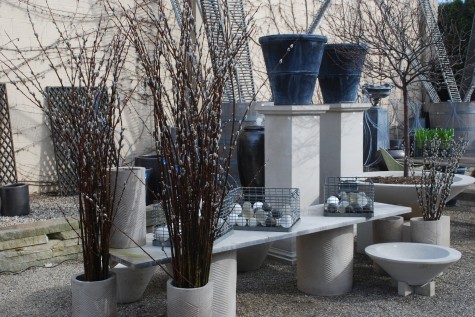
An arrangement of geometric shapes is so pleasing to the eye; the V-shapes in differing materials compliment that.  The color is strikingly contrasting-black and white, with just a little in between.  A restricted color palette is a modern gesture; the twigs soften this.  


He has quite an eye, and an ability to layer all his own.