I have never been asked to undertake a landscape or garden project where the sky was the limit. Do I regret this? In theory, it all sounds good-a design project from my heart, head and hand, given the chance to soar without any need for fuel, wings, wind, or approval. This thought might, for a moment, be thrilling. Let’s test the no limits theory. Should I put a piece of blank drawing paper on my drafting table, what would be my first move? Picture me unable to put the pencil to the paper.
Were I have to walked into my own house for the first time, with no interior walls, no division of space, no ceilings or floors-I would be way over my head, trying to make any visual sense of it. One cannot imagine a building into being. Making a building has much to do with understanding all kinds of limitations. A building has lots of restrictions as to its placement on a lot. Properties are required to drain or perk, before a building can be built. Water and electrical lines must be installed according to building codes. Weight bearing walls, sanitary sewers, height restrictions-there are no end of mitigating factors that influence the design of a building. I greatly admire and respect architects who design beautiful buildings. When I look at them, I do not see compliance with building codes, or physics, or proper engineering. I don’t see how the heat, light and water functions. I am not aware of what keeps the walls standing or the roof in place. I see a sculpture; I see shelter. The architect has managed to create a visually sound sculpture that first and foremost is structurally sound. Anyone who owns a home understands what it means when there is a structural problem. My house is 81 years old. A lack of vents in the roof soffits was allowing water vapor to build up such that plaster was falling off the ceiling in 3 rooms. Did I see this coming? Of course not. I only saw a beautiful old house that would provide me a home. That home now has 36 soffit vents, and repaired plaster, neither of which I think about any more.
I just finished a landscape design for a property on a lake that has been a field for 25 years. I have a client who is willing to trust my judgment about the landscape. This does not mean it is a project without parameters. First and foremost, I have a client with a family and a history who purchased this property with the intent of building a home. She has likes and dislikes. Notwithstanding that she is willing to listen, this will be her home, and her garden. The landscape design needs to respect her parameters. This is a given, not an option. At this moment, there is her residence under construction which occupies a very specific space. That house has created certain outdoor spaces which govern how and what I will do. Every room has a specific orientation to the light which is non-negotiable. The rear of the house facing the lake faces south. There are lots of windows on this side of the house. A large porch attached to the house has a roof over the entire space. The views will be great; the protection from the south sun will be great too.
The property has boundaries-there is a formally and legally determined set of lot lines, on three sides. The 4th lot line, a curving border, describes a set back from a lake. Those boundaries are a given. Any landscape plan can take advantage of neighboring views, but it cannot impose on neighboring views. A neighboring house has a view across my client’s property of the lake. The purchase of the property included a height restriction on plant material in this space, so the neighboring lake view would not be obstructed. The challenge of the landscape design is to create something beautiful in that space that makes no visual reference to a restriction.
As for other restrictive circumstances influencing landscape design-there are lots. Plants that thrive in California will not thrive in Michigan. Plants are very specific about what they want. Would that I could grow the roses that thrive in California. But no matter how badly I want them, I cannot have them. There are hardiness issues that govern what can be successfully grown. Soil composition and exposure narrows one’s palette of plants. Trying to grow most roses on sand is an exercise in futility; unless you consider rugosa roses. Rhododendron do not like our heavy clay alkaline soil. They hate even worse our winter winds. It is easy to fall for them at the nursery. It is incredibly difficult, maybe impossible, to get them to thrive. I inherited a stand of them planted on the north side of my house. 15 years later, they are still here. They are big, and have that gangly and windswept look that comes from having been planted in a hostile climate. Are they beautiful-not really. The question of beauty in the landscape has everything to do with how well it thrives.
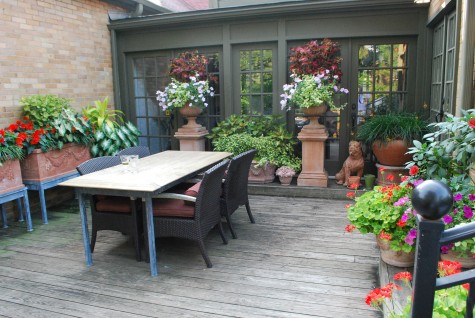
Your constraints, restrictions, parameters, restrictions, boundaries and mitigating circumstances are good friends to your design. A garden of great beauty is a garden that works.