Archives for 2011

Monday Opinion: The Drawing

No matter how well I communicate an idea about a landscape to a client, I need a drawing.  The drawing is a bird’s eye view of a property which in no way communicates the sculptural volumes that might bring an idea to life in a dimensional way, but it formalizes my thinking.  It helps me explain my idea, and all of the details of that idea.  For me, the drawing and the creating happen at the same time. Some clients take the drawing of the design, and install it themselves, or contract with someone else to do the work.  All of this is fine with me. I could make models, but I have too many design projects at any given time to make that idea practical. And truth be told, most clients want to feel comfortable that what they are getting has value, beauty, sensibility, and inspiration.  They want this much more than a drawing.    

A drawing is a series of lines put to a piece of paper.  A definition of a drawing includes the signature on a check, a couture designer’s gestural record of shape, a graph tracking any number of trends, the doodling most people do while on the phone.  It can be utterly simple, or amazingly complicated. Architectural drawings are incredibly detailed.  They are a map which details how a structure should be built.  Topological surveys, mortgage surveys, drainage plans, installation details-these are all highly technical drawings from which an idea can come to life.  There are drawing made by Picasso whose lines can be counted on one hand.  There are drawings by Albrecht Durer that involve thousands of intersecting and overlapping lines.

These drawings are not technical in nature.  They are emotionally generated, and emotionally charged.  A pencil, a charcoal or pastel stick-some line drawings are not so much about the shapes the lines describe, as the pressure placed on the medium.  My drawings are a skeletal and dispassionate version of a sculpture which I passionately believe will live and breathe.  Not art.  They are a means by which I can better express an idea.

I do all of my drawings by hand.  I find the time I spend creating the drawing influences the design.  There are times when in the process of constructing an angle or a space-I have a different idea.  I value an idea, no matter what time it appears. These hand drawn plans may not be as perfectly crisp or accurate as a drawing assisted by a computer,  but my hand made gestures speak volumes to a client.  There is a person governing that hand. 

I am very stubborn about taking the time for a plan to develop.  I like to see homes or buildings out of the ground before I commit myself to a plan.  Most of the the time I spend designing happens in my mind, in the course of the day.  Just before I wake up.  Monica has learned to distinguish those times when I am looking at her, but actually somewhere else.  I rarely put a pencil to a piece of paper before I have reviewed and determined a point of view in the abstract. 

Ideas that help to design a garden can come from lots of places.  A picture in a magazine.  A comment from a friend.  A favorite color.  I subscribe to lots of design magazines.  I read them twice, then I rip out any page that still appeals to me.  I don’t need to know what I like about anything I see at that moment.  The time will come when that picture will inspire a particular design.  But nothing helps my creative process so much as the drawing.  It does not need to be finished or fancy.  It needs to have rhythm.  I cannot explain this very well, but what you are thinking needs to come out of the end of your pencil as a drawing.  No gardener plants ideas.  They plant living things appropriate to or in celebration of an idea. 

None of my clients like to draw for me.  Sometimes I insist.  I learn more about how a client feels about a space by seeing their drawing of it, than I do talking to them about it.  Their drawings are about clearly expressing spaces and shapes; this is an art of a different sort.  In just a few lines, they express to me what they hope for, what they need, what they expect.

People’s signatures interest me.  They are usually highly individual, and beautifully gestural.  A signature is a drawing that has been developed and practiced over a long period of time.  Most signatures are very confident, and sculptural.  Your garden bears your signature-so does mine.  I might not really be aware of what my signature is-who thinks throught the process of signing a check or document?  I do what I do-you do what you do. That expression-it is a drawing you could do at a moment’s notice.  A design for a landscape should have that same immediacy and confidence.  My advice-do not second guess your signature.  Just sign, and build.

My drawings sign-sorry- assign spaces, places, accessibility, movement, rhythm.  They are simple maps, detailing what I hope will be a good journey.  That line drawing at some point will become something else entirely.  A place to live.  A place to grow food.  A place to cut flowers. A place to be.  A place to entertain friends and family.  A mini-soccer field.  A place to relax and read.  

My advice?  Blow up your mortgage survey to a scale you can easily study.  Draw the beds and spaces you have, the best you can.  Draw your ideas and dreams over top of what is existing.  Look at the picture this makes.  Make lots of marks with your pencil.  Draw lots of lines before you ever put your shovel to the dirt.  Your drawing may turn out to matter more than you ever thought possible.
At A Glance: A Certain Dahlia

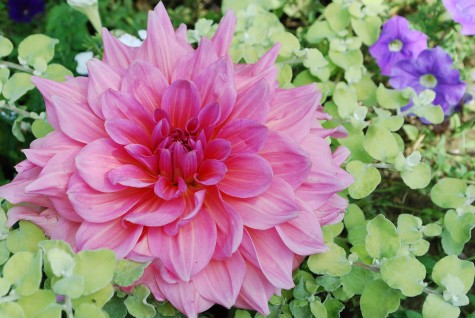
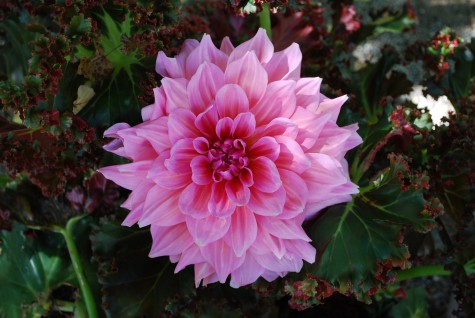
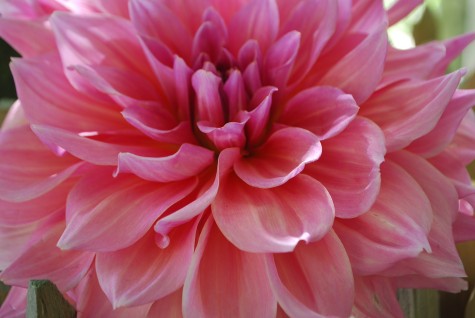
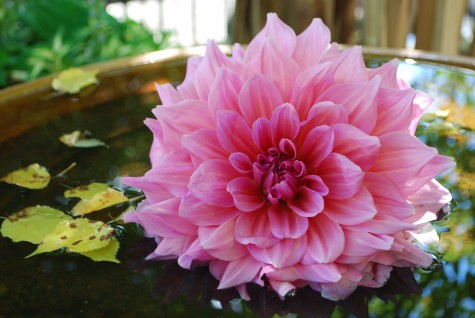
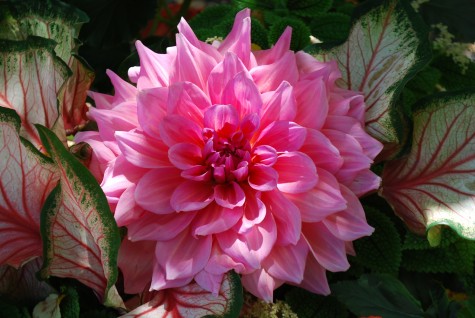
Michael and Mattias came Saturday for the presentation of their landscape master plan.  There was very intense conversation for two hours.  But they thanked me in advance; the meeting was preceded with a half dozen white eggplant, and a half dozen red peppers from their garden.  Ant the most amazing dahlia bloom is has ever been my pleasure to meet.  The color, the structure, the size, the luminosity-well, see for yourself.

Night Light

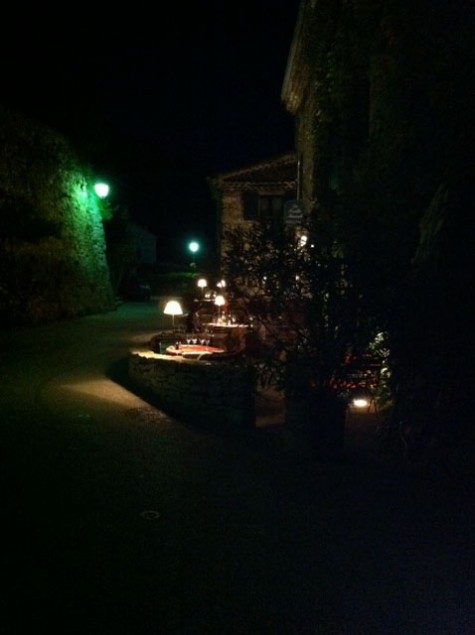
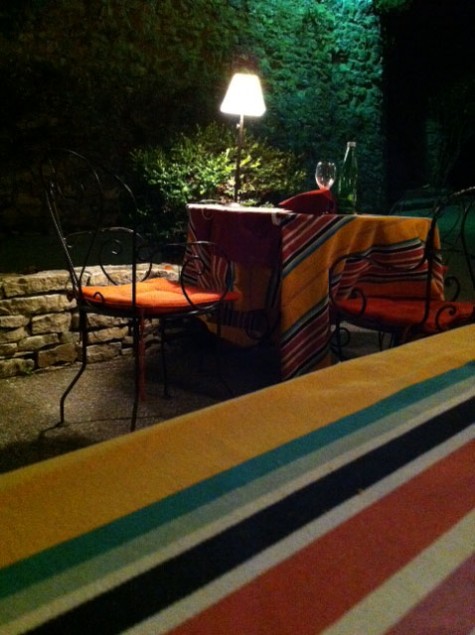
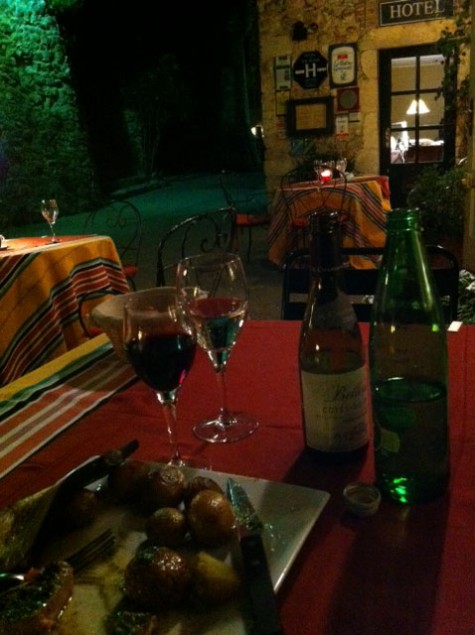
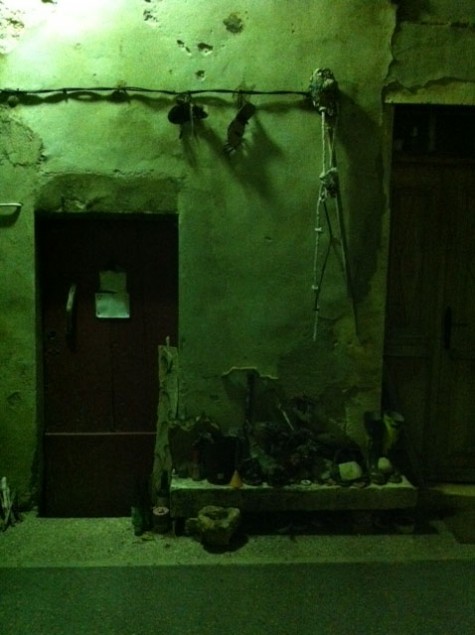
Rob has been putting in some very long days.  He doesn’t quit until the daylight is gone.  He sent me an entire group of pictures about his 9 o’clock dinner hour.  Rural France is not in any way lit like my neighborhood at night.  The light is intense, but just every so often.  The dark is punctuated by the occasional light.  I cannot imagine having dinner outdoors only inches from the road.  Public American landscapes are all about medians, curbs, and most importantly, big spaces.  Big segregated spaces.  Rural French landscapes are about a very close relationship between travel, commerce, farming, neighborhood, and the natural landscape.  It is a small country.  Dinner on the edge of the road-a unique experience.         

 The lamp illuminating the striped tablecloths-just enough light to make the space cozy.  I have mixed feelings about landscape lighting.  Lighting for safety’s sake is a given.  Stairs, doorways and sidewalks are spaces that get used regularly at night need to be well lit.  Lighting the landscape is so easy to over do. The best light-natural light. Sunny, overcast, early late, stormy-natural light is much about climate and weather.  What comes next is about artifice.  How much artifice is too much, and how much is just right?       

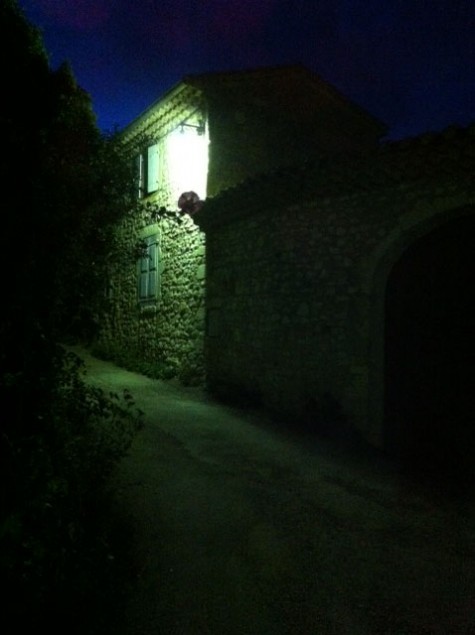
Up lighting gives every element of the landscape a theatrical look-as in the the drawings and paintings Degas did of dancers in the theatre.  Down lighting, expertly done, believably replicates the the light of the moon.  In this picture, all of ther light is coming from the top down, or from the side.  Up lit trees have a very theatrical and unnatural look to them.  I light my pumkins in my pots at Halloween-it gives them an extra measure of holiday creepiness.  At the Christmas holiday, I pull out all the lighting stops.  We have more dark than light, and our natural light is likely to be about grey and overcast.  

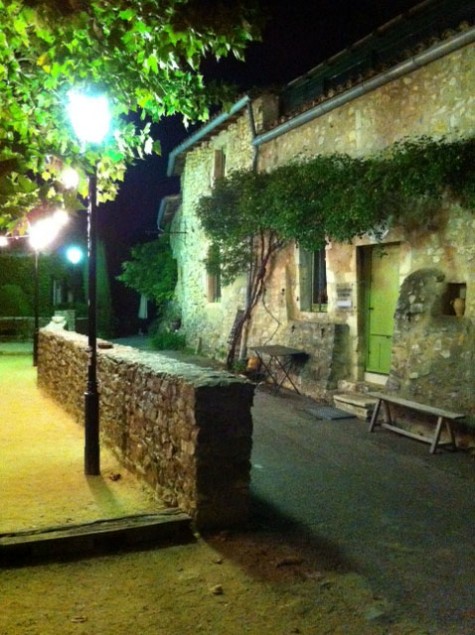
Rob’s pictures are provocative.  Perhaps uneven lighting creates an exciting atmosphere.  Very bright street lighting is about providing safe passage, but has that carnival, rather than theatrical look to it.  Black shapes, and long shadows are visually striking. The CFL’s-or compact flourescents are cool to the point of being cold.  The CFL’s,  in combination with incandescent lighting-the French are doing such innovative work with combining the two.     

Artificial light is not one bit like the light from the sun.  This is not to say that one source of light is better than another.  Just different.  This lit doorway has a lonely but starkly beautiful look.  This is a landscape experience of a different sort.  Rob has a big interest in lighting.  I am sure I will see the results of this evening in France somewhere is his winter and holiday lighting schemes.   Rob’s late evening in France was as much about the light as the place.  The deserted streets in the evening is much different than in my neighborhood, where there is activity almost all night long.  Every season I vow to spend more time thinking about how a landscape can be beautifully lit.  This is not to say I do not consider the lighting-I have a contractor whose point of view and skill I really like.     

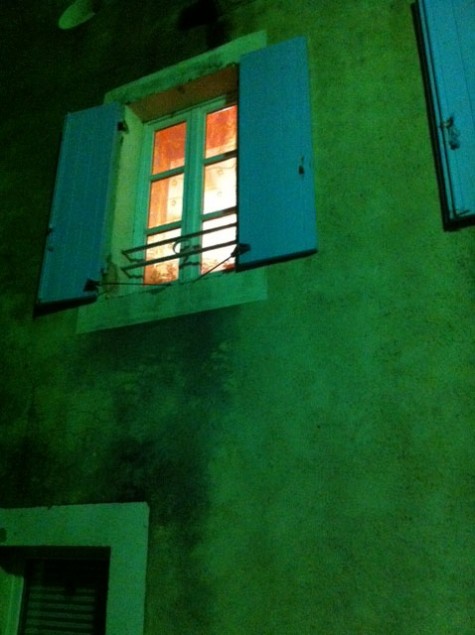
The warm light illuminating this building comes from within.  The green walls appear all the more blue, given the compact fourescent light from the street. The green walls, blue shutters, and orange light-vivid.

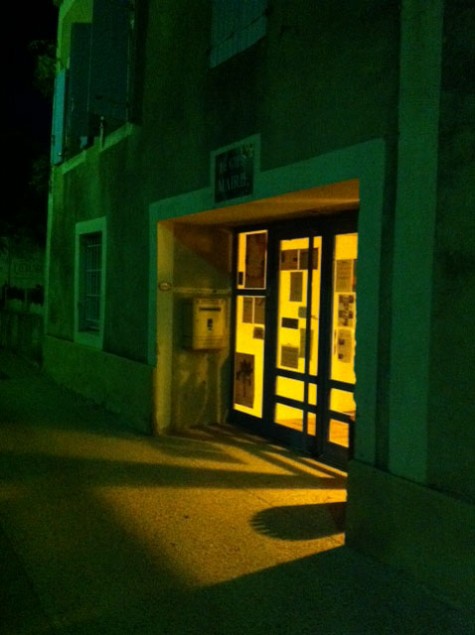
This is the mayor’s office.  The warm yellow orange light from the interior spilling out into the street is comforting.  The contrast of light and dark is graphic and moody. 

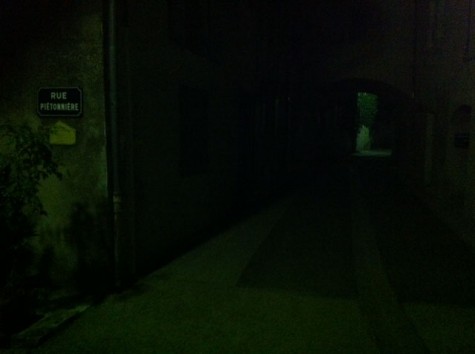
The sign designating the Rue Pietonneire is still visible, even in low light at the end of the day.  Haunting, this.

Patine Ancienne

Rural France is home to many artists who make garden pots.  Each one has their own style and finishes, most of which are based on designs and shapes dating back to the 18th century.  Detroit Garden Works will have a substantial and wide ranging collection of French terra cotta come spring.  This has everything to do with Rob’s willingness to travel.  It is not possible to shop these pots from a catalogue, a website, or over the phone.  You have to go.  To see them in person.  Anything you see in the shop Rob has seen in person. 

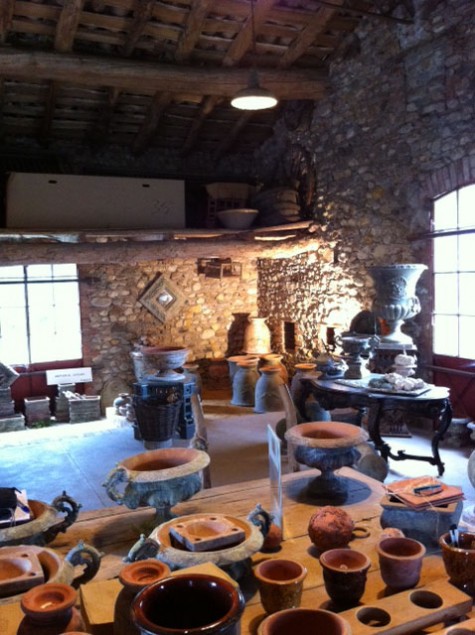
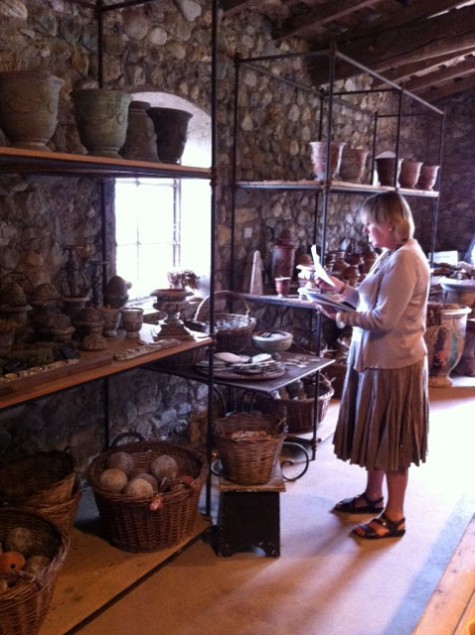
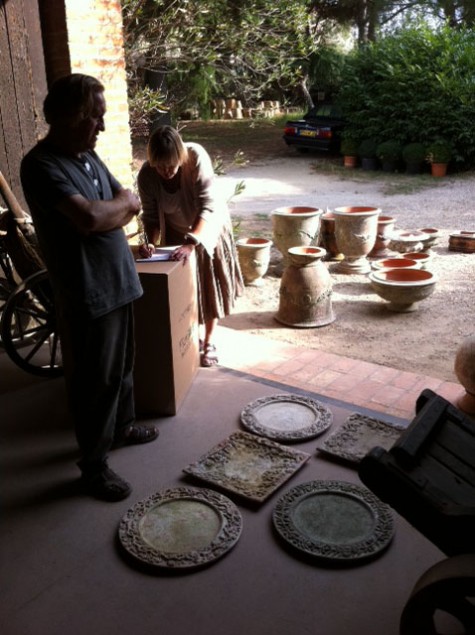
This modest showroom gives an overview of this artist’s point of view.  Much of what Rob bought here has to be custom made.  This style, in this finish, or this color.  That style in this size.  How he shops is much more rigorous than what this picture would suggest.  When a 40 foot container of terra cotta from France arrives, it will be an edited collection, with a point of view.  There will be multiples, with careful consideration to size.  There will be a small representation from certain potteries whose output is limited.   

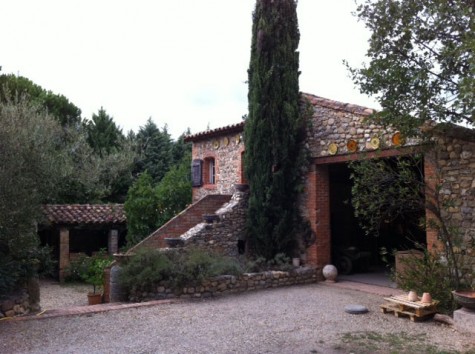
This particular pottery features very unusual finishes on their terra cotta.  Rob hears that no outsiders are ever permitted in the studio.  This particular poterie is represented by a broker Rob met in Paris a few years ago.  She arranged for a visit and consulted with him on his order.  She will be supervising the manufacture, will inspect all of the pots prior to shipment, and will arrange for pots to be readied shipment.  Multiple orders will need to be consolidated, and packed into a container dropped at the poterie with the most substantial order.  The most important issue-the finishes.  She will look every pot over.   

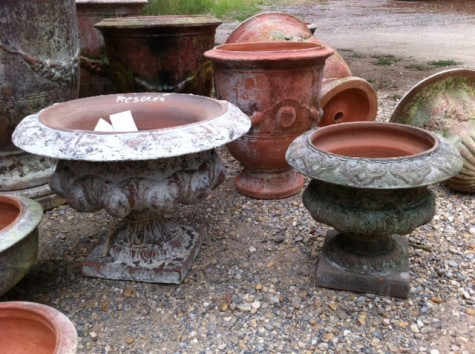
Many of the poteries have an interpretive finish they call a patine ancienne.  There are many very old French terra cotta pots still in use; the climate is mild, and pots can be left outdoors all winter.  Old glazed French pots are characterized by how much of the glaze has been shed from exposure to weather.  The old pots are priced at a premium.  I have but a few truly antique French terra cotta pots.  Interpretive finishes-some are great, some are overwrought. 

Rob tells me that he has an interest in the patine ancienne.  Patina refers to a surface condition which has acquired a certain look or color or texture from age.  Antique stone urns from England may have large colonies of lichens and mosses that verify their age.  Though he has an interest in aged surfaces, he prefers some contemporary interpretations over others.     

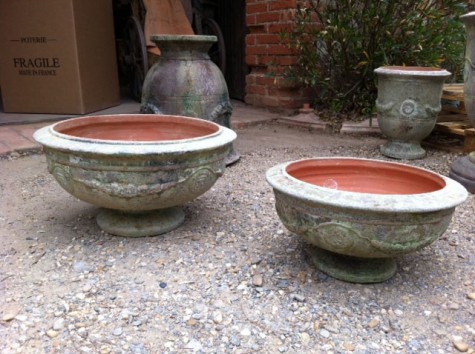
This particular poterie features finishes that he likes.  They have a feeling of age which is subtle.  Not too hard hitting.  When I first saw these pots in his pictures, I was sure I was looking at vintage pots.   

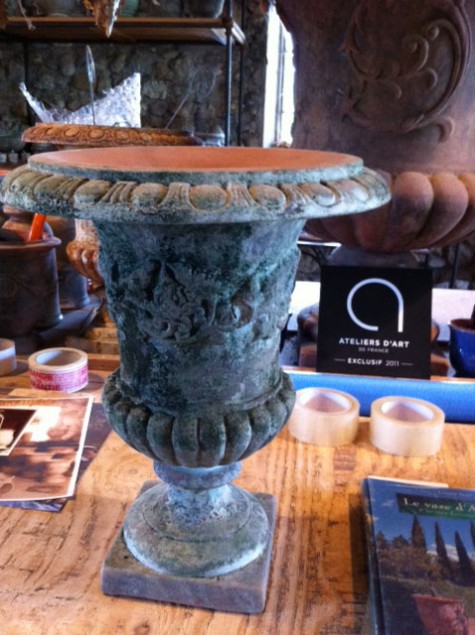
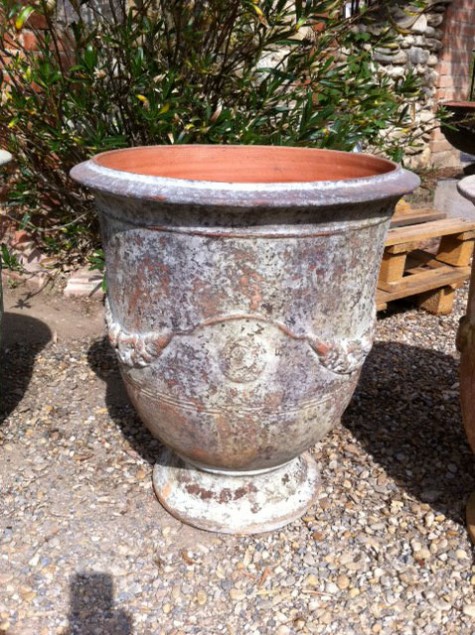
We have bought many containers of pots from the Poterie Madeleine over the years; we have sold all but a very few.  Their high gloss glazes in jaune, (yellow), vert (green), flamme (green and brown flames), and blu lavande (this is a hard color to describe-it is blue and lavender mixed) were beautiful. They were the classic vase Anduze I always associate with French terra cotta. The ownership of the poterie has changed since we first shopped there; the pots are different-the business is different.  Madame Pellier is no longer there.  I have many good memories of dealing with her over an order.  The new pots-they are too hurriedly made, says Rob.  He tells me we need to move on-so be it. The classic vase Anduze pot pictured above-the surface is beautifully different than anything we have ever had before.  

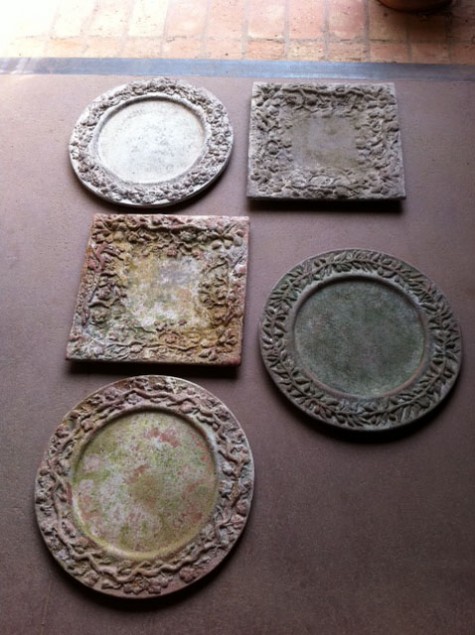
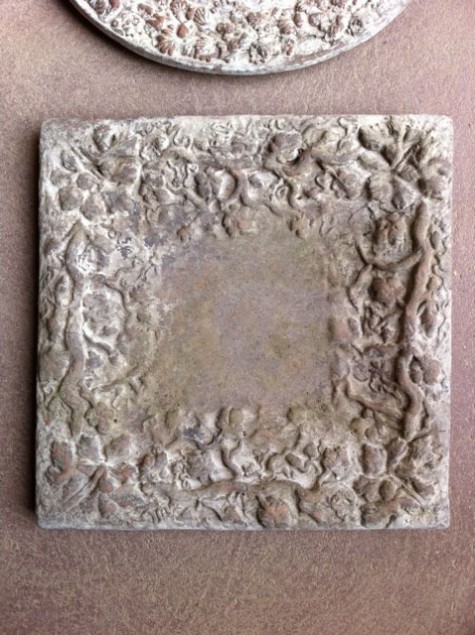
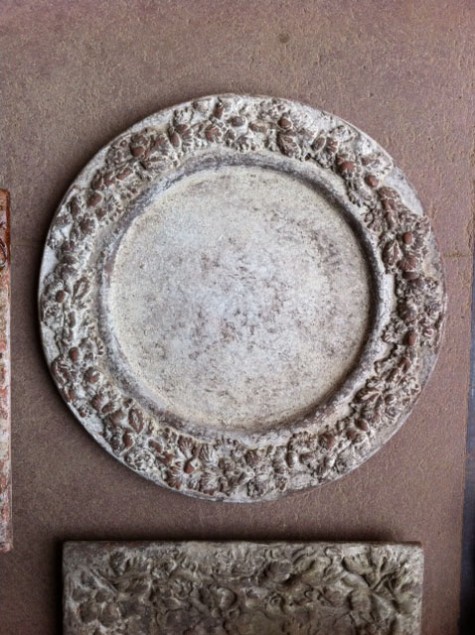
This poterie has captured his interest.  The colors and finishes defy description.  They are not overwrought.  There is ample evidence of the human hand.  These trays-he laid them on the floor to study them.  The poterie that makes them have studied equally.   

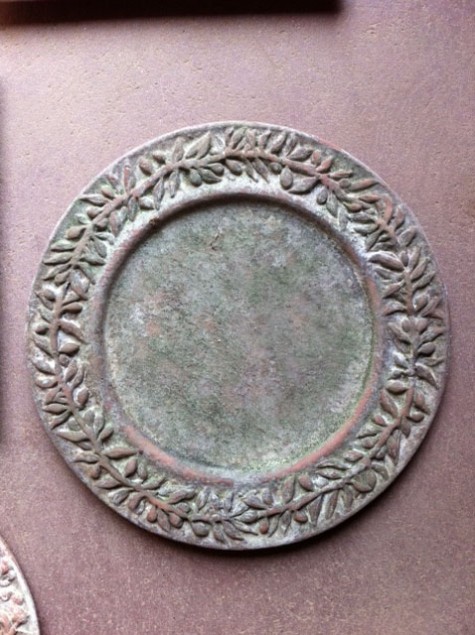
If you are a gardener, you have a relationship with clay pots.  The simplest machine made terra cotta pot is a friendly home to a plant.  That fired earth breathes. It promotes good root growth.  It soaks up water freely; that water can evaporate just as quickly.  This tray speaks much more eloquently to the clay earth from which it was made than a machine made pot.  The decoration is simple, and strong.  I am sure when the time comes that I can pick up this tray in my hands, it will have weight, and heft which is as much physical as it is visual.  The finish is subtle and moody.  I could live with this. I might not be able to live without it. 

This interpretation of patine anciennne is beautifully rendered.  I am sure the work of it is lengthy.  Rob purchased from the poterie’s available objects.  He placed a very large special order, which we do not expect to be completed until well into November.  Every piece will be well worth the wait.  Great garden pots-Rob has made a life’s work of this.  What he has brought my way-priceless.