Archives for 2010

Sunday Opinion: A Sense of Balance

It should have been the good news of the week-the clearance from my surgeon to retire my training wheels 30 some days after my knee replacement.  But getting up the nerve to actually turn loose of my secure vehicle for a cane has been a tough go.  After 33 days, I had gotten attached to all of its deluxe features.  Four omnidirectional caster wheels that could turn on a dime, locking handbreaks, a comfortable seat should I suddenly get tired, a sizeable storage compartment-the Hugo-mobile enabled me to safely get from one place to another, even if  I faltered.   I could prop my leg up and ice that new knee just about anywhere.  In the early aftermath, it did indeed keep me aloft.  I didn’t go far, but it was always with me. Buck tells me that later that my physical therapist was patiently instructing me to push it along with my fingertips only; I don’t remember hearing that.  He was not nearly so enchanted with it as I-mainly as he’s been hauling it up and down the stairs every day for the past few weeks.  But he has remarkable patience-at least where I am concerned.

Though I understood the words perfectly that the time had come to move on, I was incredulous that anyone would expect me to ditch my great ride for a stick. Sticks were for placing strategically into spring and fall pots, staking wayward perennials, throwing to Milo, picking up after a storm, unstopping a drainage hole in a pot, or drawing bedlines in prepped soil.  How could I expect that a stick half my height, and one tenth of the size of my leg would keep me upright?

My physical therapist-she was on the front line of all this angst.  Considering how she handled it, I am sure I was not the first person to be dubious about putting their faith in a stick.  She explained that an artificial knee is an incredibly strong gizmo whose design and installation procedure would take your breath away.  It is virtually impossible to break. We did not go over the worst case, we went over what I should do if I fell.  Number one, stay down until you assess your problem-no need to panic, and try to leap up.  Leaping up in the wrong way-that can be bigger trouble than a fall.  We practiced. Good advice for a new knee, or a life-don’t you think? If you are wondering how in the world this relates to gardening or gardeners-I will get to that.  But my quick answer-the challenges that life throws at me, I see in personal terms-and I am very personally, a gardener.

Back to my physical therapist-she explained the weak link in the whole constellation of events was the musculature, charged with keeping a knee in place, that had been in decline all the while I fooled around, putting off what would fix an irreparably deteriorated joint. Muscles that don’t get used atrophy, and waste away.  No kidding they were wasted-the ensuing physical therapy designed to target strengthening those muscles made my hair stand on end-and I have a ways to go yet.

My surgeon wants me to sign up for a month of out-patient physical therapy-a more aggressive program.  I can flex to his satisfaction, and I am off any regular tylenol-this is not typical of his knee people at this stage. He told me that in spite of how I have fast tracked a recovery that he feels fine signing off on, he wants me to sign up for a month of more aggressive PT.  Why?

Gardeners need good strength.  A physical plant that hums along.  The ability to back up on a whim.  The ability to stand and work, on uneven ground.  The ability to swoop down and pluck a weed.  The ability to dig a hole-digging a hole is an art, but it is also hard work, is it not?  The ability to get down and see the crocus sieberi face to face.  The ability to drag a hose, lift a three gallon potted shrub, man an edger-the ability to stand on one’s highest tip toes to prune a broken branch.  I will never play squash, or participate in a ballet, but I need knees to garden.

Yesterday Buck put the stick in my hand; let’s try it, he said.  It took only three steps before I left his arm behind. At first I concentrated on the order of events.  Put the stick out there, move the new knee leg up to it, follow up with the knee that is still working-repeat.  Keep going.  I walked through every room and back again.  The stick-I wasn’t leaning and looming over it.  It just gave me a fingertip point of reference.  I could not believe how good it felt, to be moving under my own steam.  That stick-graceful and unobtrusive.  A stick-a small object of considerable strength, grace, and cache; I have a new appreciation.  The Hugo-I am over it.

I think I understand balance in a new way.  As a designer, I realize that symmetrical  compostions have a great and formal strength.  Formally designed spaces are stable and quiet.  I am a bilaterally symmetrical being that has been balanced for a good many decades-this has not changed.  I was meant to be securely upright, and on my feet. I am in fact back on my feet-this feels so good.  I spent the better part of the day, stretching, and relaxing.  The tension of my worry about the integrity of my balance drained away.  I felt so good today!  I never lost the ability to be on my feet-I had lost confidence.  So much for bilateral symmetry-there is another world out there.

I understand that asymmetrical compositions need to address how elements of unequal weight can be balanced-either by placement, or repetition.  Or how any and all design elements make for balance. Some impossibly balanced compositions provide no end of interaction, and interest.  How nature reaches equilibrium, either in ponds, or climax forests-every gardener knows about this. I am confident in saying to said gardeners that if you physically feel off balance by a composition, that composition is no doubt off balance aesthetically.  Are you comfortable looking, or walking through that garden of yours confidently, securely on your feet?  Does any element seem lonely, or too heavy?

No matter what I intellectually bring to any issue,  I respect the natural course of events.  It is my idea that when I am really old, and not gardening anymore, I could make some drawings regarding my impression of the natural course of events. But for the moment, I am back on my feet and moving-good deal.
How Much Longer Until We Get There?

A Harbinger Of Spring


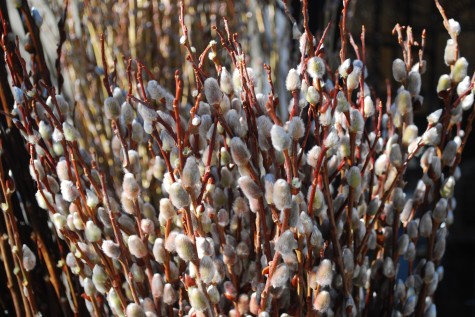
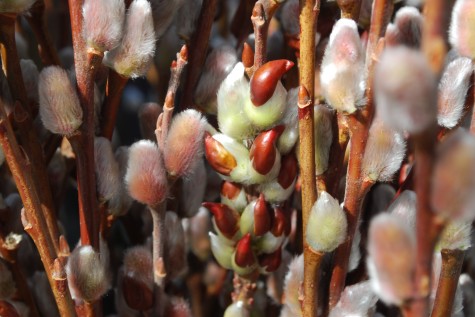
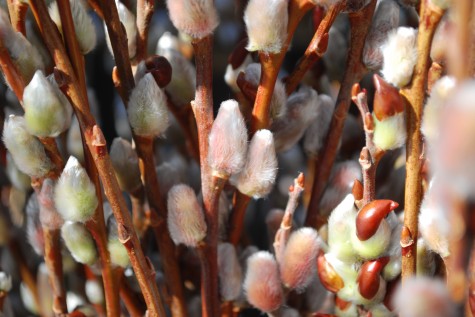
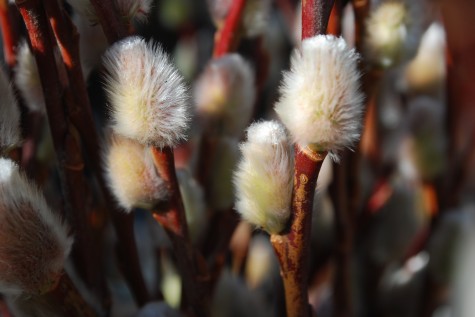
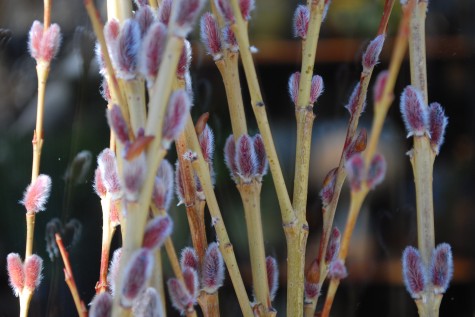
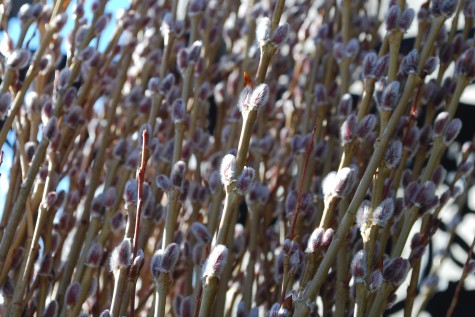
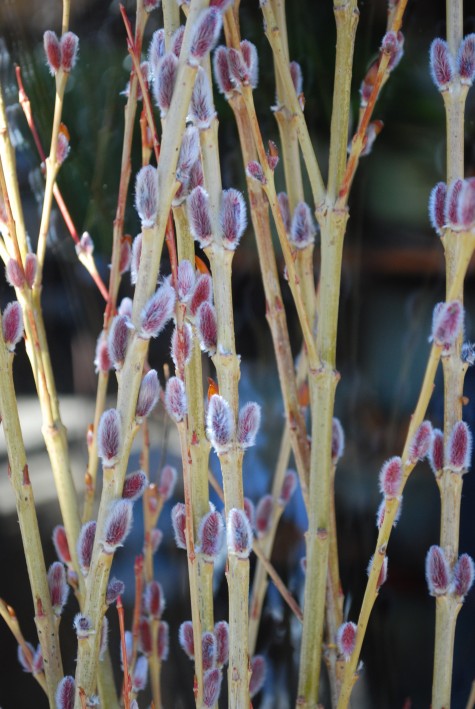
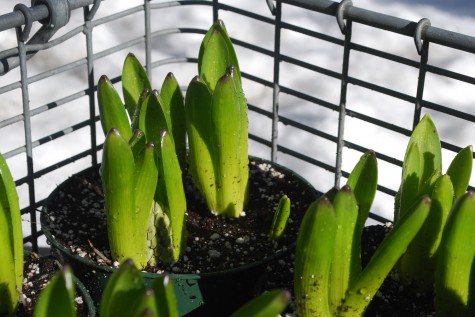
The most amusing event of my week?  Bunches of pussy willows, fully decked out in their silvery fur, arriving via UPS. Maybe it doesn’t take so much to amuse me, but was there not a time when every yard had a gangly overgrown and not so gorgeous salix whose main claim to fame was how they woke up and got going in March-the early fur bird of the garden?  Just about to burst, we all cut branches and brought them inside, as it was still way too cold to stand outside and appreciate this modest but sure sign of spring.  Pussy willow delivered to my door-what has the world come to?

Like its shrubby partner in crime, forsythia, early counts for a lot in my zone.  Some gardeners with foresight may have galanthus  or eranthis popping out of the ground.  Or a hamamelis in bloom. Other warm and urban southern facing walls may be softened by daffoldil leaves springing forth, announcing the imminent change of the season.  But pussy willow holding forth is a sure harbinger of spring.    Do you think you would still love pussy willow branches if they came on in June or July? Sure this is a rhetorical question; timing is everything, yes?  In a past life when I had five acres of land, only two of which were even remotely civilized, I could wade in those wild places and be sure to find pussy willow, forsythia, and rosa multiflora making moves in March.  I could see the sap was rising in the willows; the branches are waking up.  The color was distinctly different-luminous, and alive.

The poplars, whose rustling leaves stage a concert most every summer day, are all branches and trunks in March.  But there will come a time when that grey bark is suffused with with a green welling up from underneath.  There are no stands of popples where I live now. Should I decide to plant a meadow of popples, pussy willow, forsythia, wild roses, bergamot, buffalo grass, centaurea, and willow in the right of way on my urban corner lot, I most likely would be facing some highly irate neighbors. 

Not everyone shares my idea of beautiful.  Why should they? So  I’ll keep the lawn in the tree row, for now. I have another source of spring from which to draw.  My twigman has made a life of growing specific cultivars whose twigs make the faces of gardeners light up. This salix, which he calls prairie willow, I have never seen before. When I unwrap his long sturdy stems, I am delighted, relieved, beyond all belief.  His pussy willow branches are studded with furry buds, one right after another. 

Do I long for my wild pussy willows-not really.  I never pruned them properly.  The stems had missing teeth-inevitably.  They grew at angles impossible to right.  Though I have no end of nostalgia for what enchanted me 30 years ago, I am perfectly happy what came my way today.  Living and breathing-spring is on its way.

The first harbingers of spring in Michigan-they have a big job.  We gardeners are starved for sun, life, movement.  We are most interested in winter loosening its grip. There are signs from nature that will help that big ache you have.  Mine came in the mail today.

Travelling

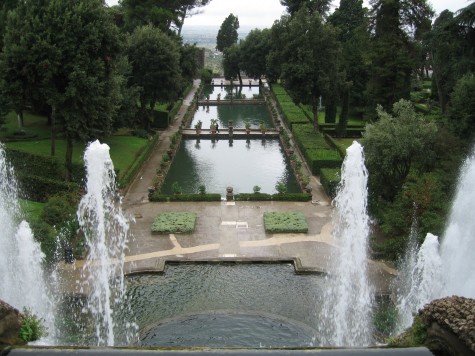
One of my favorite clients and dear friends took off this morning for Rome. As hard as it is for me to believe, she insisted my post on Villa D’Este inspired her to go visit her granddaughter who is on foreign study in Rome-and by the way, go see that  garden. By this time last week, she had enlisted both of her daughters-one of whom is Carol, the proud Mom of said student Grace.  Daughter Diane is an RN living in California-she flew out for the Romefest.  Four other friends signed on.  She organized an entourage- soon to land in Italy.  Tonight, I think.

She has the week ahead planned.  A guided visit to the Vatican.  Villa D’Este, of course.  A request from me for an Italian boater with an orange band.  A cooking course she thought sounded like fun.  I have no details on this, as once you use the word cooking within my earshot, I black out. Some time she has left to Grace to organize.  Her energy puts me to shame.

I am thinking about her, as she loves to travel.  She so enjoys the garden tour we do every year; she has been trying to worm out of me for weeks where this year’s tour might take her.   She drive-travels straight through to get her granddaughter back to Clemson University in September, and drive-travels again to pick her up at year’s end.  She travels in other ways less literal.  She considers ideas outside her realm-she is happy to go anywhere, and decide if she likes it.  She is a traveller. 

I am not a board a vehicle and go traveller.  I hate the packing and the time it takes to arrive at a destination.  I am not crazy about being away from home. I travel-reluctantly; the process exhausts me.  I am always happy to get where I am going-what is not to like about seeing new places.  Whomever can convince me to travel-many thanks.  When NASA figures out how to beam me up, I will be first in line.  On occasion, something or someone will beam me over to what never occurred to me-best regards, and many thanks for this. But I am always thinking about travelling when I design.

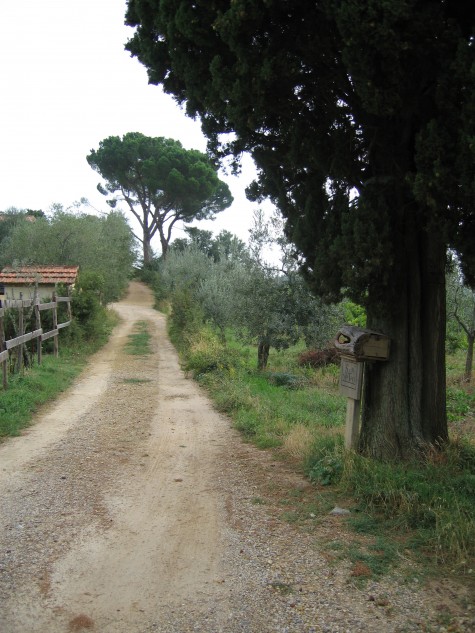
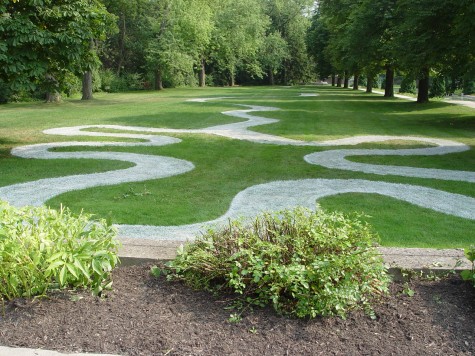
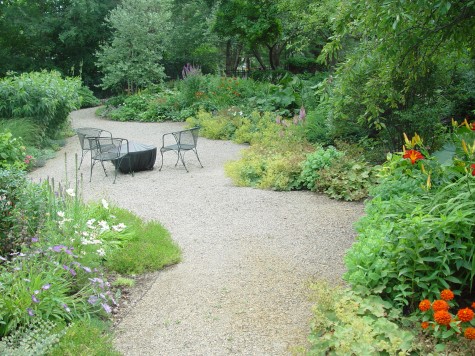
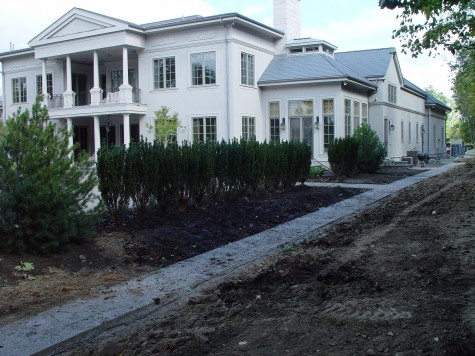
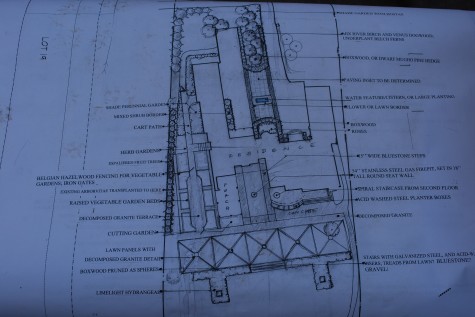
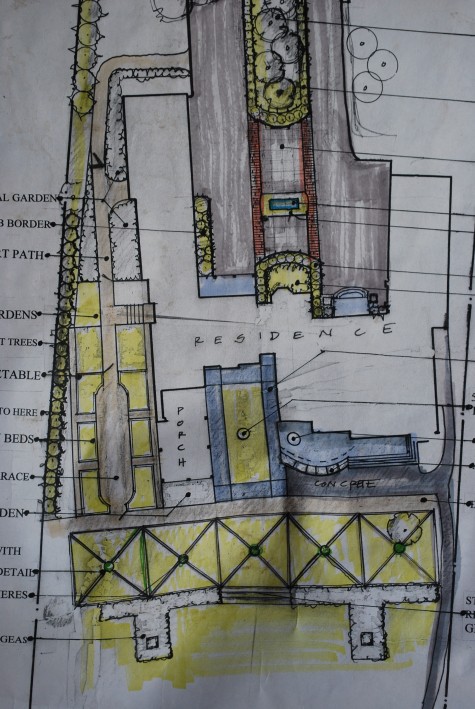
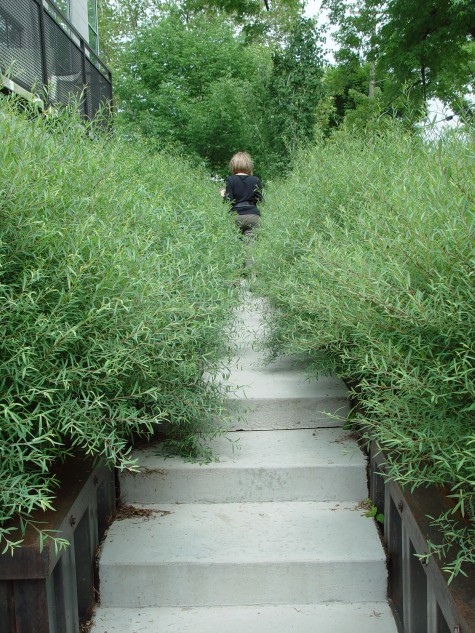
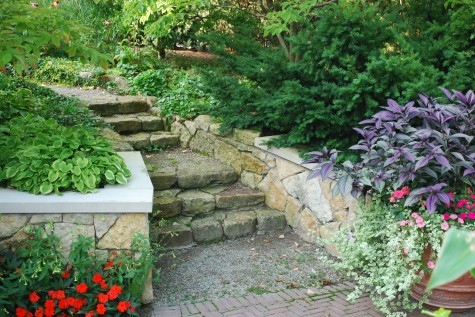
 I know travel is a key issue in design.  Once a mortgage survey is in my hands, my first move is to decide how, why and where one might travel in the landscape.  For anyone designing their own landscape, I would encourage them to build some roads in their garden. Some roads need to be two lane.  Other roads can be a skinny dirt two-track.  Some places need stop signs.  Other places need roundabouts.  A travel sceme is essential for you, your kids, dogs, and guests.  Plan your routes before you decide anything else.

How will you get from the house, to the grill, to the terrace, to the trash, to the rose garden, to the street, to the back door, to the compost pile, to the picnic table-how will you drive through, walk through, and linger in the space?  Where will your family and friends congregate?  If you were to walk your garden with a video camera running, would a story be told?   Expand off road wherever you have a mind to. 

No writer/gardener I ever read more clearly and more beautifully addresses the travel particular to the journey of a gardener than Dominique Browning; I have talked about this before.  Her discussion of the evolution of her garden has everything to do with travelling through, and lingering here or there. When she is stopped, she is stopped in her tracks. When she moves on to somewhere else, there is a big pair of lopping shears in her hand,  and /or significant emotional travel involved. 

She has a sense of humor about her basic unwillingness to budge off her comfort spot. She is entirely dispassionate about all of her passions.  I admire this in her.  Her writing encourages me to loosen up, and move around more.  How you will live, perch, lounge, work, read or take a nap are questions that need to be addressed before you make moves. 

 No matter how glued I am to my place, I put that aside, and encourage myself to take my clients somewhere. Somewhere better than they thought they could have it. Think about this, you people who have a mind to design your own gardens.  If you have a notion to hire a designer, first and foremost understand how you will travel through the landscape they have designed for you.

Jane’s travels are much more than I have detailed here.  Like all of us, she has roads to travel, like them all or not.  Getting control of  the layout of those roads may make things easier.  Some paths are 25mph quiet zones.  Others have lots of traffic. It is important to get this part right.  Some badly placed plants can easily be moved-your routes, not so easy to redo.  Whether you use a piece of paper, a garden hose, landscape paint, or stakes and strings, taking the time to plan your trip is a good idea.