Up and Down


The installation of a landscape for a new house is a lengthy process, as it needs to be.  Though some disciplines cross over, there will be the excavators, the rough carpenters, the plumbers, the inspectors, the finish carpenters, the gutter people and the air conditioning techs, the kitchen designer, the pool and spa people, the painters, the stone masons-the list is long.  Coordinating a project of this size is a challenge.  There are bound to be things that don’t happen on time, or things that happen out of order.  The landscape is last of the outdoor work.  I have been on this project since last August, with a long hiatus born of relentless rain from mid-September through October.  Delays are the order of the day on a large project.
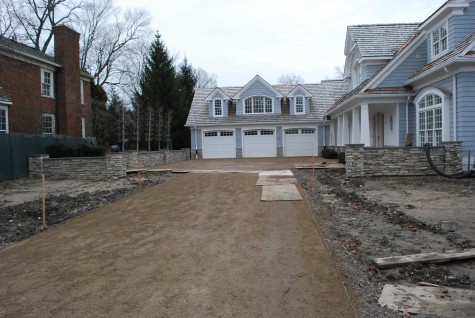
 

 But in December, after the walls and planter box were built, the stone installed on the front porch, the outside of the house finished, we were able to install the crushed granite drivecourt.  At least the front of the house would be somewhat presentable for the winter. Everone involved did a great job-it just took more time, more space, and was more messy than anyone anticipated.  
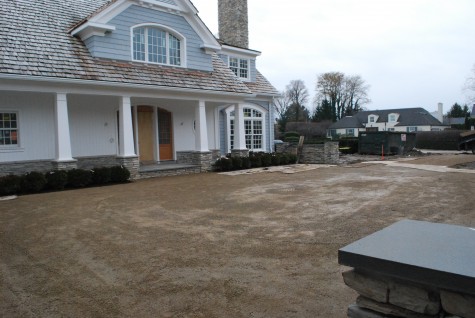
 The stone on the lower portion of the walls of the house were inspiration for the wing walls on either side of the drive, and a stone planter box on the lot line.  On the ground level, the drivecourt is surrounded by stone.  A drivecourt was necessity; no parking is permitted in the cul de sac, and the street parking is chopped up by a substantial number of driveways.  The idea was to make this utilitarian space as visually pleasing as possible.
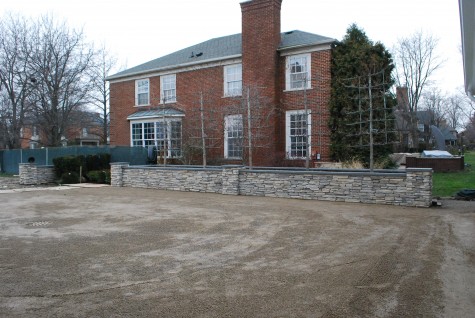
 

A large stone planter box is home to 5 katsuras, which will be underplanted with boxwood in the spring.  This will provide evergreen screening on the ground plane from the downstairs windows of the neighboring house.  Some Himalayan white-barked birch will be planted in the spring to the left of the stone box.  A short hedge of arborvitae will be planted on the lot line to the right of the box.
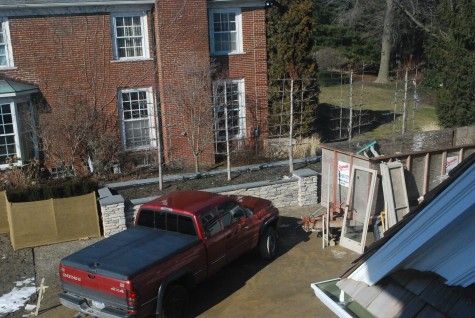
The view from upstairs is equally as important.  The living areas upstairs will be as private as that narrow space between the lot line, and the corner of the garage allows.  As the espaliers grow, they will create a green wall that takes up relatively little width. This is an old neighborhood, where the homes are quite close together.  Addressing visual issues downstairs and upstairs is important. 
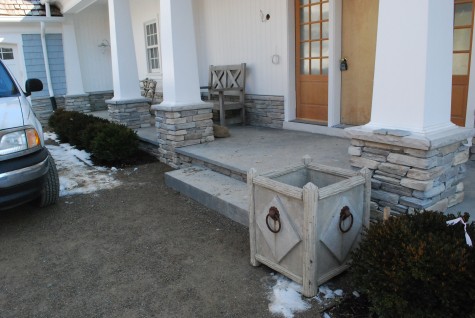
We were there on Friday, trying out some pots and furniture for the garden.  A pair of these concrete boxes with diamond panels and iron rings will flank the front step.  A small vintage English teak bench looks great on the porch.  Settling these details before early spring gives me hope we will finish the project well before the onset of summer.
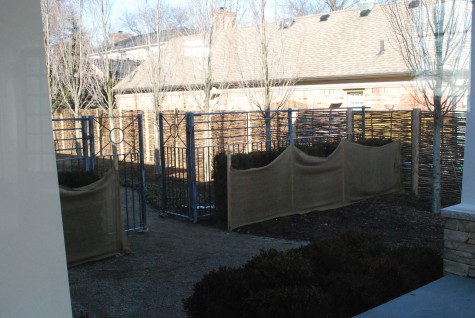
We had installed the iron fencing and gates, and the pergolas a few weeks ago.  The winter weather has been so mild, we were unexpectedly able to get this part of the project finished. The property perimeter fencing was chosen especially for the privacy it provides.  The iron fence running from the property line to the house will insure good views into this part of the garden, and provide a safe outdoor space for a beloved dog. 
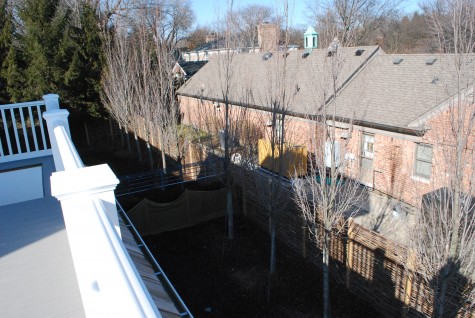
Upstairs, the second floor balcony terraces are done.  I can see that the  12  6″ caliper columnar red maples planted last September will provide great screening  from the house next door during the summer, at a time when privacy matters most. Evergreens provide great screening on the ground level.  They tend to be too narrow at the top to screen an upstairs view.  If they are large enough to screen a view 20 feet off the ground, the width of those trees on the ground floor is considerable.  Lacking the luxury of ground level space, these columnar trees will do a great job where they need to.  The Belgian wattle fencing will handle the job on the ground floor.  
The lakeside was a muddy mess for a long time, but we were finally able to get in there and grade, and set the major lawn panel and its crushed granite frame.  A pair of steel pergolas almost 40 feet long each were slated to be installed off each end of the house, and frame the lawn panel on the ground floor. 
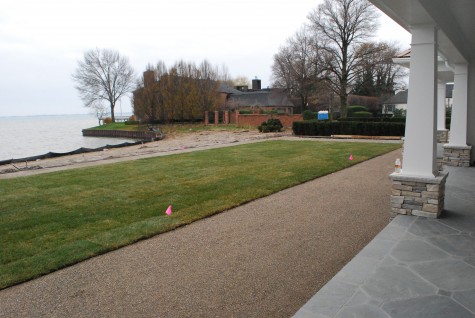
 This picture was also taken in early December.  The major grading, the majority of the evergreen planting, and this lawn panel got done-I was pleased to have this much finished.  But this lakeside rear yard is still quite exposed to the neighboring homes on the cul de sac side.  The screening issues were complicated by the fact that nothing over 4′ tall could be planted in the space between the cul de sac curb and the house.  This restriction would enable everyone who lives on the street to still have a view of the lake.
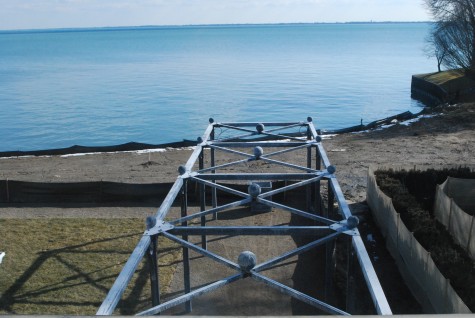
Restrictions are an invitation for good solutions.  The pergola, outside the setback line, is 10 feet tall, and will never be any taller than 10 feet.  This means no view of the lake will ever be obstructed.  Both of the pergolas have a great look from upstairs.  Who wouldn’t  like to wake up to this view?   Once it is planted with climbing roses and clematis, there will be that much more to see from here, and some shade to sit in downstairs.
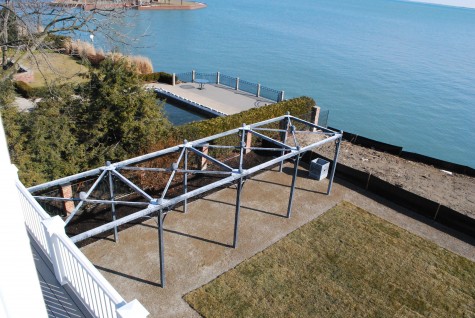
The pergola on the opposite side will be planted in a like matter.  Venus dogwoods will be plated to the outside of each of the pergola, in an effort to screen both neighboring houses from view.  
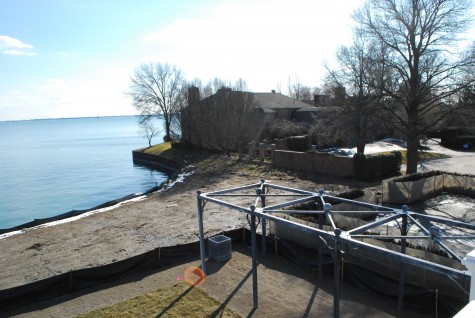
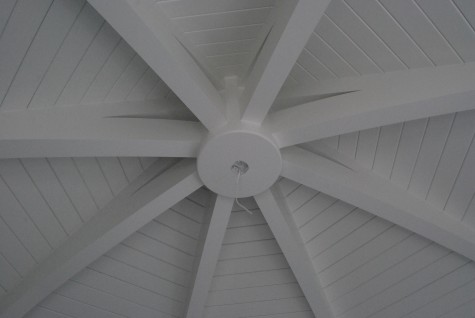
The views from the third floor cupola clearly reveal a foreground space dominated by the pergolas, the midground gardens yet to come, and the far view which is the lake. A widow’s walk, or deck enclosed with railings on the roof, is an Italianate architectural feature popular in American houses built near the sea in the 19th century.  This widow’s walk is a completely enclosed all weather room.
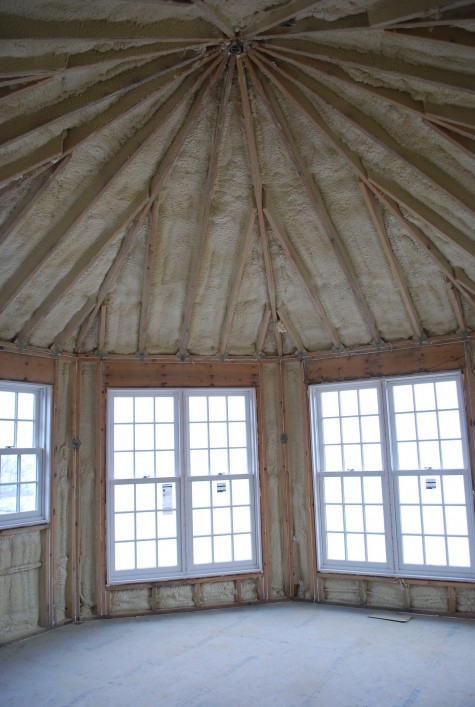
 The room is ringed with windows to take advantage of all of the views.  The opportunity for a bird’s eye view of the landscape and the lake in every sort of weather, and all of the seasons-very special indeed.
Both the house and the gardens show a lot of progress. It won’t be long now, to the finish.
Monday Opinion: The Drawing

No matter how well I communicate an idea about a landscape to a client, I need a drawing.  The drawing is a bird’s eye view of a property which in no way communicates the sculptural volumes that might bring an idea to life in a dimensional way, but it formalizes my thinking.  It helps me explain my idea, and all of the details of that idea.  For me, the drawing and the creating happen at the same time. Some clients take the drawing of the design, and install it themselves, or contract with someone else to do the work.  All of this is fine with me. I could make models, but I have too many design projects at any given time to make that idea practical. And truth be told, most clients want to feel comfortable that what they are getting has value, beauty, sensibility, and inspiration.  They want this much more than a drawing.    

A drawing is a series of lines put to a piece of paper.  A definition of a drawing includes the signature on a check, a couture designer’s gestural record of shape, a graph tracking any number of trends, the doodling most people do while on the phone.  It can be utterly simple, or amazingly complicated. Architectural drawings are incredibly detailed.  They are a map which details how a structure should be built.  Topological surveys, mortgage surveys, drainage plans, installation details-these are all highly technical drawings from which an idea can come to life.  There are drawing made by Picasso whose lines can be counted on one hand.  There are drawings by Albrecht Durer that involve thousands of intersecting and overlapping lines.

These drawings are not technical in nature.  They are emotionally generated, and emotionally charged.  A pencil, a charcoal or pastel stick-some line drawings are not so much about the shapes the lines describe, as the pressure placed on the medium.  My drawings are a skeletal and dispassionate version of a sculpture which I passionately believe will live and breathe.  Not art.  They are a means by which I can better express an idea.

I do all of my drawings by hand.  I find the time I spend creating the drawing influences the design.  There are times when in the process of constructing an angle or a space-I have a different idea.  I value an idea, no matter what time it appears. These hand drawn plans may not be as perfectly crisp or accurate as a drawing assisted by a computer,  but my hand made gestures speak volumes to a client.  There is a person governing that hand. 

I am very stubborn about taking the time for a plan to develop.  I like to see homes or buildings out of the ground before I commit myself to a plan.  Most of the the time I spend designing happens in my mind, in the course of the day.  Just before I wake up.  Monica has learned to distinguish those times when I am looking at her, but actually somewhere else.  I rarely put a pencil to a piece of paper before I have reviewed and determined a point of view in the abstract. 

Ideas that help to design a garden can come from lots of places.  A picture in a magazine.  A comment from a friend.  A favorite color.  I subscribe to lots of design magazines.  I read them twice, then I rip out any page that still appeals to me.  I don’t need to know what I like about anything I see at that moment.  The time will come when that picture will inspire a particular design.  But nothing helps my creative process so much as the drawing.  It does not need to be finished or fancy.  It needs to have rhythm.  I cannot explain this very well, but what you are thinking needs to come out of the end of your pencil as a drawing.  No gardener plants ideas.  They plant living things appropriate to or in celebration of an idea. 

None of my clients like to draw for me.  Sometimes I insist.  I learn more about how a client feels about a space by seeing their drawing of it, than I do talking to them about it.  Their drawings are about clearly expressing spaces and shapes; this is an art of a different sort.  In just a few lines, they express to me what they hope for, what they need, what they expect.

People’s signatures interest me.  They are usually highly individual, and beautifully gestural.  A signature is a drawing that has been developed and practiced over a long period of time.  Most signatures are very confident, and sculptural.  Your garden bears your signature-so does mine.  I might not really be aware of what my signature is-who thinks throught the process of signing a check or document?  I do what I do-you do what you do. That expression-it is a drawing you could do at a moment’s notice.  A design for a landscape should have that same immediacy and confidence.  My advice-do not second guess your signature.  Just sign, and build.

My drawings sign-sorry- assign spaces, places, accessibility, movement, rhythm.  They are simple maps, detailing what I hope will be a good journey.  That line drawing at some point will become something else entirely.  A place to live.  A place to grow food.  A place to cut flowers. A place to be.  A place to entertain friends and family.  A mini-soccer field.  A place to relax and read.  

My advice?  Blow up your mortgage survey to a scale you can easily study.  Draw the beds and spaces you have, the best you can.  Draw your ideas and dreams over top of what is existing.  Look at the picture this makes.  Make lots of marks with your pencil.  Draw lots of lines before you ever put your shovel to the dirt.  Your drawing may turn out to matter more than you ever thought possible.

Susie’s Pots


Making a move to renovate a landscape usually begins with some fairly compelling idea. Who would take on the mess and expense, unless there is some imagined outcome that will make for a decidedly better experience? As much as my daily routine has to do with tearing up people’s yards and putting them back together in some other way, I personally find change to be unsettling and difficult.  Maintaining the status quo has its attraction. I am likely to dig in my heels, and hang back until something throws me in another direction.  An appreciation and interest in the out of doors was a given for this client, but other issues were getting some play.

She had raised three girls, and was toying with the idea of moving to a smaller place, and making some time for travel.  Her decision about an outcome had to do with a few basic things.  She could not imagine a place she would like better than the one she already owned free and clear.  She had already spent a lot of time and trouble furnishing the inside of the house to suit herself.  In the end, she decided to stay where she was, and create a beautiful space outdoors that would make her feel like she was on vacation.  She is very happy with her own private vacation spot-I attribute that to her clear idea of what she wanted from her landscape. �
Everyone’s defining landscape decision is different.  Every committed gardener asks for something individual from their garden.  The important thing is to think through what it is you need and want before a shovel goes in the ground. Figuring out what you really want is not always so easy.  I might in casual conversation say I want vast perennial borders, but in truth I do not.  I work on perennial borders every day.  What I want when I go home is peace, quiet, and order. My landscape has lots of evergreens; they are very low maintenance and are beautiful all year long.  My container gardening is a foil for all of that-each one gets a new outfit every year.  They are my idea of fun.   

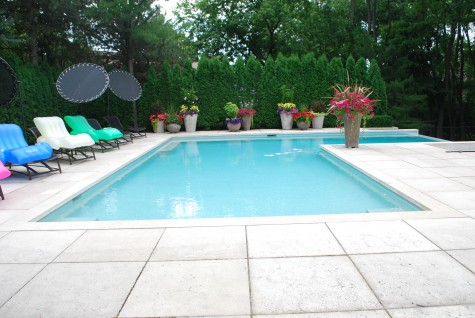
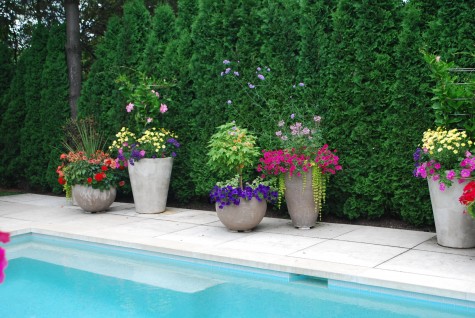
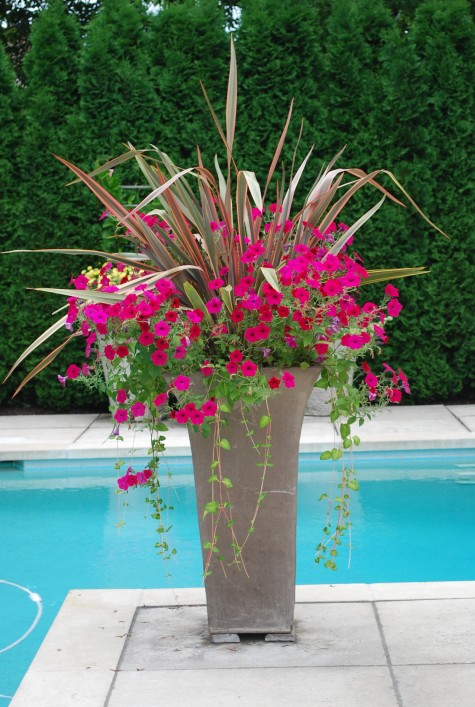
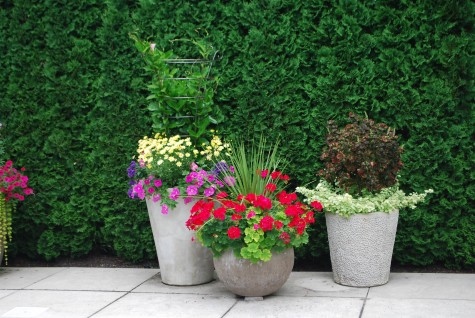
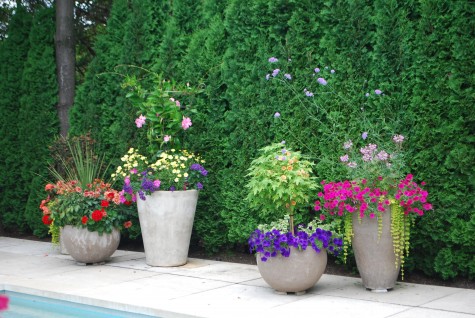
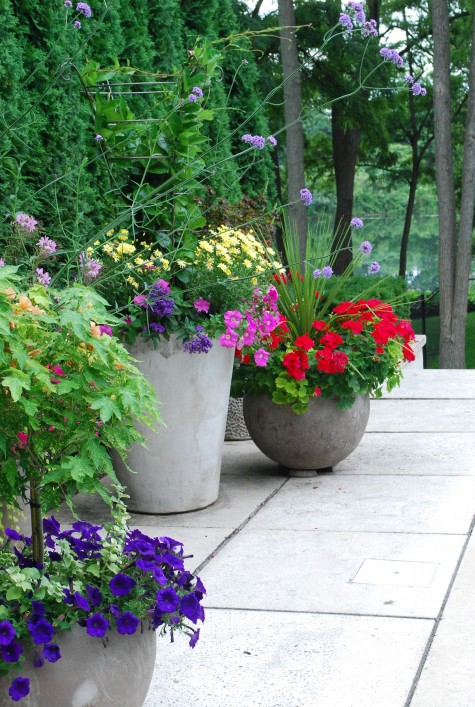
Susie’s pots are bold in color and form.  All of that resort style turquoise blue water asks for a strong color statement.  She enjoys taking care of her pots as much as she likes swimming in the pool.  The care of the pots is an everday pleasure, not a burden.  

Our late June and early July have been scorchingly hot.  The annual and tropical plants thrive in that heat much better than I do.  Susie is poolside every day, enjoying the weather as much as her plants do.  I can tell at a glance that they get daily care.  Anyone lacking the drive or time to look after containers every day can still be successful with them.  The installation of automatic watering and the planting of drought resistant plants can go a long way to help with the maintenance. A care plan is as important as the design. 

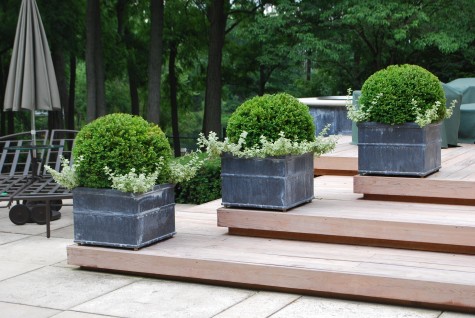
Three of her steel boxes have boxwood in them that live there all year round. The variegated licorice thrives on the boxwood watering schedule.  She does see this particular spot looking out the window in winter.  There is always something there for her to see.     

A pair of Belgian boxes were moved to the driveway.  She not only sees those boxes coming and going, she can see them from a window in her living room. My guess is that we will fill this box with something good looking for the winter months.

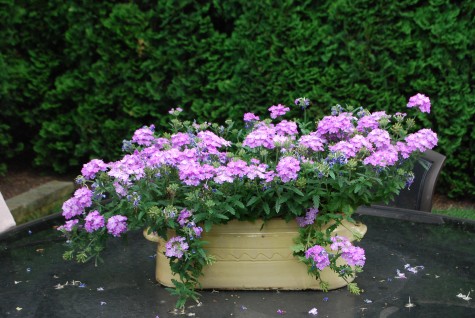
The dining table bakes in the sun all day long; the trailing verbena Lavender Star thrives in this environment.  The yellow glazed pot from Cliousclat in France, and that lavender provide a lot of color in a very small space. 

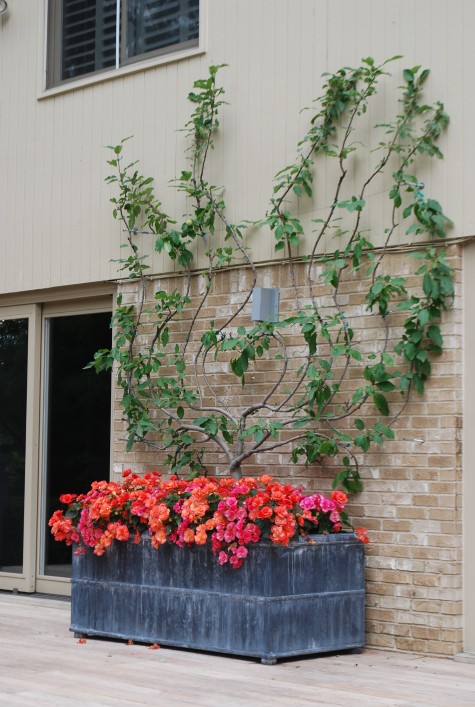
The apple espalier is now on its 4th year, living in a large steel box.  I had my doubts that it would live over the winter with its roots above ground, but she was willing to risk it. It is doing well enough that we need to install another wire up top, to keep the branches growing vertically.  An espalier grown in a heart shape-we both fell for it. 

This pool yard would be every bit as beautiful without the container gardens, but such a landscape would not suit my client.  She truly enjoys making plants grow.  The responsibility is great, but the rewards for her are greater.  

What makes people happy-it makes the gardening world go round.

A New House

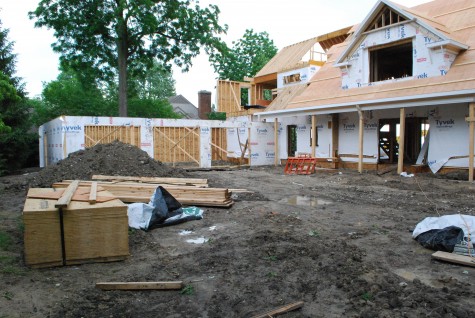
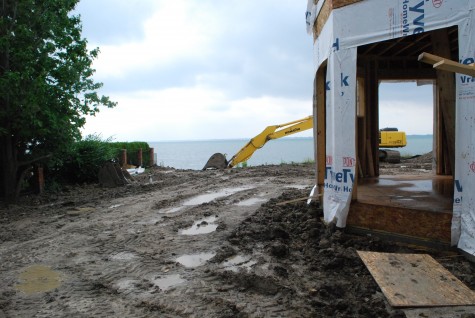
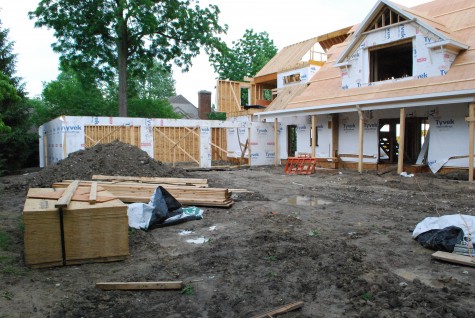
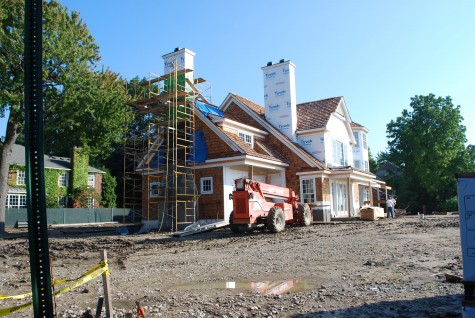
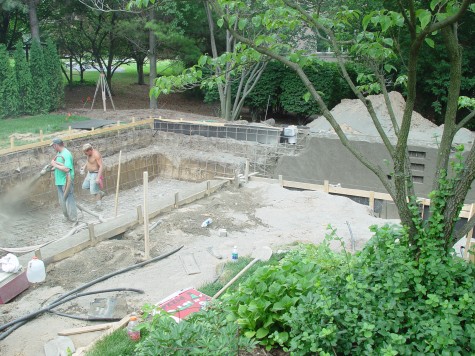
I have a client with a new house under construction.  Now that the structure is out of the ground, I wanted to see the property.  We have had what is starting to feel like endless rain-the construction site of course was mud and more mud.  But that doesn’t faze me much-I am too busy looking at the spaces the house creates, and envisioning what could be there.  On the left of this picture, a three car garage.  On the right the large open space will be the front door.  I am unwilling to design a landscape from a drawing of a house-I need to see the mass of it.  I admire how an architect can visualize something which does not yet exist.  But since the landscape has to come last anyway, I would just as soon look at the house before I design.  The house is the major feature of a landscape;  seeing a building sitting on a pile of dirt makes that very clear.   

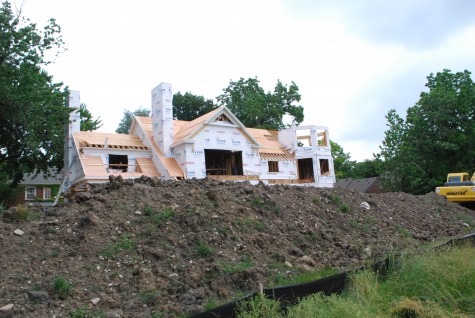
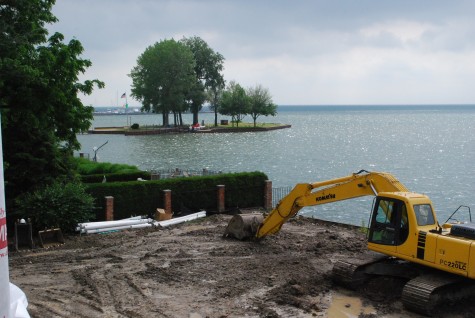
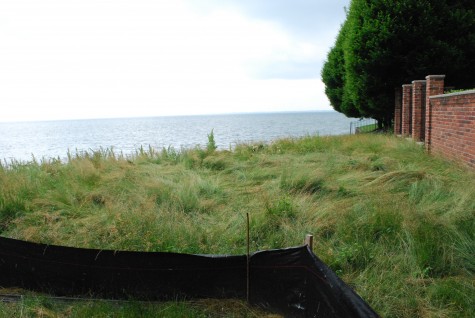
I will have to come back, once the soil from the excavated basement is hauled away. Right now I do not have the best sense of the lay of the land.  The back of the house faces a lake; preserving the views to the water will be an important aspect of the rear yard landscape.   

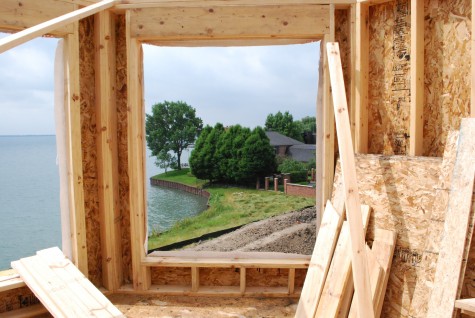
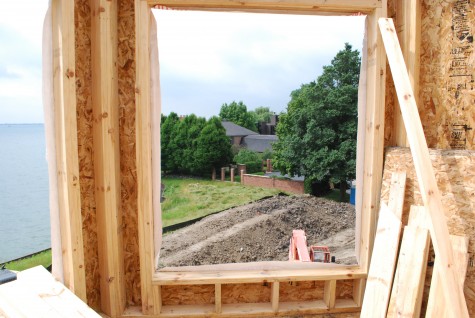
The lot had been empty for many years; this is the first house to be built on it.  This meant that there was very little in the way of existing plant material.  Luckily some mature and good looking plant material exists on one of the three lot lines.  A mulberry tree I will most likely take down.  I would guess it grew from a seed dropped by a bird.  I am fairly easy going about trees that drop twigs seeds and fruit, but the fruit of a mulberry is intolerably messy.  This picture was taken from a third story tower; the neighboring landscape is mature, and well looked after.  Unlike many lake communities that prohibit plant material over a certain height that might obstruct the view of the water, the landscapes in this community have been planted with privacy in mind.

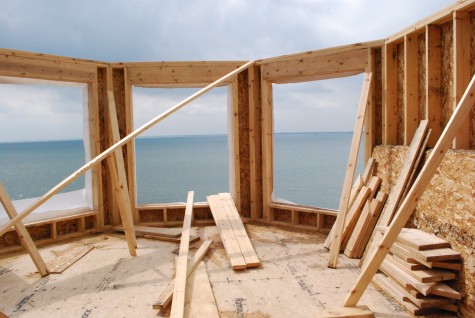
The view straight out from the tower is spectacular.  There will be a good reason to walk up here and see what the weather over the lake looks like every day.  A natural feature as spectacular as this is well worth building around.

The neighbor on the opposite side has one of the most beautiful stands of mature carpinus I have ever seen.  I would never have thought they would tolerate living in a windy exposed spot, much less thrive.  My client will have a borrowed view in this direction that is quite beautiful.

It seems as though the rear yard slopes quite a bit before reaching the water. There is also quite a drop to the water from the seawall.  Dealing with the changes of grade – the sculpture of the ground- will be necessary ahead of any planting.  My instinct tells me how the ground plane is handled will be a very important factor in the landscape.    


Did I have a good sense of what the property would feel like before I saw it-no.  The experience of nature bears little resemblance to the experience of a technical drawing.  The things that make each property unique cannot so easily be represented in a drawing. I do make design suggestions for properties I have not seen, but I am uneasy doing that.  I have to see what the land feels like.