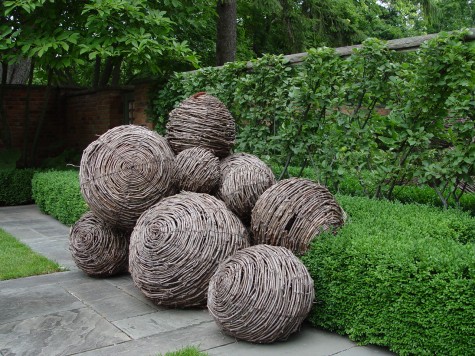
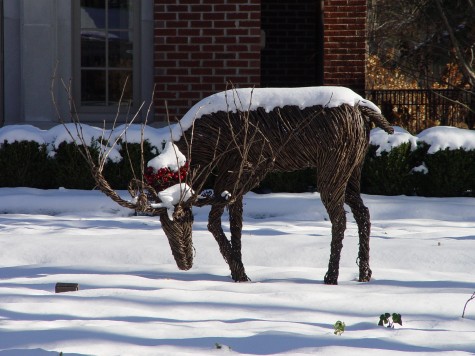
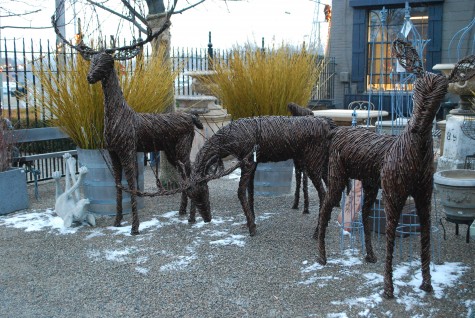
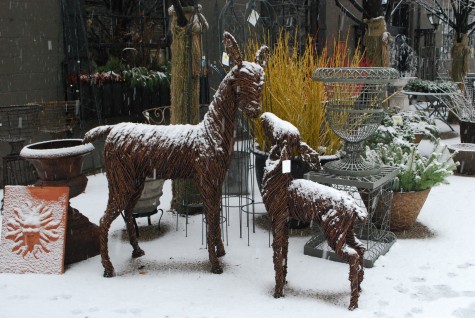
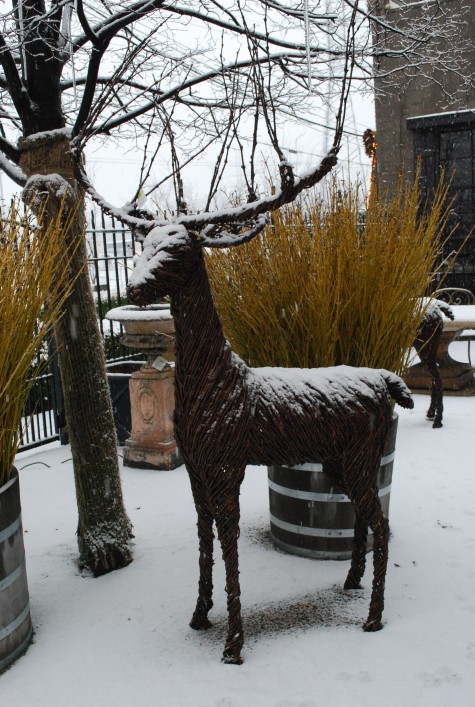
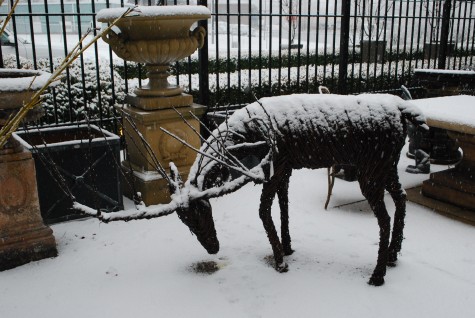
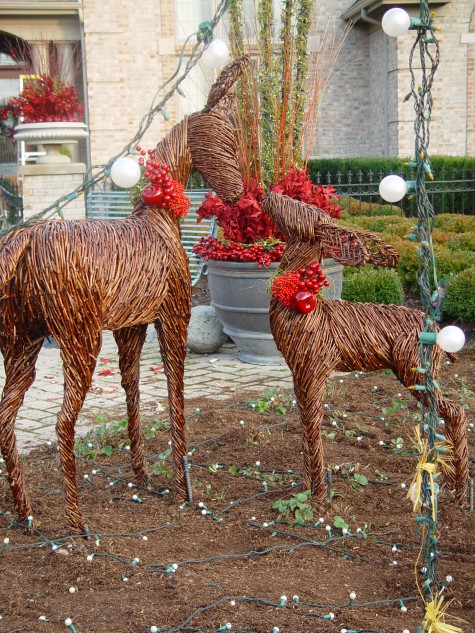
 Deer in the garden is a sore subject for those gardeners who are plagued by the destruction they wreak on every plant shrub and tree in the landscape. What they don’t eat, they trample. They even rub the bark off of trees when they are rutting, for Pete’s sake. Preventing deer from demolishing the garden is the subject of page after page of essays on Google, and countless books and videos. But the grapevine deer sculptures that Detroit Garden Works has stocked for a number of years have their fans. The life size bucks and does come in standing, grazing, and seated poses, just like the fawns. They look terrific in any spot in the garden asking for a representational sculpture fashioned from a natural material. The grapevine is wound around a substantial steel armature, and should survive outdoors for many years, providing they get a yearly application of a penetrating oil based sealer.
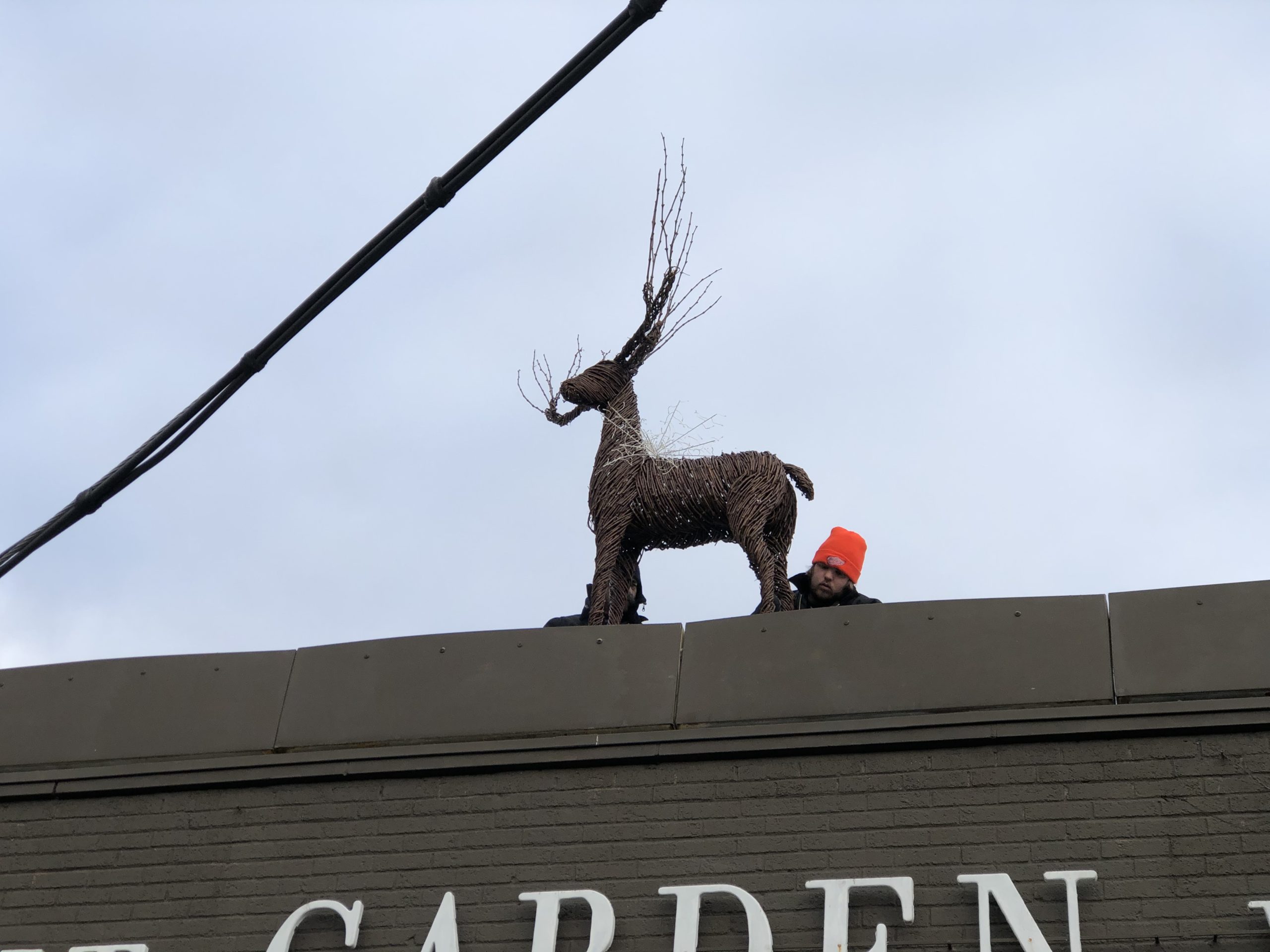
 Who knows what possessed me to put a deer on the roof, but there is a certain Buck that has been near and dear to me for many years. That personal association aside, Christmas folklore is full of references to a certain St Nicholas circumnavigating the globe in a reindeer drawn sleigh, bringing gifts to children world wide on Christmas Eve. It is a story that delighted me as a child. Apparently I can still be enchanted by it. Winter and holiday containers and displays bring an element of delight to the landscape that has gone dormant, and quiet. It was not so far fetched to cast the grapevine deer as a grapevine reindeer. A holiday diorama in the making, if you will.
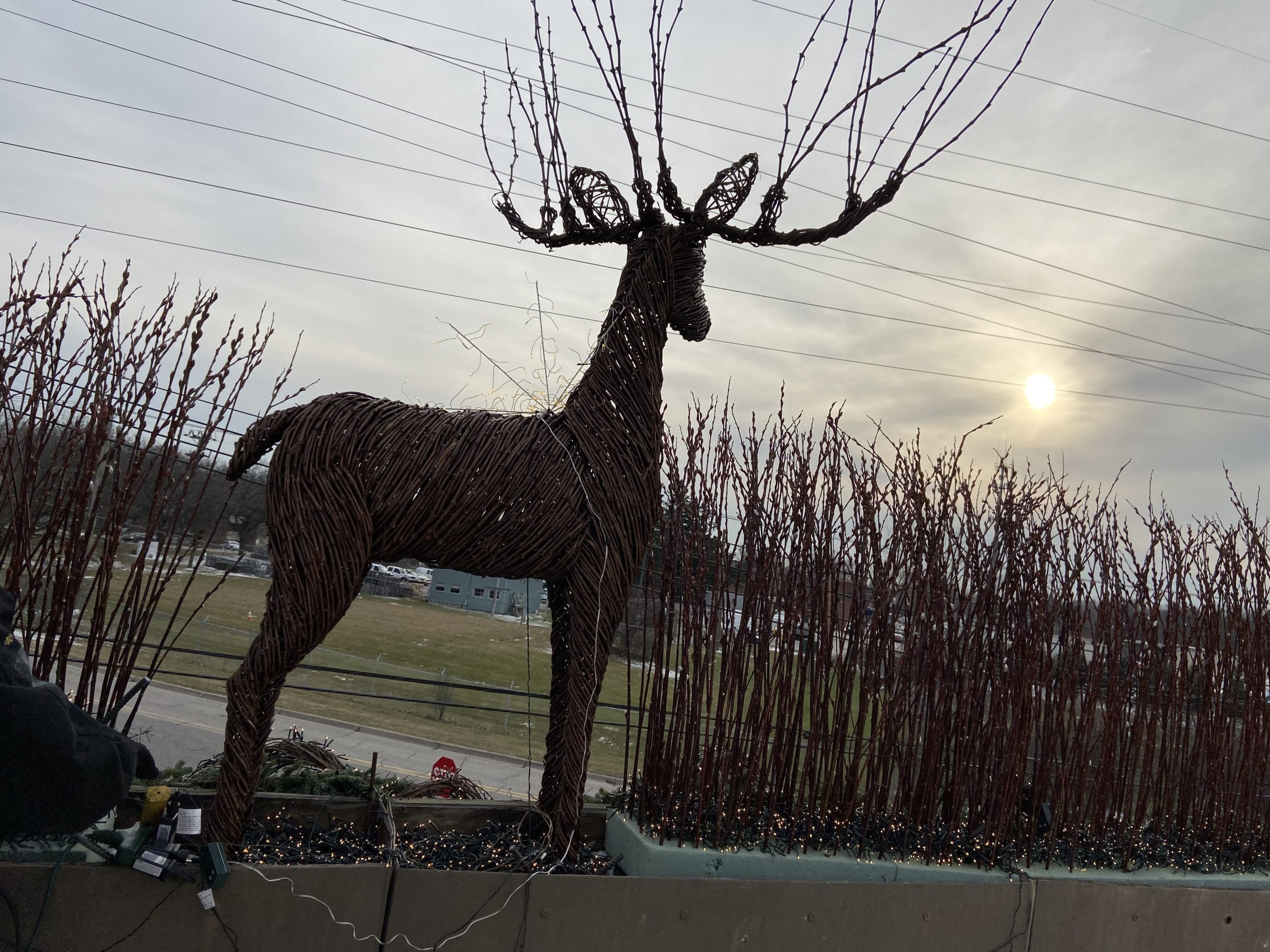
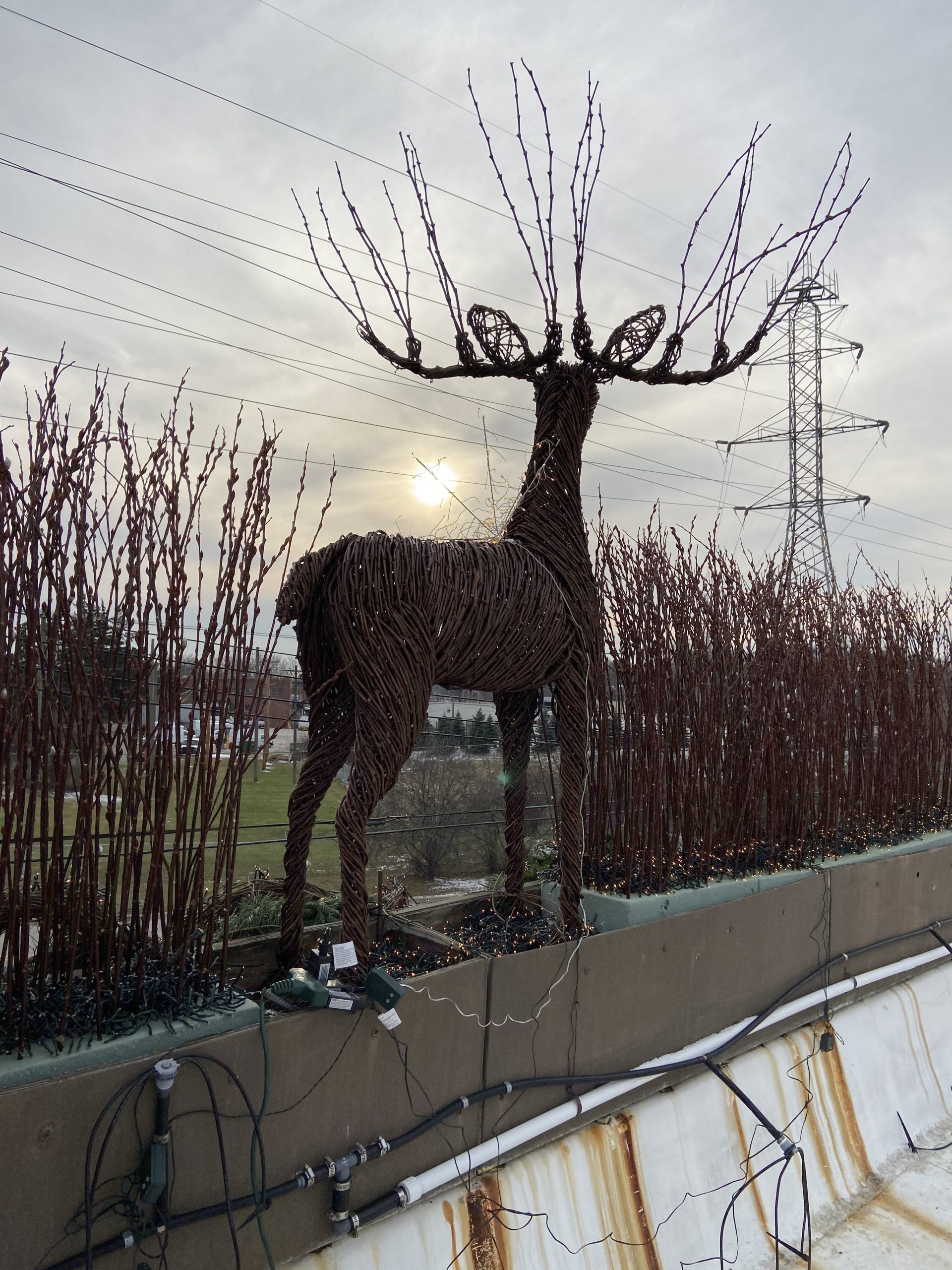 The roof at Detroit Garden Works is home to eight planter boxes, each of which are five feet long. They were fabricated from heavy duty sheet metal – there is not one thing fancy about them. These painted metal hold soil, plants, and an irrigation system. The magic is what gets grown in them over the summer. We intended to bring a little magic to the winter season that is at hand. Our reindeer was secured in the center via steel rebar pounded in at an angle. On an angle? A gusty wind could pull steel rods set vertically out of the soil in a matter of moments. The steel set on a steep angle is weighted down with a thick layer of saturated and frozen soil. A wind strong enough to uproot that buck would be a rare wind indeed, and most likely would take the box as well. We took every precaution to keep that reindeer in place. Of course we needed lots of lights. And a thicket of twigs. As the soil was frozen solid, we made foam forms, buttered them with lights, and stuck them with medium height pussy willow. Each one of these forms was additionally secured with angled steel rebar and concrete wire. Suffice it to say there is a lot of rebar on the roof right now.
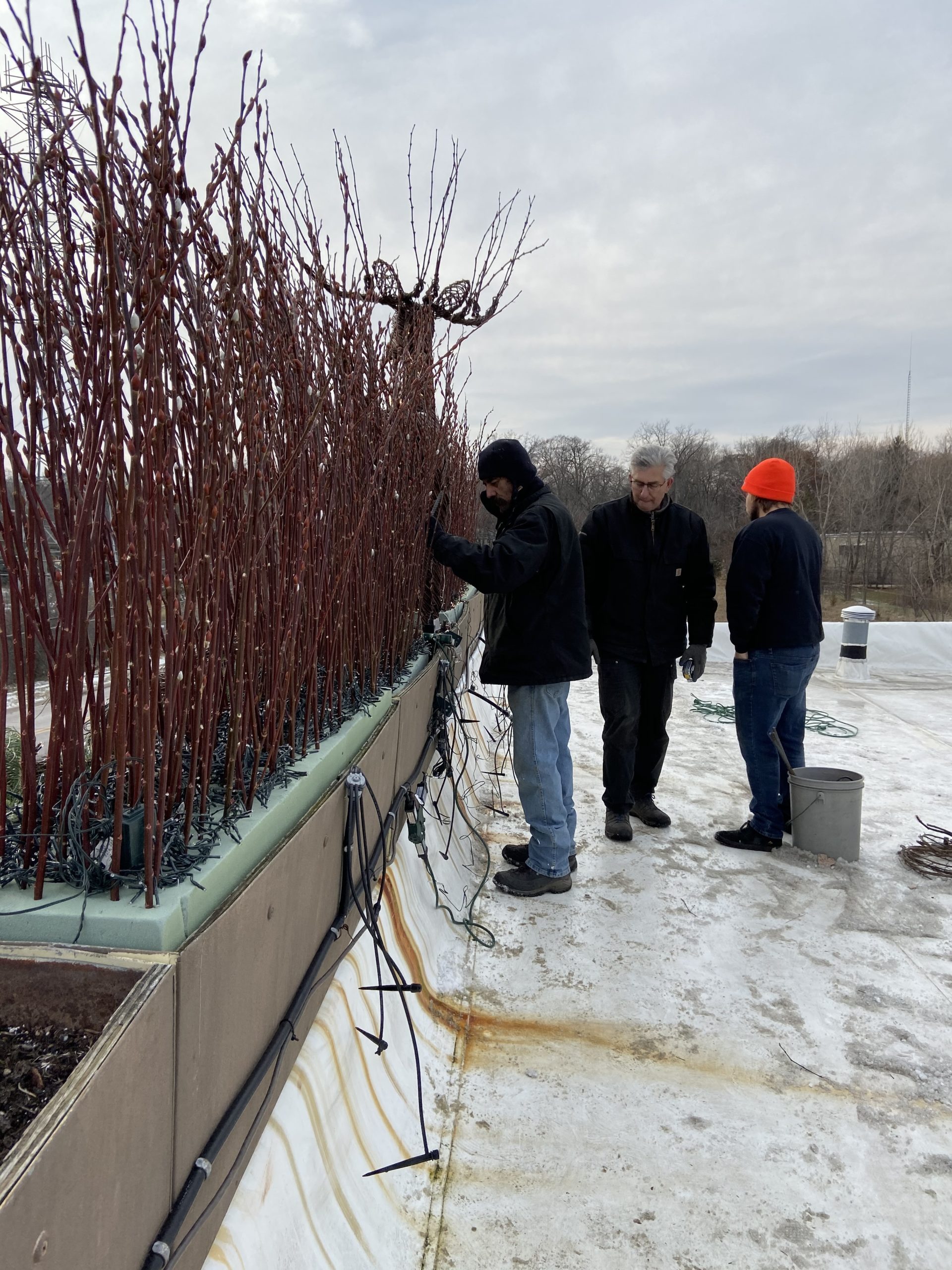 All of the irrigation tubes and emitters were pitched over the sides of the boxes. There was plenty of additional work involved in making it possible to flip the switch on the lights.
 A simple evergreen garland, wound round with garland light studded grapevine was attached to the leading edge of the boxes, and down the sides of the building.
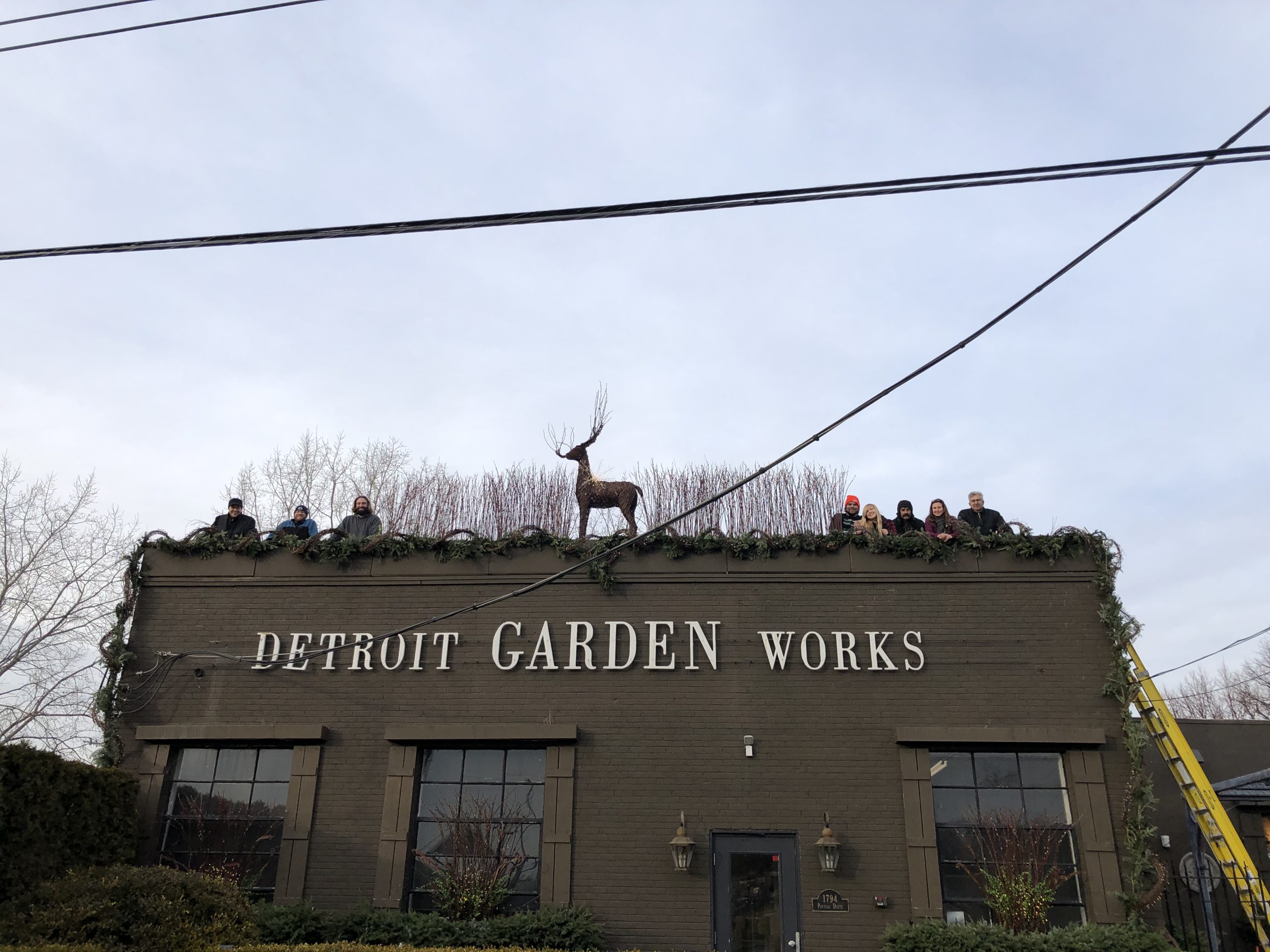 My crew was keen for a group portrait. Why not? These pictures do not really reveal all of the work that went in to moving this project along to this point. They were caught up in the fun of it, and committed to seeing it through.
 The view at dusk made it clear we needed to do more. The thicket of twigs needed to describe the entire width of the building. We had run out of pussy willow, so what now?
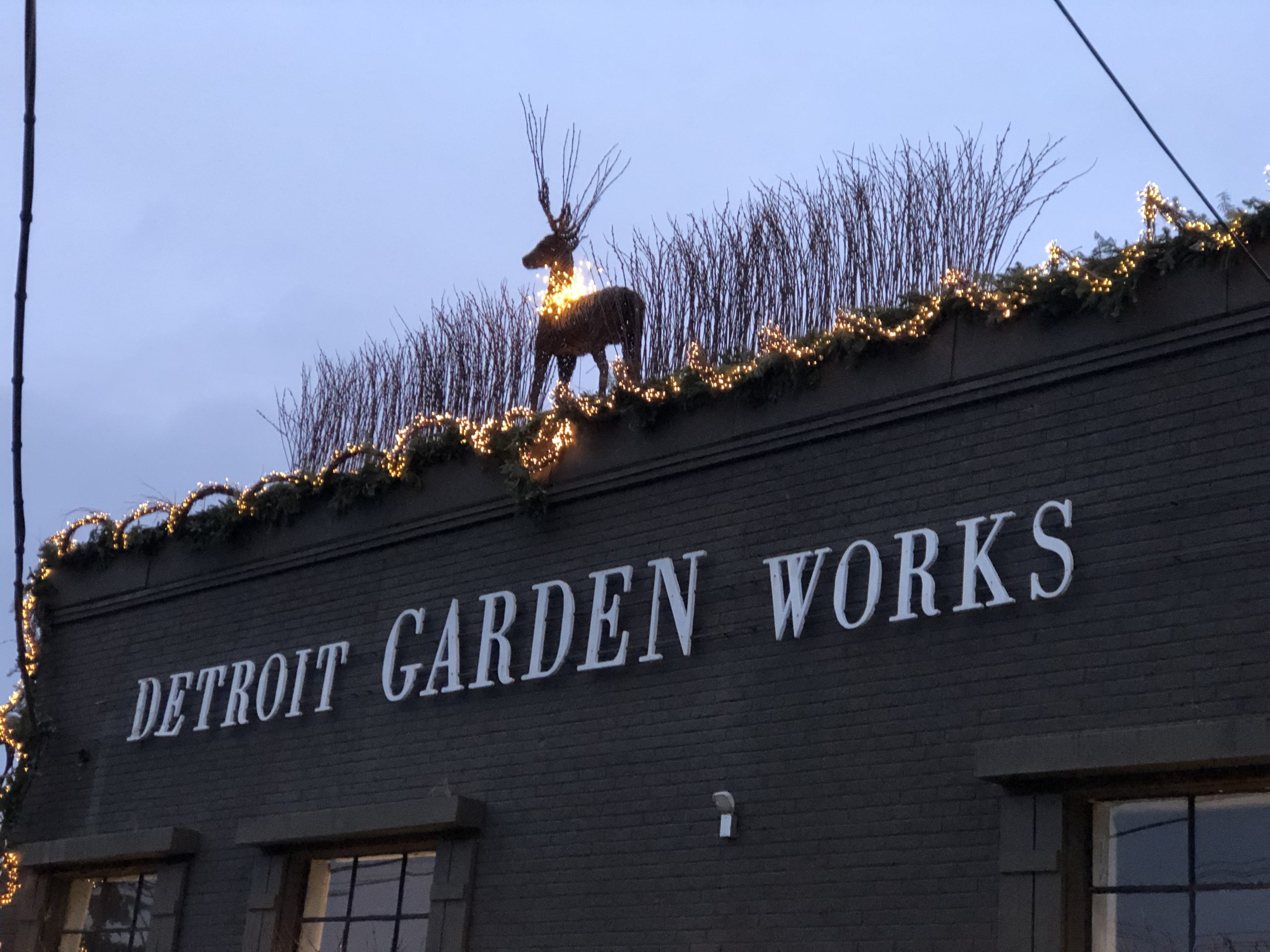 The light burst collar on the deer did not illuminate the sculpture. It spot-lit the neck. The twigs were in silhouette at dusk, and invisible come dark. We regrouped.
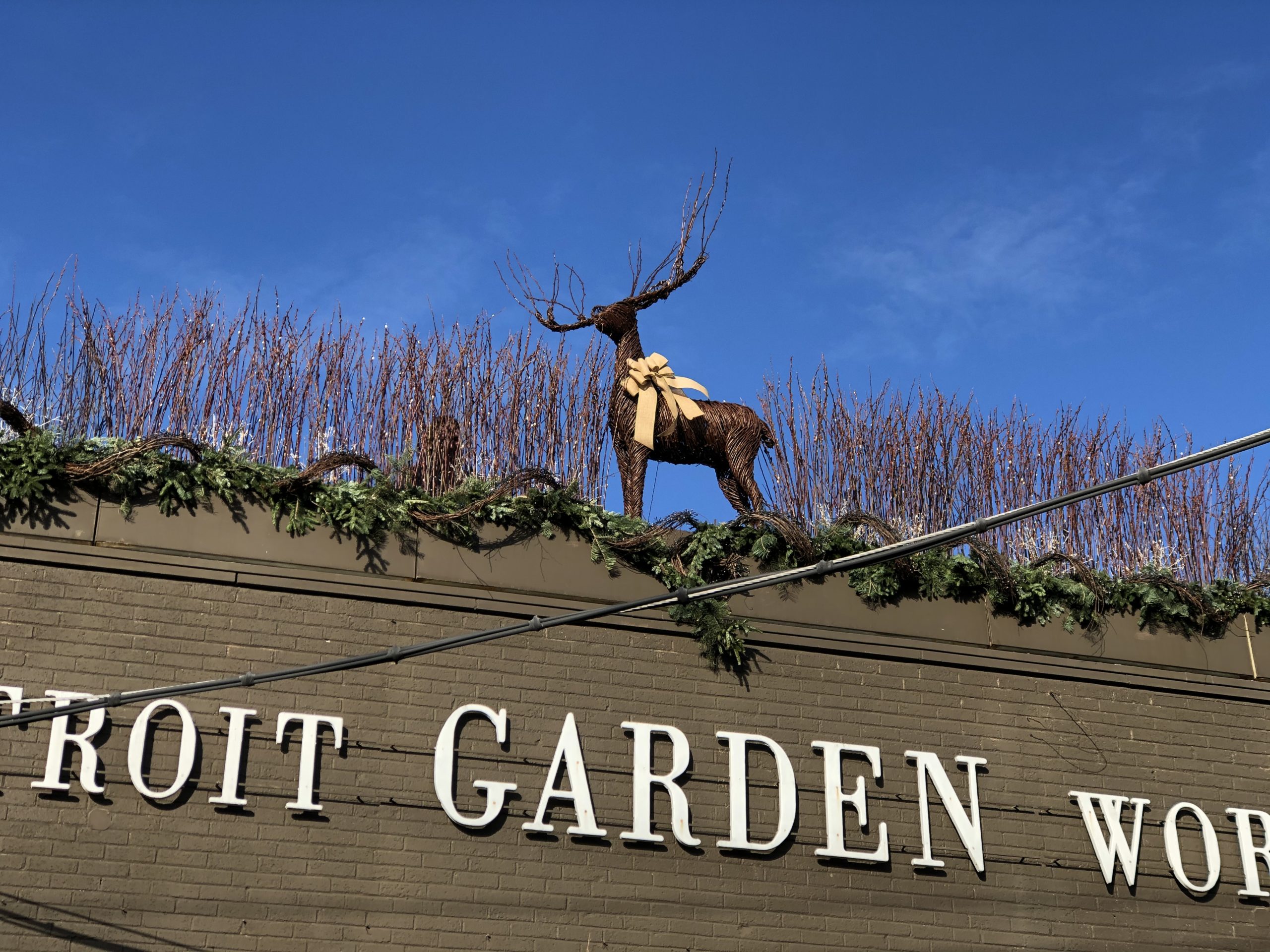
 Phase two of the fabrication and installation asked for a burlap ribbon collar. The light collar did not read during the day, and was a too strong blob of light at night. Karen obliged with the fabrication, and Joe got the collar attached in just the right spot, and at the right angle. We had to rethink the lighting.
 Attaching multiple light bursts to the front edge of the twigs might do a better job of illuminating the thicket at night. It was certainly worth a try.
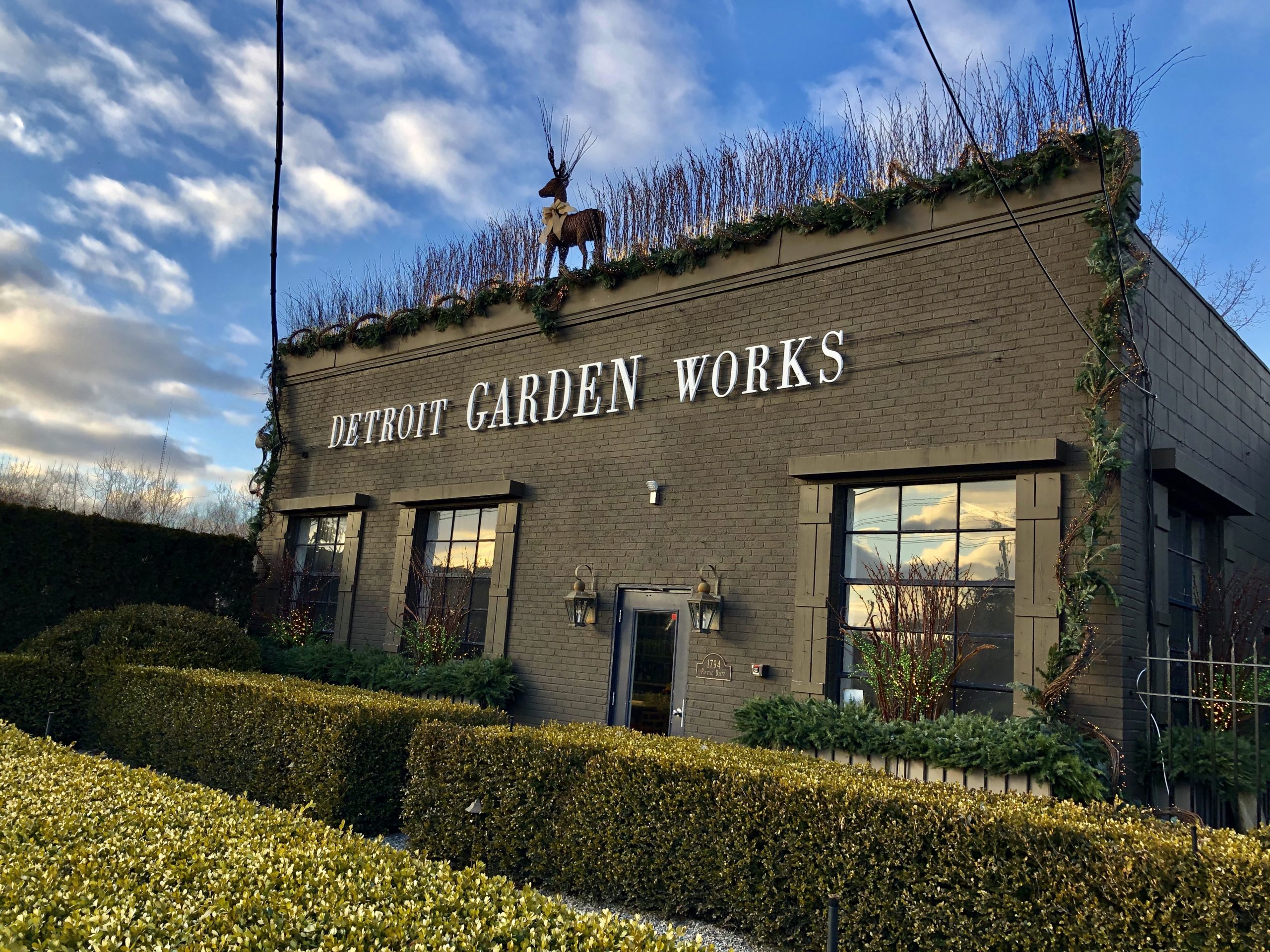 Lengthening the twig thicket proved to be easy. The last few bunches of black dogwood, mixed with lots of alder branches made a believable transition from the more formal and vertical pussy willow stems to a more wild and natural look. A thicket spanning the entire width of the roof seemed more deliberate and finished.
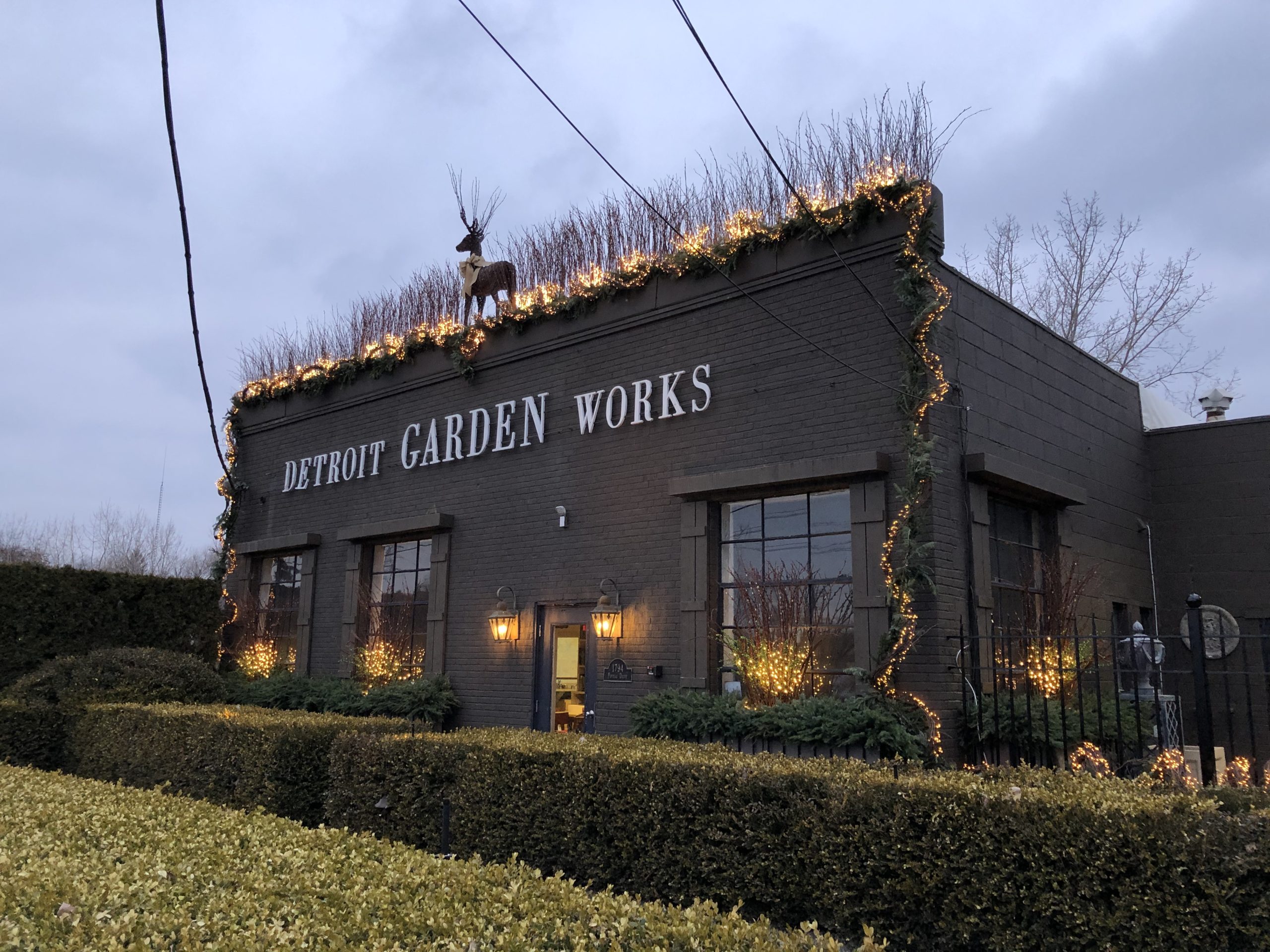 The multiple light bursts did a great job of illuminated the face of the branches at dusk.
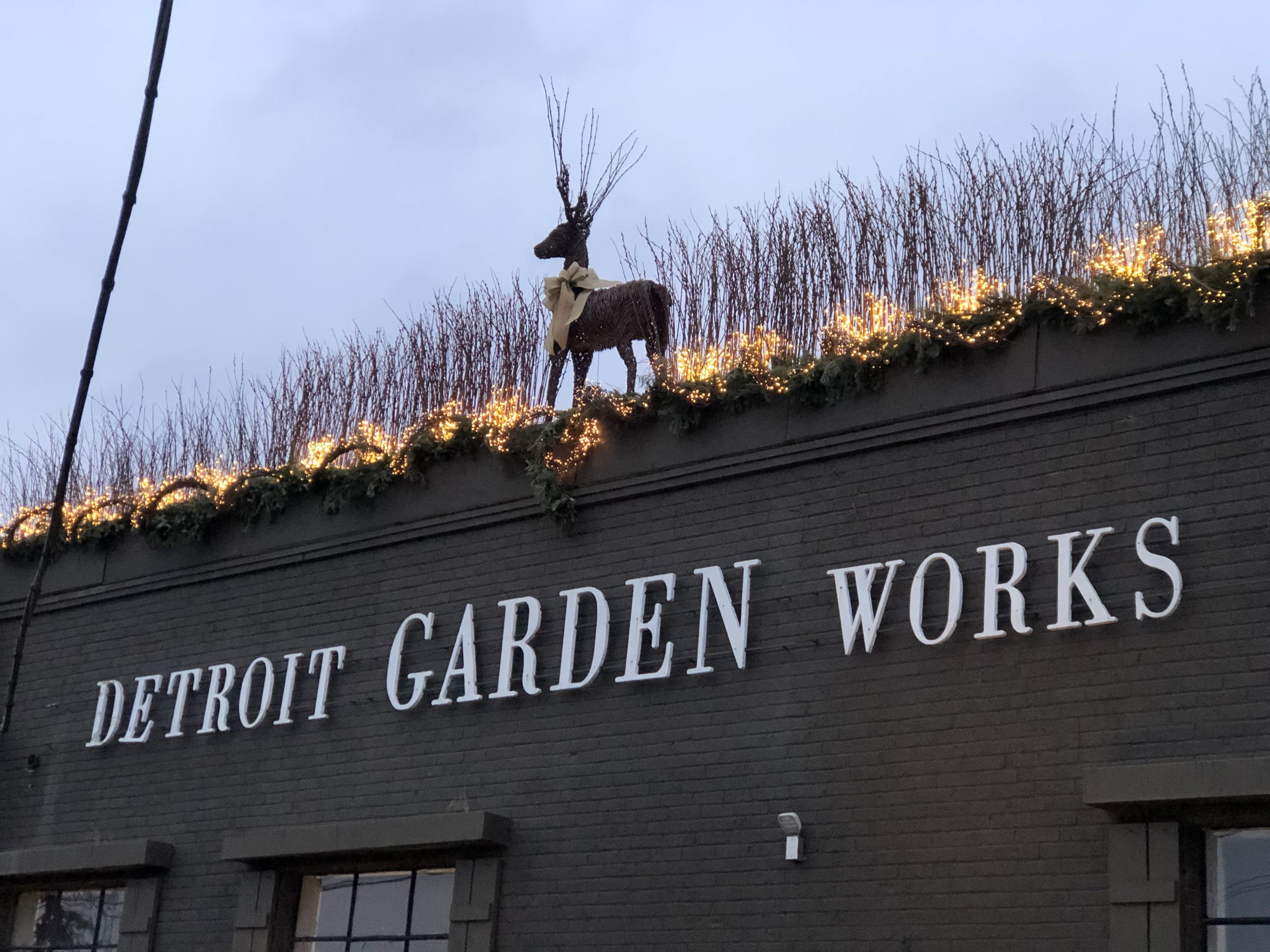 The burlap ribbon collar on our reindeer read plainly and properly, both day and night.
 much better, this.
 I know if Rob is photographing something, he likes it.
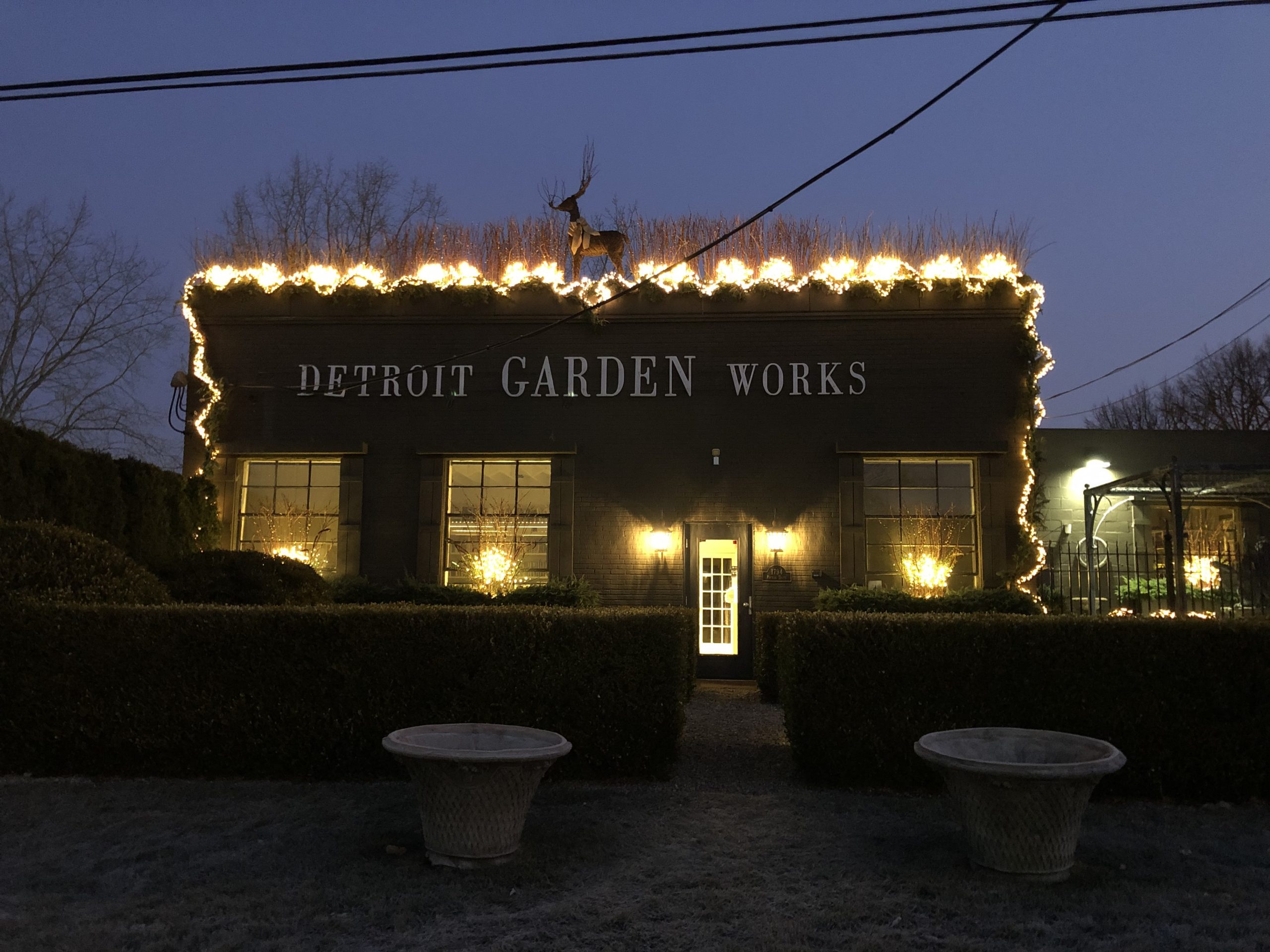 Who knows if St Nicholas will require the last minute services of our reindeer buck tonight, but I am sure he will have no problem spotting him from space. The Works is ready.
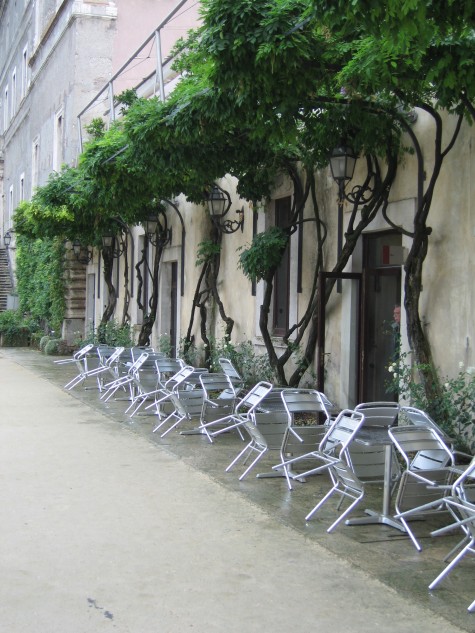 Vining plants have a very special charm. Provided they have secure support, they take up little to no room in a garden. Most of them are energetic growers; this I especially appreciate in a plant. Wisteria gives new meaning to the phrase “willing and able”, but with proper support and ruthless pruning, their sculptural effect in a garden will rival their long and languid racemes of flowers in June. I would only advise that any thought of planting wisteria should be undertaken in tandem with where the iron will come from. Iron support, and iron fisted supervision are must haves. Any other scenario risks waking up to it growing in your bedroom window.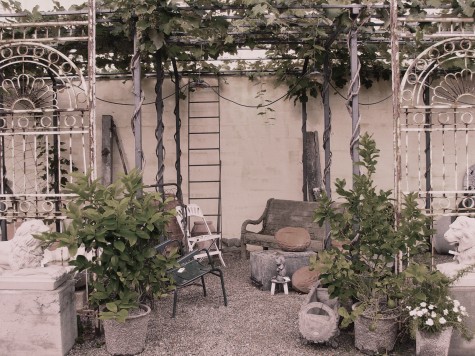
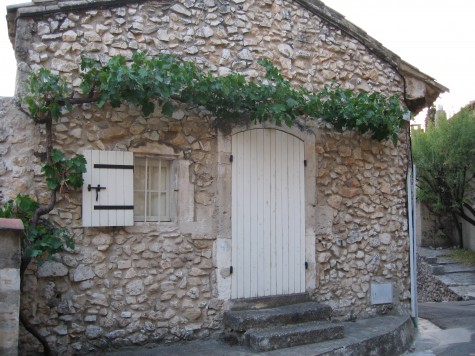 Grapes are like any other vine-lax in habit, and best grown within the confines of a well run dictatorship. They are sterling performers with a good gardener at the helm. But like the willows and dogwoods I discussed yesterday, their strong suit is about the harvest. I will never grow grapes for the table or for wine; I suspect the art and science behind that is considerably more than I imagine or could grasp. But I do value the look and feel of ornament made from materials from the garden.
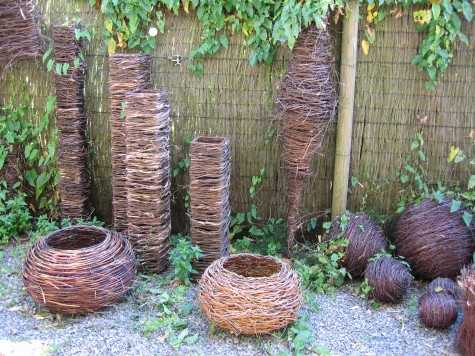 My shop has featured many garden ornaments made from vines and flexible twigs over the years. They never seem to loose their appeal. Those woven over a steel framework have an astonishing long life; they are as beautiful breaking down as they are brand new. Every year I pick up a large French basket from a client planted with a colony of medium sized agaves, amazed that it is still all of a piece. Enamoured as I am of Belgian design both inside and out, these airy, often hairy objects are a beautiful foil to brick, plaster, stone, concrete and iron.
 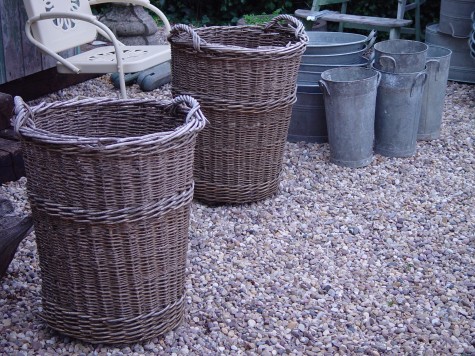 Only in England would you find a business named The English Hurdle and Basket Center. Despite sounding like remedial center for floundering collegians, it actually produces vessels and baskets of great artistry. The graceful shapes belie the skill and strength needed to form them. The artist Serena de la Hey, for whom I have the greatest respect, creates truly inspired sculpture for the garden. My very first purchase for my shop in 1995 was a order for one of her boar sculptures. She is well worth a look;
 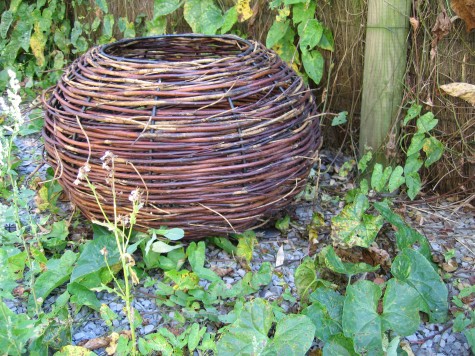 The framework that is visible here makes the object eminently renewable. Though the wood and bark of willow is remarkably resilient to weather, it will eventually deteriorate. I appreciate the chance to renew, redo, and rethink an object; this is a good part of the appeal of twig and branch sculpture.
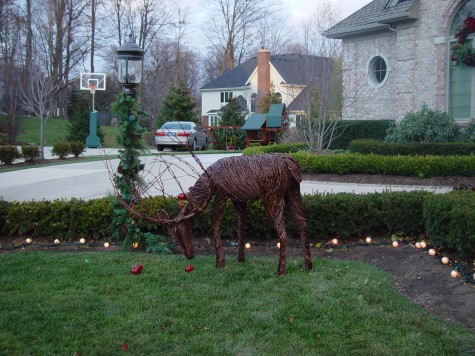
 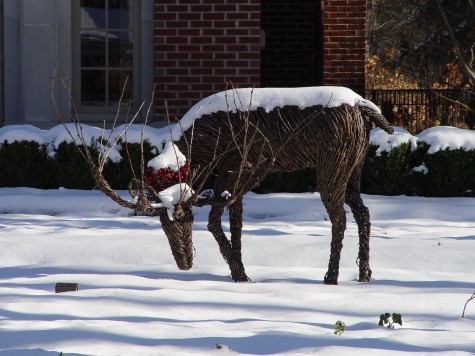 Though this stag looks perfectly at home in my client’s landscape, it is made in California. The metal frame will last a lifetime. The willow is painstakingly woven; the sculpture is heavy and sturdy. Carleen’s life size animal sculptures are enchanting. I have seen enough of them to recognize which of her artisans is responsible for a specific piece. This is grape vine, beautifully rendered.