 My post earlier today featured the best that there is going on outside here-that best is not so great. It is still winter where I live. So I went back into that stack of old pictures and projects looking for something a little less chilly and off-putting. This landscape and garden I worked on intensively between 1986 and 1994. A client with a beautiful house on a small piece of land-I cannot remember how we met. But I do remember that she decided that a garden, and a great garden at that, was just what she wanted. Though she was always clear about what she liked, she had not so much knowledge. I not only designed and planted for her-I taught. She wanted to know everything I knew about wildflowers, perennials, meadows-and most of all, roses. I had a history with roses, fostered by Al Goldner. A highly regarded landscape designer with a degree in floriculture-he put up with a young employee (that would be me) who insisted to him in 1985 that tea roses were overbred, disease prone, and marginally hardy prima donnas. He had the confidence to allow me to order roses of my own choosing for Goldner-Walsh. I knew he was giving me just enough rope to hang myself.
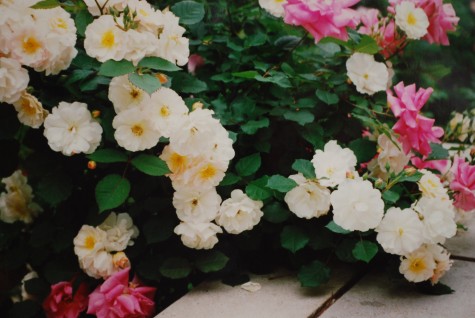 I placed an order for roses with Hortico in Canada. I bought antique roses. Climbers. Rugosas. Species roses. And a line of English roses-the David Austin roses. Everything and anything that was not a tea rose. I vividly remember the day I pulled a company pickup truck full of bareroot roses up to the Canadian/American customs booth-of course they pulled me over. Who knew I needed a phytosanitary certificate? I spent hours on a bench next to a man in handcuffs-it was terrifying. Eventually they let me go. This was some years before Wayside Gardens began offering David Austin roses. I potted up just short of a thousand roses, and brought them on. I learned plenty about them, just taking care of them. Though I was by no means a rosarian, I had a client who wanted any and all of them. Susanne.
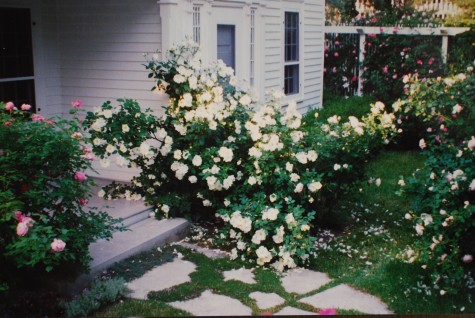
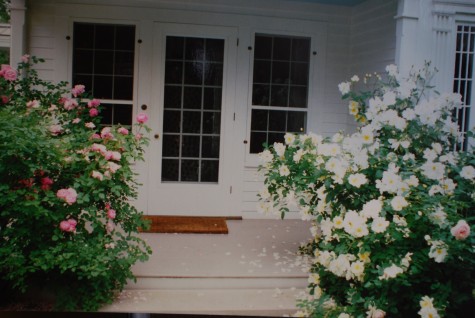 There are those people you meet. In the course of business. In the neighborhood. In the grocery check out line. They encourage you to be better than you ever thought you could be. This perfectly describes Susanne. She lit a fire under me the likes of which happens only rarely. Some days I would come to plant, armed with hellebore species I had stood on my head to obtain-and she would still be in bed. I would march right upstairs (I had the run of the house by then) and roust her out. Years later, her front porch was dwarfed by mature David Austin roses-Mary Rose to the left here, and Heritage, on the right.
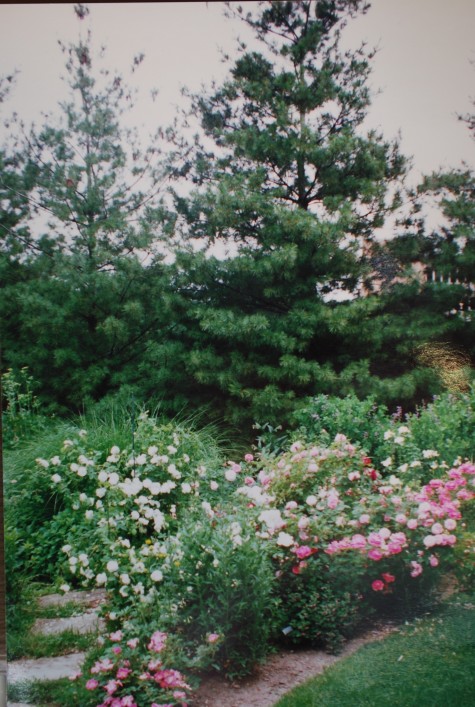 Her rear yard had about 15 feet of flat ground, before the earth dropped precipitously to the Rouge River. That 15 feet of space-stuffed with roses. They were lush. She was lush. My gardening life had an operatic quality to it, thanks to her. Her entire property smelled of roses. We grew roses with perennials. We grew roses with asparagus, and grasses. We grew roses wherever we could. The we part was important there-the two of us gardened as if we only had 10 minutes to live.
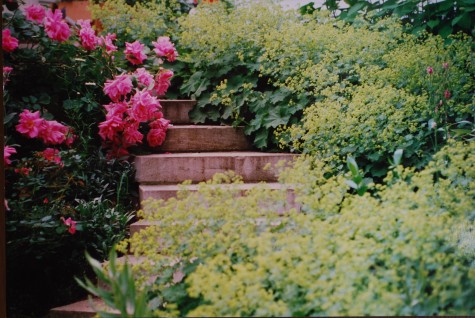 Every walkway, every staircase-redolent with the blossoms, the smell, and the habit of roses. Not one of them was a tea rose. I could go over the names and the classifications, but that is not my idea here. Though we also planted no end of unusual perennials, wildflowers, grasses, trees, espaliers and shrubs, the organizing metaphor of this landscape-for the love of the rose.
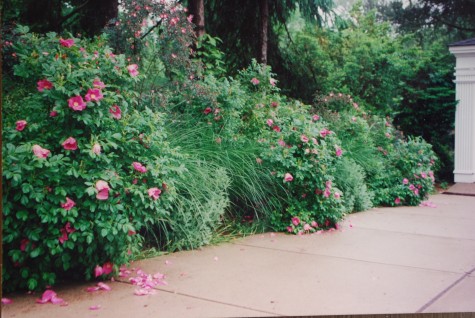 The driveway garden-a mix of Rosa Rugosa Scabrosa, rosa glauca (formerly rosa rubrifolia) miscanthus gracillimus, and artemesia. Petals on the drive-how I loved this.
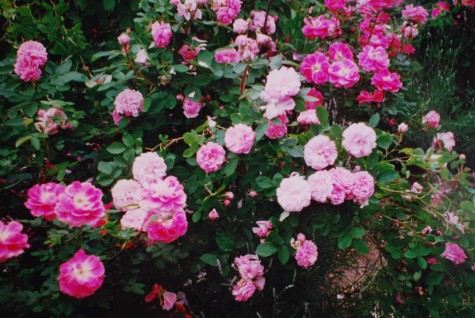 It has been so long ago that I designed and planted this garden, I cannot perfectly recall specific varieties from these old 35mm pictures. But I do know my knowledge of roses burgeoned. Susanne wanted to know everything she could about them-from me. We both learned.
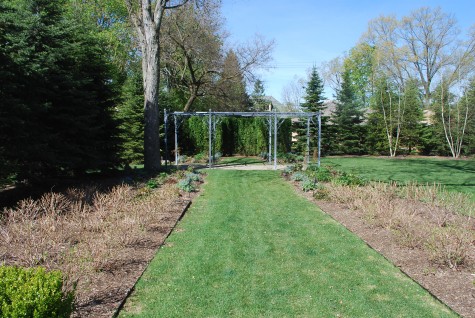
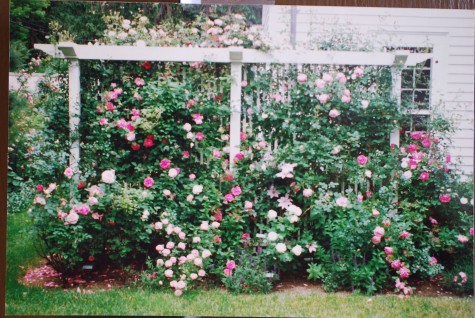 Her architect in Chicago built this rose arbor for her-I planted it. This picture does little justice to that day some years later when I took this photograph. Her passion-that’s what I see here. I forget everything routinely-but I remember this day as if it were yesterday.
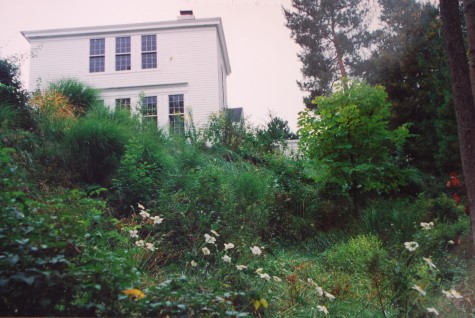
Her home sat on a very small piece of level ground. The back yard dropped off precipitously to the Rouge River. I gardened this entire steep slope-species and wild roses, grasses. Perennials. Weeds. The anchoring trees-yellow woods-Cledrastis. This garden on a steep slope about did me in-but it was wildly beautiful.
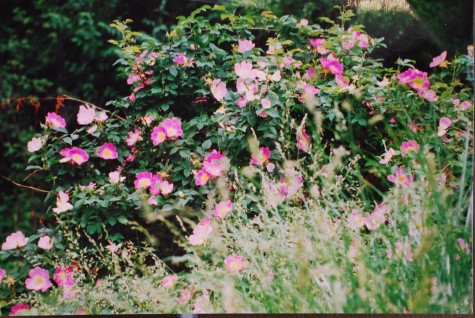
All over that slope-Rosa Complicata. How lucky I was to have met Susanne. This garden changed my my life.