Time

dunlap3-3

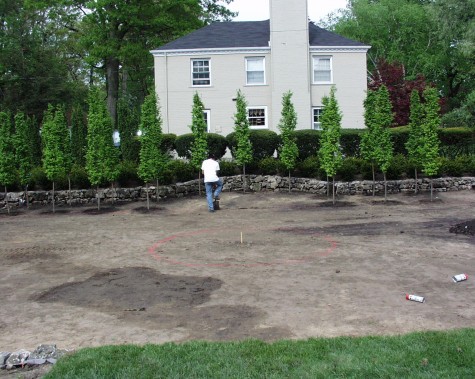
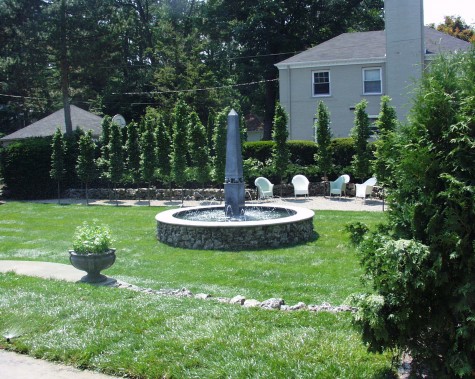
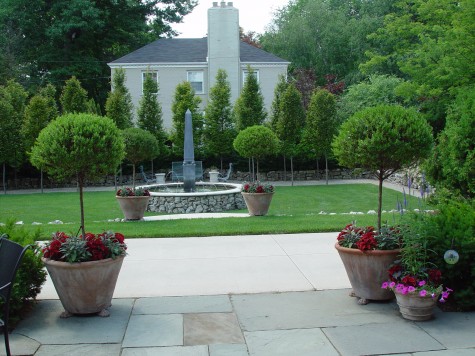
This Friday past I wrote some about a landscape renovation project I did in 2002. I planted a slew of carpinus fastigiata grown in 25 gallon pots for the bosquet pictured above.  The need for so many trees suggested trees of a reasonable price;  my clients understood that small trees would take hold fast and grow. No plant decision is ever easy; big trees that are transplanted at worst fail, and at best, take years to feel at home, root, and move in.  New landscapes are not hard to spot, even if large plant material is installed.  Most newly planted  plants have that distinctive look common to nursery grown plants.  Growers have different goals than gardeners.  But three years after the installation, these trees are starting to do what I knew they would, given time.
dunlap-2-9

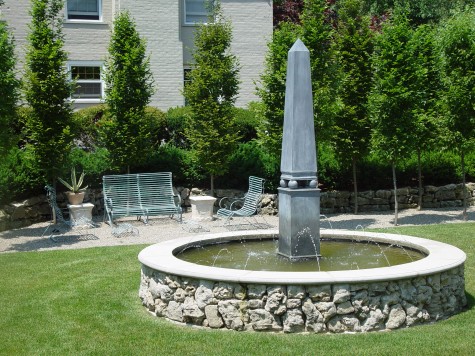
Growers pay plenty in taxes for the land they own.  Their idea is to plant as many plants as they can,  per square foot.  A grower needs to plant closely, and harvest often.  So trees and shrubs are grown as closely together as good horticulture will allow.  These carpinus did have that skinny, grown in a row, look. Planting them too close together would have made for problems later, so there were some years my clients had to suffer the gaps in their screening.
dunlap-1-25

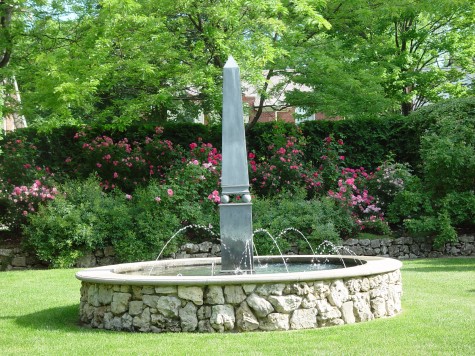
Perennials, including roses, are more quickly adaptable. A two gallon perennial is a big plant which will take hold in one season, given a serious gardener.  What you see here has everything to do with a gardener in charge. Though relatively easy to establish, perennials are plenty of work-deadheading, dividing and the like.  They also have a short lifespan, relative to trees and shrubs-unless we are talking peonies and asparagus.
dunlap-8-06-32

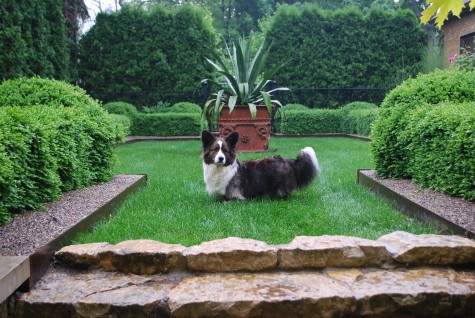
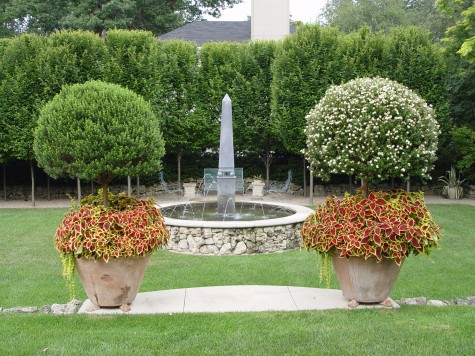
The small hornbeams took hold, rooted in,  and grew.  This photograph taken 5 years after the installation recorded a dramatic change; the view of the house next door is fading fast.  The bosquet is now a shady place to sit.
dunlap-8-06-35

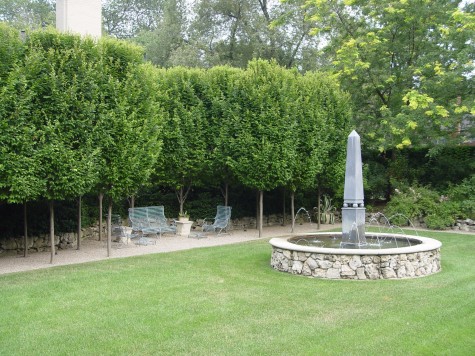
What once was dirt-what once was a spare diagram for a space, is growing vigorously.  The day the installation was finished, these clients took ownership of the maintenance. It is a very good thing when a client picks up and carries on.   It did take some time to work out the irrigation issues, and there is a big pruning job to be done every spring.
dunlap-1-22

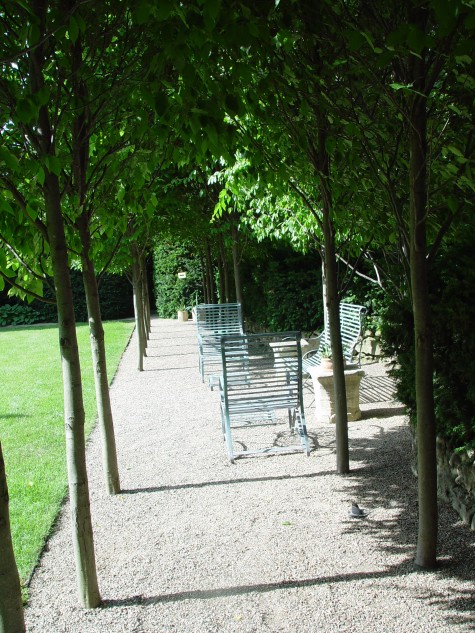
They have pruned the interior branches such that the trees provide a vaulted green ceiling.  A suite of iron furniture is complimented by a pair of antique English capitals.  The long view to a group of  agaves in stone pots, and a birdhouse, is a good one.  A garden needs time to establish a look like this.
dunlap-8-07-18
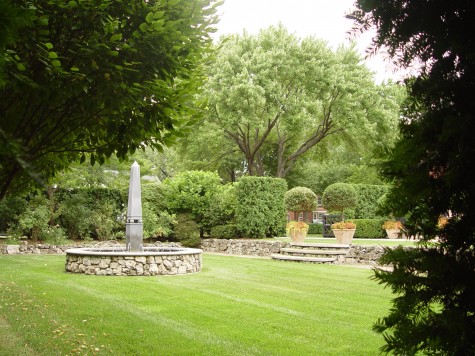
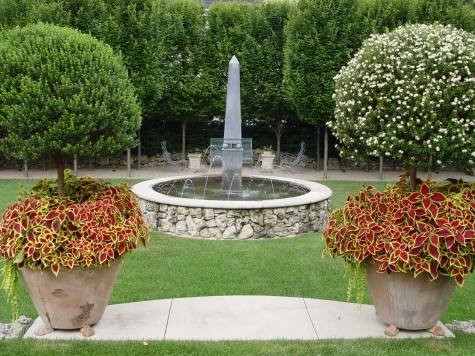
The landscape is beginning to look in proper proportion to the existing mature trees and yews on the property .  Proper scale and proportion is tough to plan for, as it has to be imagined.  With time, any mistakes is spacing or choice of plant material will become apparent.  I see landscapes only 5 years old that are overplanted, and consequently overgrown.   This landscape is just beginning to hit its stride.
2006-pots-139

Even the topiary myrtles that go to the greenhouse for the winter have grown.  Their trunks have become substantial. Making something grow is no small accomplishment.  However, the patience to give a garden the time it needs is sometimes the best move you can make.
Sunday Opinion: If You Can

The attribution has been written down in many slightly varying forms, but the gist of  Henry Ford’s famed quote goes something like this:  If you think you can, or if you think you can’t,  either way you’ll  be right.  My most serious reason for having this on my mind this minute is a client, of whom I am very fond, who is facing a lengthy and complicated surgery which will be followed by a trying rehab/recovery time-coming up first thing tomorrow morning.  According to his wife Jeannie, he is remarkably unfazed by the whole affair.  She says he has not devoted much time or effort to worrying, or talking about worrying,  as he basically thinks he  can do this.  By no means do I mean to suggest he is a fatalist, passively awaiting his fate.  Plain and simple, he not only thinks he can, he knows he can.  I don’t believe this confidence to be a genetically derived personality trait.  I think there is an art to living a life, and he is treating his life as such.  The science of his situation is not his life.

I have another client who has for several years grown vegetables in the lot next door, under the shade of mature oak trees.  His tomato plants are twelve feet tall, his bean vines bear beans, there are vegetables of all kinds-enough to go around the entire neighborhood.  Anything and everything I have ever learned about growing vegetables successfully would suggest his garden would fail; it is anything but a failure.

I grew up in a household in which all of science was held in considerable regard.  My Mom, the consummate scientist, virologist, microbiologist, who put her mathematics to use studying genetics, did however stop short of  worship.  When she thought I was old enough to understand (I think I was about 38), she did explain that what she actually held in such great regard was the beauty of science, not the certainty of science. She believed that whether the sum total of all scientific knowledge was one millimeter or 100 miles from a perfect knowledge and understanding of life-no matter.  In her opinion, it comes to nothing –  how little or how great the distance is between the end of science and the beginning of life;  that gap can never be closed.  Hope if you are ever gravely ill, she said,  that your scientist physician is also a skilled artist, as he or she may wish to diagnose and treat you with as much as what he imagines will work, as what science might dictate will work.  Working the science is an art, she said.

Good horticulture makes certain demands, and they cannot be ignored.  But inexplicably, some science-driven choices I was certain would work, do not work.  At 59 I observe that the sum total of all the science of horticulture I have absorbed in 25 years does not enable me to grow a decent columbine, not anywhere, not under any circumstance.  My scientific knowledge is a big pile of conflicting information always on the verge of decomposition.  The more years I study the science, and work, the further I seem to be from a definition of life beyond its miracle.

Does this mean that I can grow geraniums in deep shade, and ferns in the desert-of course not. However I do believe that there are many ways in which things can work.  There is not one way to grow roses.  There are many ways to grow roses that work.  If I so choose to believe I can,  then I will figure out a way to make roses work.

The day I met Fred and Jeannie, their landscape was wild, robustly overgrown, unuseable-I wondered how I could possibly make sense of it.  They did not wonder that at all; they knew I could.  They are as optimistic, generous, and enthusiastic as any two people could possibly be. Some two years later, how they have chosen to live, shows. The garden is light and airy, spacious, and graceful.  The waterfalls are working, there is a third pond, there are vegetables and flowers growing , there are spaces to read, nap and entertain.  The choices they have made have proven to be right for them.  They have no doubt that the best is yet to come; they are so right.

At A Glance: Dog Days of Summer

july15-066

july15-069

aug1-060

aug1-070

june-13-003

aug-8-059


july19-028

july15-0893

aug1-133

Saving the Stone

dunlap00141
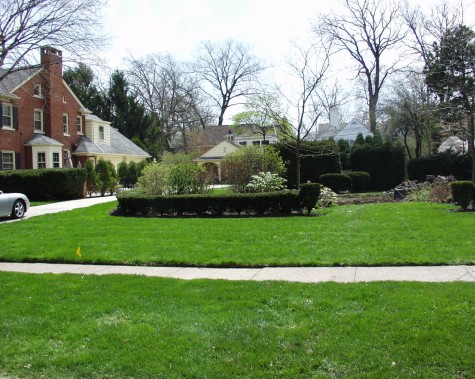
Eight years ago a client came in with a plan to renovate the side lot adjoining his 1920’s vintage house.  This part of his landscape had been a series of free flowing beds of flowering shrubs and perennials, edged in a volcanic rock I call Castelia stone.  Named for the town in Ohio where it occurs naturally, I see this stone in fountains, etc, at homes of this period.

dunlap0016
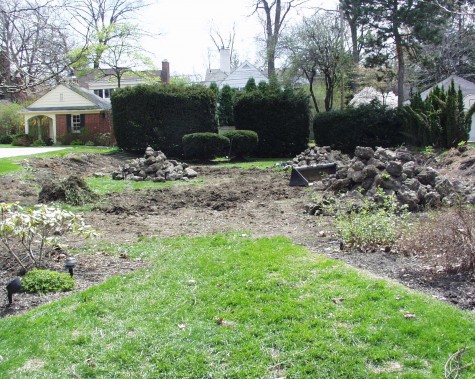
The land dropped dramatically from the grade of the existing driveway.The plan called for hauling away all of the Castelia stone, and installing a terrace of concrete pavers.  Alarmed by this, he thought a second opinion might be in order.  The stone was no doubt spectacular, and there was a lot of it.
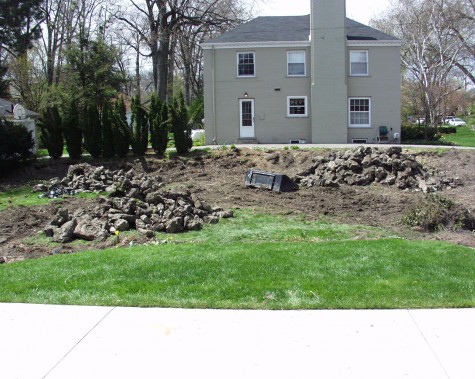
The  design issue of the day?  How could that stone be featured in a landscape that would be beautiful and appropriate to the house.? After hauling away ten yards of debris from overgrown shrubs and scrub trees, it became apparent that stone could be the key to solving the grade issues.dunlap00071
The land was a giant dish, bordered by my client’s drive, and his neighbors drive.  This stark view to the neighboring home was the dominant visual element.  I told my client I thought a formal sunken garden would be in order-an idea in which the existing stone would play a prominent role.  Sinking the garden down 20″ would also make the job of screening the neighboring house easier.

dunlap0021
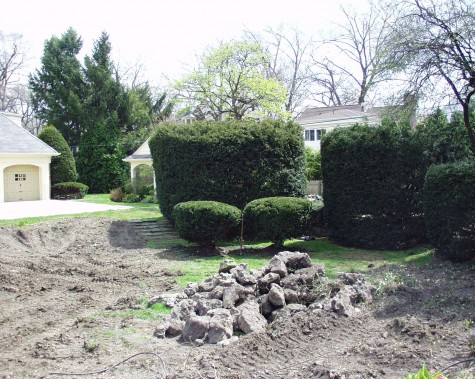
An old flight of steps, now blocked by a yew of great age, had been the only access to this area of the garden.  The decision was made to orient the new sunken garden around a side terrace adjoining the house, and plans were made to allow for good access to the space.

dunlap20002
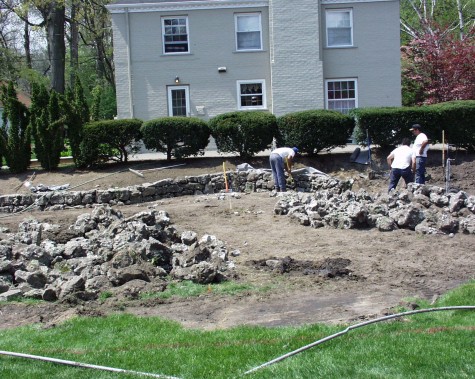
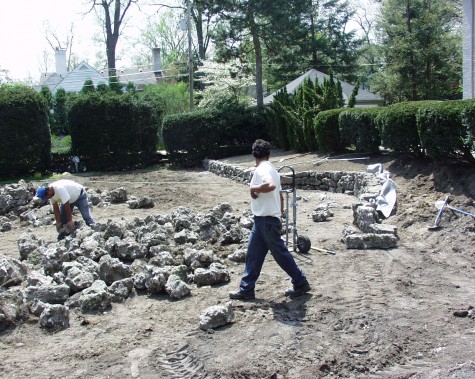
It is one thing to use materials that existed in an old landscape;  it is another thing to use it in such a way that it appears to have always been there.  The client was interested that the new landscape seem like it had been built on top of the old one.  We transplanted a row of old yews that had been a foundation planting across the front of the house to the lot line adjoining the neighboring house. We then sloped the soil down to a 20″ tall retaining wall of the old stone.

dunlap20005
Each stone was fitted into the wall by hand and by eye.  The use of any power tools to force a fit would have interfered with the illusion of age.  The evidence of modern tools would have immediately dated the wall as a contemporary construction.

dunlap10004
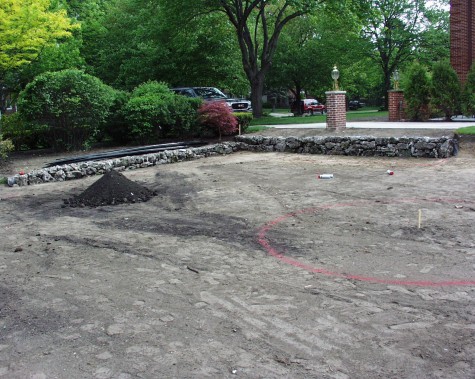
The ground was graded and regraded; soil was brought in to fill areas that were low; the ground plane was topdressed with topsoil in anticipation of the lawn.

dunlap10013
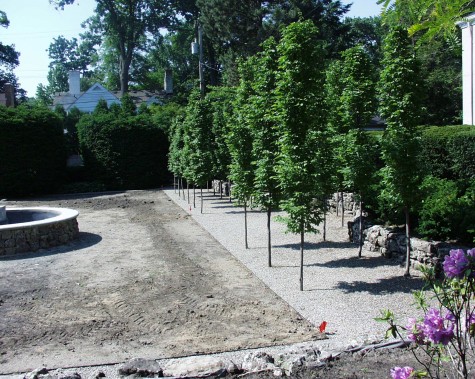
Densiformis yews were planted solidly on the slope down from the neighboring drive.  This gave the background landscape a bit of a contemporary feeling. The French word bosquet refers to a densely planted block of trees, which when grown in, provides an architectural element similar to a pergola.  These 25 gallon potted columnar carpinus planted as such would make an allee across the back of the garden, and would eventually screen the house next door.

p6100004
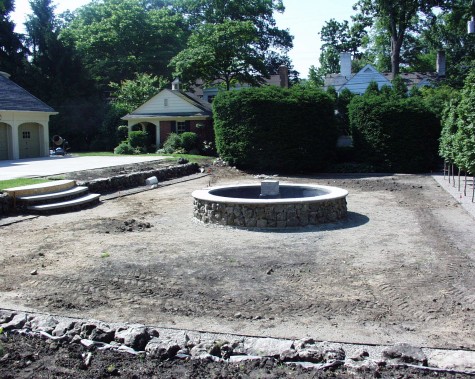
It was decided that a fountain, whose basin would be faced the in the same volcanic rock, would anchor the space.

p6100003
Edger strip was installed, and decomposed granite provided a hard surface under the bosquet.  This treatment also formalized the edges of the lawn panel to come, and celebrated the irregular surfaces of the stone.

p6100011
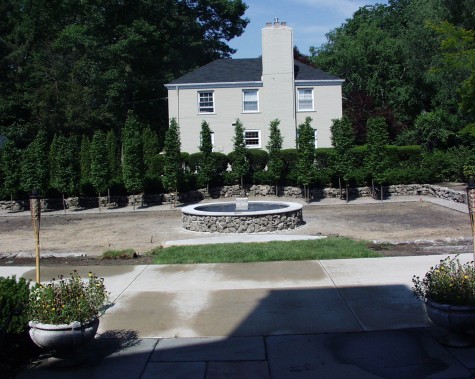
The radius of the fountain dictated the radius of the center of the bosquet. The center would have room for garden furniture.

p6150023
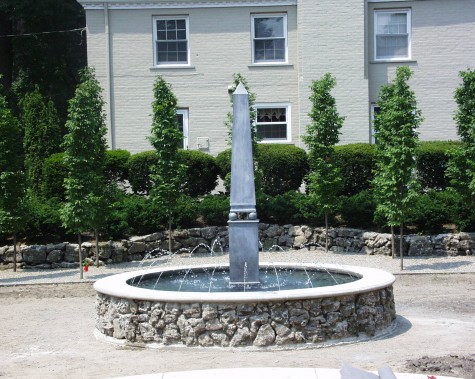
A contemporary European lead obelisk is a striking contrast to the stone.  A lawn panel is all that is missing now.

dunlap1a-1
The resulting landscape is a great place to view whatever the weather, and a great place to entertain.  Its composition makes much of the relationship of old materials, and my client’s more contemporary design sensibility.