


Deborah Silver is an accomplished and experienced landscape and garden designer whose firm first opened its doors in 1986.
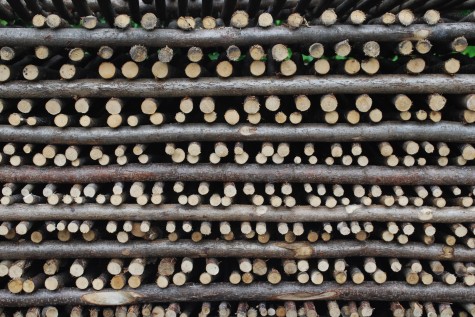 I wrote a few days ago regarding my excitement about the delivery of a container load of hazel wood hurdles from Belgium; the order we placed in May finally arrived. Wattles and hurdles are panels, woven from the coppice wood of willow and hazel wood. I personally favor the heft and longevity of the hazel wood; it is vastly more durable and substantial than willow. Coppicing is the practice of cutting trees or shrubs to the quick, with the intent of harvesting the branches for fuel, or fencing. The shrub or tree regrows, only to have its branches harvested again. Woven hurdles keep the livestock out of the vegetable garden. They border herb and vegetable gardens. They provide privacy without being utterly opaque. They work wherever they are needed. Woven hurdles are a fence material friendly to a garden or landscape of any point of view.
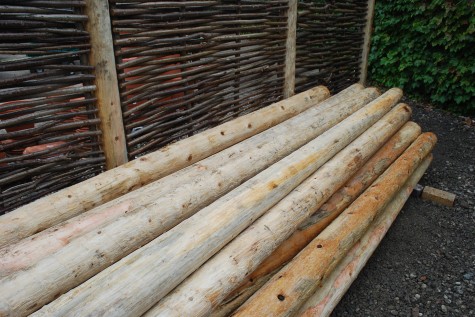 I have a client who has become a friend; he supports Michigan industry in a big way and was so pleased these stripped cedar fence poles we bought are Michigan grown. Though I ordered 5″ diameter poles, 10 feet long, they looked like telephone poles when they got delivered from a supplier in Michigan’s Upper Peninsula. As I relentlessly speak to issues of proportion, I was worried I had gone over the edge by an inch. I was wringing my hands, until the fence went up. I should not have worried. The size of the pole was perfect for the heft and texture of the fence. The bare cedar poles are a good contrast to the woven hazel wood, which has all of its bark intact.
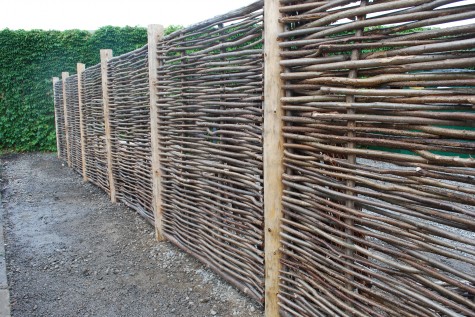 There is no substitute for the time when the talk ends, and the making begins. We set a pole down 24″ or so below grade, and set a panel up next to it. These panels are made by hand, and vary in width somewhat. One pole, one panel, and so on. This one step at a time construction ensures that the space between two poles is fitted to a specific panel. Steve toe-nail screwed the panels to the center of each post; this is a sturdy construction. What I like even better? This fence has no back or front; the panels are the same back and front. How friendly is this to neighboring properties? This fence looks good to both sides.
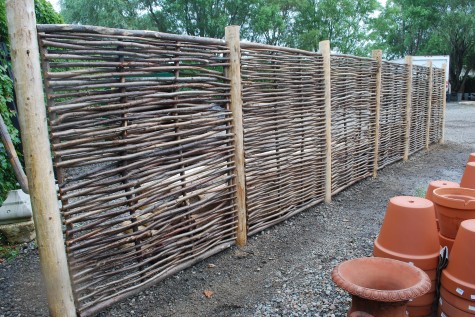 I have a client who plans to screen his hot tub with this fencing. It was the subject of intense debate today-will these hurdles screen a man who is happily skinny dipping? I vote yes-unless the neighbor plans to be close enough to see through the hurdle branches. The neighbor with his nose pressed to the fence-that is the subject of another essay, is it not? The fence is also friendly to vines that need to grip to climb. Clematis grown on this fence is especially lovely. We are careful to install the fence slightly above the existing grade of the ground. Wood in constant contact with soil will deteriorate much more quickly than wood that is able to shed water.
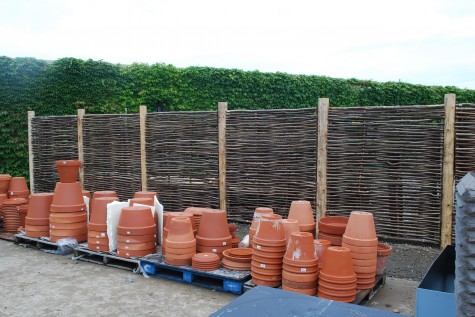 The fence is good looking with contemporary steel ornament, traditional terra cotta pots, a funky birdbath made from recycled materials, or a formal lead cistern fountain. This is by way of saying this fence looks good with almost anything. As to its longevity, imagine how long it takes a dead tree to fall and deteriorate. Branches and twigs are not good materials for the compost pile, as they break down so slowly. We have stocked this fencing for 8 years now. I have yet to have someone tell me it had disintegrated. Wood fences do age though-that is part of their charm.
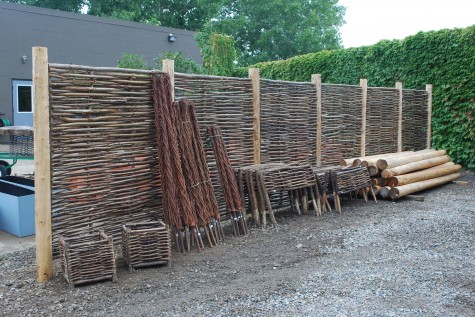
Robert Frost once said that good fences make good neighbors. I would go beyond that to say that good fences can be beautiful. They slip into tight places. They screen views not suitable for public consumption. They divide this from that. They are happy to support climbing plants. They enclose great views. This hazel wood fence goes beyond to please the eye, and warm the garden.
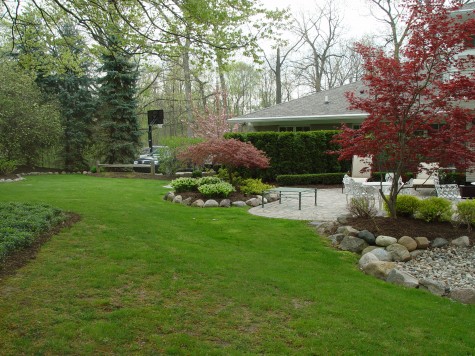
This quiet and well tended landscape was sputtering along on too few cylinders; it seemed to be needing a big dose of what I call lush life. The retail store of the same name in Atlanta Georgia wedges great gifts, ideas, objects for home and garden, floral design, books, antiques and much more into what once was a small home and property. Everywhere you look, the space lives up to its name. www.lushlifehomegarden.com. Lush Life is a striking visual lesson in how to create beautiful spaces, and views; shopping this store is even better.
Lush life-I knew those words would appeal to my client. In her typically direct fashion, she said she wanted me to design a landscape that would persuade her to get involved.
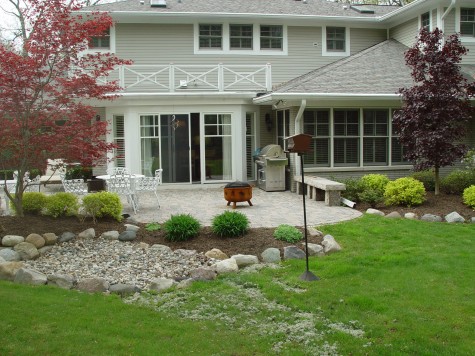
Her lawn service had installed this giant pool of egg rock right off her terrace, thinking to drain water from a low spot that was impossible to mow. I guess this is one way of handling it. When I see things like this, I know the most important job will be getting to client to reclaim ownership. Persuade me, she said.
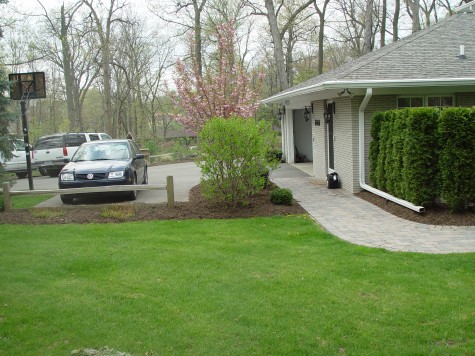 The drive and walk were functional. Though well maintained, it was indeed enough to put you to sleep. Every space was in full view of every other space. The parking area got top billing, driving in. The landscape telegraphed all of its visual moves such you could see it all, driving by. As the only landscapes I love driving by are Lady Bird Johnson’s blubonnet meadows on the Texas highways in late March, Lake Michigan from a perch on the Mackinac Bridge, and other big open places of the same ilk, I knew she needed not just places to be, but lushly living places where she could live too.
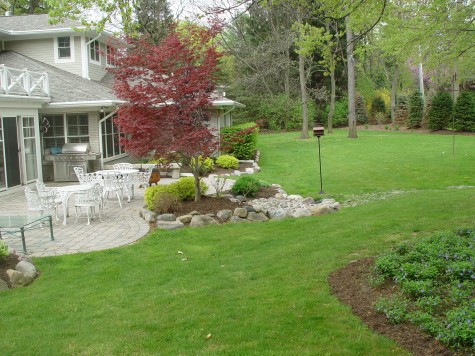 Even a good looking lawn is not enough, if the shape of the lawn is not beautiful. All the elements of a landscape need to help each other look better. The white Victorian period iron furniture was not good with the red Japanese maple, which was struggling in the shade of one of the most beautiful big European beech I had ever seen.
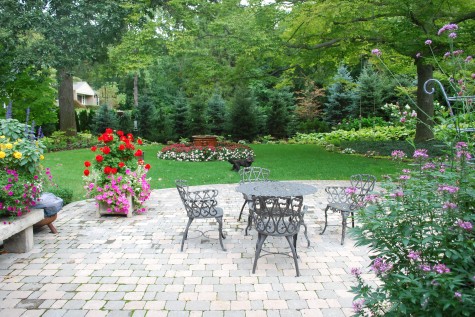
The white furniture is now dark. The terrace is twice the original size. A fountain made of a concrete pot in the classical Italian style sits over top a giant underground French drain. Some big pots lush with life warm up the terrace. The terrace garden is green and gaining visual weight.
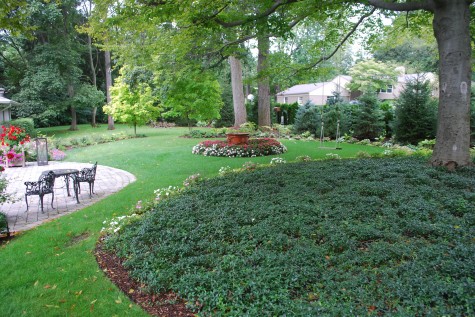 The big beech is underplanted with an even bigger sweep of myrtle. Two Princeton Gold maples mark an entrance from the immediate terrace garden, to the far gardens. There are enough curves and swoops to keep the eye moving around the space.
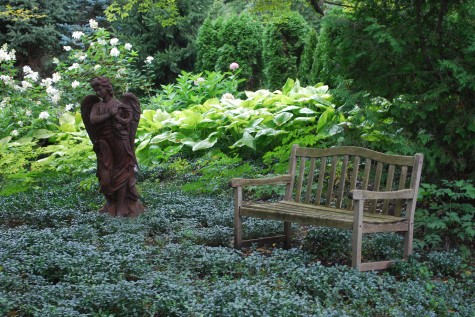 The lush carpet of myrtle is home to an old cast iron sculpture, and an aging wood bench. There are views to this from several vantage points-all the views are different. The masses of chartreuse hosta soften and lighten the space. The backdrop of mixed evergreens is growing in.
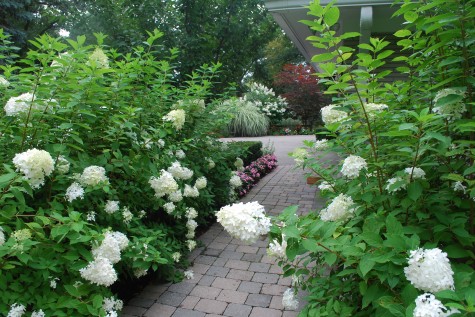 Parked cars are no longer part of the landscape. The view to the drive is anchored by a big splash of variegated miscanthus grass, snugged up to a hydrangea Tardiva. This is an casual landscape, with strong impact.
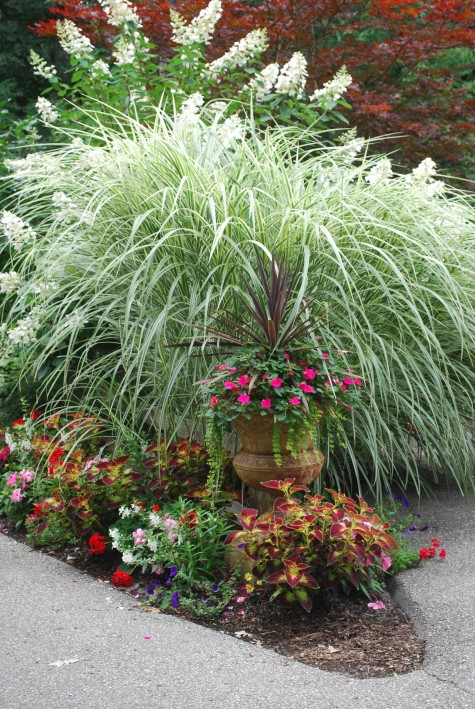
By no means should casual mean sleepy. There is a very interesting thing going on with color here-a cohesive statement consistent from back to front.
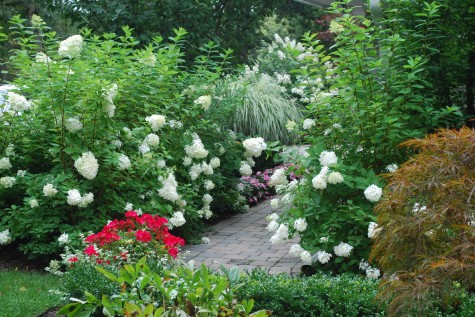
Lush life. She likes it.
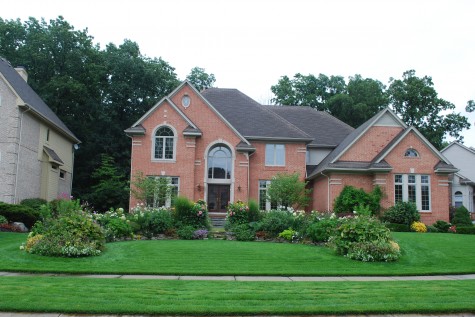 I do have clients who are hands on; Dr. Luria is one of those. I designed his landscape, and gardens, and I have planted a few of the bigger evergreens for him-but by and large, he has done this work himself. I can relate to that gardener that really does like the dirt. The perennial garden sits on top of a low elliptical wall, which strongly borders the space while the garden is dormant.
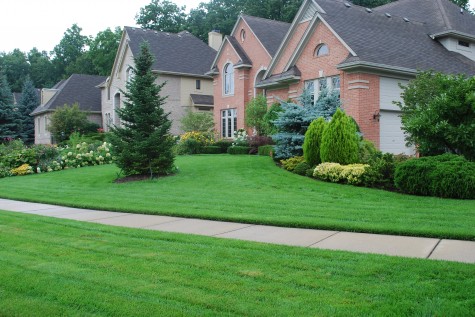 lI tried very hard to dissuade him from having a perennial garden in his front yard, but working against me was how the house sits on the property. This neighborhood has large common areas that all the homeowners share. Thus most of his property, and almost all of his sun is in the front yard. I need not have worried. This garden is better than well looked after. It is the jewel of the neighborhood.
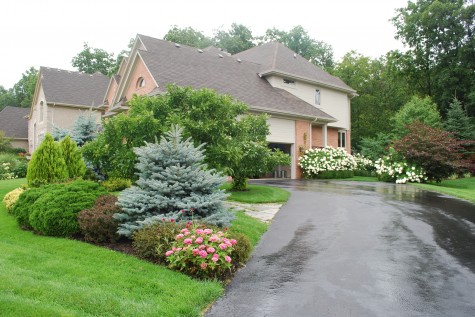
A dwarf conifer garden lines the walk to the front door from the drive. These evergreens in different shapes and textures and colors have grown in beautifully over the years. Along with the douglas fir in the lawn, and the yews near the front door, the dwarf conifers see to providing visual interest during the winter months. A pair of dwarf magnolias are a welcome shift of texture from the evergreen needles. The side yard is dominated by groups of Limelight hydrangeas, fringed in boxwood. The white flowers read strongly from the street; they look inviting.
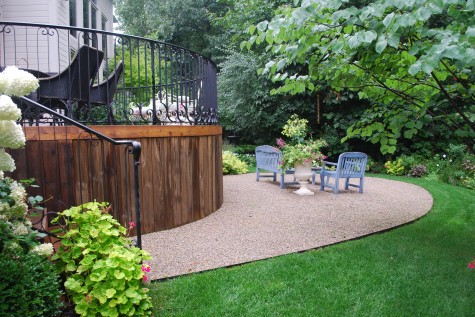 In the back yard, The woodland common property is faced down with a mix of shade perennials. This greatly helps to expand the visual space of the rear yard. I suspect he takes care of the woodlot as well. A round terrace/deck is notable for its beautiful iron railings. What I dislike about decks the most is what I see underneath them; I rarely see a surface treatment I find attractive. The undersides of decks also tend to accumulate tools, hoses, toys and the like. This deck has the illusion of being solid to the ground; the vertical wood planks add so much color and texture to this small garden. The stairs hug the deck radius, and spill out onto a second terrace, finished simply in gravel contained by black aluminum edger strip. The blue furniture looks great.
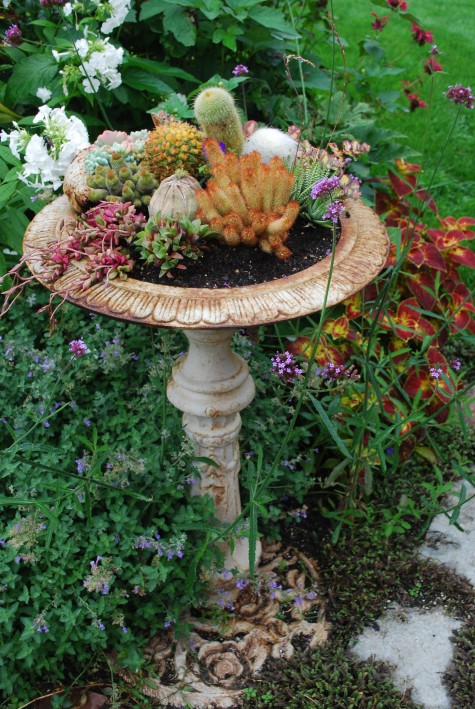 I so enjoy the gardens my clients make for themselves. Never would it occur to me to plant a cactus garden in an iron birdbath. Does this not look swell? I like everything about this small spot in his garden-the color, the textures-and most of all, the presence and personality of the head gardener.
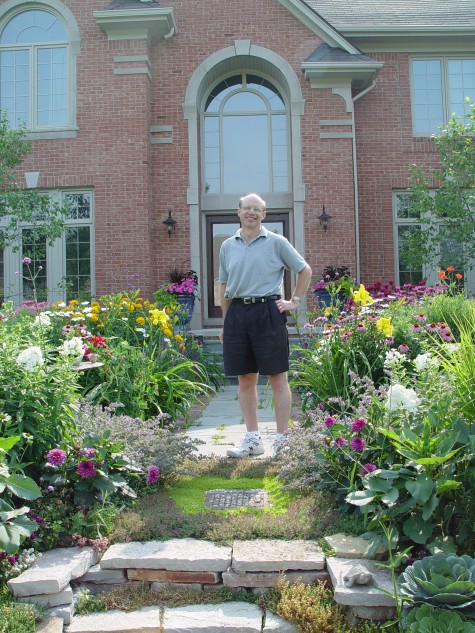 Dr. Luria has been making things grow his whole life, and it shows. The plants are robustly happy and lush; how they look says everything about how much time he spends here. Though I am sure there are days he wonders what he took on here, the state of the garden gives no hint of that. Well grown plants are so much a part of what makes a garden beautiful.
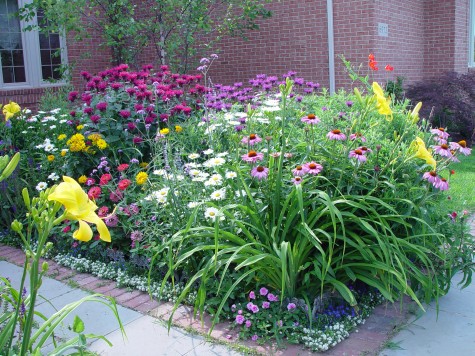 He also does a beautiful job of adding annuals to his perennial mix. Any day you go by, something interesting is going on. In any given year, the annuals he fancies can change the complexion of the entire garden. It looks new and fresh every year. He may consult with me about this or that, but he makes the decisions.
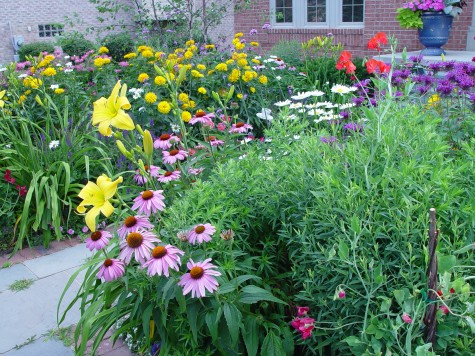
He likes plants, and he likes color, but how he mixes and matches works. The garden is graceful, relaxed, and profuse. I know how much work it is to keep that wild look just this side of chaos. He clearly does not fear the work of it. In fact, the entire gardens looks like he enjoys it.
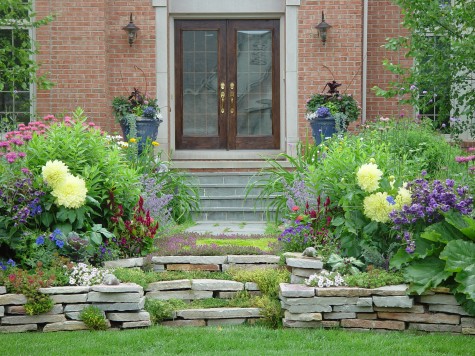
This garden is truly lovely; he is the driving force behind all you’ve seen here. He should be very proud of it, should he not?