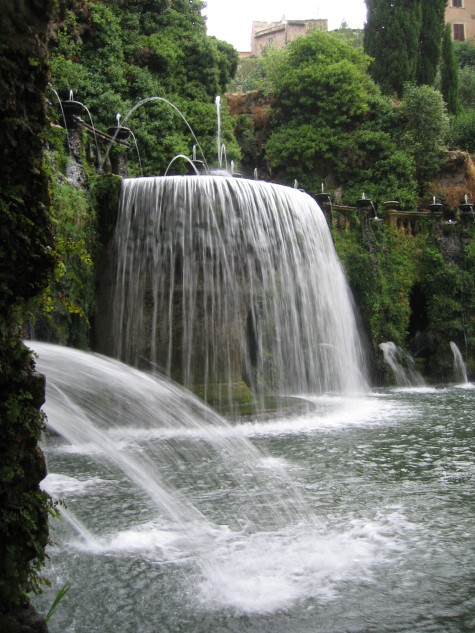
Landscapes such as Villa D’Este, grand in scale and of epic proportion, are a visual delight. I affectionately call them OPG’s-or “other people’s gardens”. The other person in this case-Cardinal Ippolito d’Este, a Catholic prelate whose work on his villa and garden took place on and off between 1550 and 1572. According to Judith Chatfield in her book “A Tour of Italian Gardens”, “… the garden was famed throughout Europe before its completion.” No surprise there. This grand garden is a symphony-an opera if you will- to the beauty of water in a landscape. The first of its kind in Italy, it is a national treasure, open to the public.
 I have only visited this utterly romantic garden via these photographs of Rob’s. I can only imagine, for plenty of reasons, what it must be like to be there. My native topography is flat, and more flat. Only occasionally will a project come along with an unexpected change of grade as a central feature. With the possible exception of Tahquamanon Falls, water like this is not part of my experience. But that does not mean what I see here cannot be part of my vocabulary.
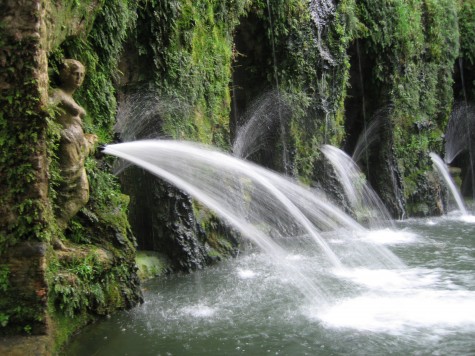 Other people’s gardens can instruct, provoke, and influence the way one thinks about a garden. The idea of fern and moss covered rock can be readily incorporated into any landscape, provided the conditions are right. Proper scale is a relative thing-but I try to err on the side of overscaled. As a friend and mentor once said, who wants to get to the end of their gardenmaking and think they were never bold enough. It’s a good thing in a landscape, to be driven by being bold enough.
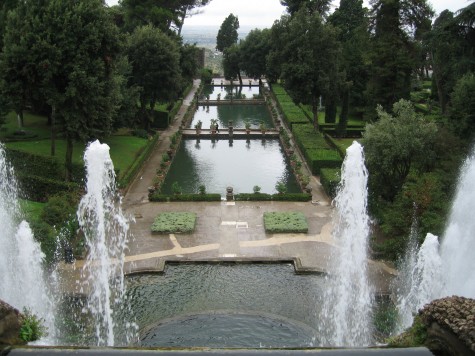
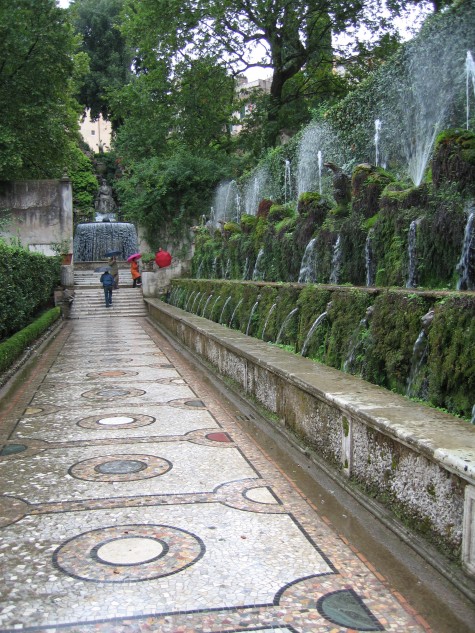
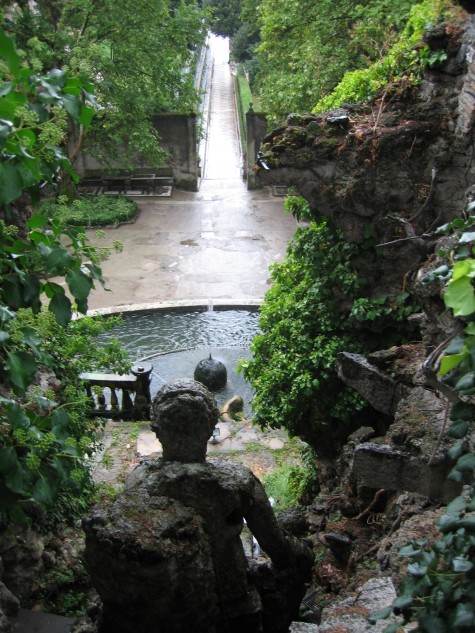 Lots of people own homes several stories high. I have likewise seen more than a few homes with two-story entrances. Then what? A landscape needs to address these features, and views. The beauty of the composition above lies in how it describes and emphasizes great depth, and space. In the foreground is a strong sculpture whose scale I suspect is much over life size. When my eyes go to what the figure in the sculpture must be looking at-the mid-ground fountain pool-its jet seems much smaller than the figure. Smaller in the midground is another way of saying further away. The terrace whose wet surface catches the eye next narrows to a walk. The wide entrance to the walk is clearly marked by tall walls; when the walk disappears from view, it appears much narrower. The end of the walk thus seems very far away. Where the walk leads-a mystery, from this perspective. This photograph is a rectangular flat object-but what it pictures appears to have great depth.
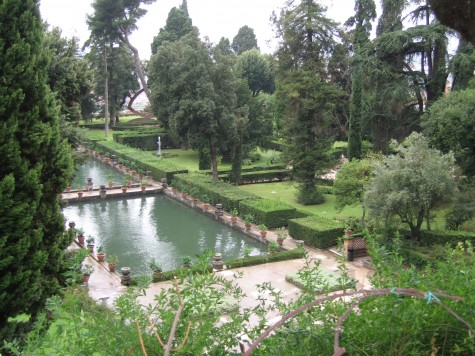 Every gardener knows any move gains importance when it is repeated. Though probably not accurately, I count 42 pots in this photograph. They make much of those rectangles of water, as do the yews in repetition. The shapes of those yews and lawn echo the shapes of the water. Far in the distance at ground level, a glimpse of that shade of blue that best says “I am far away”. That blue dwarf spruce you are thinking of might be at its visual best as far from your view as possible-rather than close up.
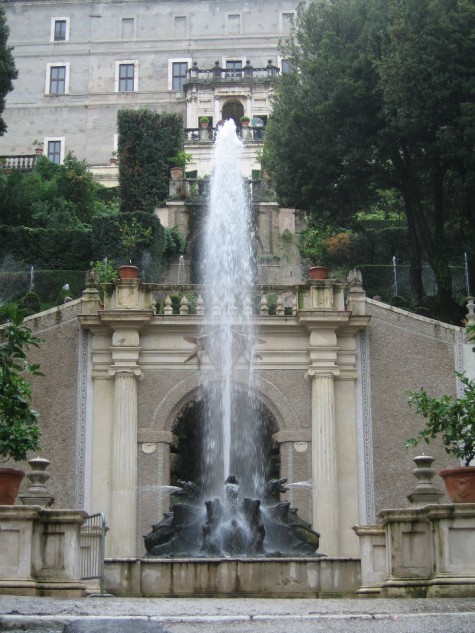 The scale and the height of this fountain jet is right, given the height and scale of the villa. My fountain jets at home will go fifteen feet in the air, should I feel like some big waterworks are in order. Given the size of my house and garden, that fifteen feet reads on the same order as this fountain, just at a different scale.
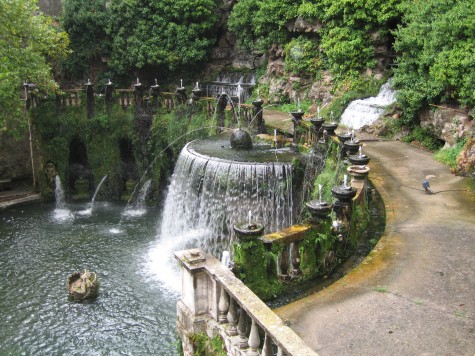 Everything in the architecture, the surfaces and the plantings are in support of this cascading water. There is no visual confusion aboout what exactly is the star of the show. Though elaborate in execution, it is very simple in design. I am quite sure the natural land forms influenced the design as much as any other element. A semi-circular wall of espaliers might make a similar statement on a property with little elevation change.
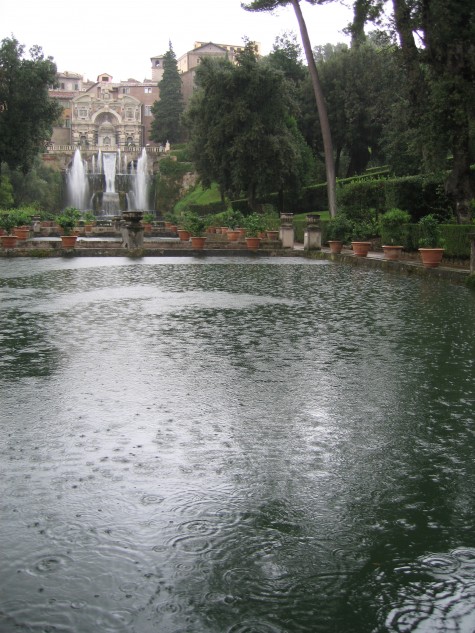 Looking back at the villa and its fountains from ground level, the pools seem immense, as they are close to your eye. The trees and sky are bigger than the villa; they keep it company, naturally. This property is in fact very large. It might be difficult to mask that, but it is a tribute to the designer here, Pirro Ligorio, that every aspect of his composition reinforces the depth and breadth of the space. Villa d’Este aside, it is possible to design such that no matter the size, any property can be visually spatial.
It is no wonder to me that gardeners seem to greatly enjoy a garden tour. Other people’s gardens-who knows how or what they might inspire.
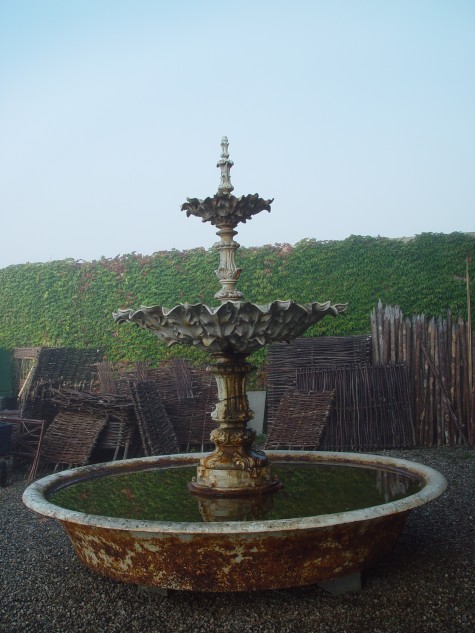 I am sure I own the most fabulous French antique fountain on American soil-take a look; do you not agree? I detailed some time ago the process by which this incredibly beautiful piece came to me-but it is not the subject of this post. As beautiful as it is, a fountain, any fountain, is a means by which to introduce and integrate water as a decorative element in the landscape. I do such injustice to use the word decorative; what water does for a landscape is give and sustain life. What water does for a gardener borders on the sublime.
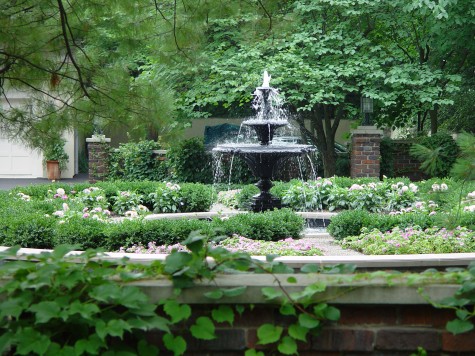 In my early years designing, I never went near any suggestion of a fountain, pond, pool, or lotus pot. I did believe anything of any importance in a garden sprang from the earth, and grew. Arranging for delightful water for a client was just over my head, and beyond my capability. It is the sorry truth that a lot of things I thought early on about landscape design proved to be provincial, ill-informed, and shallow. Thank heavens the normal course of events is to grow up into something. My age and history is a good thing. At some point I figured out that fountains were not the sole province of public parks and libraries; any home garden is all the better for water in some form. This English iron fountain I placed a few years ago-I never tire of the look of this water in motion, the peaceful sound of it.
 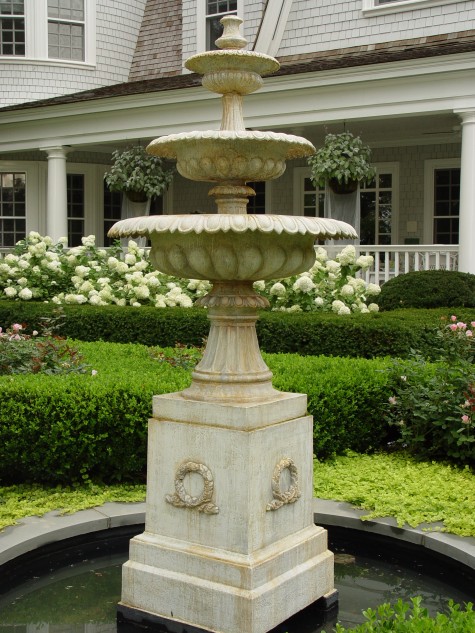 This very regal cast iron fountain is of American manufacture, mid 19th century. This part alone enchants me. Placing an American garden ornament of historical significance in an American garden was a good moment. It looks even better when the water is moving over its surface. Note the planting of creeping jenny around-water splash comes with the territory when water drops a long way. Plan for plants that like this regular shower when water is being pumped to great height.
 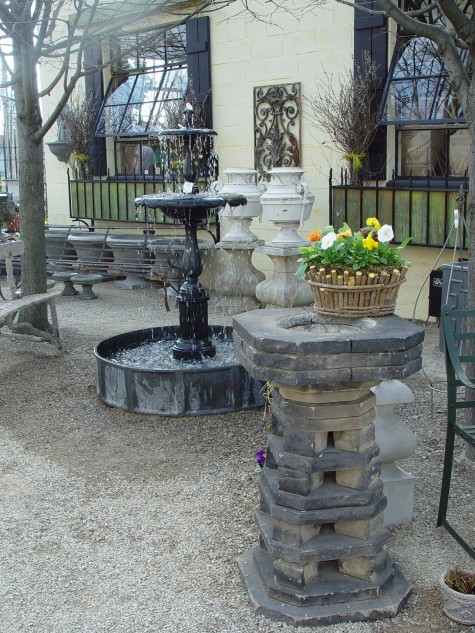 No matter any history, or construction issues, water beautifully representing in the air is available to any gardener. This small English iron version of a classical tiered fountain has a lead basin just 5 feet in diameter. This fountain is installation friendly; take it home, set it up, and plug it in. Three things are at issue in putting together a fountain. You need a means by which the water gets airborn. This could be a decorative piece like this one, any pot or sculpture which can be modified to convey water. A copper spout works fine. You need a pump of sufficient power, and the electricity to run that pump.
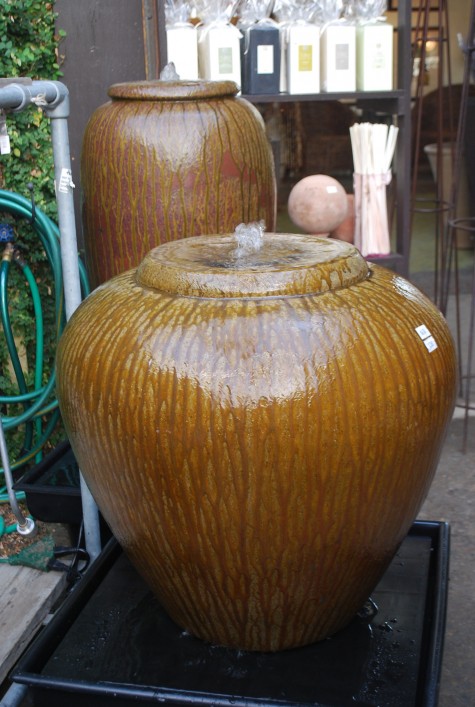 These gorgeous glazed ceramic jars have been outfitted by the manufacturer brilliantly-meaning, thoughtfully. The jar, a water reservoir , and a pump make it possible to take this complete water feature home, place it in a great spot, plug it in, and learn firsthand about what water in the air can do for a garden. The water moves so slowly that it cannot break the surface tension of the jar surface. No splash means you might consider bringing it indoors for the winter.
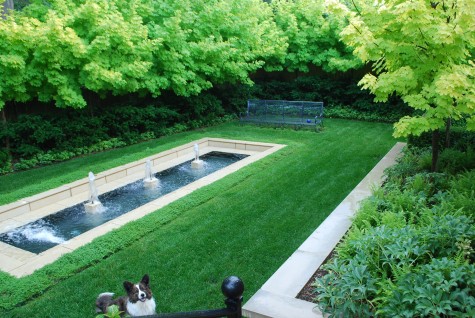 My 26 foot long by 4 foot wide fountain-a gift from my Mom. It so irritated her that I never took any time off work-she made an issue of this, when she was alive. What she left me enabled me to build this fountain. I hear the sound of it when I get out of my car at the end of the day. I get in it, to cool off, and scale back. I go and sit in its company every day. I am on vacation-at home. Some days I just look at all that watery motion from the deck. I can hear it when I get in bed. The action of the water in my garden-better than very good.
 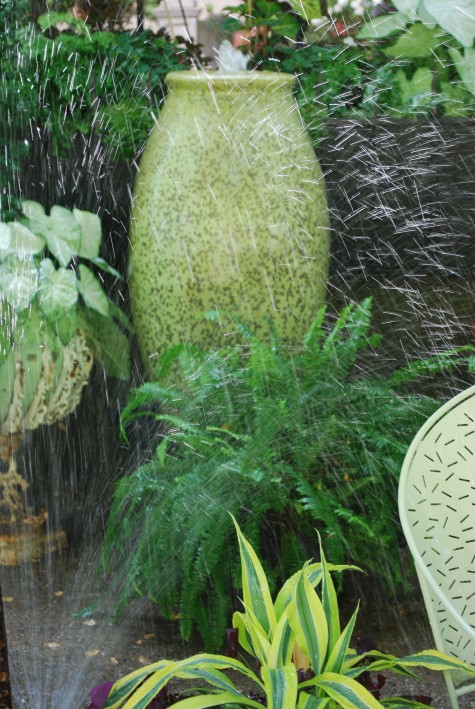 Water once meant no more than a good drink for my plants. From the looks of this, it should be easy to see how fountain water can make a garden a better place to be.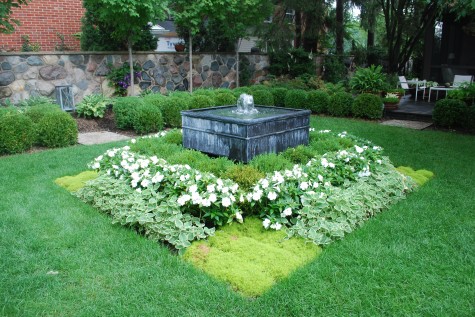
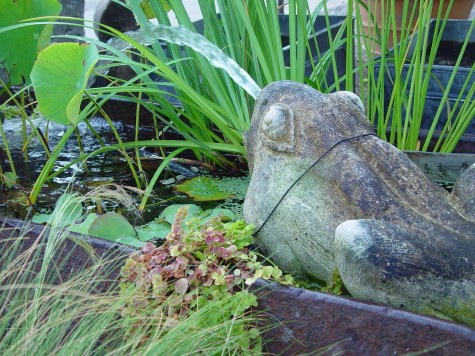
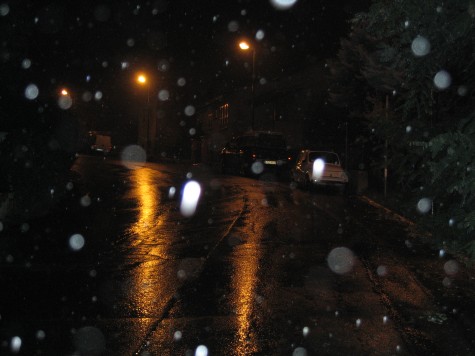 Black can be described by the absence of color, and the absence of light. Black objects absorb every spectrum of light, diametrically opposed to the reflective action of white. Black and white-simple, spare, and elegant. Black and light? Though our summer light lasts long into the evening, the night landscape is well worth some thought. A dark and rainy landscape can be visually challenging, and beautifully moody.
 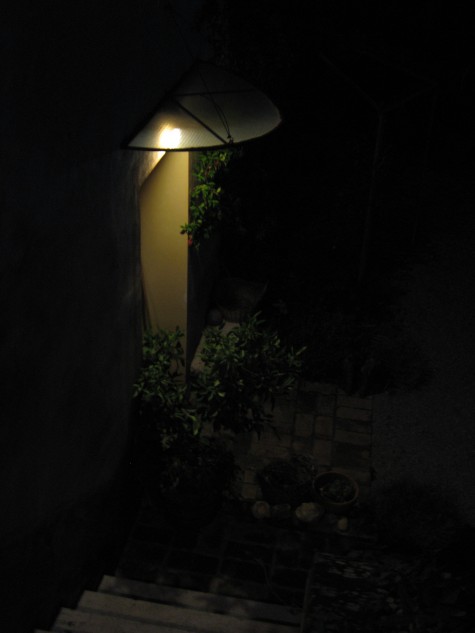 Black Baccara roses, Queen of the Night Tulips, and chocolate cosmos are not really black-they are dark versions of red or purple. Salix melanostachys, or black pussy willow, has branches that approach black. But true black in the landscape is about shadow-light and dark. The relationship of light and shadow in the landscape is a visual story that gets play every day, regardless of the season, or the time of day.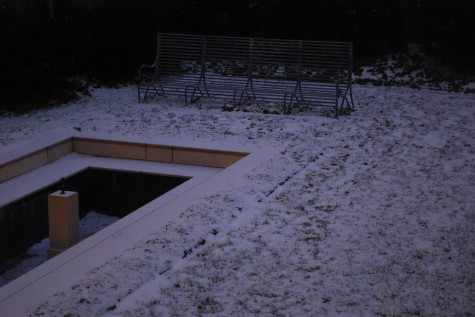
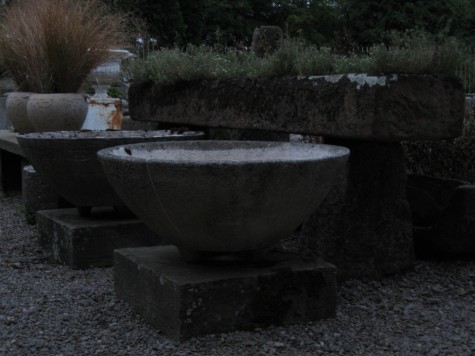 Low light reduces contrast, but none the less the white painted urn in this picture reads white, and the shadows cast by the stone cistern read black. Where am I going with this? Depending on the degree of shade, certain spots in a garden may also be described as voids. Contrasting something with nothing-this is part of composing. Like the silence after a thunderclap, black in a garden is a place for your eye to rest, and regroup.
 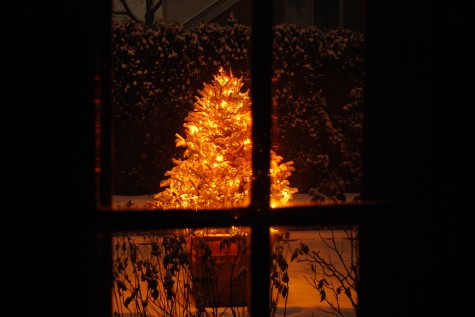 The only reason I am able to see anything of my side garden on a winter night is courtesy of the lights on this tree. Landscape lighting is easy to dislike. Rarely do I see it done in a subtle way; lots of times I see theatrical versions that might be fun on first glance, but tiresome over time. I like my theatre on stage, or my glitz and glam at a hotel where my visit is entertainingly brief. Thus I like strings of lights in the garden-lots in some places and a little in others-even after the holidays.
 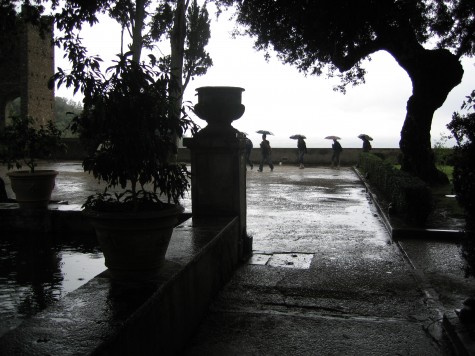 Any part of a landscape that is strongly backlit will throw the unlit side of every shape black. Both natural and man made forms in silhouette are striking. Composing and layering a space effectively can read in a very powerful way on a dark day. Though it sounds odd to say so, the sky is an important part of any landscape composition.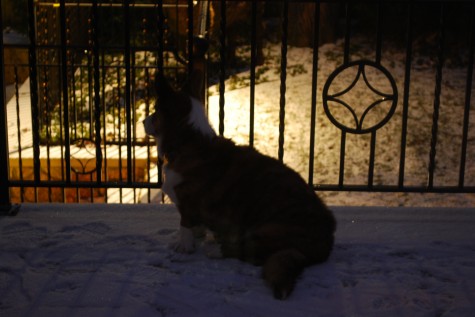
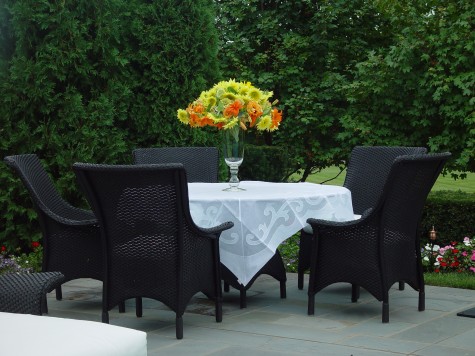 This black garden furniture is formally elegant. The lower shapes of the chairs read well against the light grey blue of the stone terrace. The tops of the chairs appear much more subtle against their dark green background. The interior leaves and needles of the trees actually appear much more black than the chairs to my eye. The texture of the embroidered white tablecloth is highlighted by the black table underneath.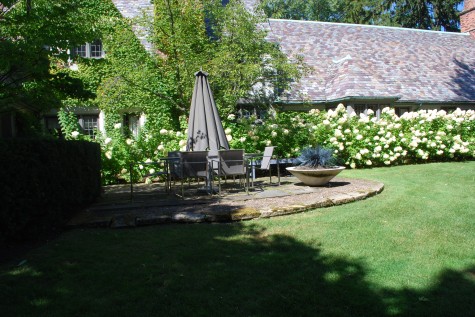
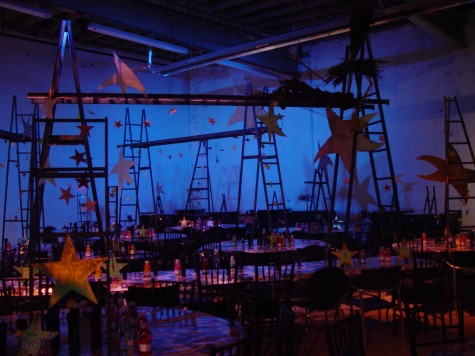
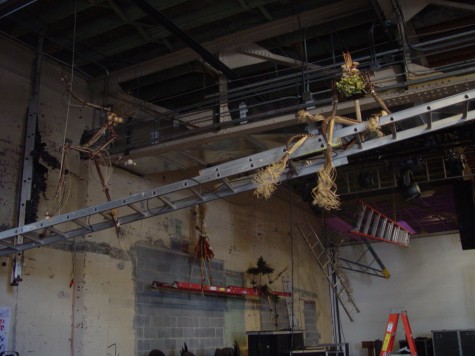 With the sculptures generated by the stick drawings of the kids for Autoglow came the idea to fill the event space with ladders. Why? These ladders symbolized for me the leg up a donation to the Children’s Center would provide to the kids they help, but also the process by which all of us climb into our lives, and get to be contributing members of our community-one step up, at a time. In the dance floor/foyer I hung from the ceiling what seemed like an endless number of ladders- borrowed from everyone I knew.
 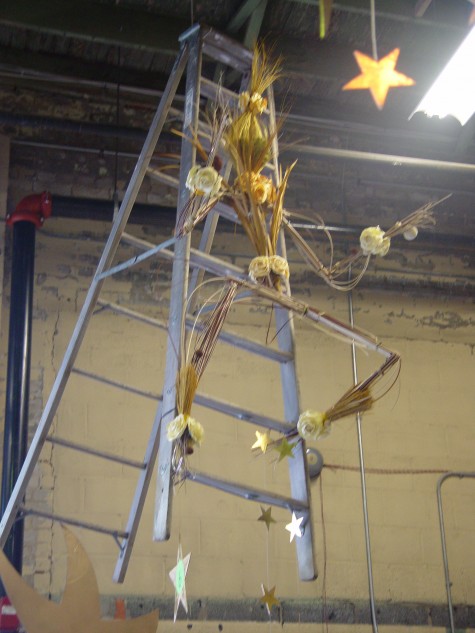 I have had a leg up from others plenty of times, just like most people. I could have never done without this. All any kid needs is a leg up from a set of parents, a greater family, a good school and a focused community and a fair world. When any part of this goes awry, all of us who are able, need to step in.
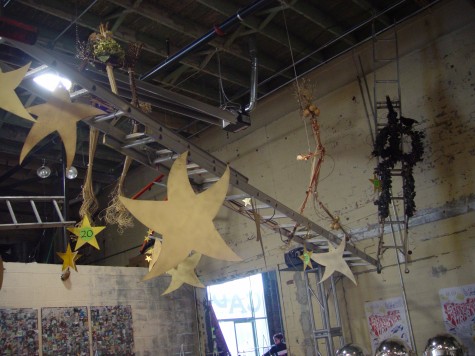 We cut what seemed like a zillion stars from thin masonite, and painted them gold. Gold stars-this a simple visual representation of the achievement of my babyhood. I still remember the gold stars I got-don’t you? My figures were happily floating in the airspace-as any kid should be.
 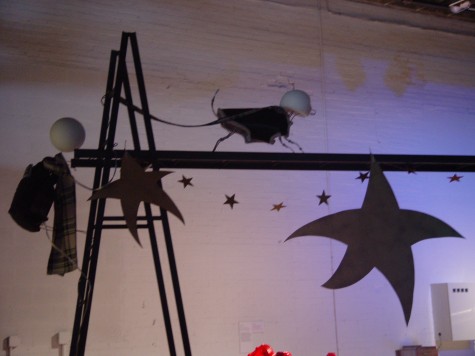 I did all of the figures, save one. The interior designer Charles Dunlap donated a figure, walking a dog, on his own. His dog went up the ladder and was already crossing over to a new place-his version of an enabled child not far behind.
 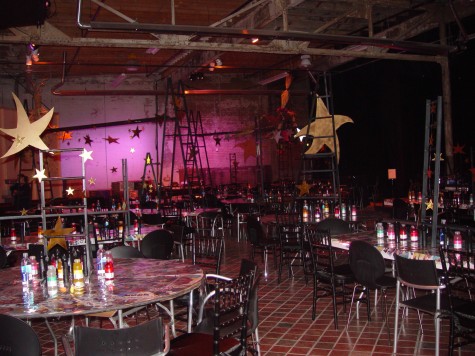 The tables were not fancy; the not fancy chairs were every version of black we could find. The tablecloths-collages of photographs of kids printed on giant sheets of copy paper, overlaid with clear acetate. The centerpieces? Flashlights-shine the light wherever you can. Bottled water energy drinks-water, essential to life. Some of the steel ladders we welded up crossed over from one table to another-fun.
 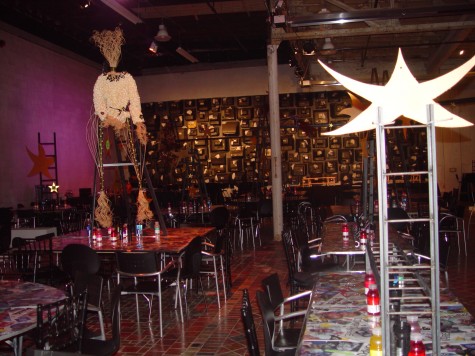 Its important with any fundraising event that the message be simple. There are those in need. There are those who can help. Helping others is the best possible time anyone could hope for. My job is to put together a visual telegram from those in need to those who can help. Let some visual sparkle do the rest.
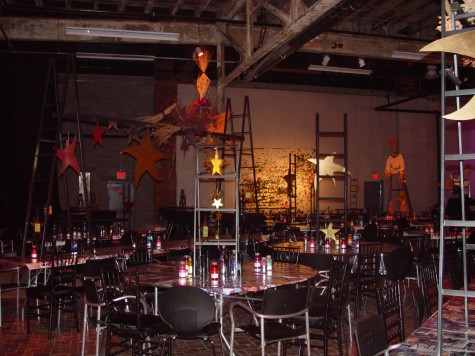 The few moments before an event designed to raise money for a cause begins- I treasure. No matter what works or falls short, in the end, everything is about the sincere energy of the effort. The lighting people, the catering people, the entertainment people, the Children’s Center staff-so many people came together on this day, to a worthy end. I am lucky to know and have worked with all of them.
 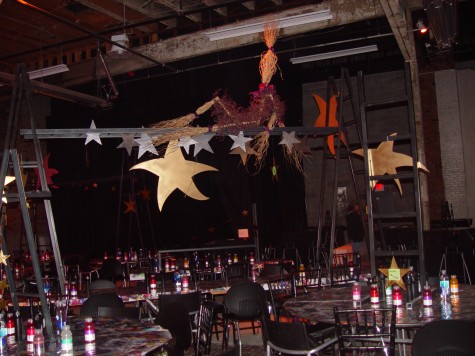 Those figures whose creation delighted me so much were not the star of this event. They just took their place along with the efforts of a lot of other very creative and energetic people. Once the room filled with people, there was a party going on. I am a member of a big group whose names and particulars may never be known-fine. We were just all hoping for the best, for the kids.