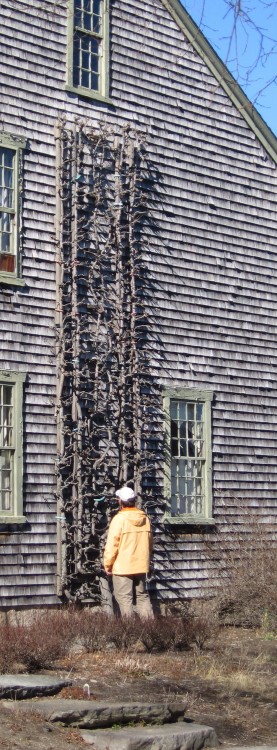
 Would not the silhouette of this tree, trained and grown parallel to a wall, get your attention? Even out of leaf, it is striking. You are looking at an espalier- a tree trained to grow in only two dimensions. In the late 1600’s, Fr. Legendre, a monk living in Hanonville France was in charge of his monastery’s garden. His fruit trees were bedevilled by late frosts that killed the fruiting buds. Noticing that the fruit trees planted closest to the monastery walls sustained the least damage, he began planting his fruit trees as close to the walls as possible. As wall space was limited, he began shearing his trees, so as to provide room for all the varieties he wanted to grow. Amazingly, the drastically sheared trees produced heavier yields than unpruned trees in the field. His book, Palmette Legendre, was published shortly before his death in 1684. This book is the earliest known text regarding the science of growing espaliers. These trees, pruned flat, spare, and parallel to a wall, had fewer cultural problems, took up little space, and were beautiful to boot.
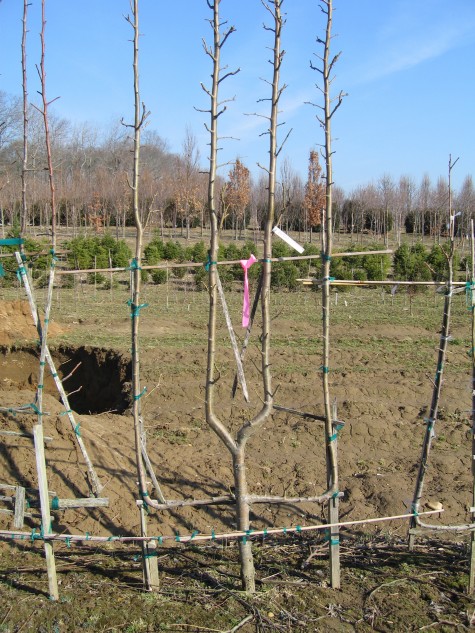 Espaliered fruit trees look like no naturally growing tree . Though no tree expert would advise this kind of planting, pruning and shaping, Father Legendre’s ideas practices enabled ample fruit for everyone living at his monastery. Sometimes the hand of man comes to good end in the environment. This very early spring picture shows an espaliered tree, grown in the candelabra shape. It would be beautiful, grown on a blank wall-never mind the fruit. Training trees to grow in two dimensions became a gardening art form-even for those who had no need to feed many from a very small plot of land.
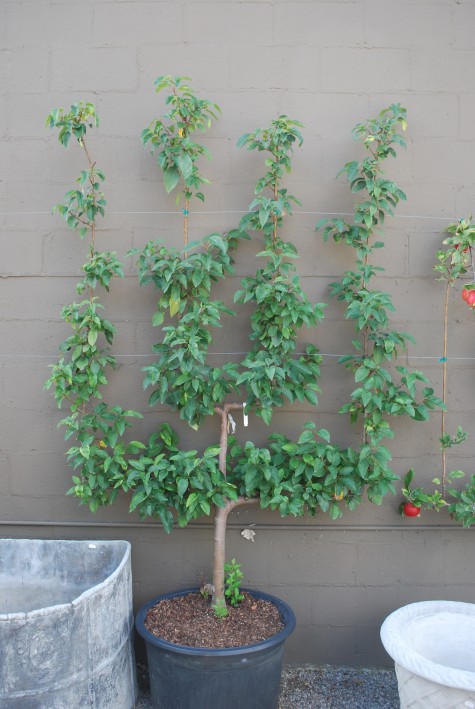 I make a special effort to offer exceptional espaliered trees to my clients. My grower of choice is of French descent, and his espaliers take my breath away. I drive a day’s length to see and review his espaliers. He grows in the traditional way, and only has a few trees to offer for sale every year. He sells no trees that are not at least seven years old; his big trees are much older. He pots his trees, and then sinks the pots in the ground. Note that the trunk of this tree is positioned to the back of its pots-his trees are easy to plant close to a wall.
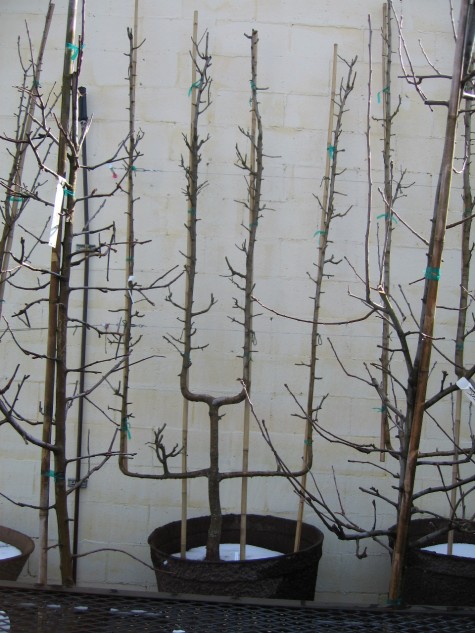 Their winter appearance is architectural. The American landscape is fundamentally based on big spaces; we have eight lane highways and driveways 22 feet wide. This makes this particular dose of French editing all the more refreshing. People who come to my store are invariably interested in their history and forms.
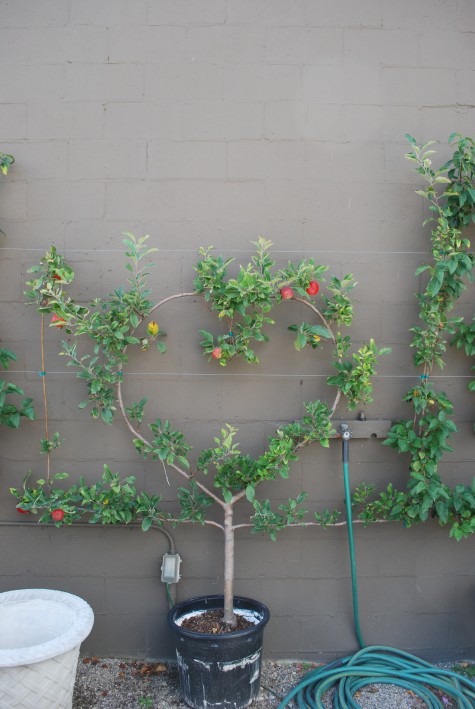 My grower trains some of his espaliers in a form not existing in the classical literature. This framed heart is entirely his invention; how I love this. It has a distinctly American feeling; he has taken his classical training, and gone beyond.
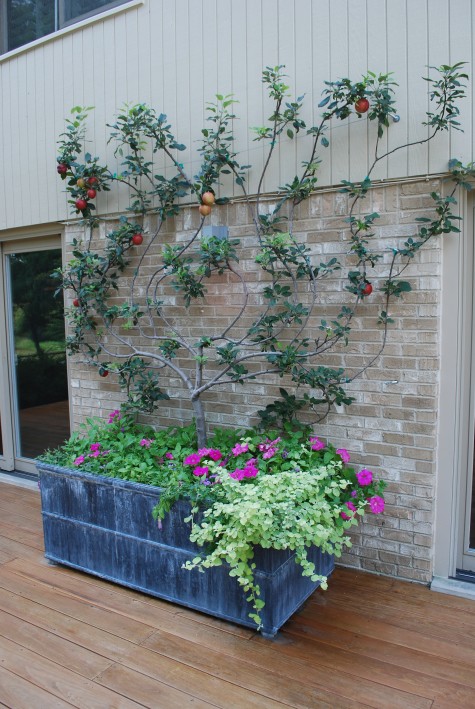 This informal heart espalier enchanted one of my clients. I call it the wild at heart espalier. As she had no room in the ground, we built her a box for her deck, insulated to slow the freeze, and delay the spring thaw; this apple tree is thriving. We heap up the compost after the ground freezes, and we uncover it in the spring; so far, so good.
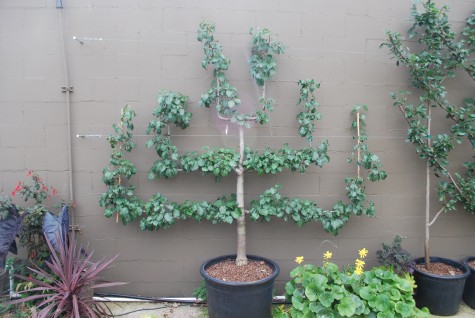 Not all espaliers are fruit trees. The art of training espaliered trees has extended to many trees tolerant of this treatment. This Bradford pear makes a big statement as an espalier. Any lonely wall would be all the happier for this tree planted on it.
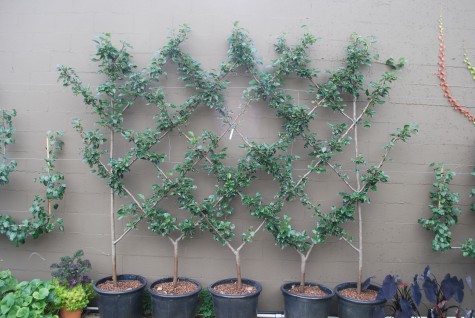 This series of trees is known as a Belgian Fence. You can see that individual trees were topped low to the ground as whips, encouraging branching in both directions. The branches of these trees are trained in a diamond pattern; what a beautiful living ornament for a long wall, or a free standing fence.
These shaggy Donald Wyman crabapple espaliers are in need of a trim to reveal their form. But no one could dispute how lustily they are growing. A wall, and an espalier make good companions. Espaliers-of course they are on my list of favorite plants.
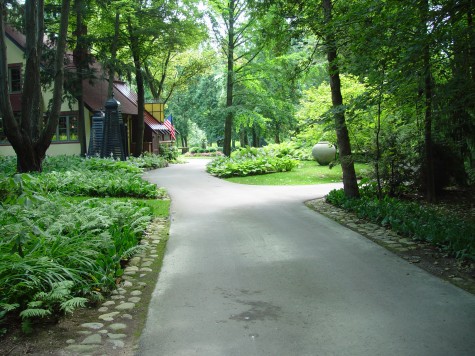 I started to work on this lovely property in 1998. Set in a forest of old trees, the house and landscape had that quiet woodland up-north feeling. Everything I designed for this client I kept in keeping with that feeling; few properties come with an aura as strong as this one did. A case in point; this driveway was laid out with the house in the 1920’s-and was no longer wide enough for modern vehicles. My solution? Edge the drive in small round native to Michigan granite rocks, and let the moss go to work on them. Anyone over the edge with their SUV-no harm. Do no harm-this was my organizing metaphor.
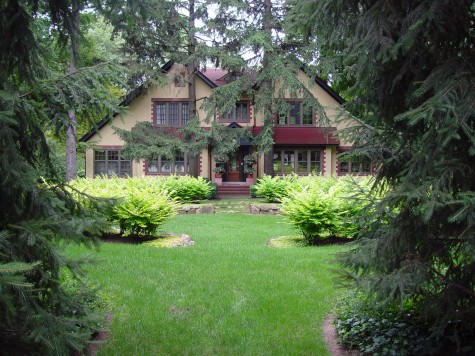 I like formal spaces in front yards, as I like a public presentation that looks good every day. All of us are very busy people-I like a landscape that can wait. But boxwood or taxus hedging seemed alien to the feel of this space. The golden vacary privet-an old plant not much in fashion since its hey day in the 50’s, seemed perfect. The chartreuse color would light up the shade. This very informal material used in a formal way, was a nod to the period and feeling of the vintage house, and its landscape.
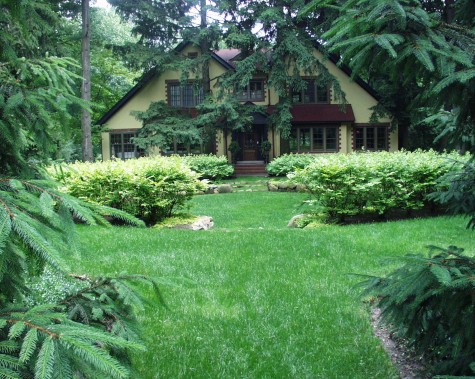 This picture is taken from the road. Old weeping Norway spruce were planted very close and gracefully to the foundation of the house. I repeated this woodland feeling at the road-with a break, a view. A brief view.
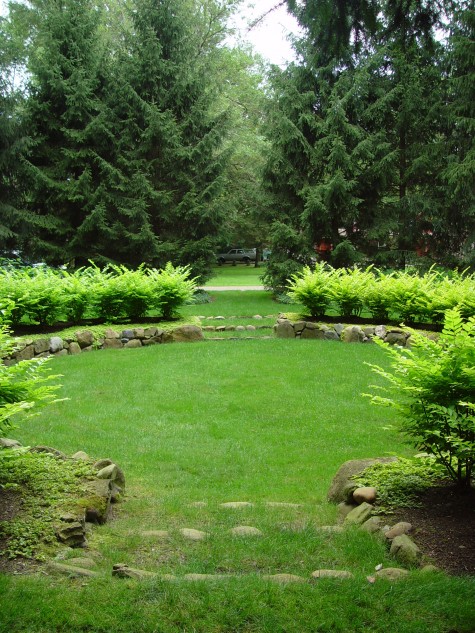 The gold vicary described the shape of a circular sunken garden. What I love the most about the native Michigan woods are how quiet they are; no noise which is technological in origin. No radio, no cars, no jet skis, no boats-just quiet. The sound of birds, wind, footsteps-these sounds are native, natural, and good. Sinking a garden even a little intensifies the quiet. Two simple steps of grass with round rock risers-a casual, northern Michigan detail.
 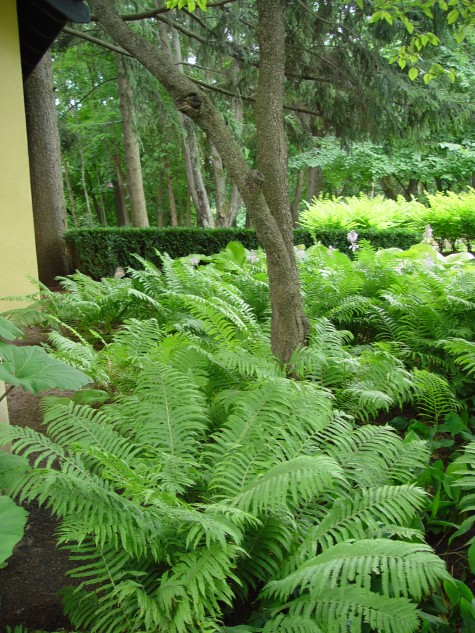 And the ferns? Everywhere. Ostrich ferns as a groundcover-this is a beautiful look. The texture, scale and informality is easy on the eyes, and pleasing. Drifts of ferns really interest me as a designer. They are bold and sculptural in big masses. But they speak directly to the primeval forest; the look of a stand of ferns wrings all the tension out of me.
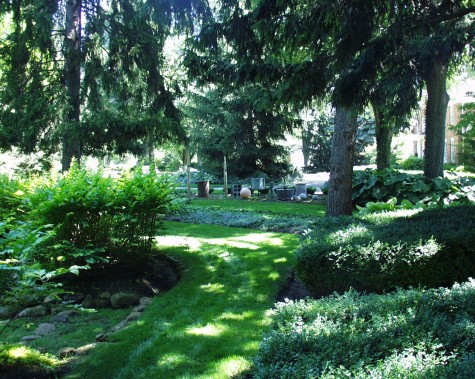 No doubt this was a shady, mossy, quiet, not perfect, natural, woodland landscape. A grouping of funky containers and sculptures, set in groundcover on the far east perimeter, was a nod to the point of view of the client. I love a collection of objects that band together to make a sculpture.
 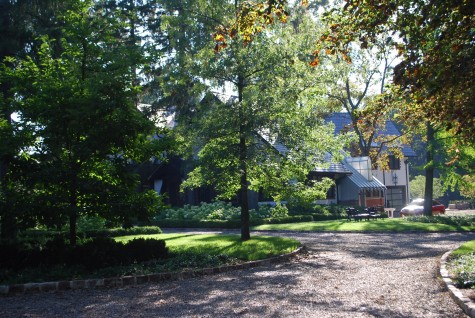 I wrote last Sunday in my weekly opinion post that a ride by this treasured project of mine revealed that the client has ripped most everything out, and installed a new landscape. I felt the shock that anyone feels when they come face to face with something so totally unexpected that blacking out seems an appropriate response. It took me two days to recover, but recover I did.
 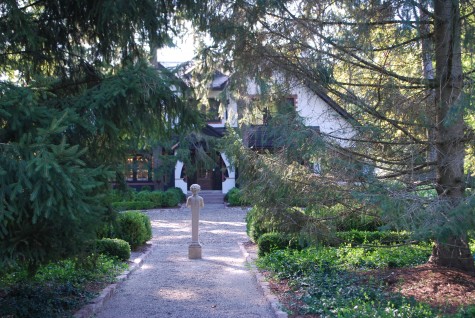 My clients have their own lives, and their own idea of beauty. They hire me-I am not a favorite aunt, or a Mom, or a daughter. Their lives change-I am not privy to most of that. I may be close beyond close for the duration of the project, but I am usually their fifth business. At my age, I know who I am. I appreciate that the lives of my clients are not subject to my review. I furthermore understand that my ownership of a project is while I am making it. What happens after-I am not responsible, nor am I honored. This is as it should be.
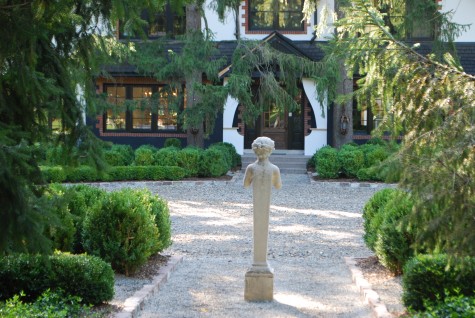 It is not my idea to critique the new landscape-that is not the point of this post. I am not interested in being a critic. I am interested in writing about my life as a designer. It is very tough to see years of work erased-no one cozies up to this. Least of all me. I am interested in history, and continuity. But I do not always get my way.
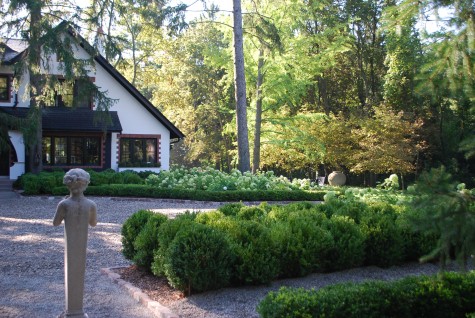 No matter how this landscape looks now, I am not unhappy about how I approached it. I have no second thoughts. I will sleep sound tonight.
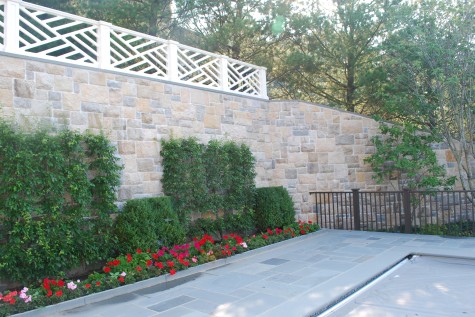
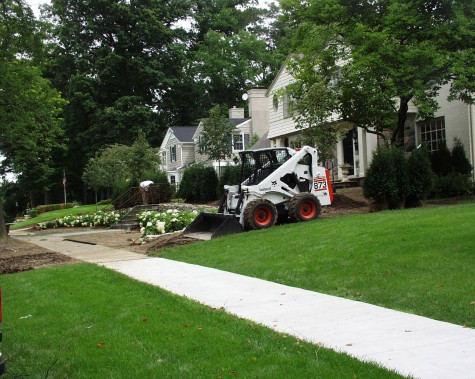 Yesterday I discussed all the grading and stonework that was necessary for this project; what a relief it was to finally be putting plants in the ground! The neighborhood association belatedly decided this wall needed to be screened by plants. They apparently did not permit walls in front yards. So I planted a slew of Annabelle hydrangeas; my clients have a great view of the wall in the winter.
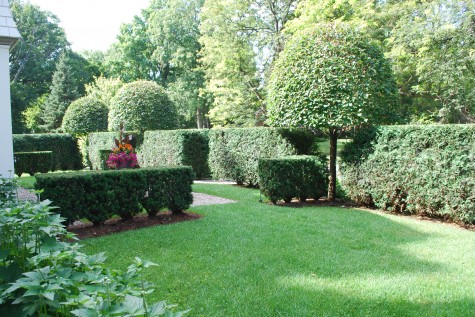
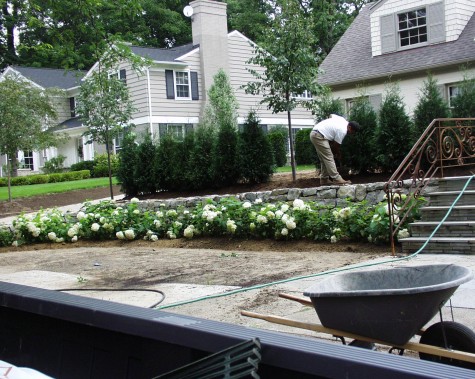 The upper level we did screen from the street. Houses that sit high afford little in the way of privacy. I interspersed five little leaf lindens in a hedgerow of techny arborvitae. The techny’s are dense, and slow growing. They also tolerate some shade, although the plan was to keep the lindens pruned.
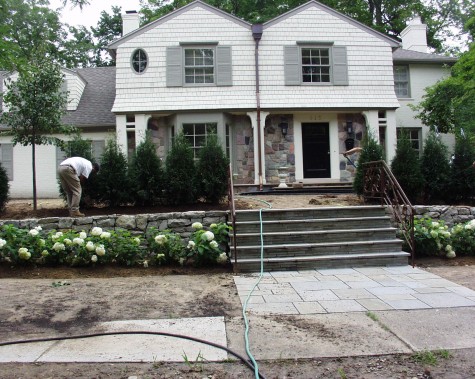 Lindens belong to that group of trees that do not mind shaping. I have seen old ones not much taller than 15 feet, with densely foliated heads. My lindens at my store are boxed; they have been pruned into rectangular shapes. They are a hedge high above ground. They greatly soften the appearance of the building-originally a machine shop built in the 1940’s. These lindens I wanted to keep in scale with the house.
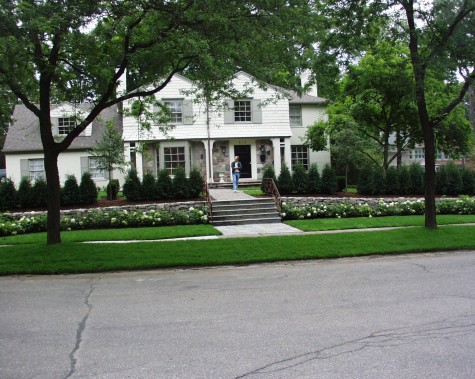 The house seems to sit lower than it once did. Though the front door of the house is off center, the landscape balances the space. The granite walled portion of the facade reads as a centerpiece, of which the front door is a part. The landscape making much of the bluestone staircase centers the view.
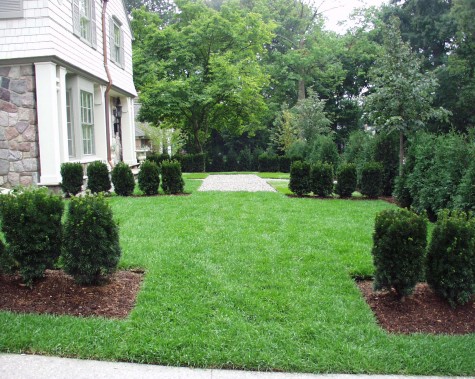 There were two issues driving the design of the upper level. How could the sidewalk gracefully turn towards the front door? The walk from the street now empties into a large rectangle of gravel; its color and size makes it read as the dominant element. The taxus viridis, naturally a very columnar yew, is planted in rows perpendicular to the house. This distracts the eye from the fact that the property in the background is dropping downhill. The techny arborvitae at the end are actually much taller than the yews-but everything reads about the same height. In time, the yews could be topped level with the horizon, thus minimizing the slope down to the west.
 Eight years later, the landscape has begun to grow in. This front courtyard is private, and simple.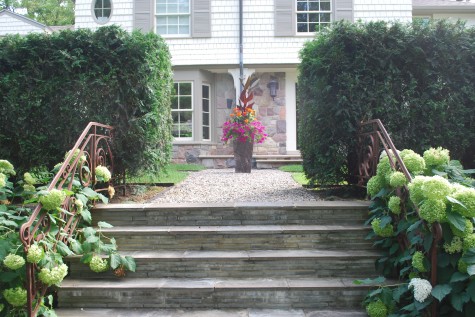
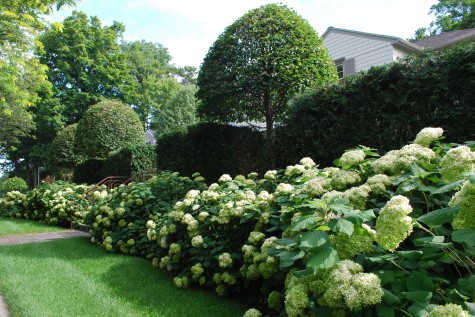
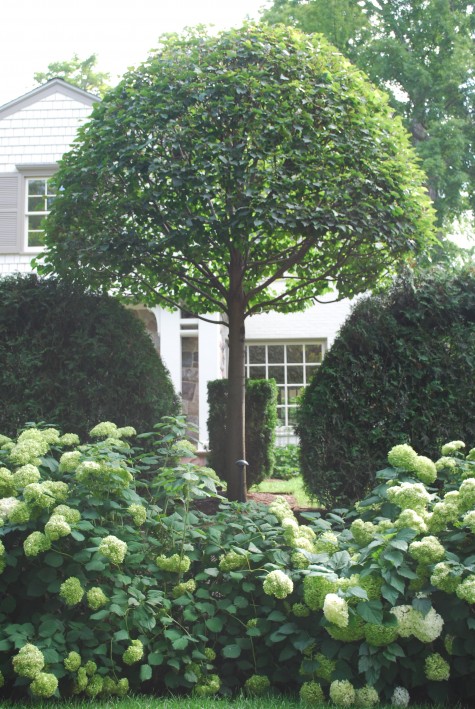
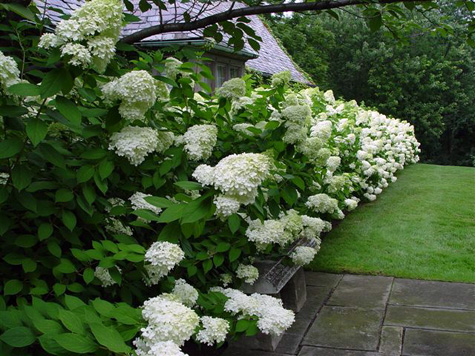
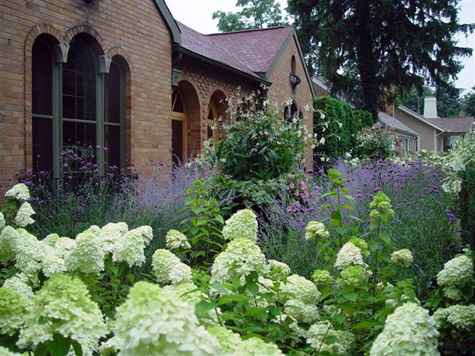 Hydrangea Paniculata “Limelight” is a favorite shrub of mine,, as well it should be. It is extremely hardy (some say zone 3), and not particularly fussy about soil, or water. It is a robust, vigorous and willing grower. Add to this a long and spectacular season of bloom-this plant earns its keep.
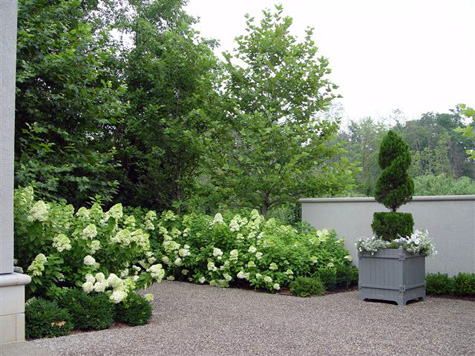 The lime-white flowers emerge late in July for me. They look crisp and fresh at a time of the gardening year that in fact can be blazing hot and miserable. They have great dignity and presence in a formal garden, or they make a graceful backdrop for more delicate and late blooming perennials such as Russian Sage, bee balms, and hyssop, in more informal gardens.
 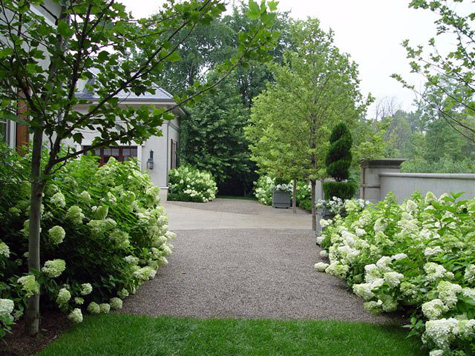 When first coming into bloom, the plant and flowers are many shades of green, and white. Few shrubs provide so much interest. The flowers mature white, and bloom for an incredibly long time. Towards the end of their blooming period, they go pink-green, and rose pink; this stage is beautiful too. They make great cut flowers, and they dry beautifully. They clearly are at home in this formal landscape spilling onto the gravel as they are in a cottage style garden.
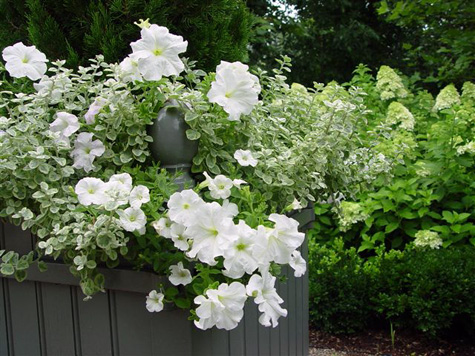 Their habit makes them easy to use in a formal garden, as well as an informal one. They stand up on their own; this habit of growth I really appreciate, as I am not fond of staking plants. Their habit has a lot to do with their genes; hydrangea paniculata has a naturally upright habit. I prune to top branches in early spring shorter that the side branches-ala a shag haircut. This permits light to reach the lower branches, and promotes blooms from top to bottom. Sometimes I prune very hard, if I am interested in keeping them smaller than their natural inclination to grow 6′-8′ tall. I have on occasion pruned them as short as 14″ off the ground, without any loss of bloom. I have read about a new paniculata variety called “White Diamonds”, which is reputed to only grow to 4 feet tall, but I have not seen it.
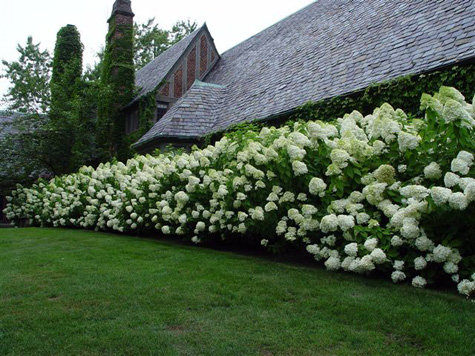
  They make a magnificent hedge when left to their own devices. This client was interested in screening close to the house; this is a very showy solution.
  They are willing bloomers with this eastern exposure, but I have planted them in full sun with just as good results. I do try to plant them in soil with a good percentage of organic material, as they do like even moisture. I do not always site plants perfectly-that’s a normal thing, to have to move things around until they have exactly what they want. But I have seen very few limelights performing poorly, even though I see them in lots of different situations.
 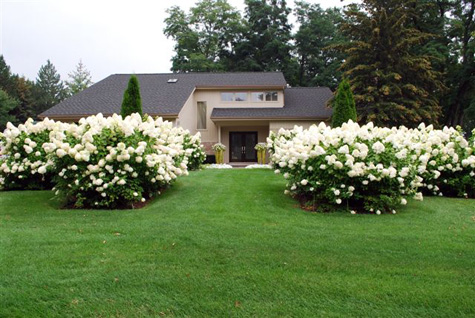 Luscious, aren’t they??