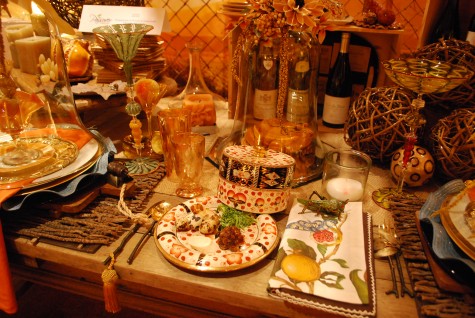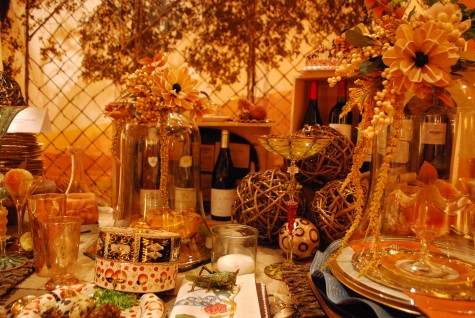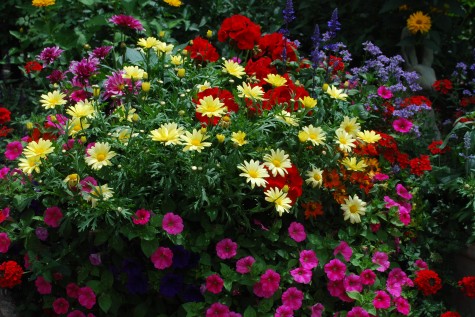
There was a time when I had no affection or interest in yellow. This was so many years ago I cannot remember the reasons why. When I came to my gardening senses, I realized that yellow is a good symbol for sunny. The color reads clearly from a distance. And it is the first cousin of the best-chartreuse. I live in a state whose grey days are many. Sunny colored flowers are so welcome, and mix amiably with other colors. Yellow can leaven the visual mass of dark flowers. I like arrangements that are airy-physically airy, as in varying heights. And visually airy.
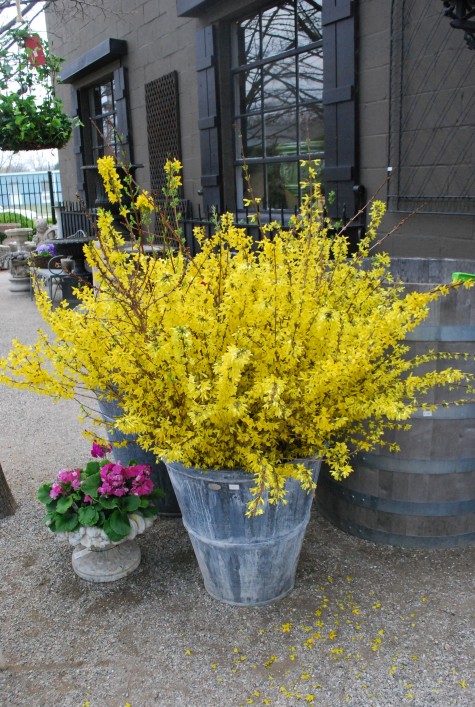
The much discussed, and usually maligned forsythia-I love the coming of its sunny yellow flowers. Do I need this shrub to satisfy everything I require from a great shrub? No. But I am grateful for its forthright announcement that spring is in progress. The masses of forsythia on Forsythia Hill at Dunbarton Oaks in the spring-stunning. Masses of yellow blooms look good to me on a spring day. That yellow is a profusely but simply worded hello-it is spring.
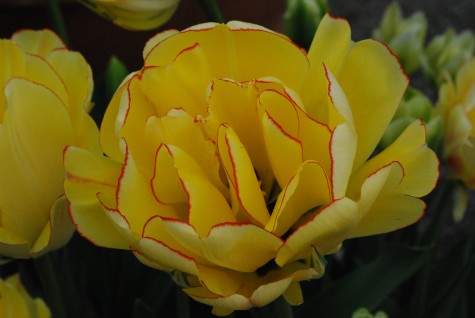
This tulip-another idea about spring yellow altogether. This double Darwin tulip, Akebono, was new to me last year. I was not aware there were any double Darwins. The shape is very unusual. The tips of the petals are berry red; the anthers and bases of the petals jet black. This yellow spring flower is as elegant as it is frilly. The flowers are very large. This so sunny tulip would be the inspiration for my spring garden at the shop.
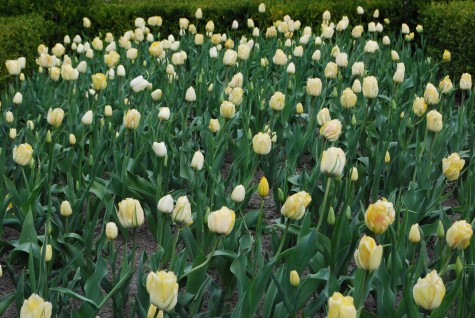
Inspiration for a garden can come from a number of places. A color, a season, a place remembered, a shape. Inspiration does not necessarily imply revelation-an inspiration can be a little thing. That particular tulip enchanted me-Enchantment is a good town in which to build a home. I chose 3 other tulips to accompany the Akebono tulips. A cream yellow, a clear medium yellow, and an intense yellow. They are all late tulips-only the Akebono are in bloom now.
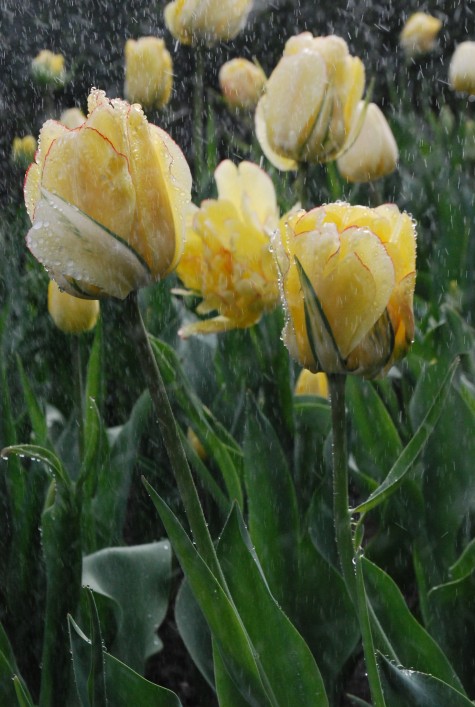
Last night we watered the tulips thoroughly with a fine spray. The forecasted temperature overnight-28. Well watered soil helps repel frost-as does late overhead irrigation. Though it may seem to be the wrong thing to do, water that freezes releases heat. The frozen water actually protects the petals themselves from a hard freeze. Tulips close up at night-sensible spring flowers, these. The Akebono tulips took the shower in stride.
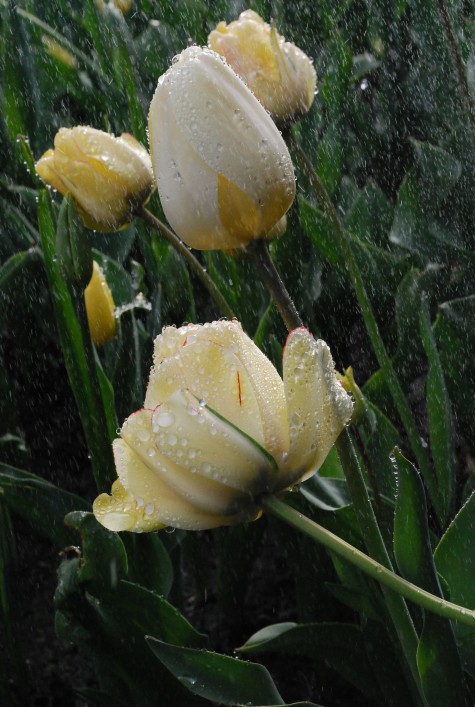
The tulip flowers have managed to survive a pair of extremely cold nights. Warmer days and nights will bring on the other yellow tulips
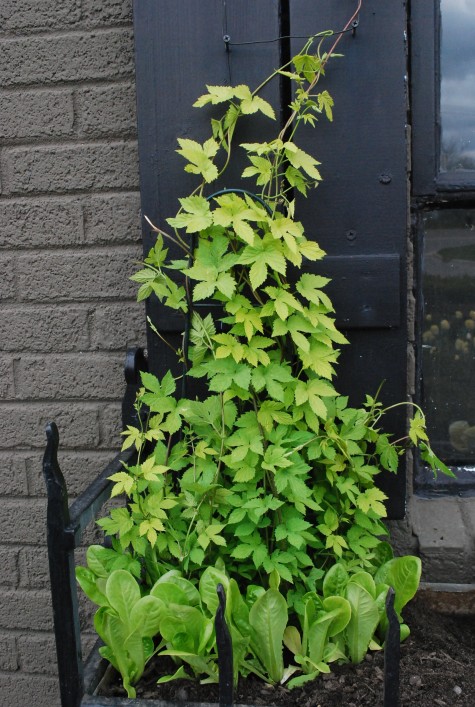
What to put in the window boxes to celebrate that inspiring tulip? Chartreuse is a very close relative to yellow, and it is everywhere in the spring. The maple flowers-chartreuse. The new growth on euonymus, boxwood, taxus, privet-chartreuse. Need I say more? In the corners of the boxes, we ran support lines up the shutters, and planted a chartreuse leaved hops. At the base-lettuce. I could not tell you the variety, but I could talk all day long about the color.
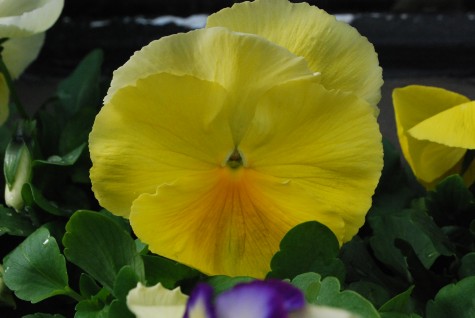
This clear lemon yellow pansy is as dramatic as the Akebono tulips, but on a much smaller scale. Spring container plants tend to be diminutive and delicate-these flowers are giants in a world populated by violas, annual phlox, violets, hepatica, forget me nots, and trout lilies. Pansies do have faces-smiling faces. What gardener would refuse to smile back. (Thanks MS, for this observation-you are so right!)
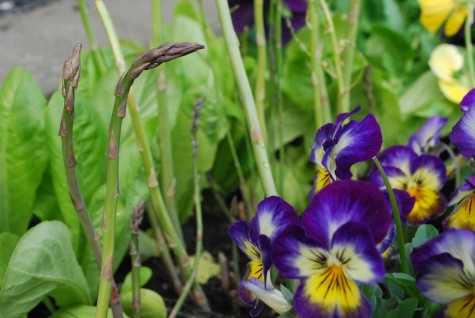
In the center of my window boxes, a pair of 2 gallon asparagus plants. The new shoots speak to spring. I have always had an interest in the relationship between agriculture and ornamental horticulture. I think most landscapes have an important relationshiop with agriculture that requires addressing. I cannot really explain this, but landscapes that arbitraily sever any connection with that history seen overwrought, self important, and lifeless. I think my attachment to European gardens has so much to do with how the food and the flowers commingle in practical ways, and romantic ways- to make a good life.
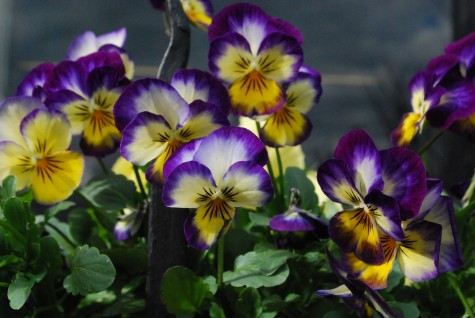
My good life is powered right now by the spring flowers. Some annual, some perennial. Some showy, some sturdy. These whiskered picotee violas have no problem celebrating, and representing the hubbub that is spring.
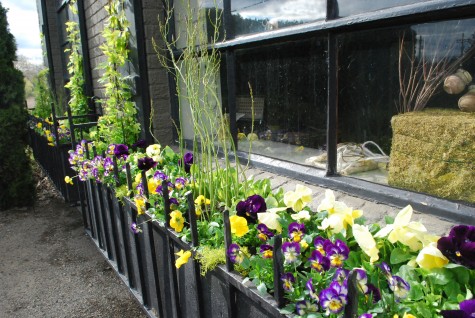
My window boxes need some time, and some warm weather to grow in, and grow up. What a pleasure- to at long last have my hands in the dirt.