



Deborah Silver is an accomplished and experienced landscape and garden designer whose firm first opened its doors in 1986.
 Just the words perennial border are enough to evoke visions of classical English gardens-breathtaking in width, and astonishing in length. Lavish. Believe me, if I could, I would have one, or five or twenty perennial borders each the size of a landing strip. Big enough to grow stately stands of every perennial I took a fancy to. There would be room for everything, from alchemilla to verbascum; I would winter giant tubs of Zantedeschia Aethiopica in number 6 loggia. I would grow peonies like crops. I would enlarge every and any border, on the slightest whim. I would have acres in meadow studded with fruit trees, and a wildflower garden the size of a football field. I would have a giant barn for tools, and a lunchroom that could comfortably seat the fifty gardeners I would need to have help me maintain it all. But my reality is much more about small urban gardens; these perennial gardens ask for some solid dreaming attended by careful editing.
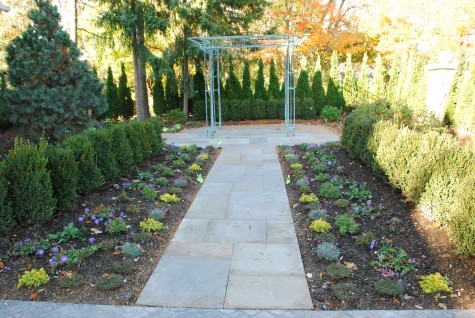
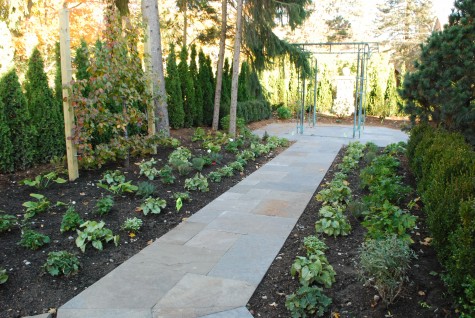 This very small L-shaped garden will very much have the feeling of a large garden, as big percentage of the square footage of the yard is devoted to perennials. The house has something of a feel of a cottage, so though the planting is regular, the plant varieties are placed in casually determined numbers. Towards a good, but not fixed, beat. The house is a very beautiful blue grey color; my first editing step was to consider color. The major tree in the yard-pinus flexilis “Vanderwolf’s”; the needles are distinctly blue. An underplanting of hosta krossa regal is a contrast in texture with much the same color. A blue hybrid of Panicum Virgatum will back up and loosen up the Carefree Beauty roses. The intersection of the bluestone walk is marked by a terrace, and a copper pergola blue with age. The blues rule here.
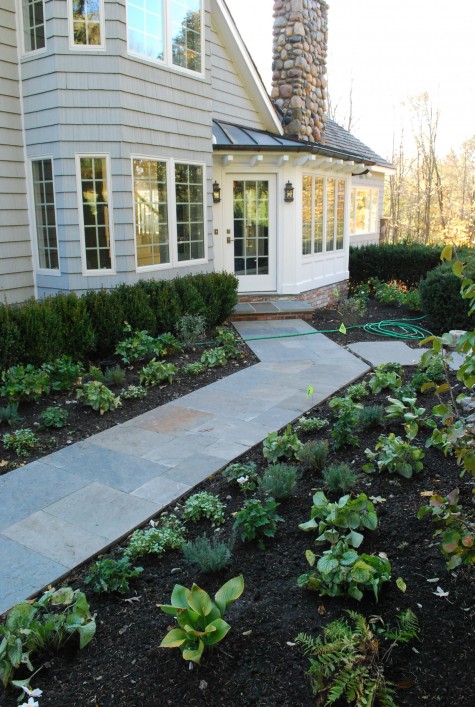 The west border is frosty in color; Jack Frost brunnera, Lamium white Nancy, Japanese painted ferns, white Japanese anemone; I threw in a few flax and Salvia May night in the sunniest and driest spots. This border may not be 10 feet deep, but relative to the overall space, the borders are generously configured.
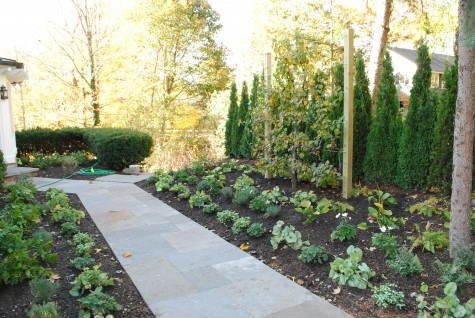 The star of the west border-a Bradford pear trained as a espalier. It is an old plant, but the branches are not yet sturdy enough to maintain their shape without a form. The posts will be stained the same color as the house. Providing privacy in the yard is the arborvitae “DeGroot’s Spire”. The small and fine texture of the needles is appropriate for a small space. Once they establish, I will prune off the spire part. This arborvitae takes well to a geometric pruning. I would like to see them kept at 10 feet with a flat face-a green wall.
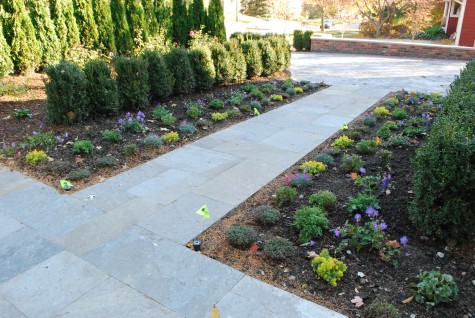
The north walk off the drive is home to two generously wide perennial borders, enclosed by a tall hedge of Green Mountain boxwood. These borders feature Salvia May Night, a dwarf monarda and geranium Rozelle; the remaining space is given to a mix of angelina, dianthus and thyme. Wide and low, this border will feature the ground plane, and make the space look spacious. On the far side of the drive, limelight hydrangeas and Venus dogwoods will make the garden entirely private from the neighboring house.
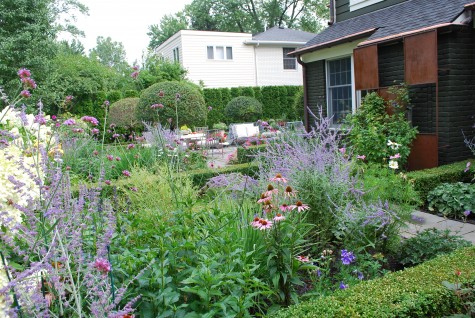 Perennial borders occupy a lot of space at maturity. A new garden with tall perennials is guaranteed to look sparsely planted the first year, and stuffed the third year. That big and wild look can warm up a small space like nothing else can. I always find someplace to plant a few verbena bonariensis-so the big garden looks airy, and not heavy.
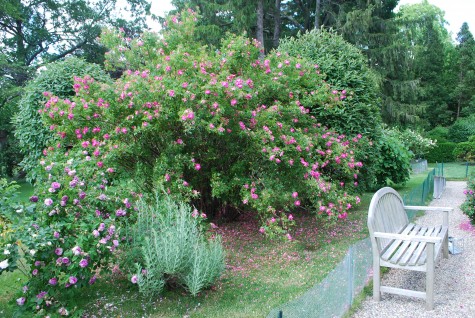
When your John Cabot rose gets to this age, changes have to be made. I planted this rose 20 years ago; this perennial garden has changed dramatically over the years. Some perennials faded-some thrive. The trees have changed the pattern of sun and shade as they have aged. Unlike a tree, a perennial garden changes dramatically over that length of time. Given this volatility, I try to edit in favor of perennial plants with a propensity to be healthy; long season interest, good habit, interesting foliage and reasonable maintenance, and reliable bloom count for a lot too. There are good reasons not to plant plenty of perennials, should your space be really small. That said, there will likely be room for those perennials that only pass the “I cannot live without it” muster; why do without them?
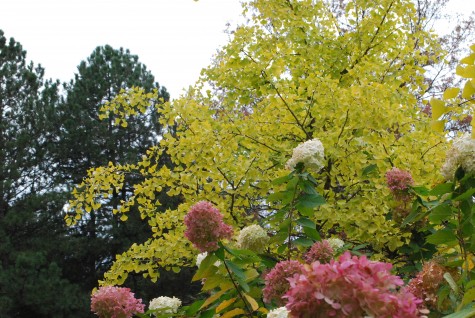 Ideal conditions for great fall color involve a season with decent soil moisture, warm days, and temps at 45 degrees or below at night. Ideal conditions- rare. Abruptly early freezing can interrupt the process by which leaves slowly stop producing chlorophyll; rather than a display in technicolor, we get a limited range of mud-brown and mud grey. This year, it is more than startling that we have not yet had a hard frost; it has been years since Halloween came and went before a killing frost. The night temperatures for the next 10 days look like they will hover in the low forties. We seem to be headed for great color. What is coloring up? Gingko leaves turn a gorgeous citron yellow in the fall; that color matures to a brilliantly clear golden yellow. But a gingko’s main claim to fall fame is about the drop. They drop most every leaf on the same day. Should you happen to be available that day, that drop is a happening.
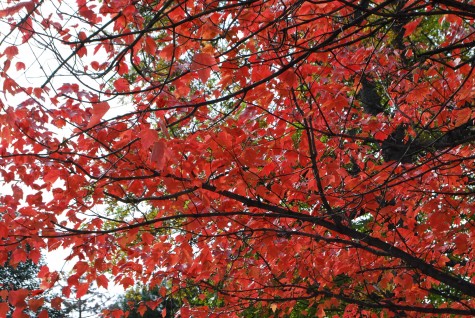 Red maples are aptly named for the intense red color of their fall leaves-but they can disappoint in a dry year. Should that red color be important to you, chose a named cultivar of acer rubrum especially bred for great fall color- like October Glory or Red Sunset. Maple leaves are large, and grow parallel to the ground. This makes the shade they cast particularly dense. But in the fall, the leaves are translucent; light shines through them. This brings that red fall color to life in a spectacular way.
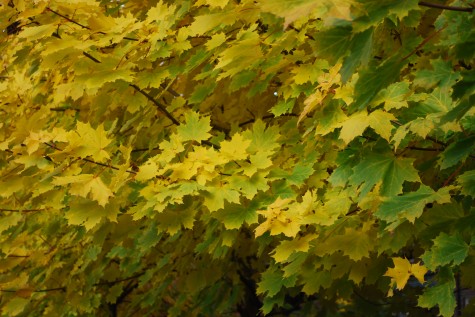 My Princeton Gold maples have an intensely gold fall color. The transition from green to yellow can take weeks. I have never had the inclination to dry flowers in a flower press, but I love pressing fall leaves-in every stage. Searching for my favorite fall leaf is not so different from shelling on a beach, or cutting the best garden flowers for the dinner table. Any gardener understands nature is a teacher, a resource that should be respected and protected- and a source from which to draw a good life.
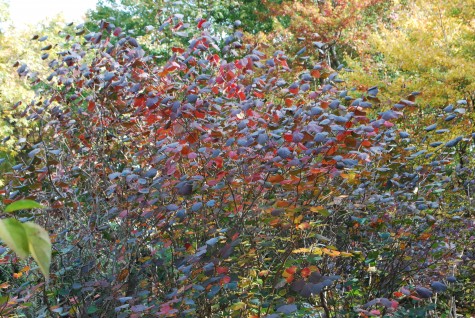 Disanthus Cercidifolius is a rare tree in my zone; native to China and Japan, they thrive in the Pacific northwest. This particular tree I saw just a week ago for the first time at Landscape Supply in Taylor. Wow. Related to witch hazel, this small growing tree has large heart-shaped leaves. However this tree comes into its own in the fall. Leaves turning purple, gold, orange-and finally red; Disanthus wrote the book on fall fireworks. Thriving in uniformly moist and acid soil not unlike what makes rhododendron happy-who would not have one if they could?
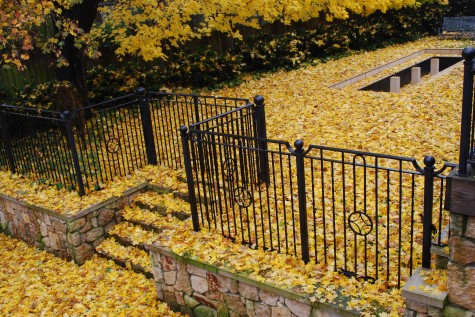 Unlike the regal Disanthus, my Norway maple is distinguished only by its age and size. This means that the sheer volume of fall leaves that will blanket my entire yard in yellow is newsworthy. This day-before I get to scooping them up-is a glorious day. I was lucky to get this picture before the Corgis got into the yard; they relish making a little ruckus running through these leaves.
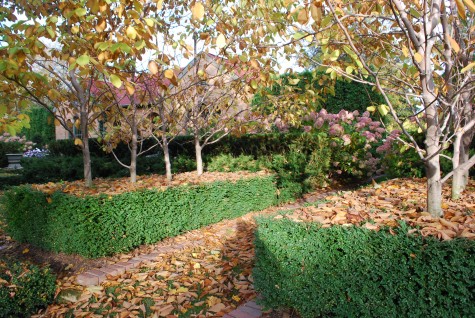 Magnolias have lusciously large leaves-but their fall color I would charitably describe as “tan”. The beauty of the fall leaf drop has everything to do with the boxwood tables underneath them. These drab fallen leaves are a kind of late season frosting on a series of shapes. The spring drop of their yellow petals is followed by a fall drop of their dehiscing leaves. There is a pattern, a order of events-the season changing. The fall color on the magnolias-not anything to celebrate.
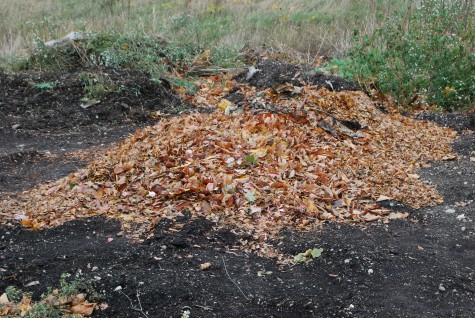 The body of leaves that fall on the properties we maintain-we collect them all. We compost them. Steve organizes the dispensation and decomposition of every scrap of organic matter we collect. We have at least 7 giant piles going as I speak-all of them are at different stages in the cooking process. Every leaf dropped from my giant Norway maple will be composted, and be returned to the soil.
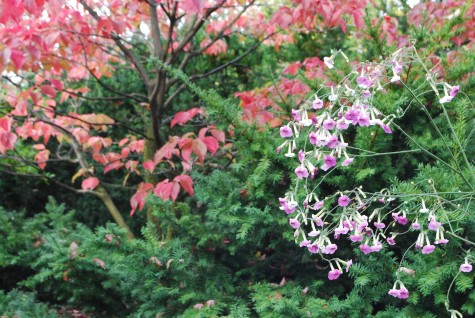 My Nicotiana Mutabilis is still thriving-it shrugs off the October cold. Its giant flat leaves are as green as my evergreens; this plant has no plan to shut down anytime soon. Each elongated leaf is still producing chlorophyll for all it is worth. Should you be looking for a plant that starts out strong, stays strong, and finishes very strong-consider this nicotiana.
In the fall, the work is leavened with delight.
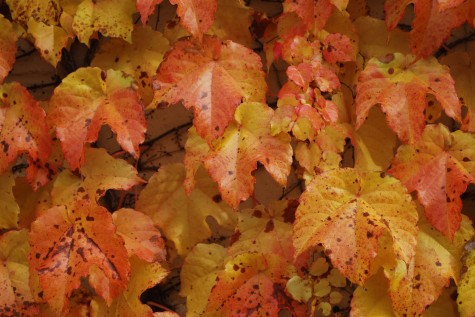
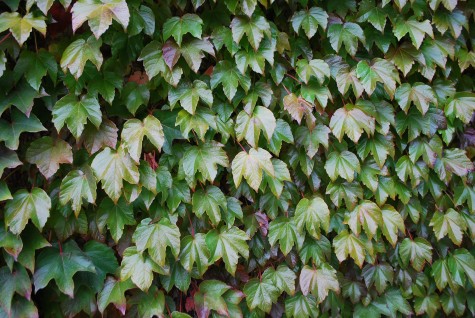
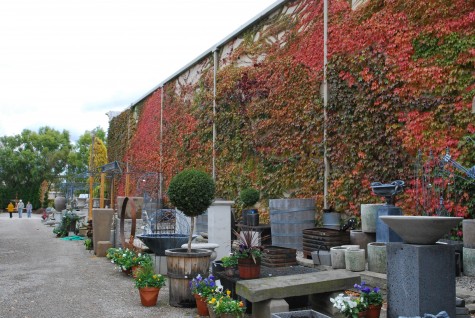
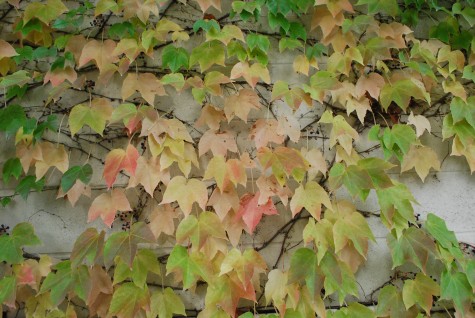
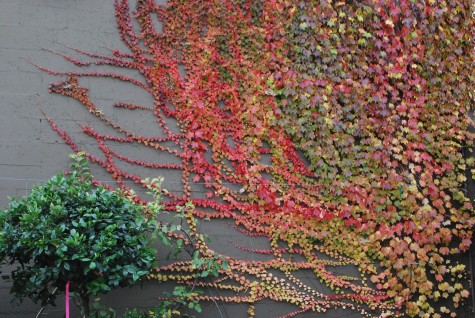
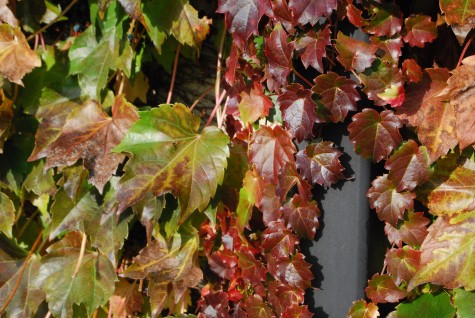
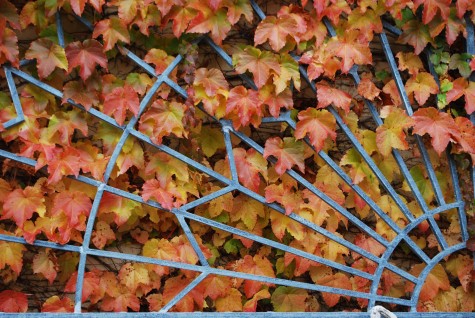
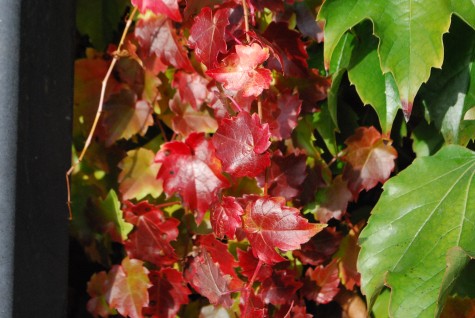
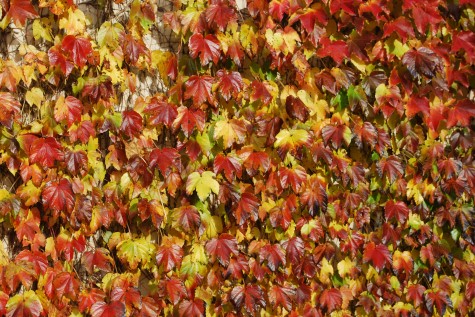
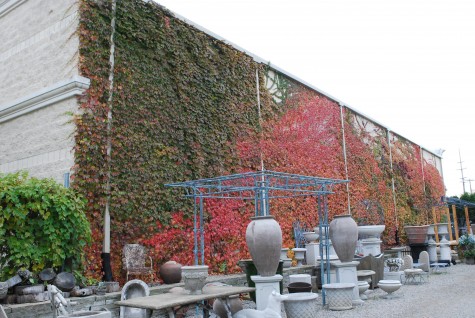
I have substantial walls enclosing the Detroit Garden Works property; those walls were in place in 1996. Many years ago, I planted Boston ivy on all of these walls. Parthenocissus Tricuspidata Vetcheii. Those walls today are uniformly and solidly and beautifully covered with the leaves of this vine. Those giant 3 lobed leaves are turning color rapidly-every leaf is different. Harmonic–the fall color on the Boston Ivy. In the fall, many of my thoughts revolve around the look of the leaves.