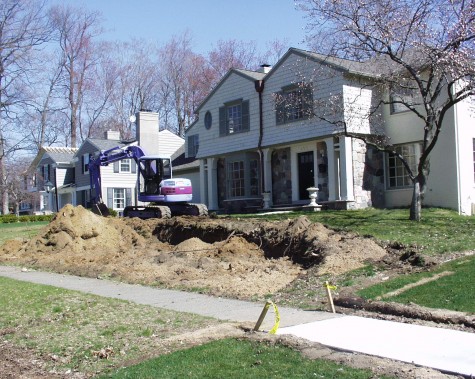
 I am so sorry I did not take a picture of this house before I put an excavator in the ground. Perched high above the street, a narrow concrete staircase sans rails made the journey to the front door a challenge. While this arrangement did keep away all but the most persistent visitors, the landscape was neither beautiful nor useful. This is a leave- me- alone lansdscape, is it not? My clients were interested in something very different.
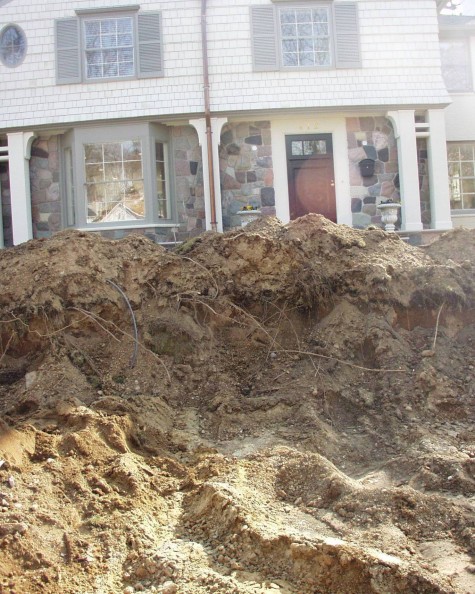 Some problems cannot be solved with a shovel. An excavator made relatively fast work of cutting into the steep slope, in preparation for a wall which would divide the steep slope into two terraces, with a staircase and landing transition.
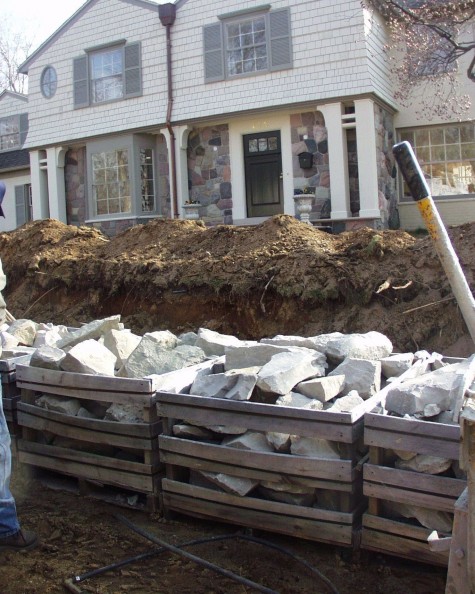 We built what I call a rubble wall. Stones of varying shapes and thicknesses are fit together to make a graceful and tightly fitted wall. This takes a person with great skill, and a great feeling for stone. My stone mason has been at this sort of thing a long time, and not incidentally, he has a gift. I would not have entrusted the job to anyone else.
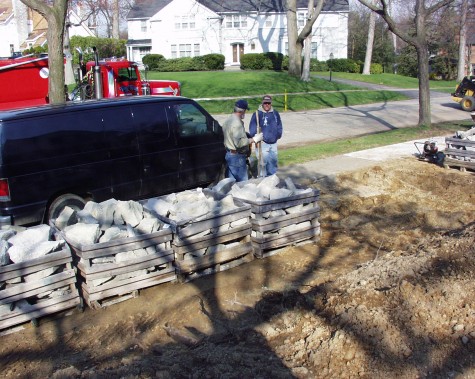 Boxes of stone were delivered via a semi truck. Each lot was uncrated, sorted, and looked over, before any actual work begun. This material would not do for stairs. The staircase needed to be made of a flat stone, for easy climbing. The finished grade of the staircase would set the grades for the adjacent walls.
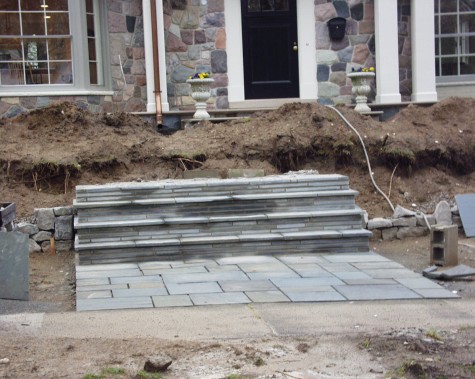 The bluestone landing matched the grade of the existing sidewalk; it is very important to be sure that walkways and stairs be set exactly as people expect they are set. Not everyone watches their feet when they walk. These stairs are set exactly level with the horizon; how they appear in this picture to be crooked explains how land actually sloped away in every direction.
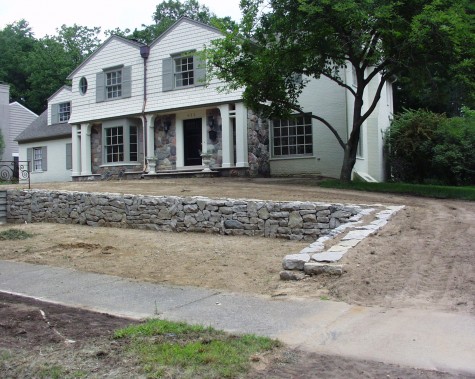 I was not about to ditch a lovely old magnolia in the front yard, so the finished grade had to respect the grade of that tree. No tree likes soil piled up against its trunk; changing the grade of an existing tree more than 4 or 6 inches is likely to kill it. One course of stone set at and into the grade of the upper terrace gives the illusion that the wall has great thickness and heft.
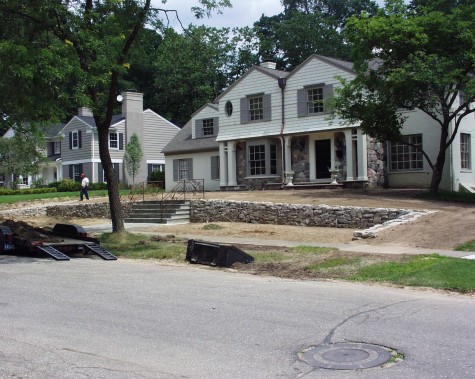 The wall slopes gracefully from the center staircase to the edges of the property. The return, or short arms of the wall, permitted me to maintain the grade to the neighboring property without interruption. A pair of antique iron railings I had acquired were retrofitted to work with the staircase. They are as lovely as they are functional.
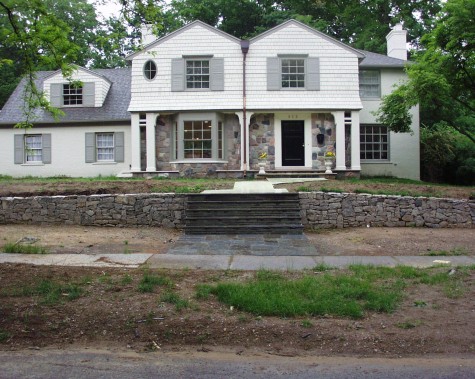
It took several weeks to make this yard accessible. The ground level terrace landing and stairs makes an invitation to visit. The upper level landscape will have to deal with how the ground slopes away to the south. A lot of design involves visual solutions that direct and engage the eye such that the problem becomes secondary. What people see is not necessarily what is actually there. As I look at this wall, I am thinking a landscape solution will involve plant material set perpendicular to the house, in order to minimize attention to the slope I could not change.
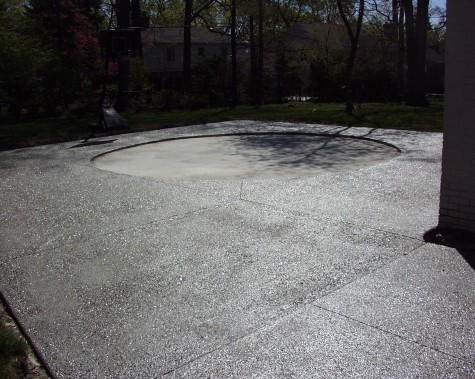 Not surprisingly the existing driveway was set to a grade which no longer existed. A new concrete aggregate driveway culminated in a parking area at the back of the house. There is no hiding a space like this, so I designed a stone medallion for the center. What one can’t get rid of needs a little special attention.
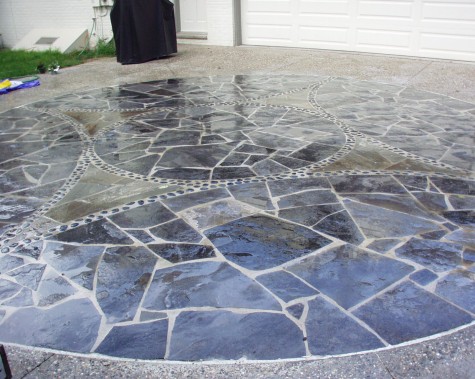
It took some weeks for all of this work to be done, and the mess cleaned up. I have patience for few things, but I am very patient about good groundwork. Tomorrow, the landscape.
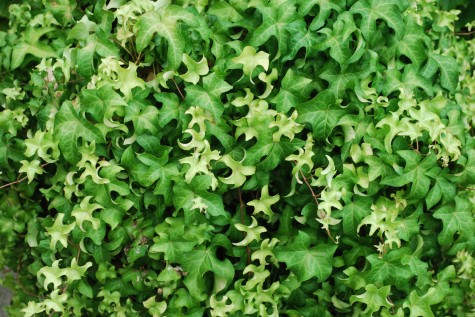


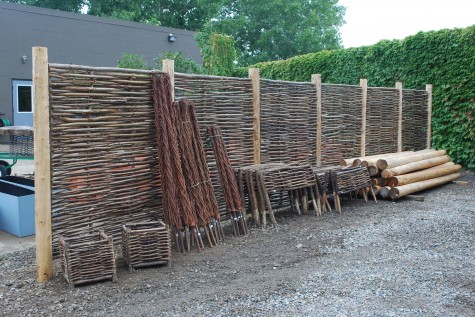
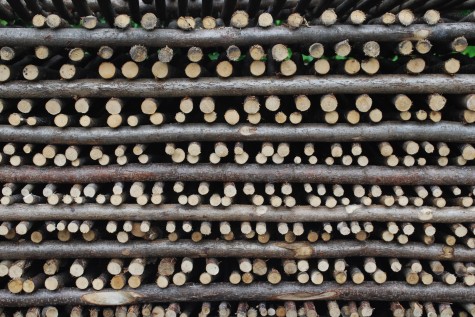 I wrote a few days ago regarding my excitement about the delivery of a container load of hazel wood hurdles from Belgium; the order we placed in May finally arrived. Wattles and hurdles are panels, woven from the coppice wood of willow and hazel wood. I personally favor the heft and longevity of the hazel wood; it is vastly more durable and substantial than willow. Coppicing is the practice of cutting trees or shrubs to the quick, with the intent of harvesting the branches for fuel, or fencing. The shrub or tree regrows, only to have its branches harvested again. Woven hurdles keep the livestock out of the vegetable garden. They border herb and vegetable gardens. They provide privacy without being utterly opaque. They work wherever they are needed. Woven hurdles are a fence material friendly to a garden or landscape of any point of view.
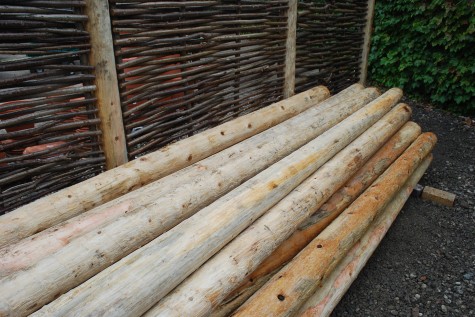 I have a client who has become a friend; he supports Michigan industry in a big way and was so pleased these stripped cedar fence poles we bought are Michigan grown. Though I ordered 5″ diameter poles, 10 feet long, they looked like telephone poles when they got delivered from a supplier in Michigan’s Upper Peninsula. As I relentlessly speak to issues of proportion, I was worried I had gone over the edge by an inch. I was wringing my hands, until the fence went up. I should not have worried. The size of the pole was perfect for the heft and texture of the fence. The bare cedar poles are a good contrast to the woven hazel wood, which has all of its bark intact.
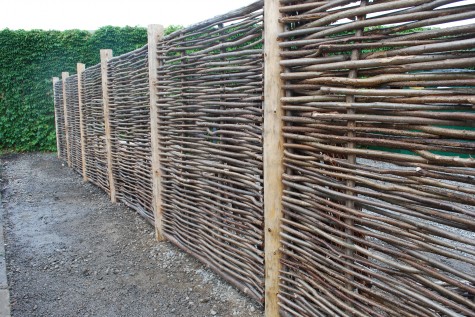 There is no substitute for the time when the talk ends, and the making begins. We set a pole down 24″ or so below grade, and set a panel up next to it. These panels are made by hand, and vary in width somewhat. One pole, one panel, and so on. This one step at a time construction ensures that the space between two poles is fitted to a specific panel. Steve toe-nail screwed the panels to the center of each post; this is a sturdy construction. What I like even better? This fence has no back or front; the panels are the same back and front. How friendly is this to neighboring properties? This fence looks good to both sides.
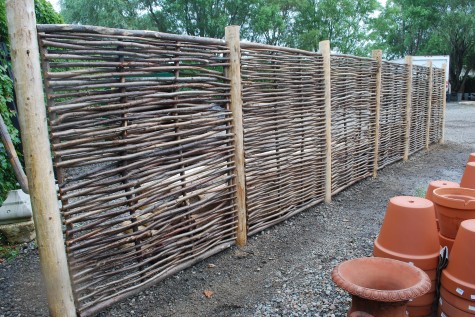 I have a client who plans to screen his hot tub with this fencing. It was the subject of intense debate today-will these hurdles screen a man who is happily skinny dipping? I vote yes-unless the neighbor plans to be close enough to see through the hurdle branches. The neighbor with his nose pressed to the fence-that is the subject of another essay, is it not? The fence is also friendly to vines that need to grip to climb. Clematis grown on this fence is especially lovely. We are careful to install the fence slightly above the existing grade of the ground. Wood in constant contact with soil will deteriorate much more quickly than wood that is able to shed water.
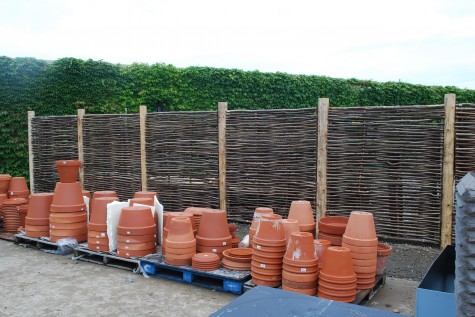 The fence is good looking with contemporary steel ornament, traditional terra cotta pots, a funky birdbath made from recycled materials, or a formal lead cistern fountain. This is by way of saying this fence looks good with almost anything. As to its longevity, imagine how long it takes a dead tree to fall and deteriorate. Branches and twigs are not good materials for the compost pile, as they break down so slowly. We have stocked this fencing for 8 years now. I have yet to have someone tell me it had disintegrated. Wood fences do age though-that is part of their charm.