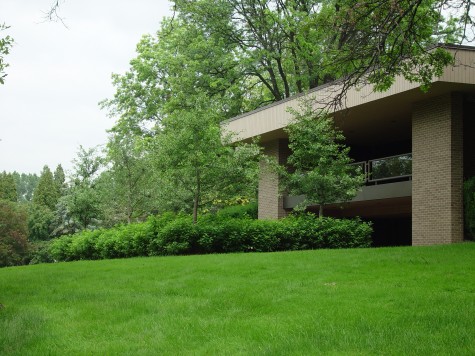
A good client has lost 6 very big and very old trees in the terrible storms we have had this season. The damage to her landscape is considerable. The remaining old trees in the same proximity look lonely, and off center. She is asking me what to do. I haven’t answered her yet, but she will most likely need to start over. Just yesterday we had a storm, wind driven and rain laden, blow through such that Detroit Edison counts it as their 10th worst storm on record. Luckily my neighborhood was spared. At the shop, a giant limb of a willow sheared off, and landed on our neighbor’s roof. Lots of people lost their power in the greater Detroit area. The big winds and the big rain took down trees in a wide range of communities. Big trees. As in, the bigger they are, the harder they fall. Miraculously, no person was injured.
Big storms are the plague of the weak and the big old trees. A sapling can gracefully bend under the duress of a straight line wind. No harm done. Old trees whose wood is stiff with age do not bend-they break. The canopy of a big tree is like a a giant sail. A wind that is too strong can stress that trunk beyond reason. For certain, large caliper trees that are snapped off above the ground, or uprooted in the height of a storm are victims of the unpredictable direction and incredible strength of that force we call nature. If you have ever seen a big tree uprooted or snapped off you understand the meaning of the word “force”.
Other trees in poor condition go over or shed big limbs without much in the way of protest. A lack of health, or a lack of regular maintenance makes them a target for the effects of severe weather. There are a lot of limbs on the ground now. The pruning that violent nature does is extreme. No judicious or clean cuts. I suppose storm pruning is effective. Any limb that is weak, or growing at an unsustainable angle gets a haircut in a matter of seconds. There is no time for a second opinion.
Our trees are our biggest plants. Old trees are up there, dealing with the brunt of the weather. All kinds of issues challenge their health. As they age, they need care. Maples in the tree lawn develop girdling roots. Sun loving deciduous trees in too much shade grow towards the light. Lots of our evergreens are being threatened by needle cast disease. I could go on and on about the illnesses of trees, but that is not my point. Trees need a gardener in charge to look after them, routinely-unless being at the mercy of nature is a place you don’t mind being.
My city does no pruning or maintenance on the street trees. I would guess this is a budget issue. So the three trees in the tree lawn on my corner lot that they finally took down this spring – I had to make a case that not to take them down would expose people to serious danger. They finally agreed. They were all maples, more than 2/3rds dead, suffering from girdling roots and seriously weakened by fungus. The maples were a poor choice to begin with. Their roots need room. They are much too large growing to restrict to the space in an urban tree lawn. Years of neglect made them a disaster waiting to happen. One giant limb at a just about horizontal angle arcing over my street featured a home trunk entirely rotted on the interior. That tree worried me to no end. I am glad it is gone now, before it collapsed under its own weight. In my next life I would like to be in charge of street tree plantings. Not that I have an agenda proud of the history of street trees in my urban community. I just have a big love for trees, and want to see them take hold and thrive. Old trees ask for some care. Loosing one – grievous. Certain neighborhoods in Royal Oak have incredibly gorgeous and substantial London Plane trees, thriving. These trees have been looked after all along the way.
An landscape asks for a regular hand. An aging landscape asks for a better than regular hand. There is no substitute for regular care. This is not to say that regular care will insure you will never have storm related damage to your trees. But it will provide them a fighting chance.
As for my dead maples, I have had the stumps ground down 24 inches. I had to transplant all of the hosta planted around them like skirts. I raked and seeded each 6′ diameter circle of bare dirt. Now it’s time to think about how I will replant that tree lawn. All living plants have a life span. Long and short. Expected, and unexpected. Looking after a property also means starting over.
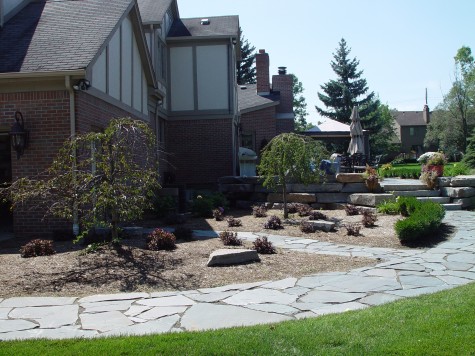 I would not hesitate for a second, recommending that new plantings be mulched with 2 to 3 inches of bark. Mulch conserves moisture in the soil, and it discourages the germination of weeds. Transplanting is a big shock; a little mulch can be calming. I do not, however, admire decorative mulch, mulch gardens, mulch landscapes, mulch over existing weeds, or mountains of mulch anywhere else beyond a landscape supply yard. Mulch should not be seen or heard from. Whomever designed the landscape pictured above should get a ticket, three points, and a hefty fine. Who would cut giant beds, dot in a few maroon-leaved weigela in no discernable pattern, and call it a landscape? This is a bark garden, just weeks after completion. In a year’s time, the mulch will be a dirty grey, blown about by rain, bikes and wind. All the while organisms in the soil are degrading said bark such that any weed seeds in the soil underneath will soon have optimal conditions to germinate and grow. I shuddered when I saw this, and shuddered again when I realized the clients had no idea the hand that had been dealt to them.
 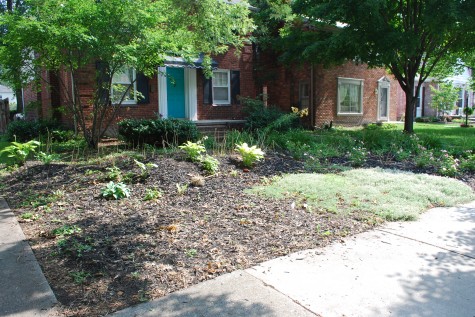 Suburban landscape/ gardens in front yards- in conspicuous lieu of grass-have become quite popular the last ten years or so. Occasionally the news tells the tale of neighbors up in arms over a non-conforming suburban yard whose messy assortment of perennials, vegetables and whatever else threatens to disturb the status quo. The debate about lawn versus garden is immaterial here-this yard is indeed a mess. What I find even more astonishing are the drifts of bark. As if bark over bare dirt,weeds, and some scraggly plants could improve the look here.
 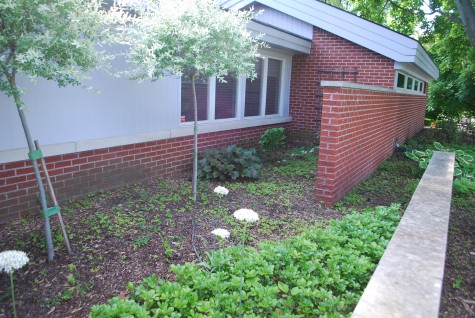 No kidding, nature abhors a vacuum. The above pictured bark is a testimonial to the fact that bare or barked dirt stays bare only a short time. Bark slows down weeds at first, but them helps them grow all the more robustly. A forest completely destroyed and buried in volcanic ash will reforest, given enough time. Some landscapes could get that fresh well-tended look if the bark were banished. It is not as if any removal is required. A landscape quick-fix? Plant more of what you already have in your bark beds.
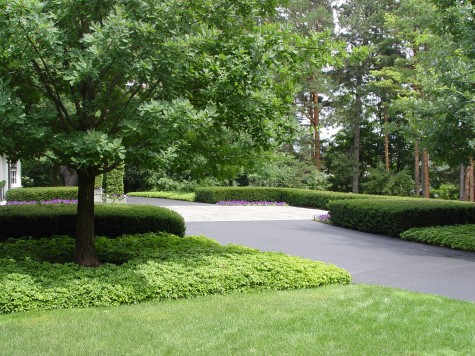 It is difficult to get plants to grow under trees; the shade and competition for water can be daunting. Planting a companion plant at the same time the tree goes in gives everyone involved a chance. I planted rooted cuttings of pachysandra with a weeding fork underneath these English oaks close to ten years ago. The groundcover has taken over the job of the bark. Though a planting of pachysandra is never going to make your heart pound, it is vastly better looking than the bark. The shape and density of growth is enough.
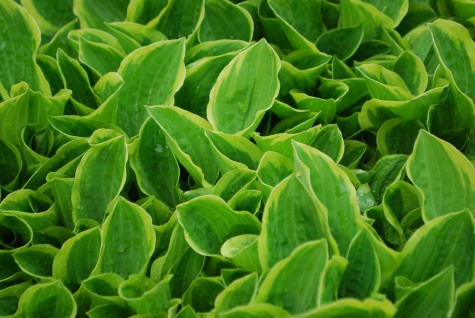 There are lots of groundcovers for both sun and shade. This dwarf hosta is a happy combination of bold texture and ground hugging scale. Not that a groundcover needs to be short, mind you. Groundcover is anything that covers the ground. For your planting trouble, you get a mass of green that conserves moisture in the soil, and discourages weeds. Does this not sound like a good idea?
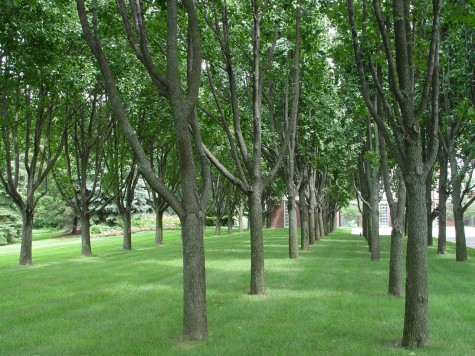 There is not one thing intrinsically wrong with grass. It is a vigorous groundcover, and it does need to be cut. It is doing amazingly well in the shade of these Bradford pears. It is as much landscape as some people can handle. A grass panel, or sculpture can be strikingly beautiful. Just because a zillion lawn care products exist is no sign you are obliged to use them. Just cut the grass. Even when my garden is weedy and falling over from neglect, I feel better when the grass is cut. I like that illusion of order.
 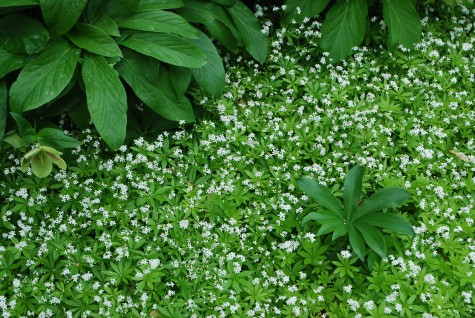 Sweet woodriff is a beautiful groundcover, but it must be sited properly. In too much shade, and in too wet a soil, fungus will prevail in late summer, leaving the garden with brown rotted leaves and bare patches. I am willing to put up with its problems, as it covers the ground under my hellebores so beautifully. My hellebores still seed here, though there is not a square inch of bare dirt to be seen.
 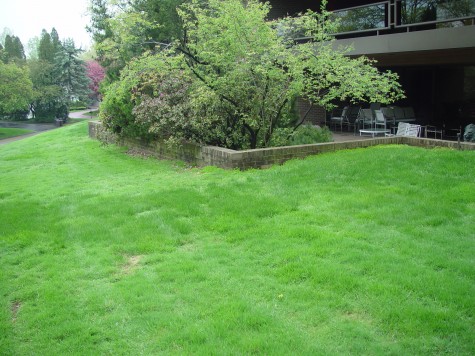 A client with a private garden carved into a hillside asked me to redo the space. The shrubs had become considerably overgrown, and a tree had died. The walled garden on the inside has been totally redone. But I was equally as interested in the street side presentation of the garden. The grass was tough to cut next to the brick wall; the grade was sloppily uneven. I stripped the grass five feet away from the wall, and added 20 yards of soil to level the ground.