Monday Opinion: Depth

From Roy H Williams:  “According to String Theory, what appears to be empty space is actually a tumultuous ocean of strings vibrating at the precise frequencies that creates the four dimensions you and I call height, width, depth, and time.”  I know, it takes time for a sentence like this to sink in.  Should you truly be interested in string theory, I can say that Steven Hawkings has more than a passing interest in it-check it out on Wikipedia, and read on. I have a much less scientific interest in this theory.  I have more of an interest in depth as a key element of good design.

 Landscape design is much about numbers and measurements.  The height of a pergola and the width of a sidewalk, the turning radiuses of UPS trucks, the angle of the sun in the fall,  grades, fall, drainage schemes, the angle of repose, ppms of fertilizer, the plants needed per square foot, the face feet of stone required, the longevity of certain species of trees, the composition of soil, proper planting practices, and scale drawings-the accumulation of knowledge of these things begins to make for a design judgment with depth.  The more “strings” I can become familiar with means I am one step closer to a “tumultuous ocean of strings”.  I am thousands of strings short of a Kathryn Gustafson or a Beatrix Farrand, but I have accumulated a few strings along the way.    I doubt I will ever understand the scientific meaning of strings, but I can understand how many different threads woven together can create something new altogether.  Given a little poetic license, imagine how a great landscape that is a tumultuous ocean of strings might go on to makes an utterly memorable and emotionally charged four dimensional sculpture.  Sensational-yes.

The depth of the ocean is not really so much different an idea than the depth of a person’s knowledge.  Though it is so easy to look up the cultural requirements of hellebores, possessing depth on the subject means growing them, over and over again, in lots of different environments.  Should you wish to grow gorgeous hellebores, put your hands in the dirt.  Or find someone whose hands will gather that knowledge for you.  Given this, my most trusted source on the subject of choosing perennials for a particular place is a grower who has grown many hundreds of thousands of plants in his career-both at work, and at home.  His depth is vastly greater than mine.  Once I have heard his string, I may accept it, or move on. 

There are those times when making a right choice about which plants to use is not the best choice.  Some out of the ordinary plantings are worth taking a chance on.  This means that the string which is about the scientific choice is reverberating with a string of another sort.  It might be a visual string, or a string about memory, or a string about geometric relationships.  This may sound like loads of gobbledegook, but the chance that it may resonate is just as great.  The depth of any gardener’s life, knowledge as aspiration, makes for quite a stew.  The same is true for garden designers.  If you are a gardener looking for a designer, see how many strings they have to put to your project. See if your strings will harmonize with theirs.  

I have posted, and have more posts to come, involving schematic plans.  I rather dislike landscape plans with too much detail in the beginning.  It is a rare project that takes me more than 8 hours to conceptualize.  How so?  Clients have every right to expect that I have depth in design and horticulture.  That I am educated, and keep up with what is new.  The depth of my understanding of their needs and requirements for the landscape-they need to assess that on their own.  But they can expect that I have experience.  That I will know what visual and horticultural relationships work.  And all of those numbers-I know them.  I provide an overall idea in a conceptual plan,  given how I hear all the strings resonating in concert.   A client, should I manage to interest them, responds by stringing up an instrument all of their own.  All of the details come from their strings.  They need a kitchen garden here, and not there.  They like this stone-not that.  A place to plant with their kids-where will that be?  A place to entertain family.  A memory of a certain tree, or a certain garden.  An idea of what beautiful looks like.  It is the relationship forged over these details that makes for that tumultuous ocean of strings.  Not everyone knows how to create or facilitate that, but everyone knows what it sounds like. 

Listen to see if that idea for your garden rings true.  Is there a depth of strings reverberating?  Any move in a landscape or garden that is more about a look than a life that has depth will sound like a spoon hitting a tin can. You’ll know when you need to invite a few more strings to the concert.   
 

Another Perennial Garden


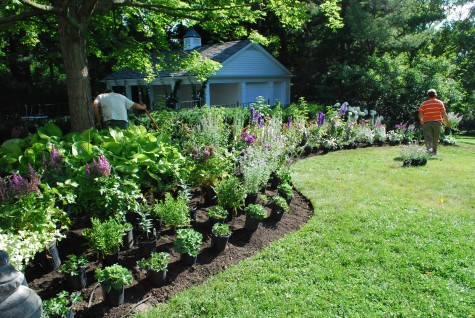
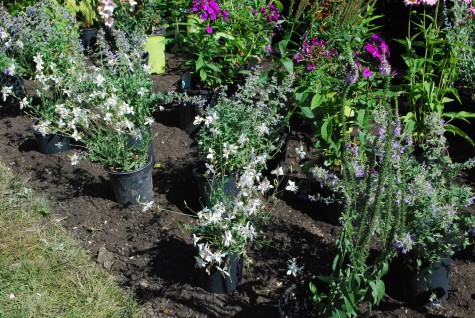
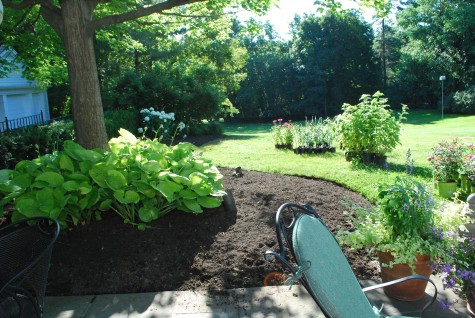
I did plant a second perennial garden this week-however many days ago I posted about the prep.  Steve did a great job of prepping the soil-we usually add plant mix, a mix of topsoil and compost- to garden soil.  I like perennial beds to be pouffy.  Crowned in the center.  So many perennial plants are extremely hardy, given good drainage.  A perennial bed that sits lower than the grade of the lawn will have problems.   This picture makes clear how this perennial sits higher than the lawn.  Perennials swimming in waterlogged soil will give up without much of a fight.  If I had my choice, no ground in a landscape would be perfectly flat.  Every surface would have positive drainage, in addition surface drainage.  The best part of landscaping a new house-I have a good relationship with that person on the bulldozer that sets the grades. Raised boxes specifically built to grow vegetables-this is all about drainage.   Lest I spend too much time on the obvious, I will simply state that water runs downhill.  Sculpt the ground accordingly.       

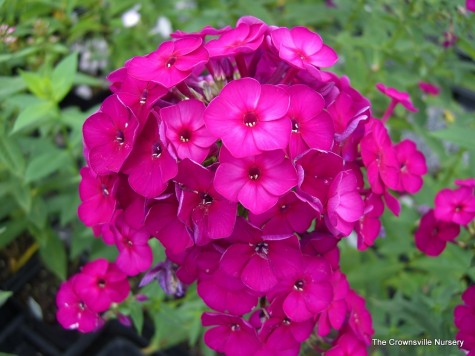
The photograph of this phlox Nicky is courtesy of the Crownsville Nursery.  The darkest carmine/purple of all the summer phlox, it resists mildew and disease such that you would want to grow it.   The smell of phlox in the summer-divine.  I like the color, and I like the vigor.  This phlox is going into this perennial garden.    

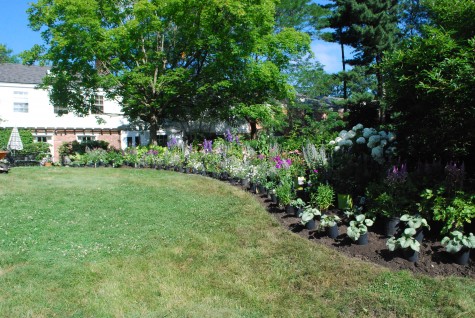
We refined the curve on the edge of this perennial bed.  Perennial beds without edger strip ask for an edger/gardener of great skill.  Any bed edge that curves needs a long slow curve with no flat spots.  If you are having trouble determining a curve, get your hose out.  Play with that hose until you get graceful curves-and then cut the edge.  Alternately, but a stake in the ground, and tie a loosely tied string to it, and mark an arc as long as you need.  Finding the right spot to put the stake just takes a little experimentation.   

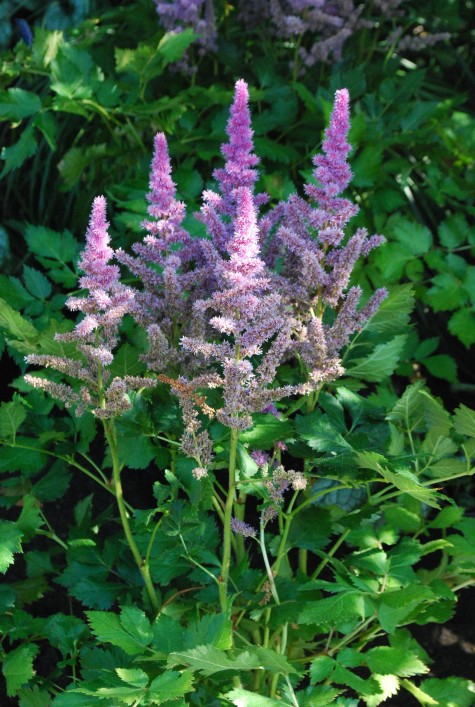
The Vision series of astibles are amazing.  They are vigorous growers.  The colors are clear, and striking.  This pink, purple, lavender and white perennial garden got a big dose of these astilbes.   Should you have some part shade areas, consider Visions pink or red. This garden begins and ends with some shadier spots.  I plan to mass both areas with lady’s mantle, Jack Frost brunnera, and this astilbe.   

I have never been convinced that Gaura is hardy in my zone, but here I am planting them.  They are willowy, and beautiful in a very understated way. 

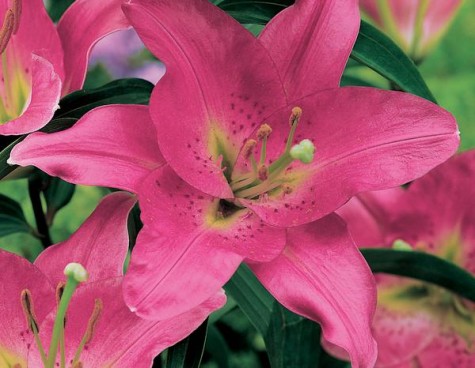
My love affair with lilies is at least 30 years old.   That is a story appropriate for another post.  But this week, the Oriental hybrid lily known as Acapulco got my attention.  Where the idea came from to plant lilies in this garden was driven by the small space in question. Bulb lilies take up  very little space, but add lots of color to any perennial garden.  They require good drainage to persist; they sometimes need to be staked.  The Lily Garden offers a wide selection of lily bulbs by mail.     

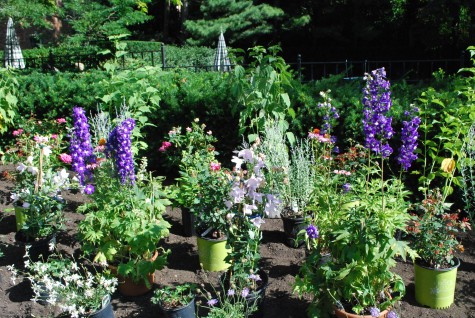
The Magic Fountains delphiniums made a big statement the day they got planted. They are fairly easy to grow, and are quite vigorous.  Their shorter stature makes it easier to gracefully stake the heavy flower stalks.  Double pink knockout roses alternated with white hardy hibiscus and planted behind the delphiniums.  Pink platycodon, and pink echinacea are alternated with Russian sage.  On the border, Blue Mist scabiosa, Geranium Rozanne, and lady’s mantle.    

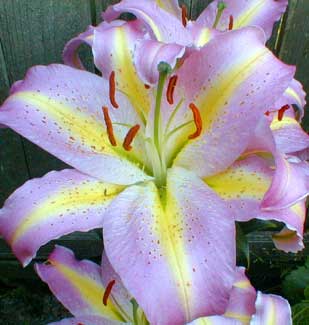
The Oriental hybrid lily Tom Pouce flowers are orchid pink with lemon yellow streaks.  This is a very showy flower indeed-not at all for the faint of heart.  Flowers that are attention getting are good in gardens viewed from a distance.  Who would not want to walk up to insepct a flower like this at close range?  Subtle flowers are best up close, where they can be better appreciated. 


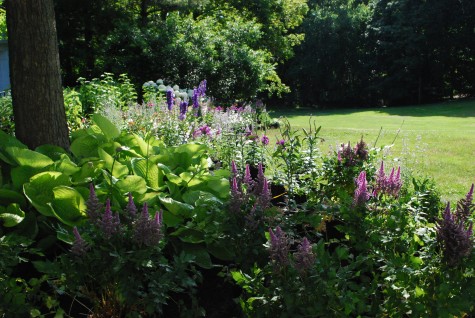
Though the perennials have not been planted yet, it is easy to imagine what the garden will look like once it begins to grow in.  The white flowers of the Annabelle hydrangea we left in the garden will draw the eye towards the back of the garden.  The very large existing clump of Sum and Substance hosta in the foreground provide wecome green relief to the mix of colors all around this.  My client likes pink, purple and white.  I think this garden will provide her with a summer garden she will really enjoy.

A Favorite Place

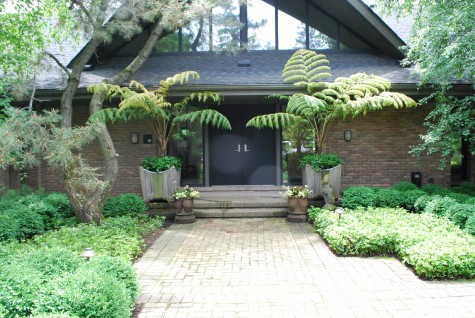
I have my favorite places.  What makes for a favorite place?  A client with an eye for beauty and a committment to the garden.  A client who is always willing to try something new.  That said, an ancient and sparsely foliated scotch pine flanks the front door-Mr. will not now, and not ever,  let me touch it.  This too makes for a favorite place-strong feelings.  The Australian tree ferns I have wintered in a greenhouse for them for about 10 years.  We cut them back to the main trunk in the fall.  By spring they are leafing out vigorously.  This year I underplanted them thickly with maidenhair ferns.    

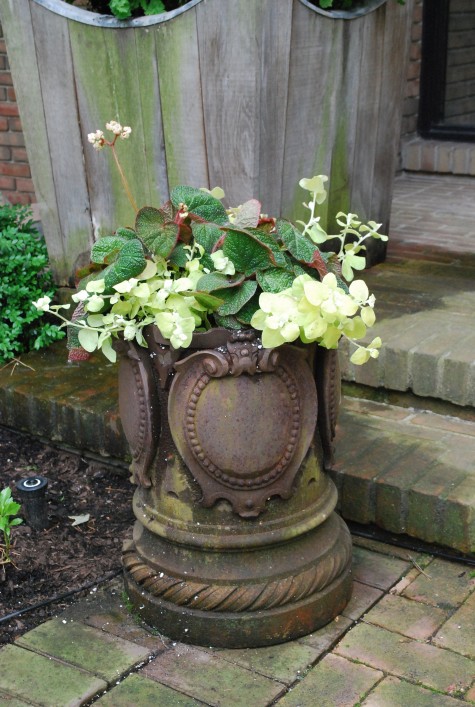
A pair of chimney pots got planted with an unknown begonia-I like the leaves.  The rusty colored hairs on the stems and backsides of the leaves look great with the rusty brown pots.  Lime licorice grows anywhere for me-sun or shade.  That pale chartreuse color will highlight those deep green leaves.

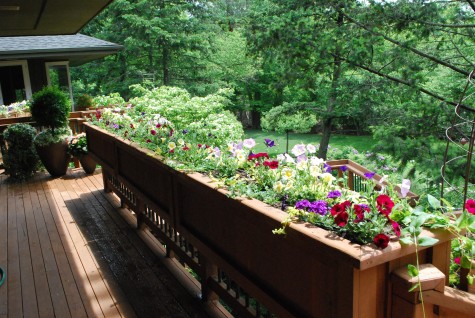
Planting day was a sunny day-so my pictures are not very good.  A lime, lavender, purple and yellow color scheme is enlivened with an occasion burgundy potunia-just for emphasis. Vinca maculatum will trail dowen long on the far side, as will the misty lilac wave petunias.

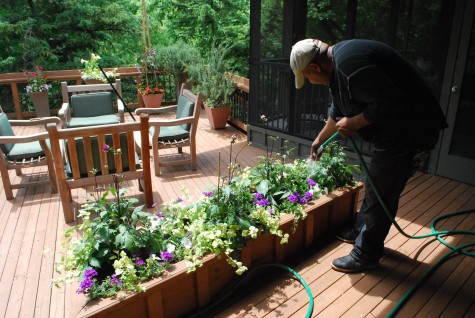
The small box got cactus flowered purple dahlias, purple angelonia (new this year) lanai blue trailing verbena, white petunias and lime licorice. 

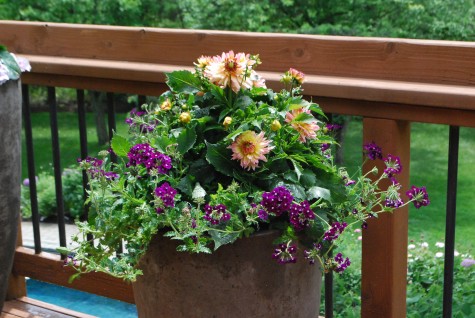
A pot nearby has a yellow and peach bicolor dahlia, and a skirt of dark red violet trailing verbena.  I like the forms of the plants together as much as I like the color.  I like the contrast of the big dahlia leaves to the slight-sized verbena leaves.  Plants have visual relationships on a lot of levels.   

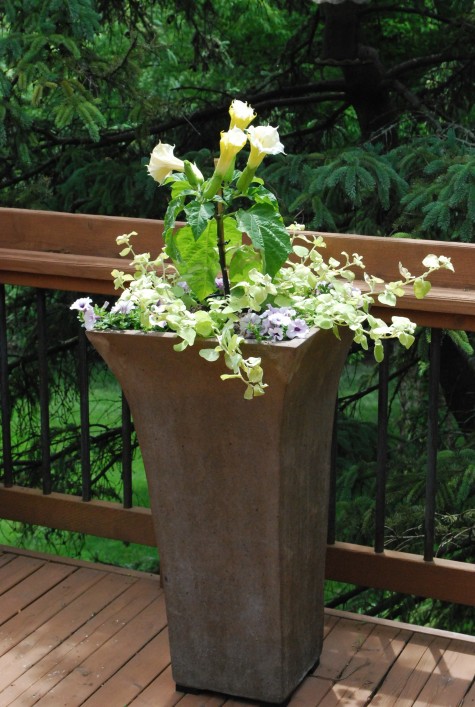
The centerpiece of this pot is a double (also known as hose in hose) datura.  I caution anyone who grows them-every part of a datura is poisonous.  The plants smell poisonous.  If you cultivate this beauty, wash your hands after you touch it.  Beyond the warning label lies a gorgeous big leaved plant with giant flowers.  A diminuitive white and lavender veined mini petunia against lime licorice is a cooly tart, and small textured mix.  The datura will be the star of the show.

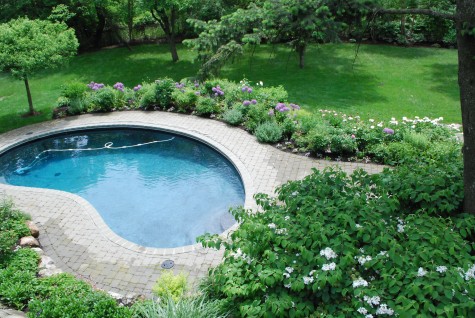
The perennial garden at the pool is just coming to life.  The peonies are out, and the roses are not far behind.  The purple alliums show well from the second floor deck; this is a garden primarily viewed from above.  We add some nicotiana and verbena bonariensis between the tall perennials, and plant an annual border to soften the edge of the pool brick.  This year, showy oregano, appleblossom petunias and heliotrope will fill in and cover the soil.   

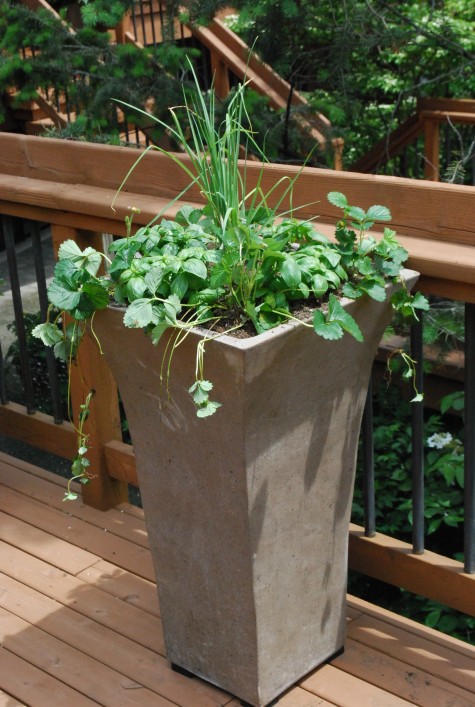
When my client asks for herb pots, she is really asking for basil pots.  I did a pair.  Leeks in the middle, and everbearing strawberries with pink flowers at the corners. Lots and lots of basil.  This I understand.  Its pungent smell and taste-irresistable.

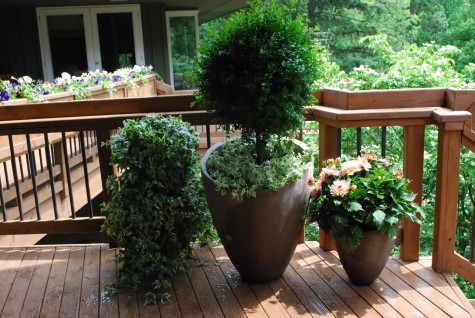
This trio of pots feature an old variegated ivy topiary, and a single ball boxwood topiary.  The boxwood got an underplanting of variegated licorice; the third pot is stuffed with a dahlia.  The pots are from Francesca del Re in Italy.  The are very simple, handsome, and frostproof.  The clay is so loaded with minerals that the pots are very strong.  We make sure no water collects in them over the winter.  Freezing water expands as it becomes ice-this process can damage pots.  These terra cotta pots have been outside for a good many years.

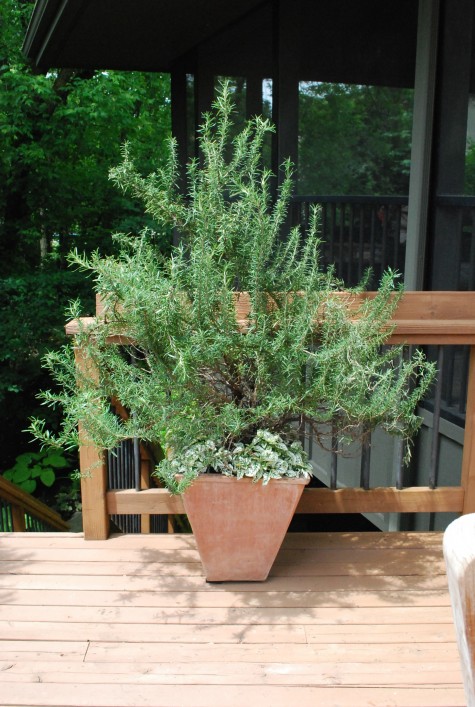
This wildly natural rosemary has belonged to my client a long time. The only thing we prune is the rootball; this plant has a life of its own going on.  This year, we underplanted it with white polka dot plant-I think I am going to like this. 


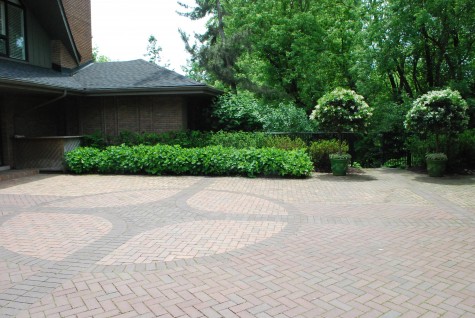
My first project with this client many years ago involved digging up every plant she had, and rearranging. This took 2 days.  There were lots of projects after this-not the least of which was the most romantic garden wedding I have ever been involved with.  My client-she drove that bus.  The story of the driveway?  The drive needed to be enlarged; the original brick was no longer available.  We took up all of the old brick, and reused it with a new brick in an entirely different pattern.  All of the pale brick you see here is original.  The two colors of dark brick are new. It looks entirely believable; the mix of old and new reads as one thought.  The 12 year old waxleaf privet topiaries got planted back in their summer home-they are just about to bloom.  Most every bit of this garden-swell.

The Front Door

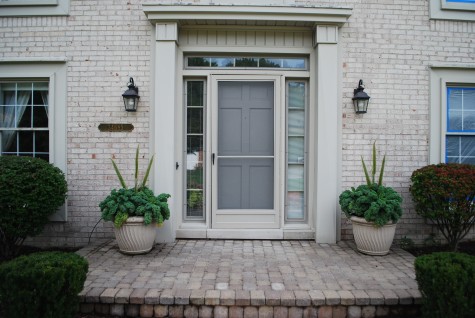
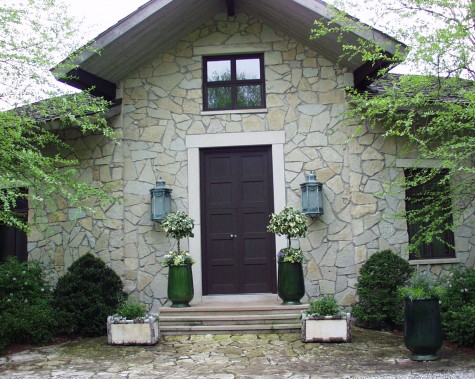
I never use my front door-unless I am outside after work, watering my pots. If I am out there watering, the chances are very good that I will exchange hellos with people walking the neighborhood.  When company comes, I am on the inside looking out.  Why I would care how the landscape at my front door looks-simple.  My friends are walking up that walk.  We have a visit or a dinner planned.  I have every interest in making that walk welcome them.  It takes a little time to get to my front door from the street; any visitor has time to see what I have going on.   The front door pictured above-my clients were interested in making a change. 

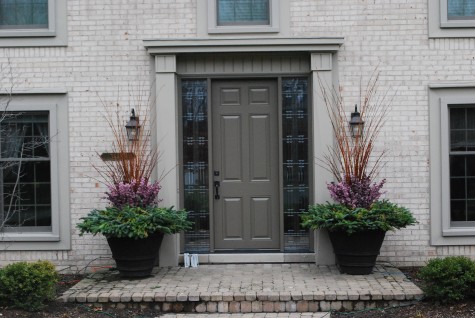
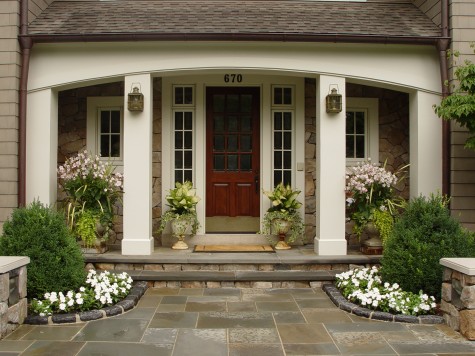
Making friends feel welcome is but one of the ways that my landscape gives me pleasure. My clients had the same idea.  They changed the door and sidelights for the first time in twenty-some years.  Their choice of a new door and sidelights-a beautiful update.  Part of that update was a new pair of containers for the front porch.  A porch generous enough in size to accomodate both pots and guests; I like the size of the porch.  These chocolate stained concrete vase shaped pots, much larger, and much more emphatic-they make a statement.  Purchased just in time for the winter season, we filled them with twigs, dyed eucalyptus, and a wide densely constructed nest of cut greens. The scale of the planters and plantings frames the front door in such a way to make the invitation read from the street.  This also makes friends knocking on the front door feel welcome. 

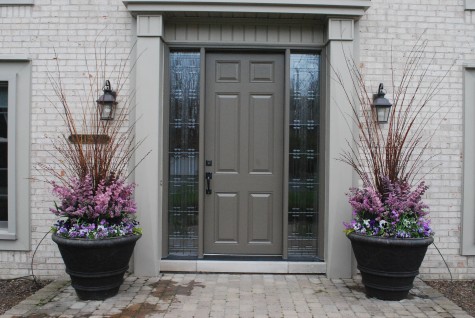
Just today, we planted these pots for spring.  The winter centerpieces we kept.  The height of the twigs, and the mass of the eucalyptus, are scaled properly with the size of the door, and the size of the porch.    Guests approaching have a sense of the landscape at eye level-this is a friendly gesture.  How I landscape places in my yard where friends come to visit-I like that landscape to put its arms around my friends, and say hello. 

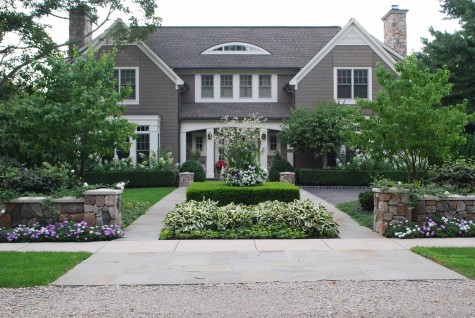
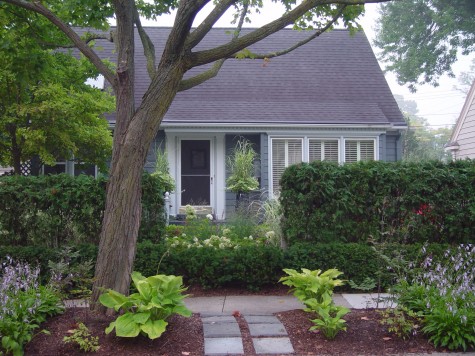
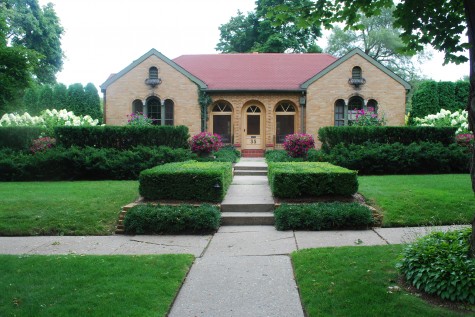
Some city gardens are built on very small properties.  A conscious choice was made here-to block the view of the front door with a luxurious square of boxwood, dominated by an antique urn.  I planted that urn very tall. How that planting obscures the front door makes the walk to the door an adventure.  Front yard landscapes have much to do with the relationship between the public presentation from the street, and the welcome issued to family and friends. 

This front walkway behind that urn planted very tall is actually an extension of a drivecourt.  A shallow porch benefits greatly from its overscaled width.  I so like the decision to do four pots on a narrow porch.  Everything about the numbers of pots, the placement and the planting influences to what extent you say hello, and welcome.

Some front doors are not symmetrically placed.  A tall portion of wall existed to the right of this front door.  A tall pot, barely visible here, is home to a planting of zebra grass and variegated plectranthus.  The planting is at eye level from the street.  The landscape successfully frames the front door. 

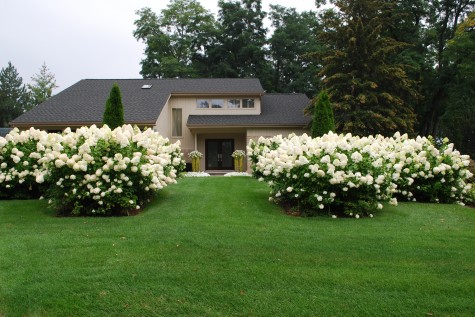
This client loves the big statement that her limelight hydrangeas make-they are glorious.  The view from the street to the front door-a long view.  Her contemporary faux bois selettes from France-they still read from a long ways away.  Up close, a mass planting of white New Guinea impatiens is complimented by lime green creeping jenny-the creeping is almost  4 feet long, come mid July.  There is no walk from  here to there-but there is a view that engages the eye in a lively way.

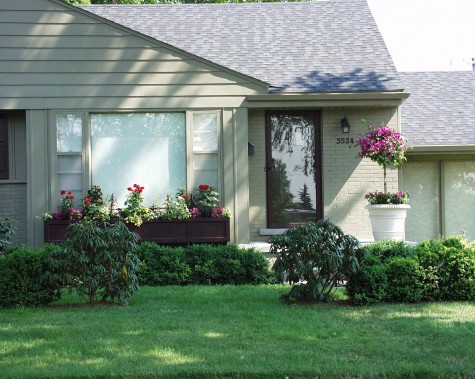
Not all porches permit pots placed symmetrically.  One planter at the door can be every bit as strong as a pair.  In this case, one giant planter is balanced by a substantial planter box.  The landscape obscures the walk.  This makes for a public presentation of the landscape separate from the private experience.  I live in an urban neighborhood.  This means I have concern about what I want to contribute to the beauty of the neighborhood, and how I might want to more personally welcome my guests. 


The back door of my property sees lots of action.  I load and unload the dogs every day-I park just 15 feet from the back door.  We take the trash out.  We come and go, and park here-all the time.  Treasured friends come in the back door regularly.  But my front door-the landscape and the pots-I have a thing about this special place.  It is my obligation and pleasure to present as beautiful a presentation as I can.  To the neighbors walking by.  To casual visitors driving by.  To special guests.  On my mind is what people driving by, and guests coming up the walk-what do they see?  What have I been so well mannered to put at their eye level.

Good manners?  Any guest of mine, I do try to consider their experience first- before I consider my own. Beautiful pots, overflowing with plants, at the front door-this is no doubt a gesture of respect, and affection.