The 2012 Espaliers


espalier apple trees

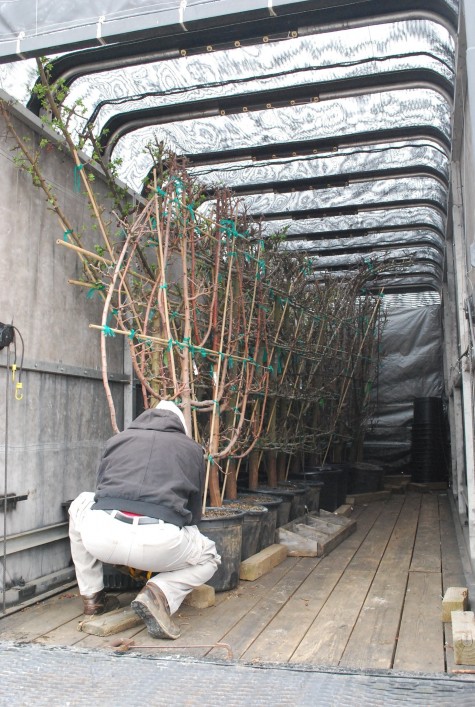
What would spring be without some fabulous plants on order?  The garden shop is a garden shop-not a full service nursery.  We have neither the space nor the inclination for that.  But I do like to carry specialty landscape plants, plants of distinction, and great plants for containers.  My love for espaliers dates back to the mid 80’s.  If you shopped with or had a landscape designed and planted by Al Goldner, chances are an espalier was part of that relationship.  He grew these specially trained and pruned fruit trees on his farm in Howell-it was next to impossible to find them available for sale, save for Henry Leuthart’s place.  Billy drove these to us himself-typical.  The care he gives his trees is a full time and then some job.
 

espaliered pears

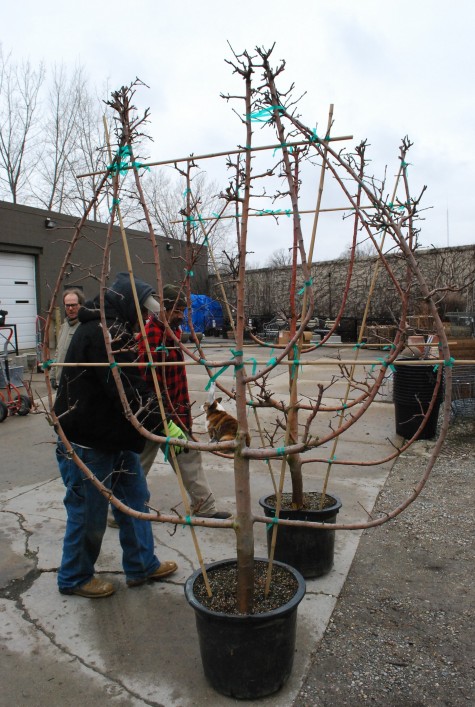
I buy them every year from a number of places, but this grower is my favorite.  He was formally trained in the propagation of fruit trees trained to grow in but two dimensions, as it has been done in France for centuries.  He sells no trees before their time.  The trunk sizes are substantial, and the primary arms are set and properly grown into their intended shape.  You can see in this picture that each tree is planted at the side of the pot-not in the middle.  This makes easy work of planting the tree close to a supporting wall.  This classical shape is know as a goblet-that should be clear.  This tree is older and perfectly grown.  The planting and bolting to a wall will be easy.
goblet form espalier

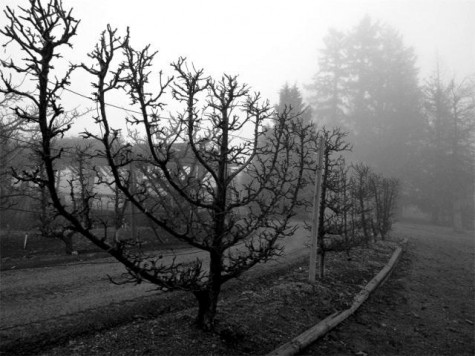
This old goblet espalier at one time had a supporting framework to hold its arms in place, but now is old enough and sturdy enough to stand alone.  Planted at the UBC Botanic garden, this tree is a living fence of beautiful design and form.  The history of espaliers is firmly rooted in a French agricultural tradition.  Fruit trees trained in two dimensions took up very little room in the garden; severely pruned trees produced huge yields of fruit.  Though most of my fruit comes from the grocery store, I find these pruned trees enchantingly beautiful.
Belgian fence

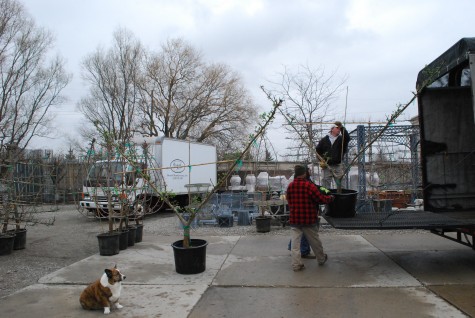
We unloaded 10 espaliers, all part of a free standing fence which will run 60 feet.  At a young age, a single stem crabapple whip was summarily topped.  A pair of shoots emerging at just the right angle on either side of that wound would be trained to grow out, producing the bottom half of a very large vertical diamond shape.  This method of growing and pruning multiple trees to create a whole is known as a Belgian fence.
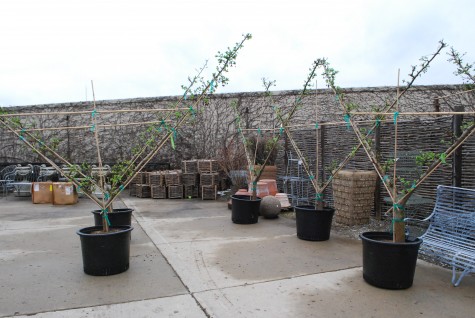
Belgian fence

Each tree will be planted exactly 6 feet from its neighbor.  You can get the idea of those large vertical diamonds that will be created by this arrangement of trees in this picture.  I have seen Belgian fence done on a smaller scale.  The smaller the scale, the more difficult it is to keep the diamond shapes clean and crisp.  This fence will bloom with white flowers in May, and produce gold fruit in the fall.  The form will be so striking in winter.  Pruning is somewhat a matter of personal preference.  Some gardeners would like their primary branches small and delicate-they prune shoots off the main trunk hard.  Another gardener might permit small branches off the main trunks to grow such that the diamond shapes are thick and substantial.  Is this discussion not so clear? 
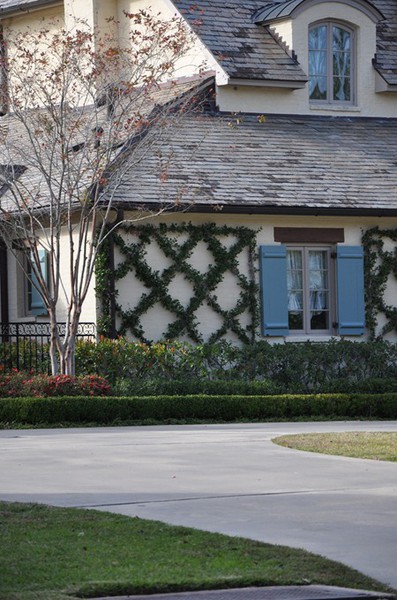
 Belgian fence espalier style


This picture makes the idea easier to see. This Belgian fence has smaller diamond shapes.  This look is created by planting the individual trees closer together.  I cannot really explain why the idea of having 10 trees that when planted together will form a wall with a continuous and geometric pattern appeals to me so much, but suffice it to say it took me all of 30 seconds to speak for these 10 trees.   
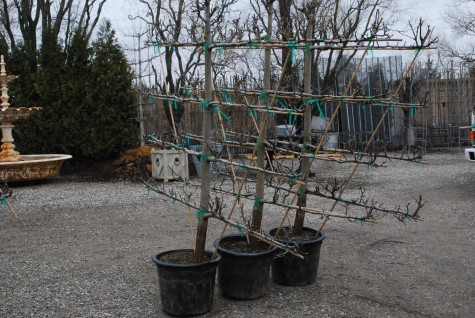
espaliered pear trees

Four  quadruple cordon espaliers were delivered-a pair of apples, and a pair of pears.  Cordon refers to the main arms of the espaliers being trained in the horizontal dimension.  The vertical distance between each arm is equidistant.  This form is common in the pruning of grapes, as well as fruit trees.  Branches growing in the horizontal dimension bear heavily.  This applies to grapes, apples, pears-and roses.  A long cane of a climbing rose attached in the horizontal dimension will bloom to beat the band. 
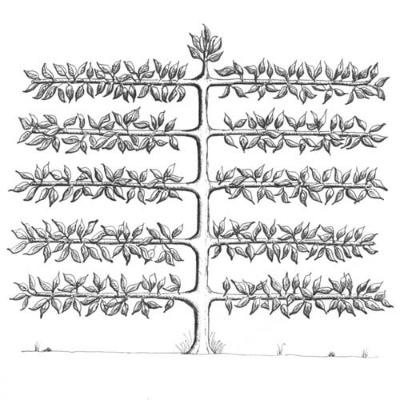
 

This drawing from Southern Living illustrates the cordon shape.  Of course few real trees have long arms that are as obligingly horizontal as this drawing would suggest-but this illustrates the ideal.  Branches and fruiting spurs off the main arms are kept closely clipped.  There is work to growing an espalier-but it is easy and satisfying work.  An espalier is a specialty landscape plant.  It is entirely friendly in even a small garden.  These trees are grafted onto dwarf rootstock.  They produce fruit.  The few hours spent pruning them feels good.
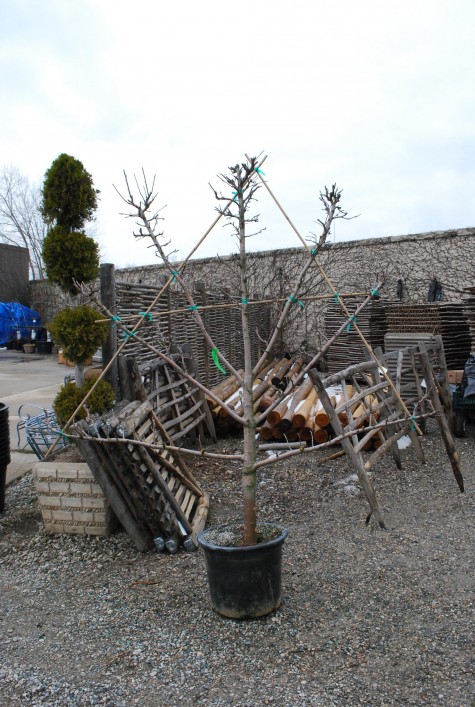
fan shape espalier

An espalier trained as a fan has arms that radiate in every direction from the central truck.  Those arms can be grown long on a big wall, or kept short in a confined space.  The bamboo stakes you see attached to this tree-travel stakes.  Every branch of every tree was firmly secured with bamboo stakes, to prevent any damage during shipping.  Though these trees are fairly old, they still rely on a physical support system to keep their shape intact.  Very long branches growing at wide angles are subject to damage, if they are not properly supported.
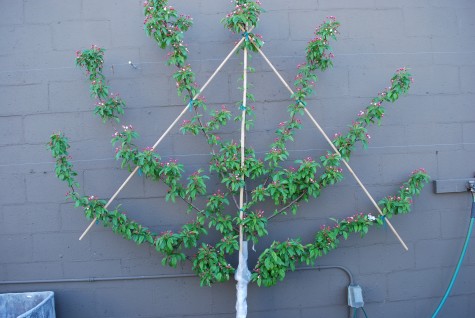
 

We have installed horizontal wires and bolts on some of the walls at the shop so we can display our espaliers.  The 3 bamboo stakes from the shipping phase have been left on, and will not be removed until the tree has been planted, and installed.  The process of giving an espalier a home involves bolts and ties into the supporting wall, or fence posts and wires for a free standing espalier. 
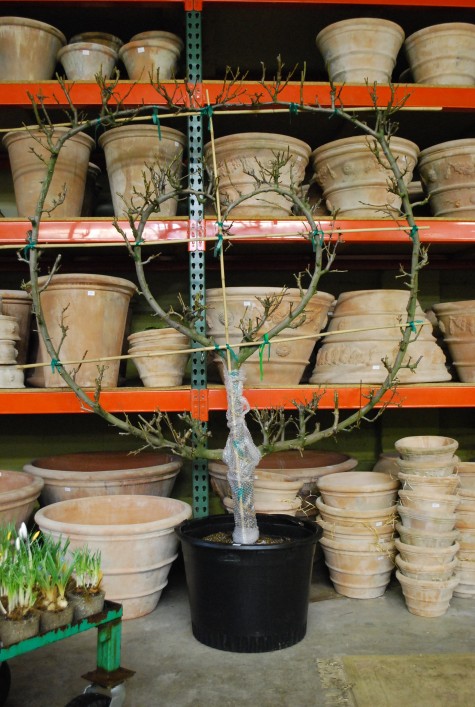
espalier forms

There is no classical precedent for this espalier shape.  It is entirely the invention of our grower.  A lively living sculpture such as this makes me want to grow espaliers from scratch.  Ours are old and established trees, but yes, they can be grown by any gardener from a single whip available from any number of fruit tree sources in the spring.  I was 35 when I saw my first espalier at Al Goldner’s farm-I still remember that day. It feels good,  carrying on, making these very special trees available years later.  This tree I call the wild at heart espalier. 
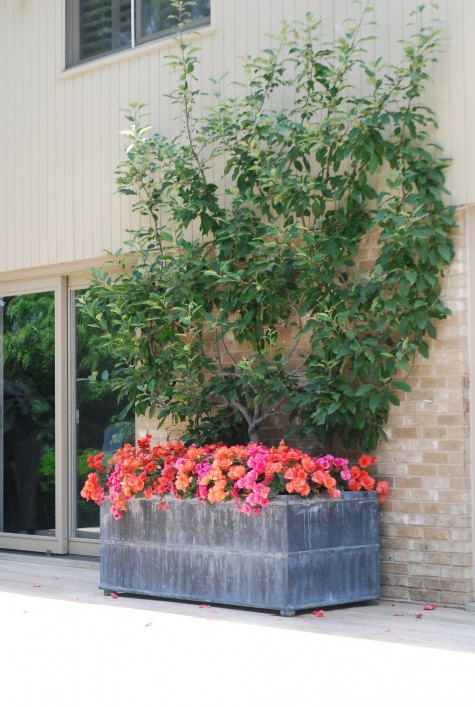
heart shaped espalier
My latest heart espalier is my 4th-I do not keep them for long.  This one, planted and successfully hardy in this large steel box for 4 years now, is happy, and grows vigorously.  This picture I took moments before its yearly haircut.  Wild at heart-yes!  A yearly haircut is not so much to ask in the way of care.  The pleasure?  Every day.  Every season.  Year after year.
 

Through The Lens


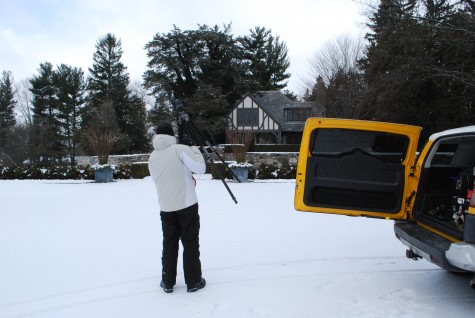
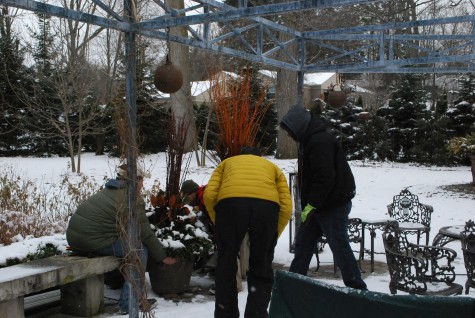
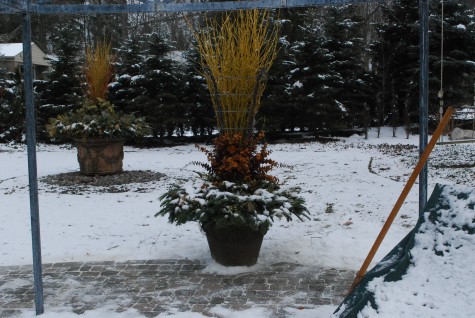
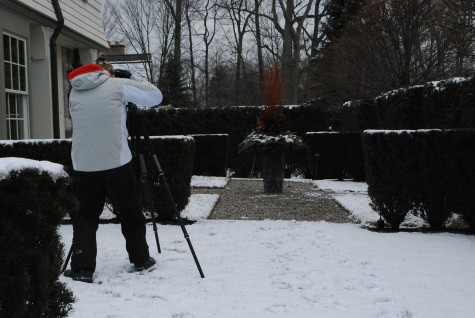
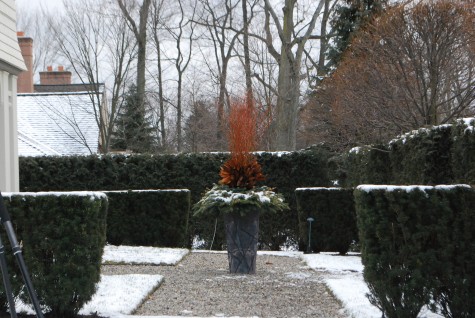
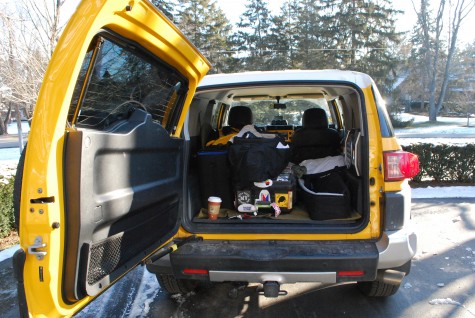
If you think the lack of posts in the past week means I must be on some late winter road trip, you are close to right.  The vehicle pictured above is not mine loaded with luggage-it belongs to Bob Stefko, a free lance photographer based in Chicago.  Better Homes and Gardens sent him over to photograph some of my winter pots.  “On assignment” means he travels with a truckload of photographic gear.  This shoot was scheduled for 9 locations-9 outdoor locations.  I was happy for the cold weather and snow.  But for that, the shoot would have been cancelled. It took a while to get permission from clients, check all of the pots, and assemble some props per the art director, and a crew to haul things around.  Once he arrived, it looked to him like it would take a day and half to take the photographs.  A day and a half for 9 pictures?  

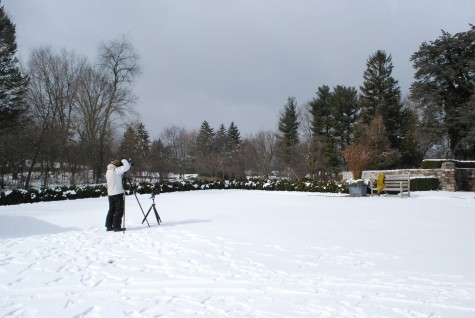
Bob obviously had experience “working on location”.  He arrived dressed in his snowboarding gear.  I would eventually envy him that outfit.  It was cold, and that cold seemed to sink in deeper every hour that went by.  Accompanying him to each location proved to be an education in what Rob calls magazine gardening.  No magazine wants to publish photographs that show any evidence of sloppy living.  Like the muck boots in a heap at the back door, or the newspaper in the drive. No dog toys, twig debris or automobiles allowed.   One of my jobs was to secure each site, so no one would spoil the new snow with footprints.  This is tougher than you think.  One mailman was very cooperative-one housekeeper glared at me, and marched up the front steps without one look back.  

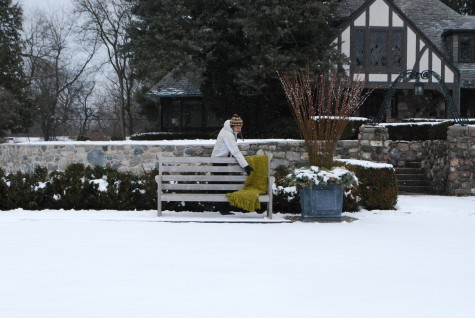
Scott Johnson, the Art Director at BHG, was skilled at getting me to fall in line with this.  He told me how much his 14 year old son enjoys fresh and unsullied snow.  Of course, I do too-I certainly did not want to look like a twelve year old.  It’s just a little harder to get that to work when it isn’t your house.  Only company uses this front door drivecourt-we were the first company after the snow.  Whew.  BHG wanted a bench that would keep this winter box company.  It could easily be that a small portion of one arm, and a glimpse of that wool throw will be all that remains of it in the final photograph.  But to get that arm in the composition, my crew had to carry it behind the boxwood, and lift it over and into place-no footprints in the foreground snow, remember?  The centerpiece got straightened straighter than straight.  The sinamay got fluffed, and some of the snow gobs were ground up, and sprinkled over the evergreen branches.  This took a surprisingly lot of time. 

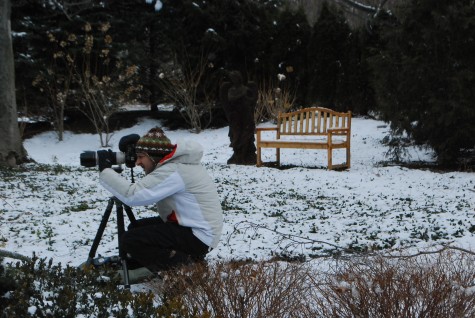
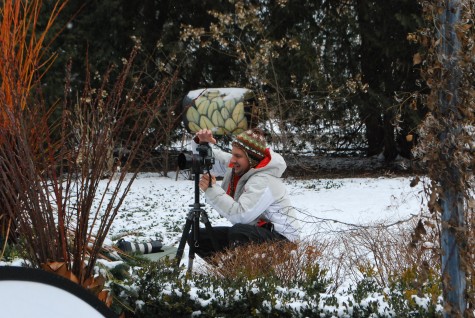
Bob took lots of pictures.  In some, his camera was held at his eye level via his tripod.  Some pictures got taken from a much lower point of view.  In the course of the 90 minutes we spent there, we had heavy clouds and snow flurries, sun, and partly cloudy conditions.  Sometimes he waited for the light to change or improve.  I get this.  The right photograph was now or never.  There would not be a second trip. 


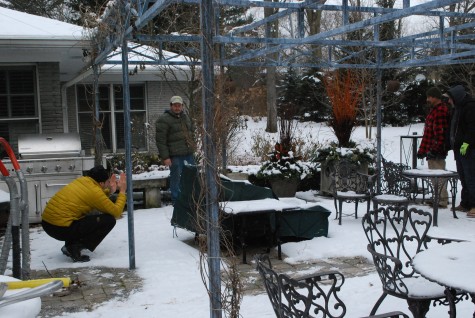
One location asked for the pots to be moved.  This is fairly easy to do, provided you have three people with lots of experience moving heavy things, and a hand truck big enough to move a good sized refrigerator.  That would be my landscape crew.  They were amused, and good natured about the events of the day.  Once the moving was done, we had to cover all of the tracks.  Snow was shovelled from the yard onto the terrace, and then swept off again. 

These pots had plastic irrigation lines in them that provide water to the plants in the summer.  Of course they were frozen in place.  I cut the lines, and made a note to be sure to get them repaired when we come to do the spring pots. (I hope my client is not reading this.)   

In hour number three, I was jumping up and down with the cold, but Bob was the consummate professional. I wouldn’t hear about the bloody cold until he was done for the day.  He did tell me taking photographs on location depends on solutions to problems.  In the studio, he is the weather maker.  By this time, my respect for landscape and garden photographers was on the upswing. 

I have 8300 pictures in the photo archive for this blog.  By no means did I work this hard to take them.  I have my camera with me all the time.  When the light, the plant, or the composition intrigues me, I snap.  My pictures are snapshots of a certain place and time.  What was going on here was the creation of an image that takes a garden to another level.  Nothing was happening here by accident.

He seemed pleased by what was going on-that’s all that mattered.  I have been involved in some photo shoots over the years.  I will confess I planted cut roses on a climbing rose for a photographer.  Do I mind this?  Absolutely not.  Every gardener hopes for a perfect moment.  Magazines do too.  A beautiful photograph can do much more to encourage me to garden than a list of must do’s and don’ts.    

I was relieved to arrive at one location that we both agreed needed nothing in the way of props.  I do dislike adding something to a landscape not intended and put in place by a client, but I also understand this is not about them, or me.  It is about an image that will enchant someone who has never been here before.


Though I am enchanted by this garden, I feel certain Bob’s photograph will be an object of beauty, all its own. I would venture to say he will transcend the subject and weather, and the existing conditions to create an image of note.  They send him all over the country to photograph for them-they do not do this without good reason.

At A Glance: Shipping The Eagles

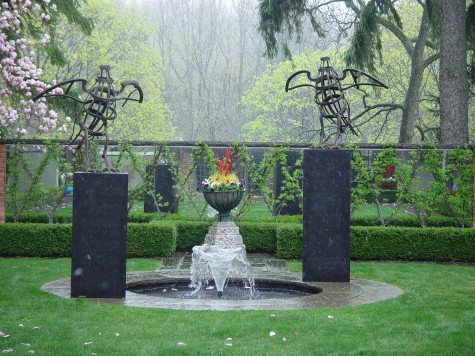
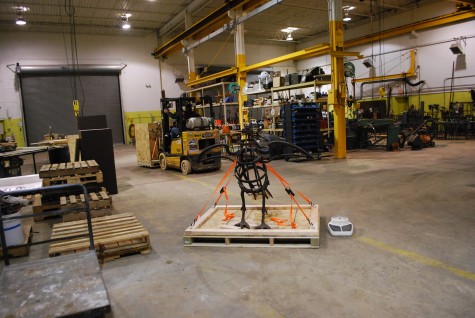
If you read this blog regularly, you may remember that I wrote a month ago or so about the sale of a pair of 18th century cast iron armatures which at one time were part of a pair of hand wrought and cast iron fully feathered eagles.  I was told they graced the roof of the Palais Royale in the 18th century-who knows if this provenance is truth or fiction.  In truth, I did not care about the provenance.  Though great age had reduced those birds to their bare bones, no garden sculpture known to me has ever made such a powerful and personal visual statement.  Though I can see right through them, they have incredible presence.  They speak much to life, age, aura, memories, gardens- and dissolution.  They are history represented in a way I cannot really explain.  I could have lived with them all my life.  But once I decided to buy and sell garden ornament, I knew there would be times it would be hard to let go.  In this instance, it knocked the wind out of me.   

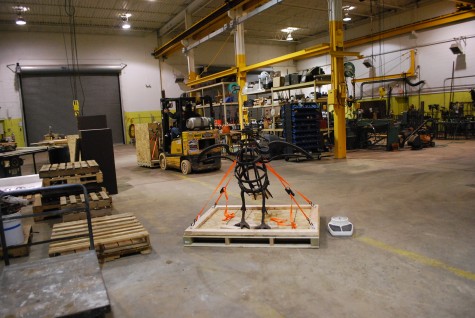
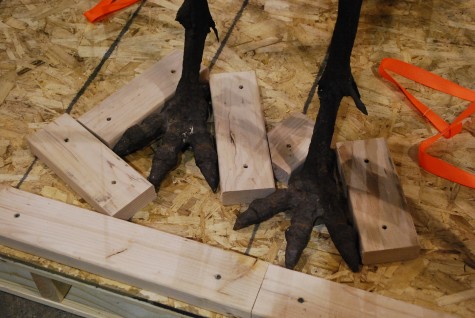
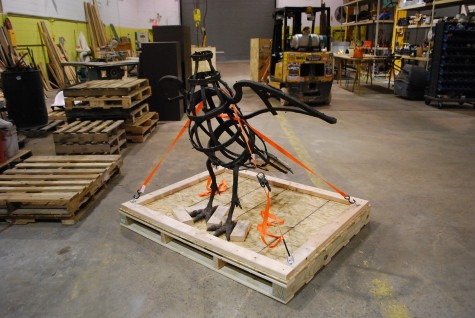
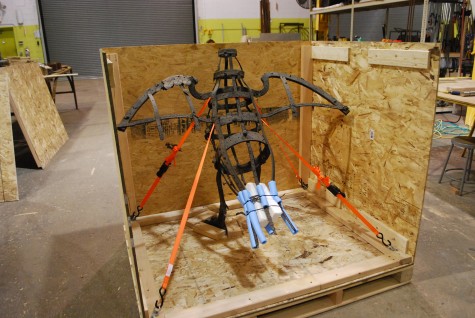
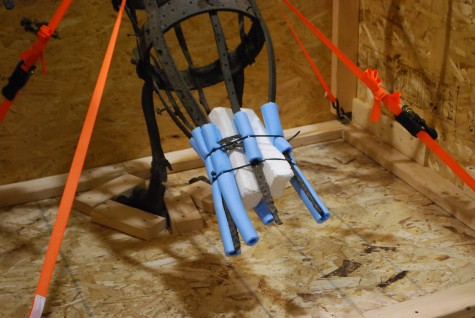
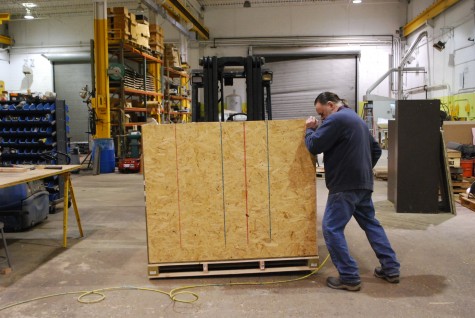
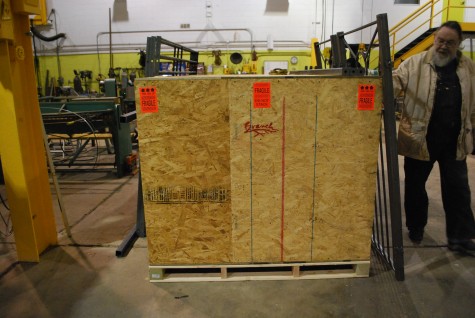
We finally had a call to ship.  Buck would crate them for what was the last leg of their long trip from Europe.  From Paris, to Brussels, to Paris, to New England, to me.  I only had them for a time-they moved on just a short time ago. I know the person who bought them, loves them.  That is enough.  They had travel ahead of them.  We wanted to be sure they would be absolutely safe and secure for that trip.

It took Buck an entire day to build the pallets and crates, and load them up for shipping.


The designer was kind enough to email me that they made the trip without a hitch, and were unloaded without incident.  I did respond with a request to see them installed in the garden.  This went unanswered-which I understand.  Neither he nor his client has any obligation to me.   I had them for what seemed like a brief moment. This someone new and unknown to me will steward them with the same care as I did-of this I am sure.  No one would buy these, unless they were sure they could not live without them.

At A Glance: No Snow


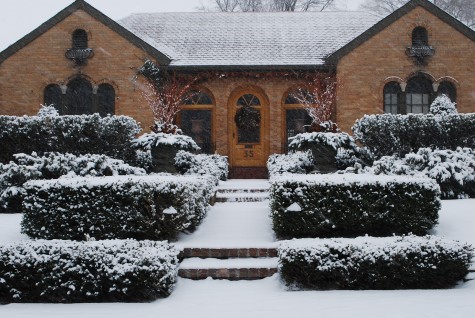
It has snowed twice this winter.  One furiously windy and brief snow the end of January.  And four inches, a couple of days ago.  Do I miss this?  The lack of snow, and the warm weather has been great-but unnerving.  If I ever experienced a winter like this, it was too long ago to remember. 

The snow does a great job of insulating garden plants.  A thick blanket of white keeps the ground evenly frozen, and all the plants in place.  Last week the buds on the espaliers we are wintering in the garage were showing green.  This alarms me.  It is not time yet to wake up.


We have been able to work outdoors this winter-that is unprecedented. The ability to install 2 pergolas, 2 fences, and 3 gates last week means we have a jump on finishing a project that did not get done last fall.  In a way, I felt deserving of the mild January.  Much of September and almost all of October was so wet we could hardly work.   

The new USDA hardiness zone map makes my garden out to be a zone 6a. I can remember staying away from perennials and roses that were not at least a zone 4, and I have subsequently felt like I was cheating planting zone 5 plants. And that sooner or later ,y cheating would be discovered, and the plants would die.  I guess all of that worry was misplaced.  But I am still uneasy about the lack of snow cover.  At least the very cold temperatures we have had lately were accompanied by 4 inches of snow. 

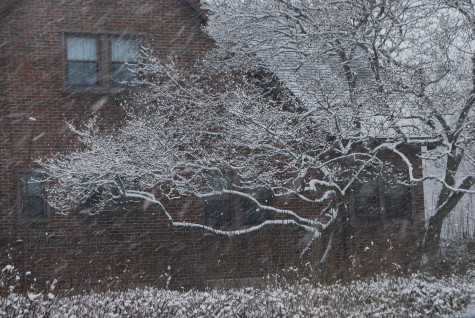
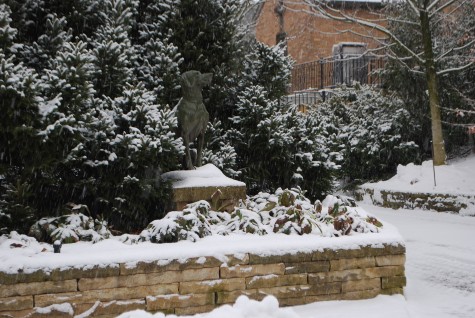
Snow on a garden can be beautiful.  If the design is sound, any weather in a landscape makes it look all the better. Gardens in northern climates ask for some structure, though a perennial bed awash in snow can be visually haunting.  

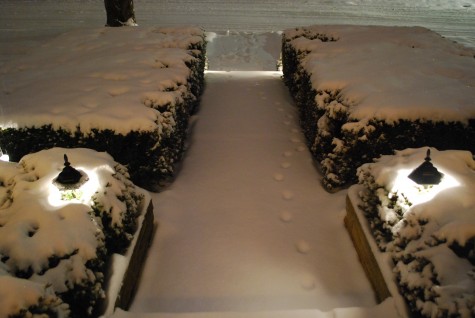
Snow means I have an idea about who comes to visit in the night on little cat feet. 

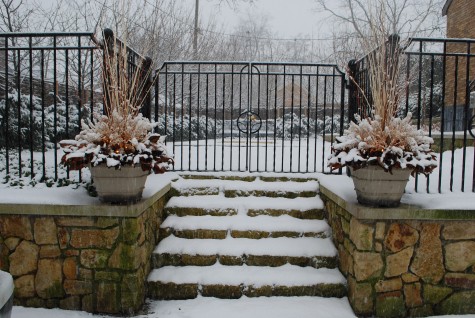
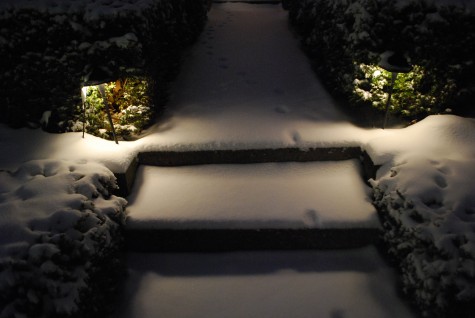
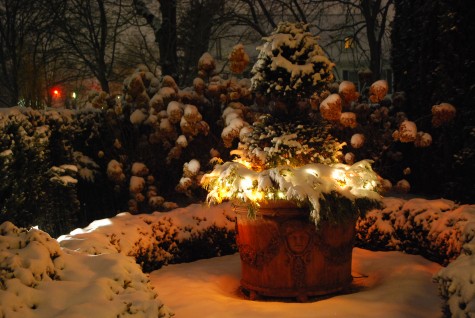
Containers can be quite beautiful with snow on them, especially if some provision for lighting them is in place.

But do I miss this?  Hauling my tripod and camera out to the bottom of these steps was a nuisance.  Most of the garden was buried in snow throughout January and February of last year. 

Winter does have its beautiful moments.  I hate to miss even one of them.