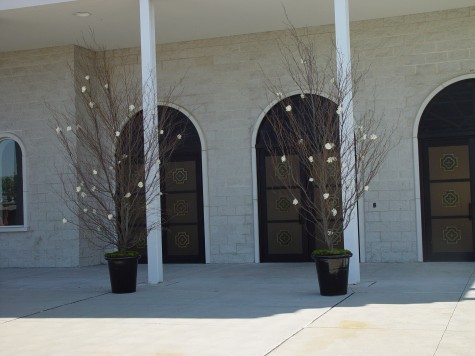
Fall weddings are not the norm for me; in addition, this request came from from gardening friends and colleagues. Jonathon Hofley, publisher of the well-known magazine The Michigan Gardener, and owner of Motor City Publishing, and his part-time art director and full-time firebrand fiancee Celeste were to be married. I instantly started fretting about what all from the garden would not be available for their date, but I need not have worried. Lucky for me, they liked the idea of sticks, grasses, mosses, vines and seeds-in season. Framing the doors of the church, starkly bare beech trees are set in pots finished in mood moss. These trees supported a smattering of white roses, visible from far away.
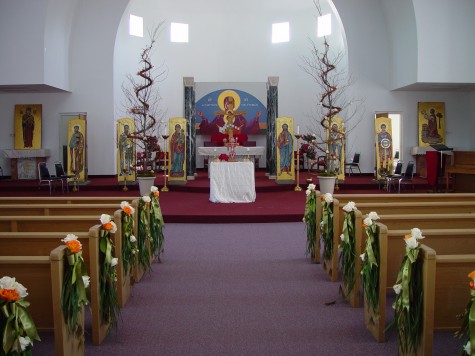 This gorgeous Melkite Catholic church needed little in the way of decoration; the beautifully vaulted white-walled interior was formally appointed with iconographic paintings of figures central to their faith. I found four 3″ beech that had not survived the season in my landscape supplier’s bone yard; they would be destined for another kind of life. Bare grapevine garland would be dressed up with bitterweet vine and the rose “Hollywood”. No other white rose opens so beautifully, and stays fresh longer, out of water. The pews we marked simply with sprays of grasses with seed heads intact, to which we added orange and white roses. The dressy olive green double faced satin formally acknowledged the space, and the occasion.
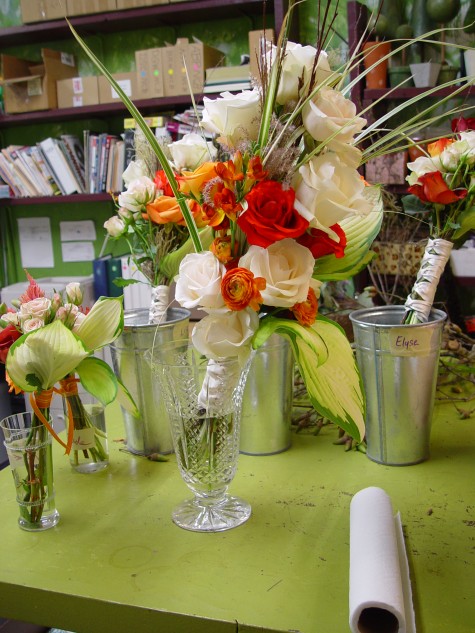 Even the bride’s bouquet included delicate birch branches. Variegated miscanthus grass and hosta complimented the orange freesia, ranunculus and roses. The bare stems were dressed in braided satin ribbon; the contrast in materials is particularly lovely.
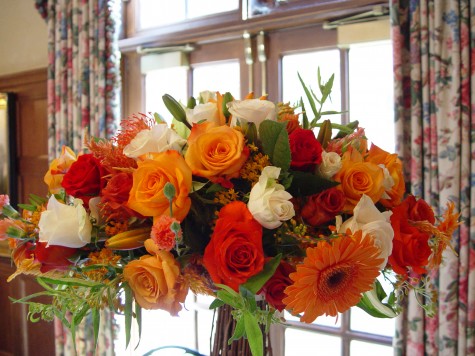
Shades of red, orange and white came primarily from roses; the season for garden flowers had passed. Always with flowers for a wedding reception is the crucial issue of placement. Flowers that obstruct the view across the table are unfriendly to conversation between guests. As reception venues are rarely personal, its important to create a mood and aura specific to the occasion that is evident upon entering the room. That first impression is important. How the airspace is handled creates an overall impression of happy anticipation at eye level for the celebration to come.
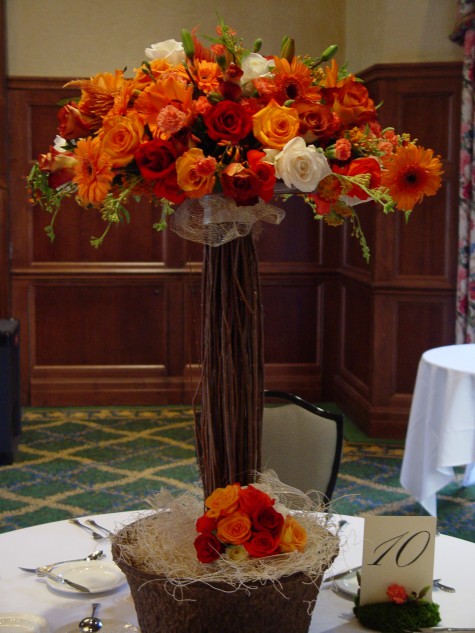 Stout bundles of willow sticks get my flowers in the air. The rustic fiber pots filled with hemp fiber make an unmistakable reference to the garden. The metal pole set in concrete not seen here is an apparatus which keeps the flowers aloft securely.
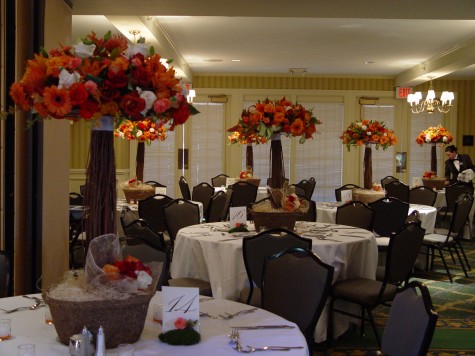 The generic quality of the room fades away; what is left is a celebration of saturated fall color, and a very important event involving family and friends. The tabletop level decor has interest and presence which will please the eye, but not obstruct anyone’s view.
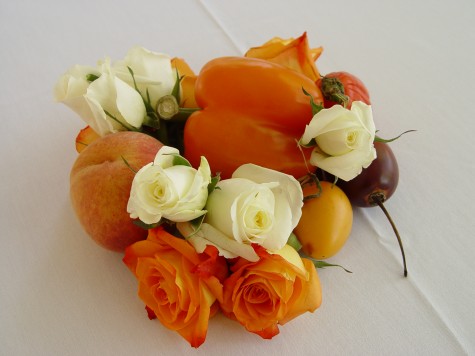
Bar tops were simply decorated with clusters of roses fruits and vegetables. Peppers and peaches take on an entirely different aspect, out of the garden or the kitchen. The ability to visualize materials out of context can expand your decorating repertoire. Orange bell peppers are not only delicious, they are strikingly attractive.
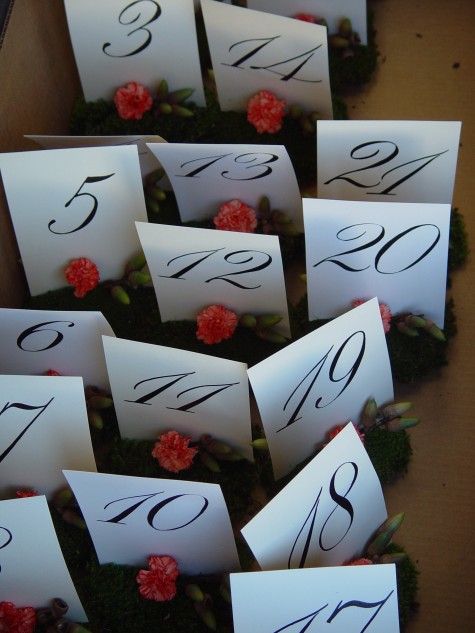 Celeste provided the table numbers, the calligraphy of her own hand. Large pieces of mood moss, when grooved, made naturally beautiful stands. The fresh green acorns-another nod to the season.
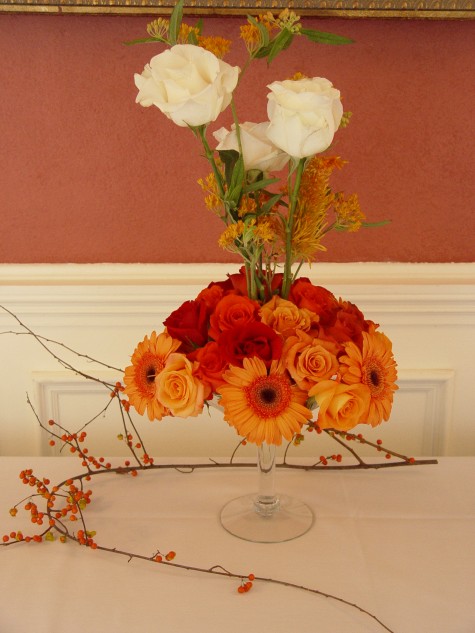 The effect of these flowers is so enhanced by the company of a length of bittersweet vine. The vine creates a visual context for the flowers. The creation of a visual world complete and believable is a daily challenge in the store; important events demand this too.
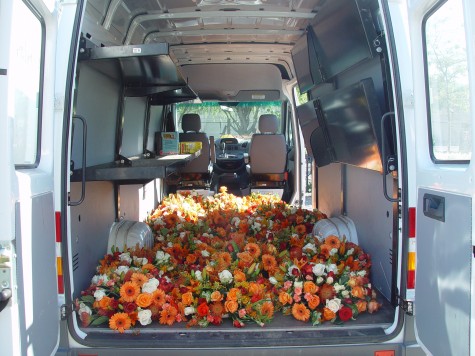
It is hard to go wrong with flowers-no one disputes how beautiful they are in their own right. But the support from the sticks enabled me to generate some atmosphere.
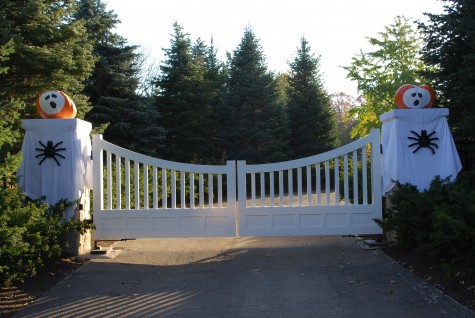
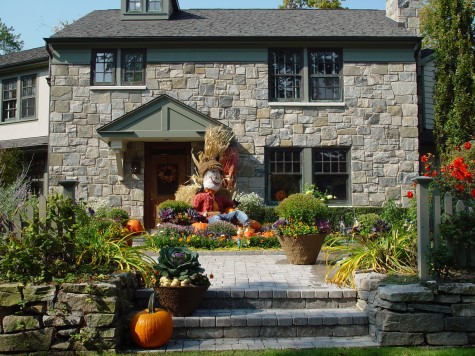
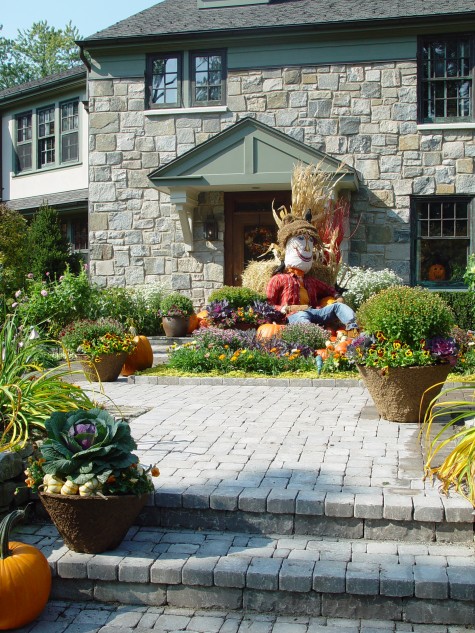
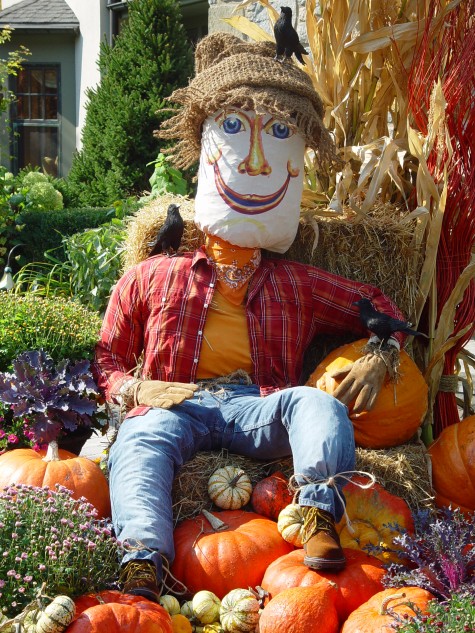
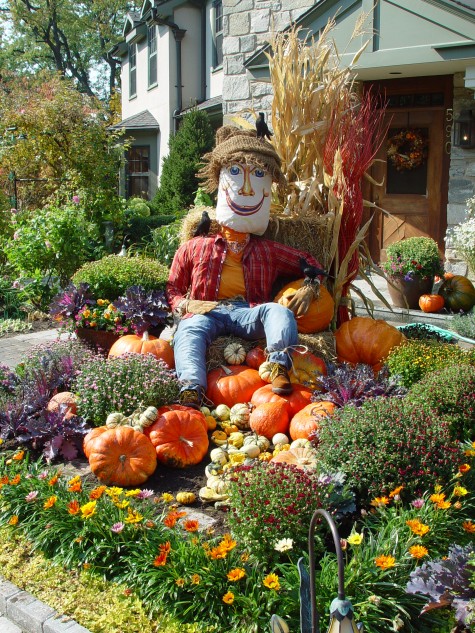 The centerpiece of my vignette-a straw scarecrow. He is not very scary-the crows are perched all over him. The clothes and boots were contributed from the lot of us; the face got painted on a pillowcase. His hat-some left over erosion mat from a hydroseeding job on a slope. He is one hundred percent straw stuffed-as he should be. The corn shocks add height, and set our fall figure down-he looks pleased to be settled in where he is. A hedge of gazanias knits everything together.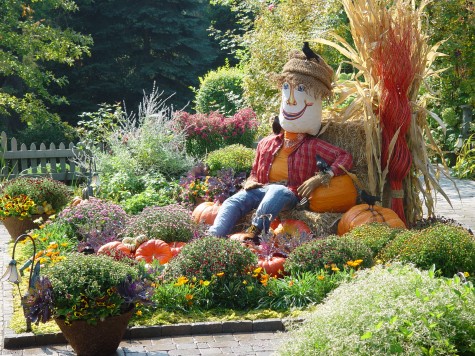
 As my clients were bound and determined that Allie, Snoopy and Vladdy would be members of their wedding party, their choices for a wedding venue were slim to none. I was happy for them to get married at the shop, and equally happy to welcome the canine members of their family. Since the decision was made some six months prior to the ceremony, I had the chance to plan a garden that would look great on their late, late summer date.
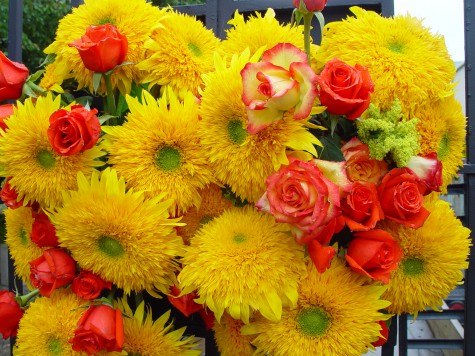
 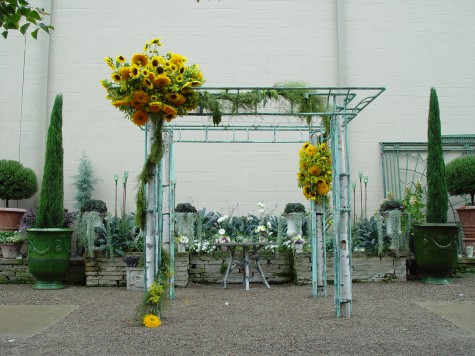 A copper pergola would provide the chuppah necessary for the ceremony. We infilled the poles at each corner with birch bark tubes. This blue and white scheme dictated the selection of plants as much as the season would. A collection of Italian cypress, giant rosemary topiaries, kales and cabbages would look swell come wedding time. Luckily a local grower has a very late batch of sunflowers, including the ultra double “teddy bear”. That intense yellow would warm up the arbor in a happy and sunny way. A goldenrod garland casually draped over the chuppah provided the roof necessary for the ceremony.
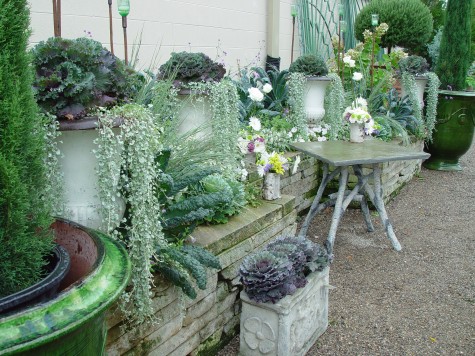 Silver dichondra has a distinctly blue cast; its diminuitive felted leaves were a great contrast to the giant blistered kale, “Nero di Toscano”. Short blue foliaged fescues, white million bells and showy oregano made good companions for the massive cabbages. White iron urns showed off the long tails of dichondra to good advantage.
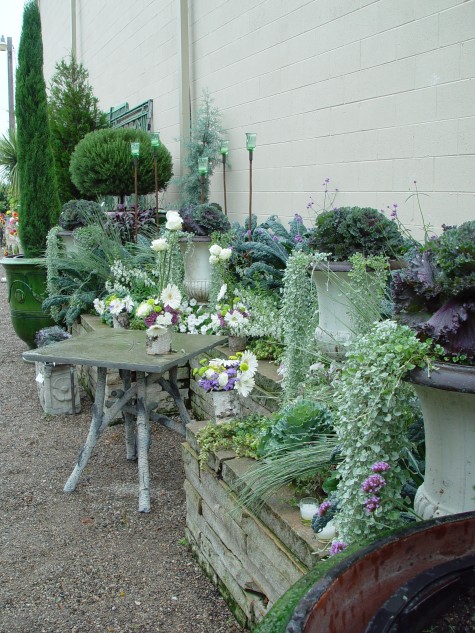 As the ceremony required a table be available for the Rabbi, my clients chose a carved concrete faux bois piece whose legs were carved and acid stained to look like birch. The wedding party flowers in lime green, white, and lavender repeated the color scheme of the garden. Is that old rosemary topiary not a dream come true?
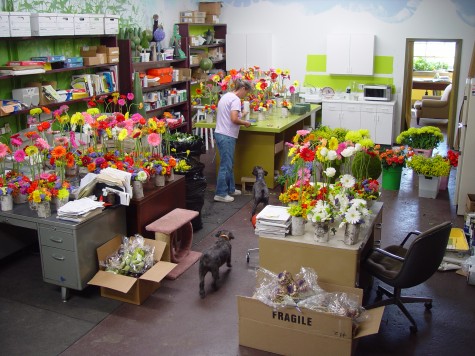 The plan for the reception involved nine 8′ long tables set end to end in the drive. Small glass vases covered in short birch bark tubes held late summer garden flowers available from the growers at my local farmer’s market. These 45 small arrangements centered on the tables would run for the entire 72 foot long reception dinner table.
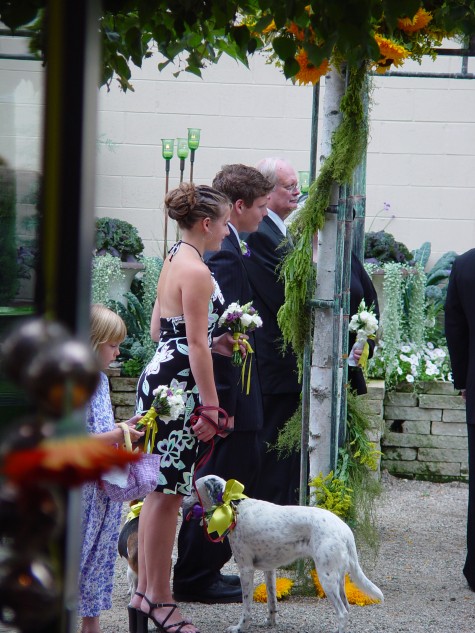 Allie and Snoopy were nervous, but they did take their big lime green satin bow and flower collars in stride. They did mill around-but just a little bit. All in all they were very well behaved.
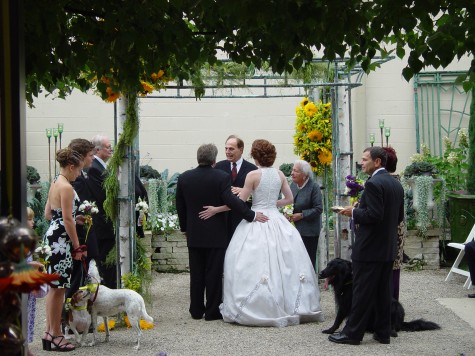 Vladdy was ordinarily fairly dignified and unflappable; he sat calmly through the entire ceremony.
 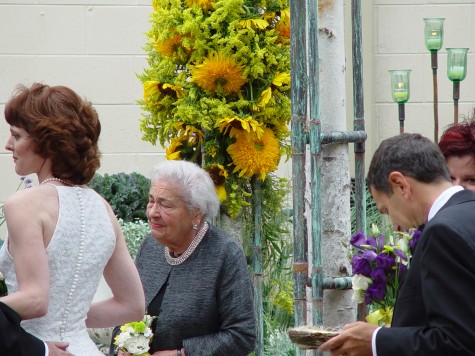 It was a beautiful wedding, and I was happy to have a part in it. There is something so satisfying about a small ceremony for everyone involved. When there are but a few details, every detail can be very personal and thoughtful. I think they were so pleased to be able to have their dog family there that day.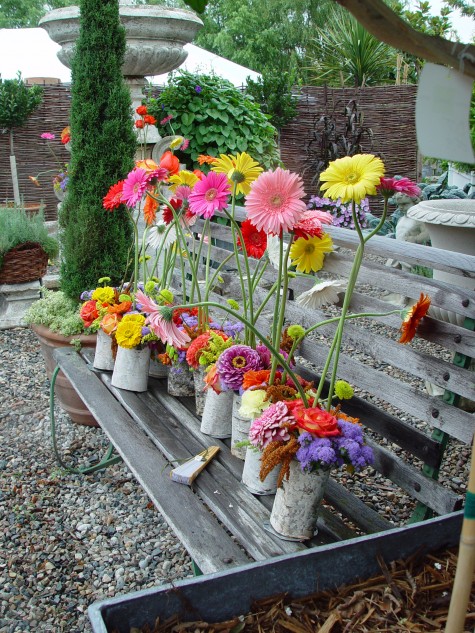
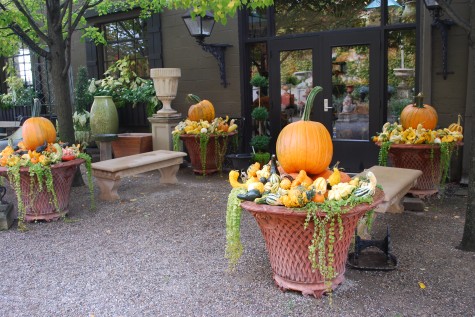
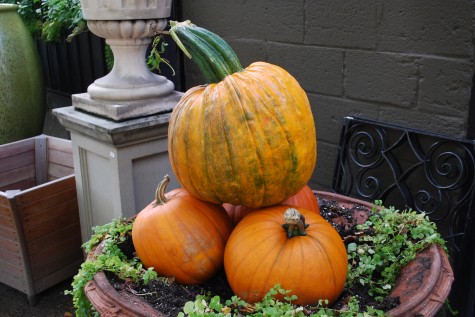 Whether I am drawing a plan, arranging some flowers, building a topiary sculpture, or staging a display, my first move is to determine the order of events. The big gesture comes first. In a landscape plan, I determine the center of interest, or organizing element, and place it. If it is a pool, that pool is assigned a size and a location; any other design is keyed to and in support of that initial decision. If the pool is centered in a space, I work from the middle to the edges of my paper. If that pool is located on a wall at the far end of my space, I would work from back to front, in tandem with establishing the views. As the topiaries that had spent the summer in these pots needed the shelter of a greenhouse, I had four empty pots in search of a reason to be. The idea of these pots overflowing with pumpkins squashes and gourds in some sculptural way had appeal. As these pots are large, a center of interest at a height pleasingly proportional to their width needed to be set first. I used a trio of medium sized pumpkins to get my big pumpkin with its giant stem at the right finished height.
 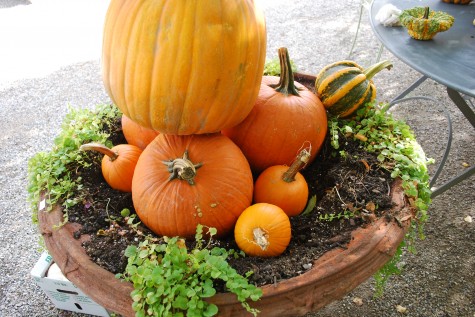 When working with rounded forms, it rarely works to use a filler material for height. Someplace your filler will show, and give the impression your slip is showing. Trying to cover up a not for viewing interior structure invariably looks like a cover up. Whatever portion of these support pumpkins might show in the finished piece, that portion will look like part of the arrangement. I would not have the faintest idea about how to turn pie pumpkins into pie, but I do know how to use them to provide crooks and crannies to set my prized specimen gourds. I set these beginning pumpkins at an angle which makes their swooping stems part of the action of the sculpture. This helps to make the sculpture look graceful. Every stem set straight up risks that soldierly, grocery store display look.
 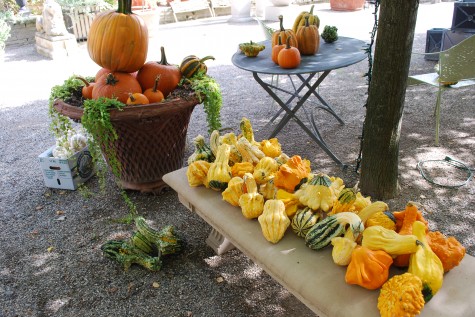 As I am interested in placing the largest gourds next, and then, arranging with color in mind, I need to look at averything I have available all at once. This can be quite a nuisance when building a stone wall, but I would not know how to construct it otherwise. In designing a landscape, a lot of shapes, textures and volumes need to be available to your mind’s eye, all at once. I am only good for a random thought that might be pertinent when I am tired; it takes energy to concentrate enough to turn off the daily noise and design. This is easy-get the gourds out, and spread them around.
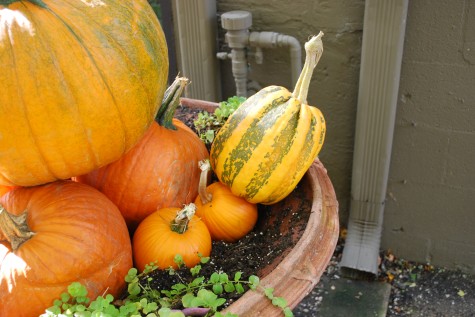 My big beautiful squashes get placed next. When I look at the four pots from the drive, I see that the pots furthest from my eye will need more emphasis than the pots close to my eye; bigger material is a good way to get what is far away to read better. A small pie pumpkin enables me to tilt the squash out over the edge of the pot, and feature the stem.
 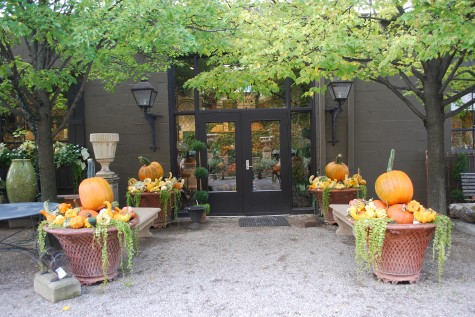 I finish placing all the large gourds, and stand back for a look. Though not so readily apparent in this picture, I have placed more of the pale or light colored gourds in the rear pots, and the darker colored gourds in the front pots. Dark colors do not read well at a distance, so placing them up front makes the detail of their shape and color read better. Pale colors read fine at a distance, and highlight dark colors placed in front of them. The pots are ready for the little bits-the smallest gourds finish and refine the shape of the overall arrangement. In a landscape, I might be planting roses at this stage, or groundcover as part of the finishing touches.
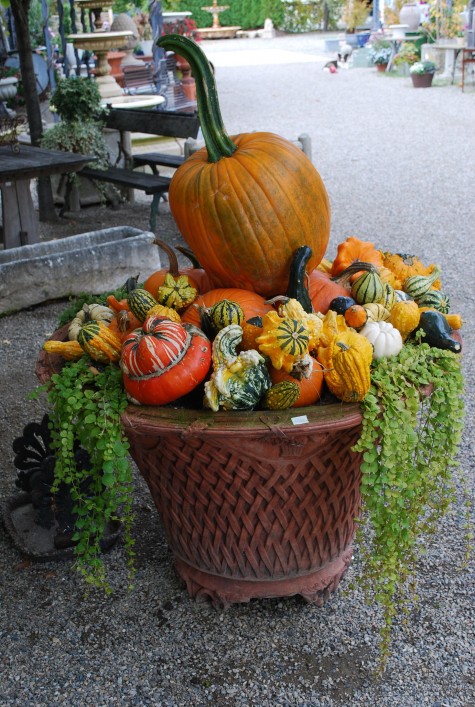 The idea is suggest a casual and not too fussy an arrangement. In fact, ordering the placement of sizes permits an arrangement where all the pieces are built sensibly from a large base supporting the fine detail-both visually, and physically. In a large flower arrangement, the interlocking big stems under water provide a framework that will hold the smaller stems where you want them. In a landscape, a long walk indicates how a garden is meant to be experienced-but it also provides weight and organization to the smaller elements you otherwise might not notice. All the elements of any composition need to interlock for a strong presentation of the whole. This front pot features dark and intense colors, with dashes of pale colors here and there.
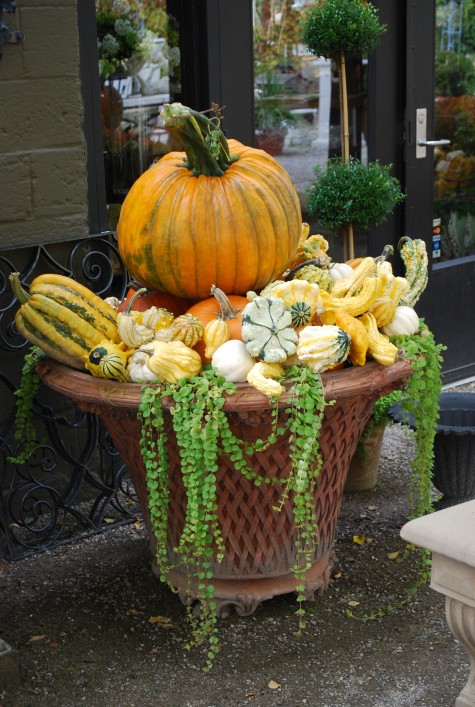 This rear pot set in a much darker environment relies on the interaction of pale colored shapes for good visibility. The varying shapes and colors of all the little noisy gourds emphasize the mass and grace of the shape of my starring pumpkin.