Bringing The Garden Indoors: Part 1


I am no fan of plants in the house.  Once the gardening season comes to a close, it is a relief not have to worry about keeping plants alive. Plants inside the house-what could possibly be more unnatural than that?  Would I really subject a perfectly well meaning and decent plant to the dry heat and lack of sun that characterizes an interior space?  Perhaps this is wrong, but I like the separation of my gardening life, and my personal life.  OK, my gardening life is my personal life, but the thought of a winter getaway from the demands of the plants is attractive.
I have a very good friend whose house is loaded with all manner of tropical plants.  Julia does a great job with them, and I marvel at how she is able to keep all of them looking great.  She cannot bear to be without the garden for any longer than a moment; her house/conservatory is proof of that.  I think if she had her choice, she would live in a conservatory situated in the middle of a giant property.    

 I have had friends bring me plants for the windowsill behind my desk.  One Valentine’s day my landscape superintendent gave me a dozen auricula primroses-how I love them. I spent a whole winter doing watercolor paintings of them, such is my enchantment with them.  It took me 3 months to kil them, but kill them I did.  Stationed in the windowsill behind my desk, I could not remember to water them until they were in a state of utter dessication.  After too many water crises, they finally gave up on me.  
 My friend and  grower Marlene Uhlianuk, whose unusual plants and vegetables are a mainstay of my local market, gave me a pot containing the smallest rose in the world.  She insisted it would be easy to take care of.  On my window sill.  It took a few months to prove her wrong, but prove her wrong I did.  I still feel guilty about it. 
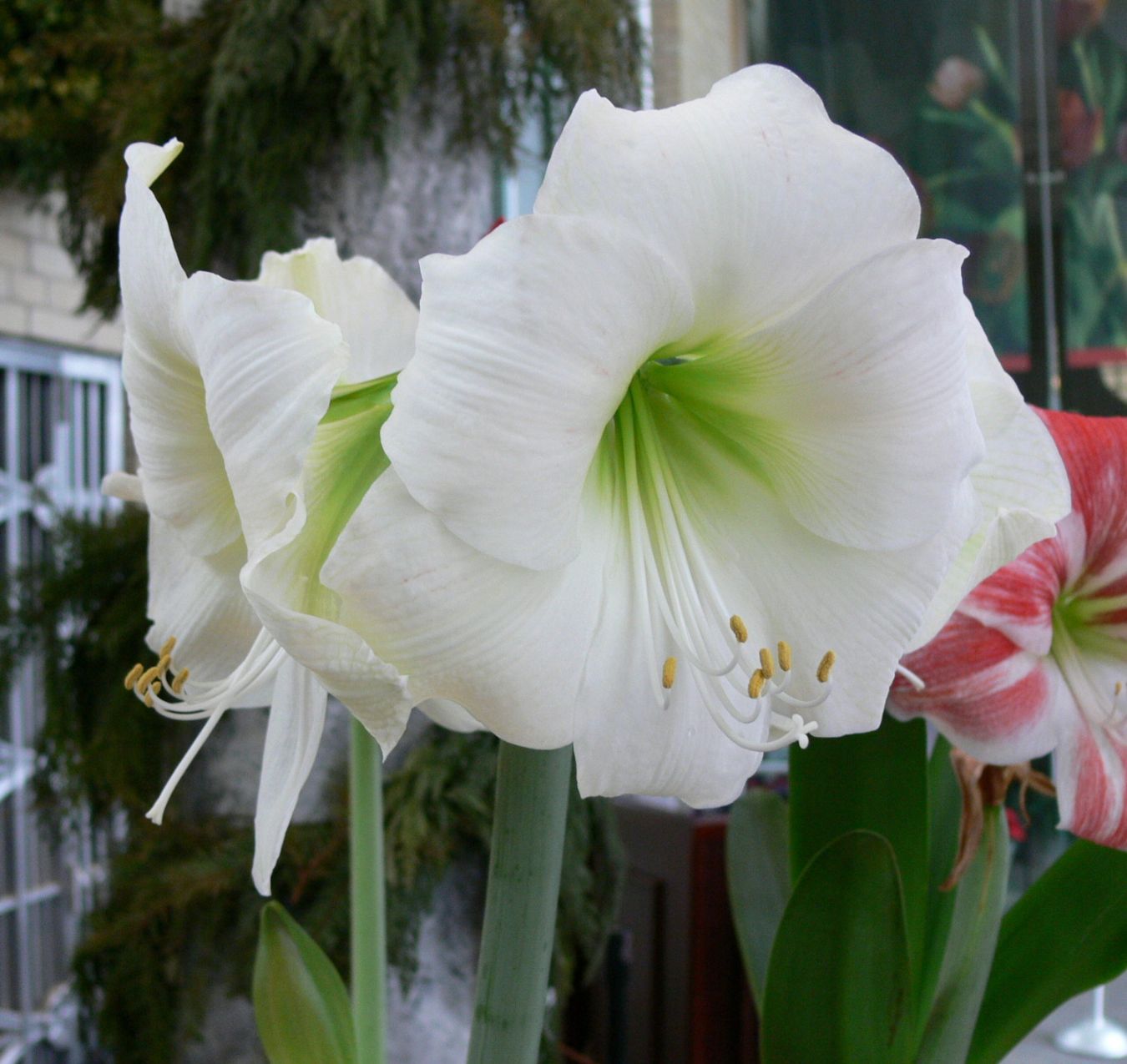
Though the thought of trying to keep tropical plants alive, inside over a winter leaves me absolutely cold, I can be seduced.  By amaryllis, that is.  Bringing on amaryllis bulbs indoors late in the gardening year-a means by which even I can bring the garden indoors. 

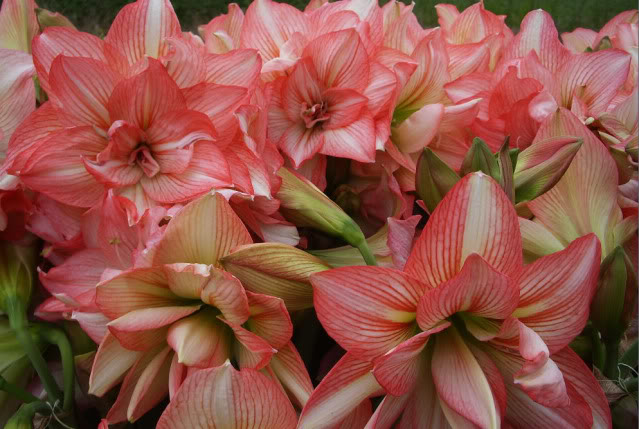
 The bulbs are enormous.  The bigger the bulb, the more stalks, and flowers.  The blooms are just as enormous-startlingly so.  There are miniature varieties, like the amaryllis “Evergreen” pictured above.  Though it is a miniature, it’s effect is anything but.  Amaryllis is a very small genus of flowering bulbs made up of just two species.  Amaryllis belladonna is a species native to South Africa.  The taxomony aside,  these hefty bulbs can produce flowering stalks from December until April. 
Potted up, a solid two-thirds of the bulb needs to be above the soil line.  This makes sense-big juicy bulbs have no need of too much water.  As for “planting” amaryllis in soil in clay pots, with 2/3’s of the bulb above ground-this leaves me cold.  I don’t have a conservatory or greenhouse, just a house.  My idea of a household is a space unsullied by dirt.  Apart from what the corgis track in, that is.  Forcing bulbs in water is an alternative that sounds good. 
  

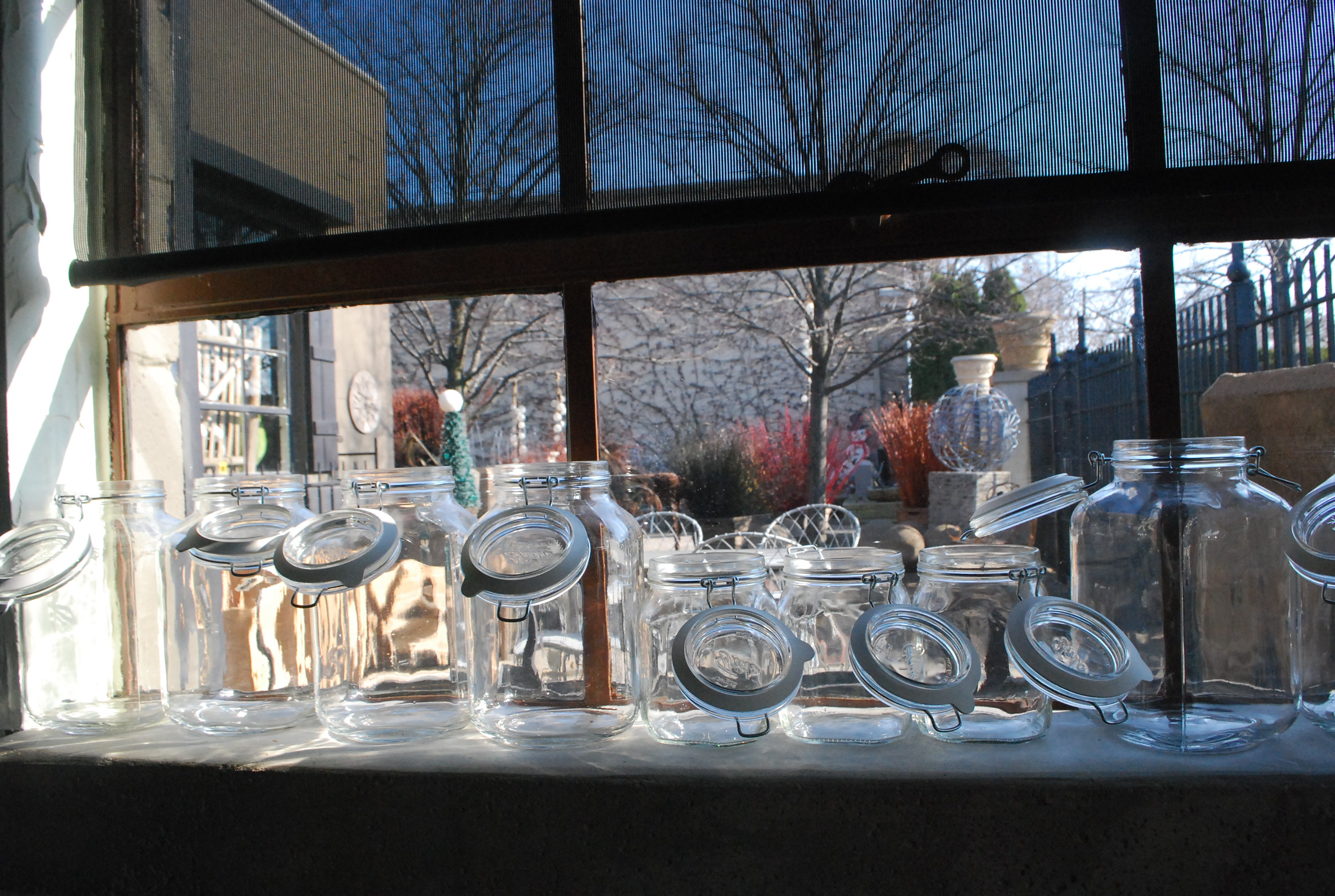
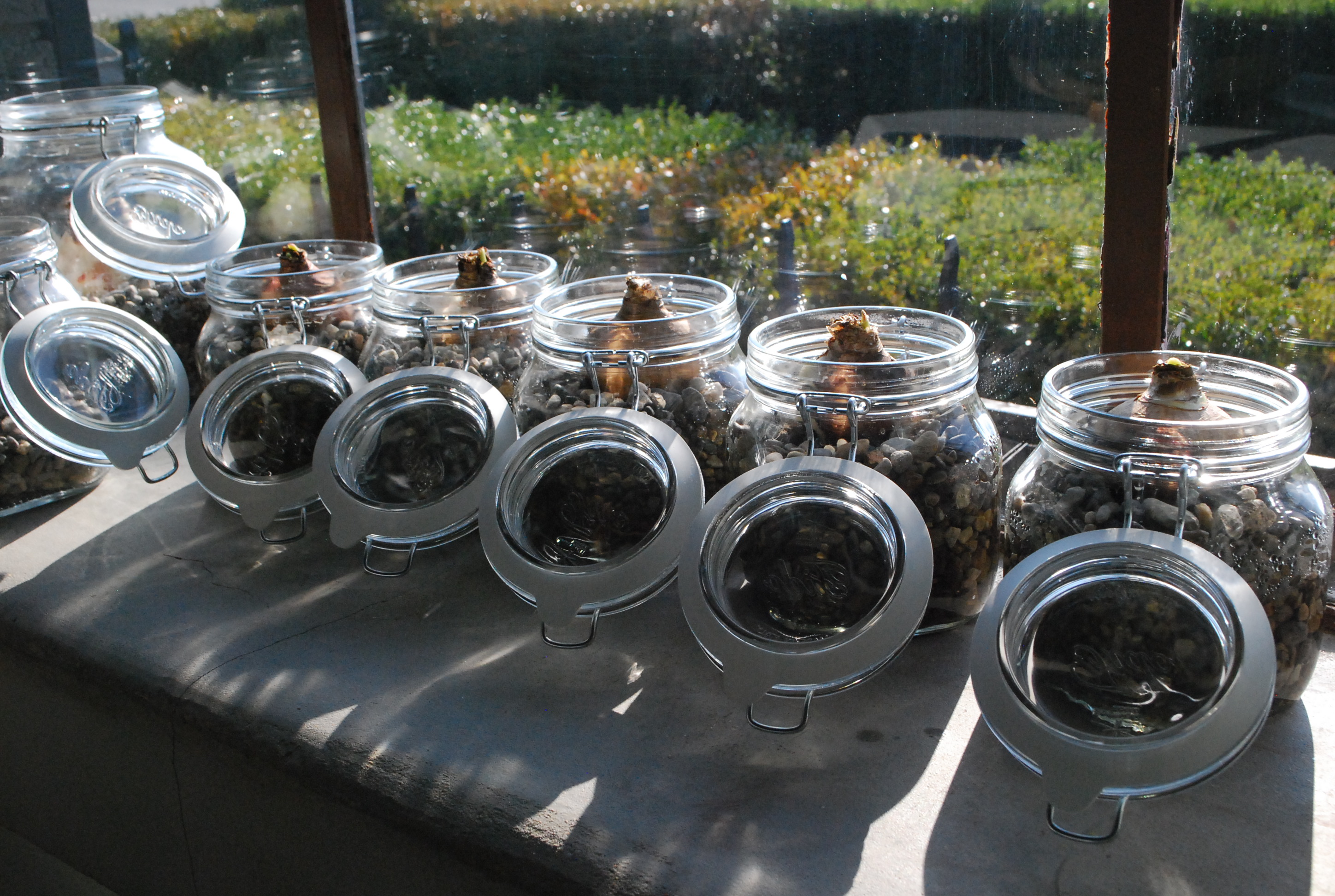
I like to grow amaryllis in water.  Water gardens are perfect for people who cannot remember to water-both inside and out.  A jar, a bulb, and a handful of stones is a simple and easy means of bringing the garden indoors.  The jar, and the stones-entirely up to you.  Rob bought canning jars for our amaryllis this year.  The capped jars from Fisk are so beautiful.   I am dubious of any idea about which might make my winter easier.  But in truth, the process of bringing the amaryllis into bloom indoors-simple and satisfying.

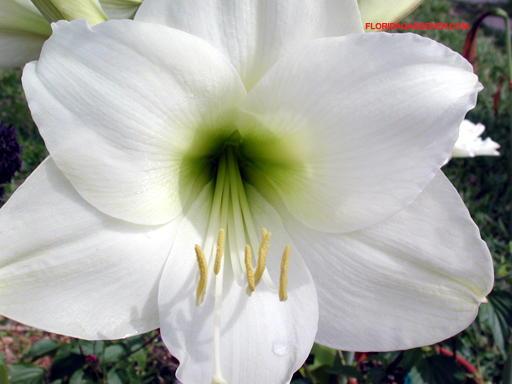
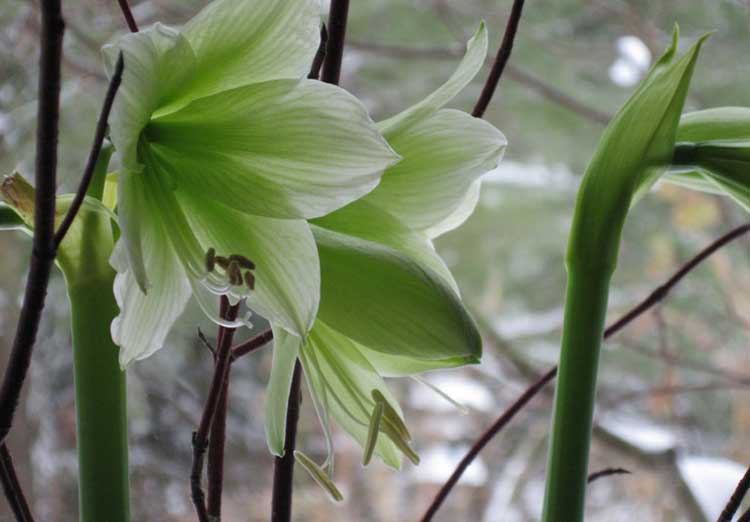
 The amaryllis Baby Doll is white, with the slightest hint of blush pink. If these pictures do not make you long to grow some on your windowsill, then nothing will.  The reward for your effort is considerable.  If you follow a few simple rules, amaryllis can be grown on, and kept for years.
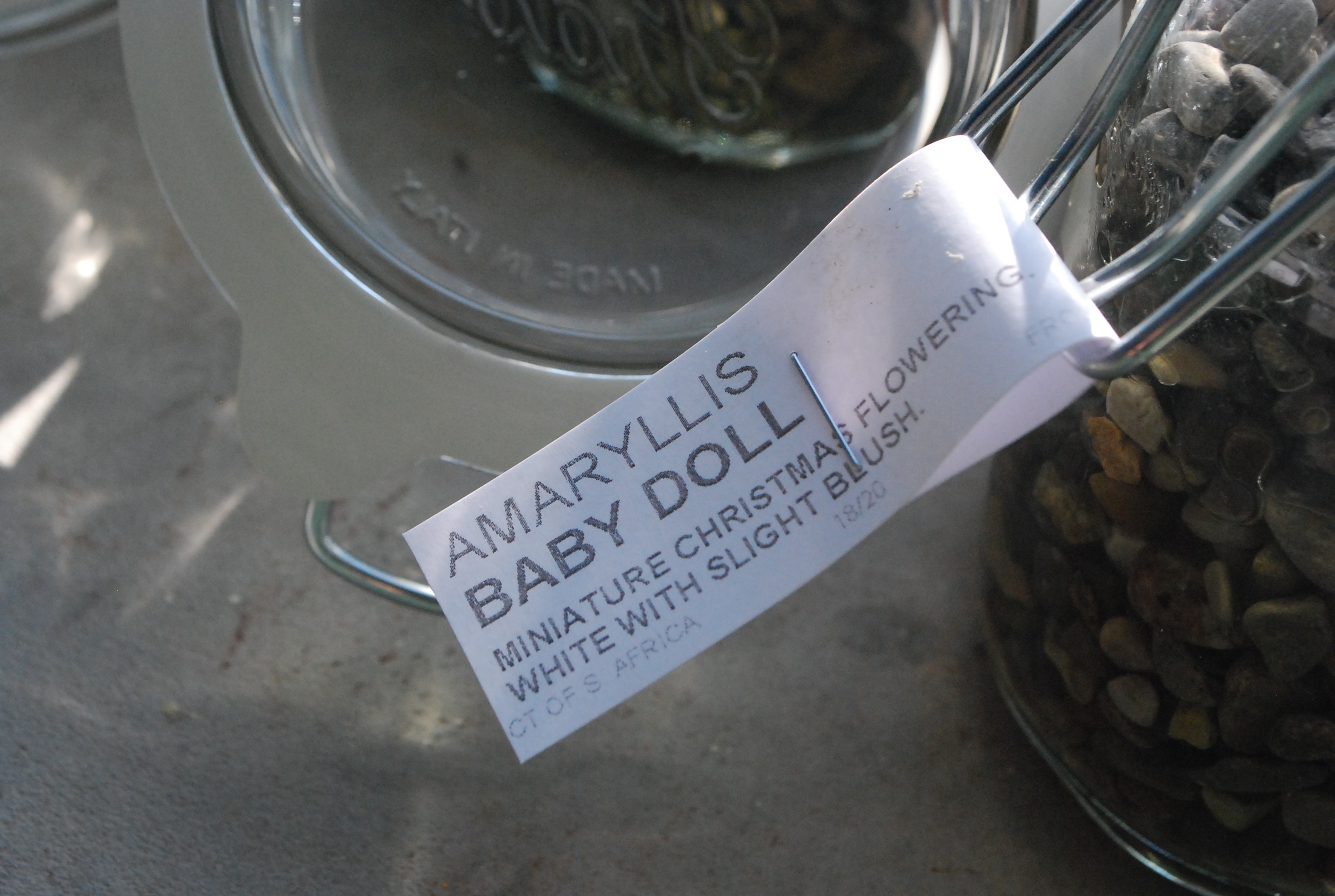
Grumpy about the passing of the gardening season?  Growing amaryllis is guaranteed to help with that.  Set the bulb low in the jar.  The rim of the jar will help hold the heavy flowering stalks aloft.  Add water to just below the basal plate of the bulb-the water is for the roots to reach for.  Soaking the bulb itself in water is asking for rot.  Provide a warm place.  Amaryllis bulbs are ready and waiting to grow and bloom, meaning that even a haphazrd effort will probably produce flowers.  Not interested in hauling in jars and bags of stone?  Rob has all of these amaryllis ready and waiting.   


Say Good Bye

Don’t you despise it-saying goodby? 

 Finishing a good book is a mixed blessing.  As much as the resolution of the story is eagerly anticipated, the closure is tinged with regret.  That experience has regretfully come to an end.  How many times did you read all of the Wizard of Oz books, hoping for yet another sequel?  Frank Baum reluctantly wrote several sequels to his first book of Oz-children everywhere did not want the story to end.  At one point, he wrote that Oz had lost touch with the world-there could be no more books.  The hue and cry was such that he wrote a new Oz book every year until his death in 1916, making 13 sequels to the original Wizard of Oz in all.  After his death, his publisher engaged the writer Ruth Plumly Thompkins to write another 21 Oz books.  There was a new book released every year at Christmas from 1913 until 1942-imagine.  35 books were written in all, as no child who read them ever wanted to say goodby.

I am sure you know where this is leading.  Though I have had gardened through 36 seasons, I still hate to say goodbye.  There are plenty of signs that make point to the end.  In a good year, the woody plants slow down gradually, so the state of being awake, and the state of being asleep is about the duration of a heartbeat.  The annual flowers fade.  The leaves turn color and finally drop.  The shortening of the day length is so gradual that the first day it is dark at 5pm is shocking to the bone.

But for a few cold days, we have had a long and mild fall.  Until just a few days ago, a neighbor had thick gorgeous hedges of mixed dwarf marigolds blooming.  My Japanese anemones went on and on.  However, the last sequel to this season is just about to come to a close.  A shockingly low 23 degrees yesterday made for an abrupt end to that long slide towards the end.

It was 33 degrees all day today.  My insulated fall jacket fell far short of keeping me warm.  Outside without gloves on, it felt like hands were about to fall off.  The perennial garden has been cut back to the ground.  The leaves from all of the trees have been collected, and added to a giant pile at the landscape yard.  Even the parrotias are shedding their leaves. 

 On the deck this morning, an ever so thin dusting of snow.  The sky was an unvarying shade of light lead all day.  The wind was biting.  All of the tulips are in the ground-where it is warmer than the air temperature.  They are rooting-not growing.  The trees are dark and skeletal.     

It is not my idea to leave any gardener with an image of dark and skeletal. The spirit of the garden can go on.  What goes on outside can come inside.  The memory of the garden can powerfully inform and lighten the burden of the winter season.  More on this to follow.


Coppice Wood

Coppicing is a traditional method of producing long straight woody stems by cutting a tree or a shrub back to the ground.  Many varieties of woody plants respond to this drastic treatment with vigorous growth-from the ground.  Coppice wood was used to provide firewood in European countries where the number of trees were vastly outnumbered by a large population requiring fire for cooking and heat.  Shrubby trees wre planted on the perimeters of farms; regular coppicing produced densely twiggy living fences.   

The new shoots emerging from the stump of a tree grow long and straight.  The juvenile growth is vigorous, and the color is vibrant.  In England, the coppice wood from the sweet chestnut tree is still used to make fencing and fence poles for livestock and poultry.  The sweet chestnut is coppicied on 12 to 18 year cycles, and then harvested to make fencing and gates.  The poles come from coppice wood which is allowed to grow upwards of 30 years before cutting. 

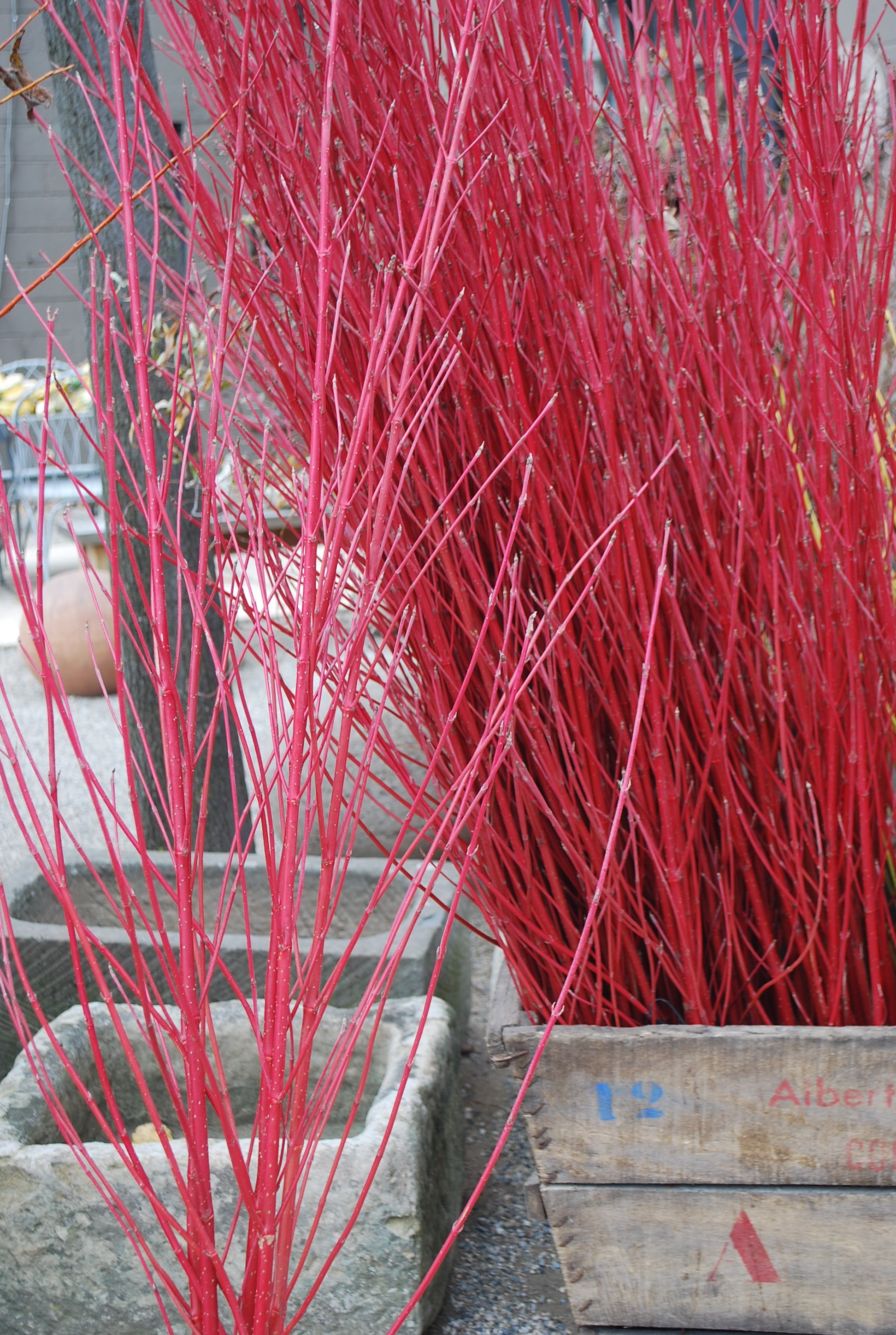
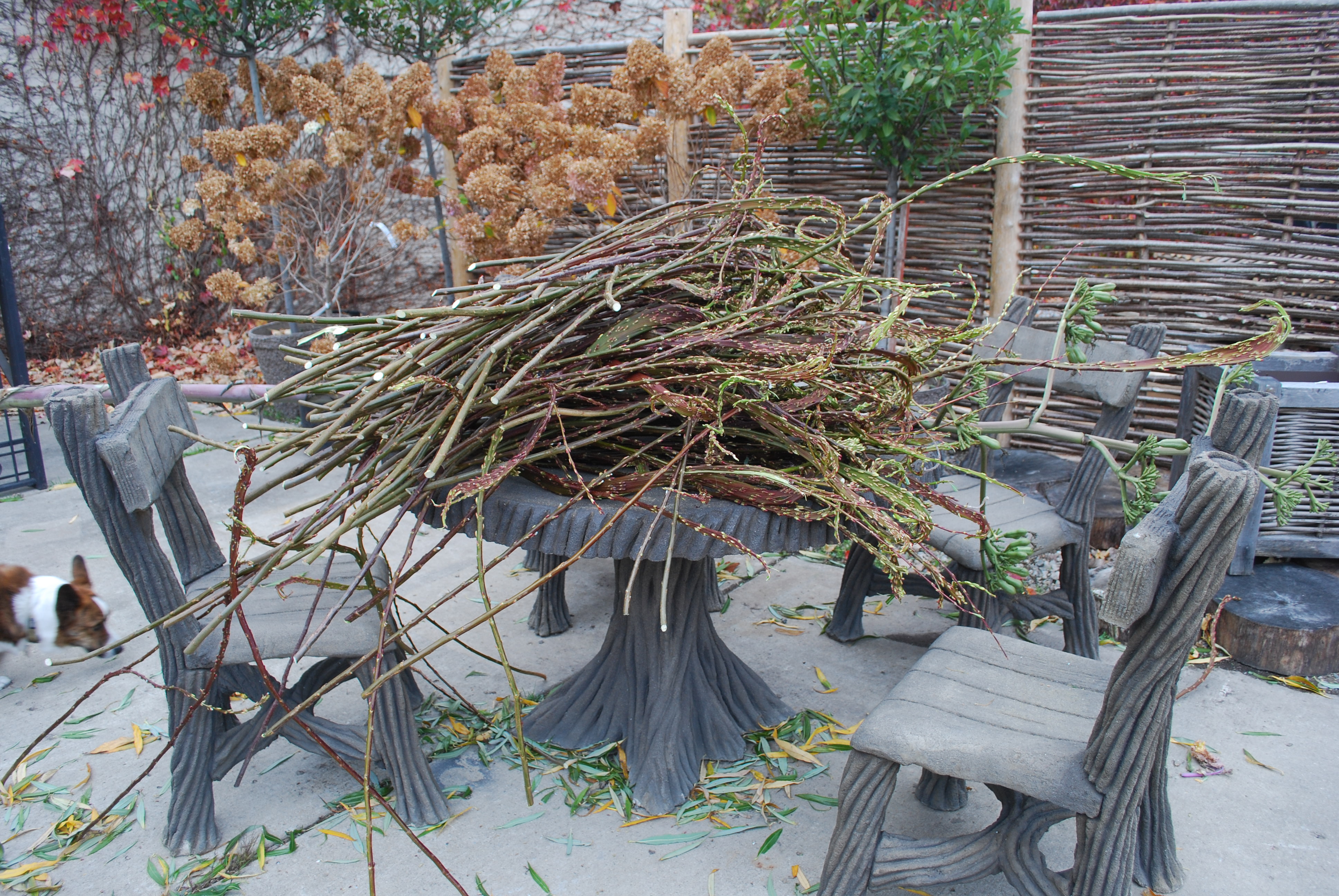
The fresh cut twigs which arrive at the shop in early November are grown by farmers who plant their shrubs in rows or blocks, like crops.  Large fields are harvested in rotation, so every year there is a crop of long straight stems.  Many of our twigs come from varieties of salix, or willow. Every gardener knows that the new or current year’s growth on a red twig dogwood shrub has the best color.  Mature stems become woody, and the color dull.  The new bark of coppice wood is lively.  Newer cultivars of the redtwig dogwood have better and brighter color.  The coppice wood of this redtwig dogwood cultivar is known for its especially brilliant color. 

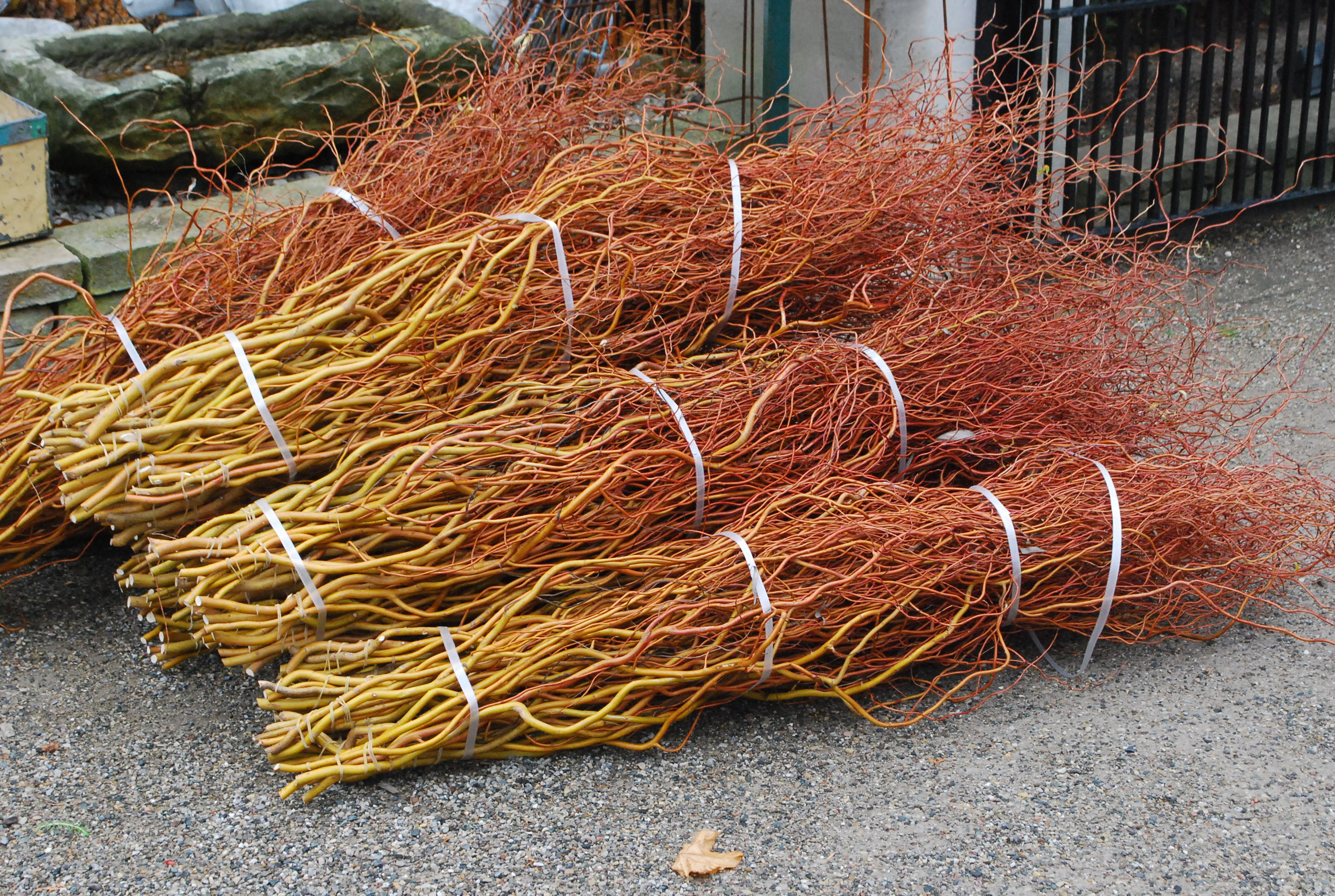
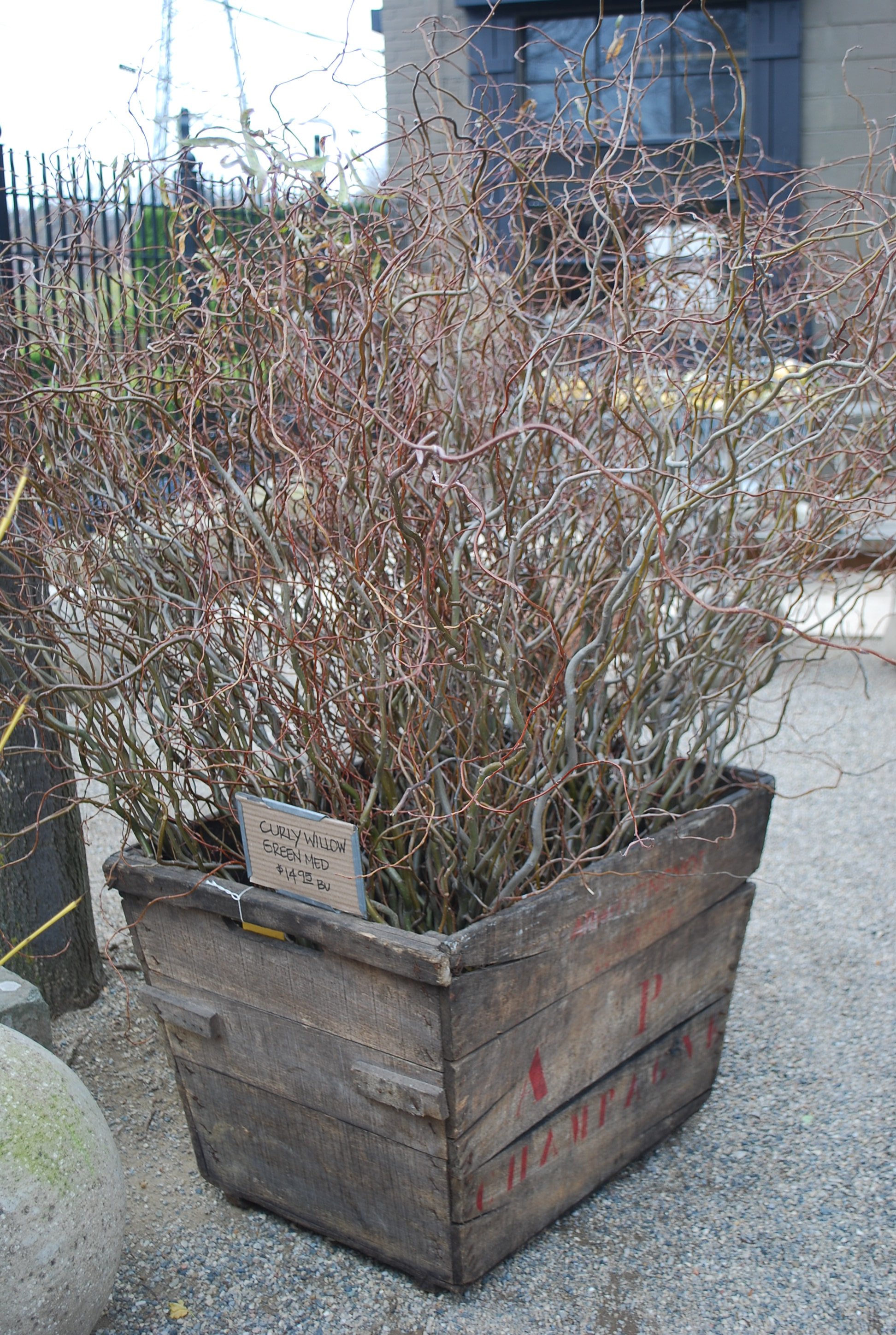
Once the leaves fall, those twigs which are ready are harvested, sorted by length, bundled and shipped.  Most bunches are 10 stems, except for the curly willow.  The winter color of curly willow stems is subtle, but no so its shape.  The curving and curling stems provide lots of volume-these voluminous bunches are usually 5 stems.  5 stems of this gracefully airy and unpredictably curving willow can endow a winter container arrangement with lots of rhythm and movement.

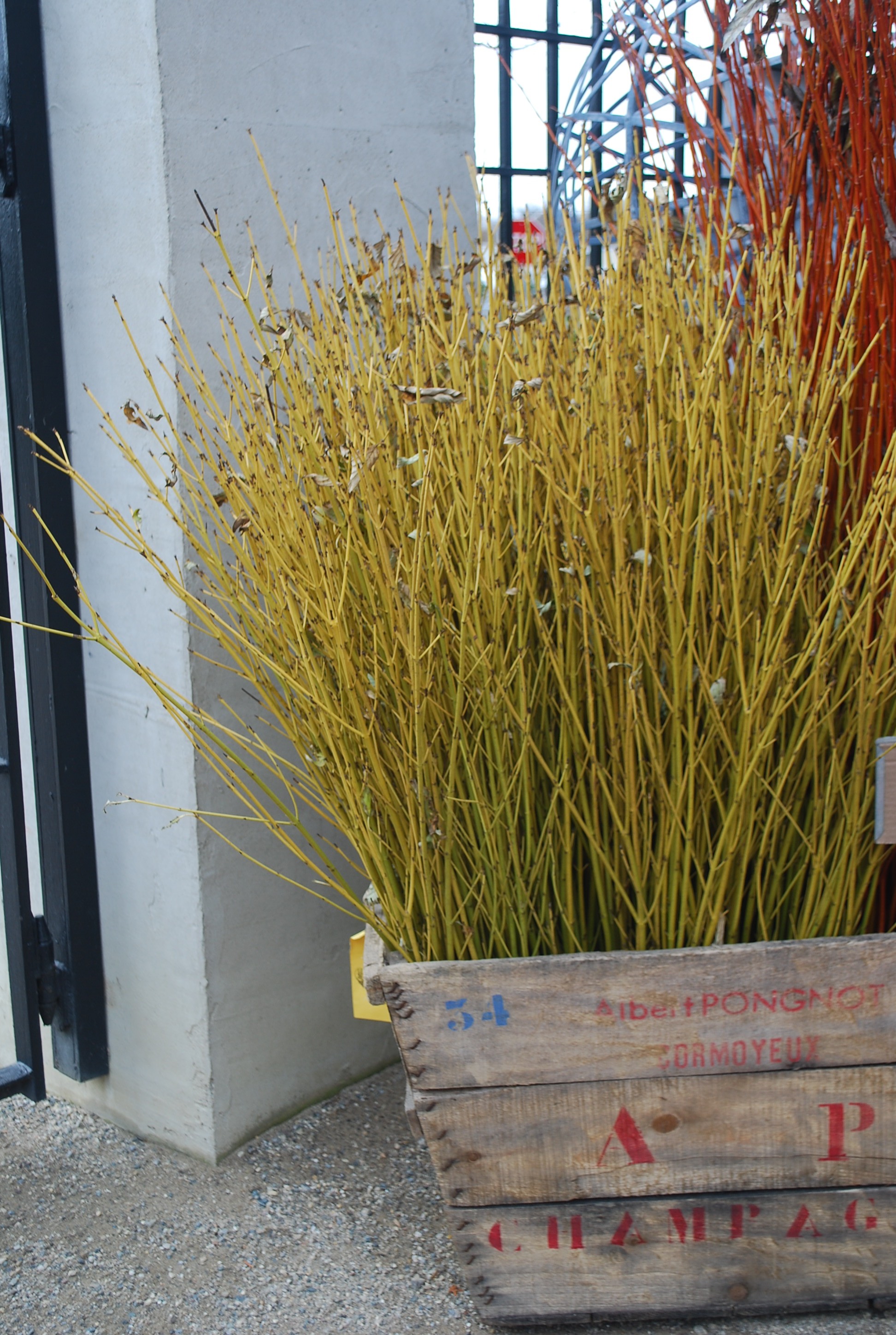
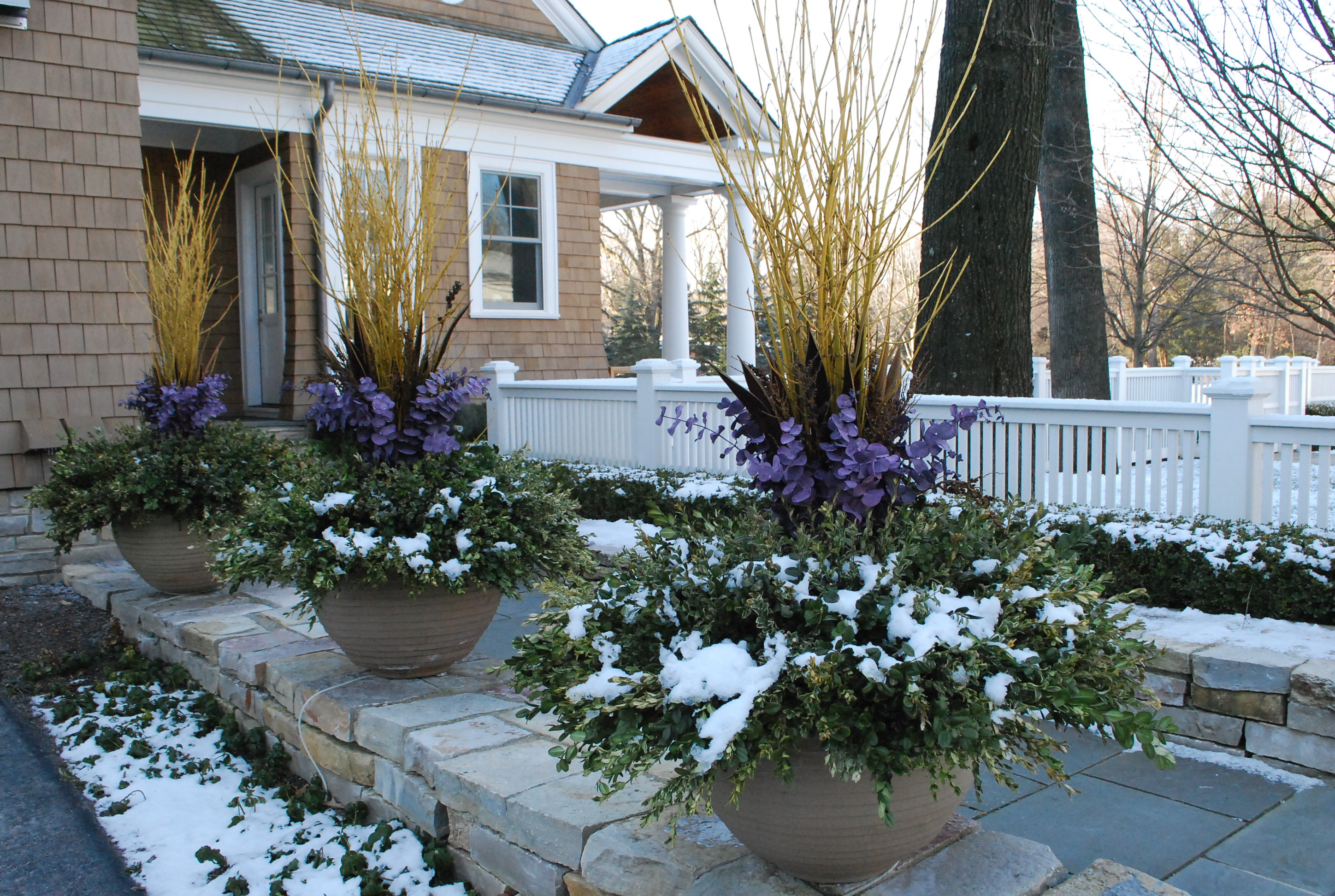
Coppiced yellow twig dogwood is brilliantly yellow green.  The twigs will be color fast the entire winter.  Used in a winter container, it is not unusual for the stems to root, and leaf out in the spring.  Though but a very few of the leaves are still clinging, the branches are vibrant at a time of year when most all else in the garden has gone dormant. 

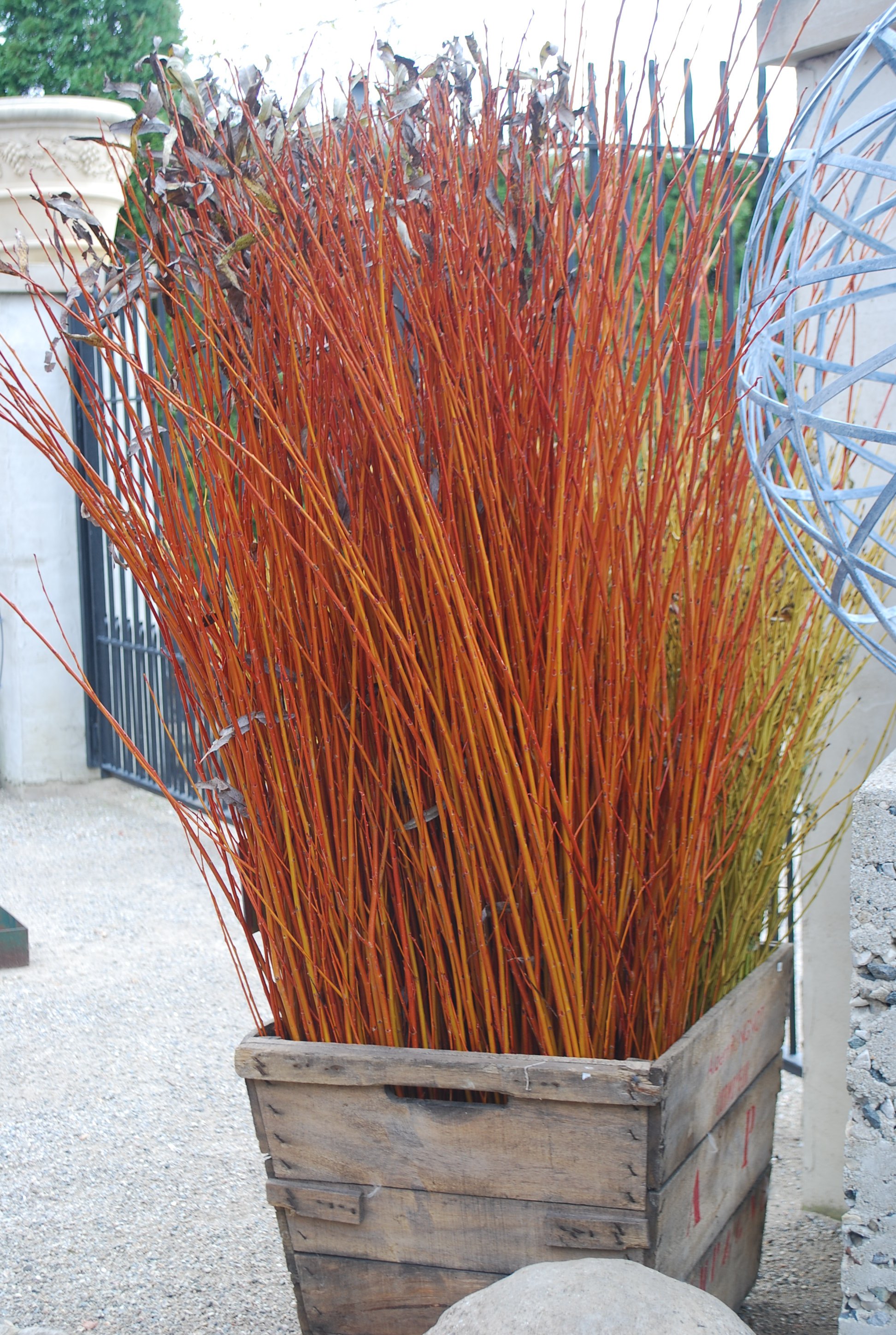
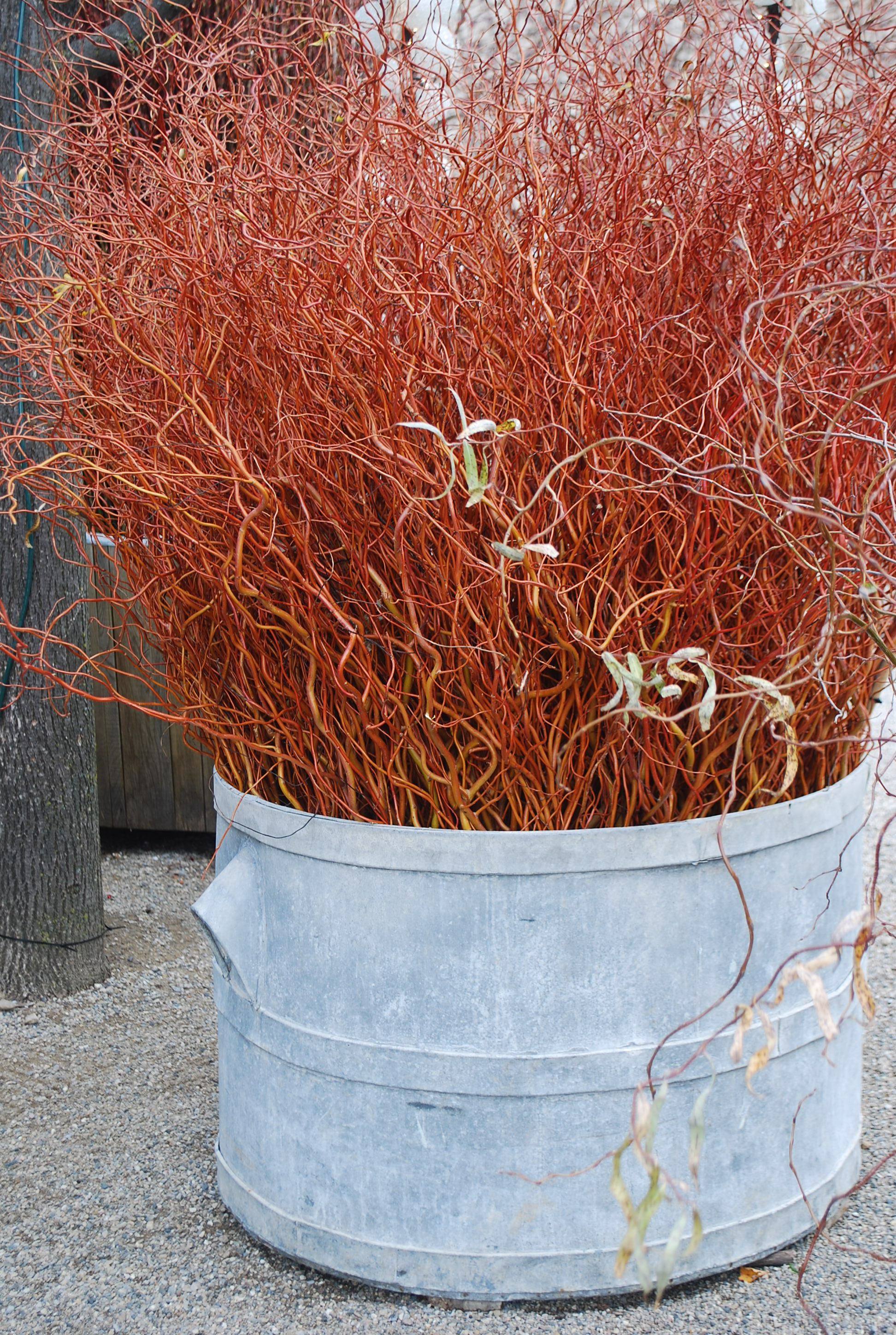
Flame willow is a striking coppery orange in color-quite unlike the bark of the trees and shrubs that grow in my garden.  This warm cinnamon color is a standout in snowy and gray weather.  This variety of willow is much more handsome in its twiggy state than it is as a green-leaved shrub. 

Japanese fan willow was cultivated from a fasciated, or flattened natural stem.  Many perennials and shrubs will exhibit this peculiar characteristic.  Some azaleas that exhibit densely twiggy growth were propagated originally from fasciated stems.  Fan willow is noted for its exotic shapes and forms.  No two branches ever look the same.

Curly copper willow exhibits much the same habit of growth as the green curly willow.  However the striking color means it will take fewer branches to make a statement in a winter container.  Our coppice wood has arrived at just the right time.  The cold temperatures outside will help keep them fresh, and the surface of the bark glossy.  Thought the color will survive the winter perfectly intact,  the warm weather in the spring will eventually dessicate and shrivel the stems. 

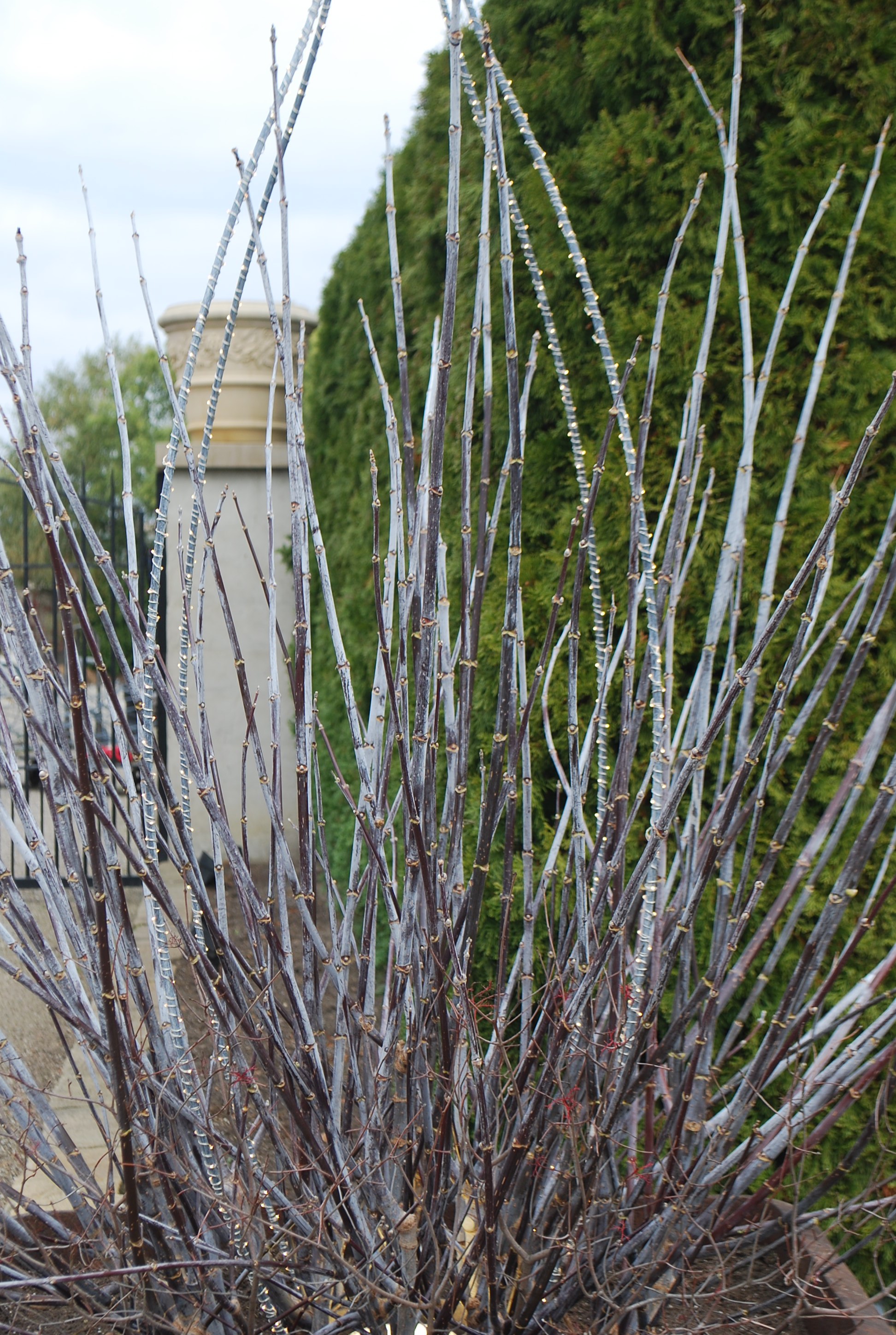
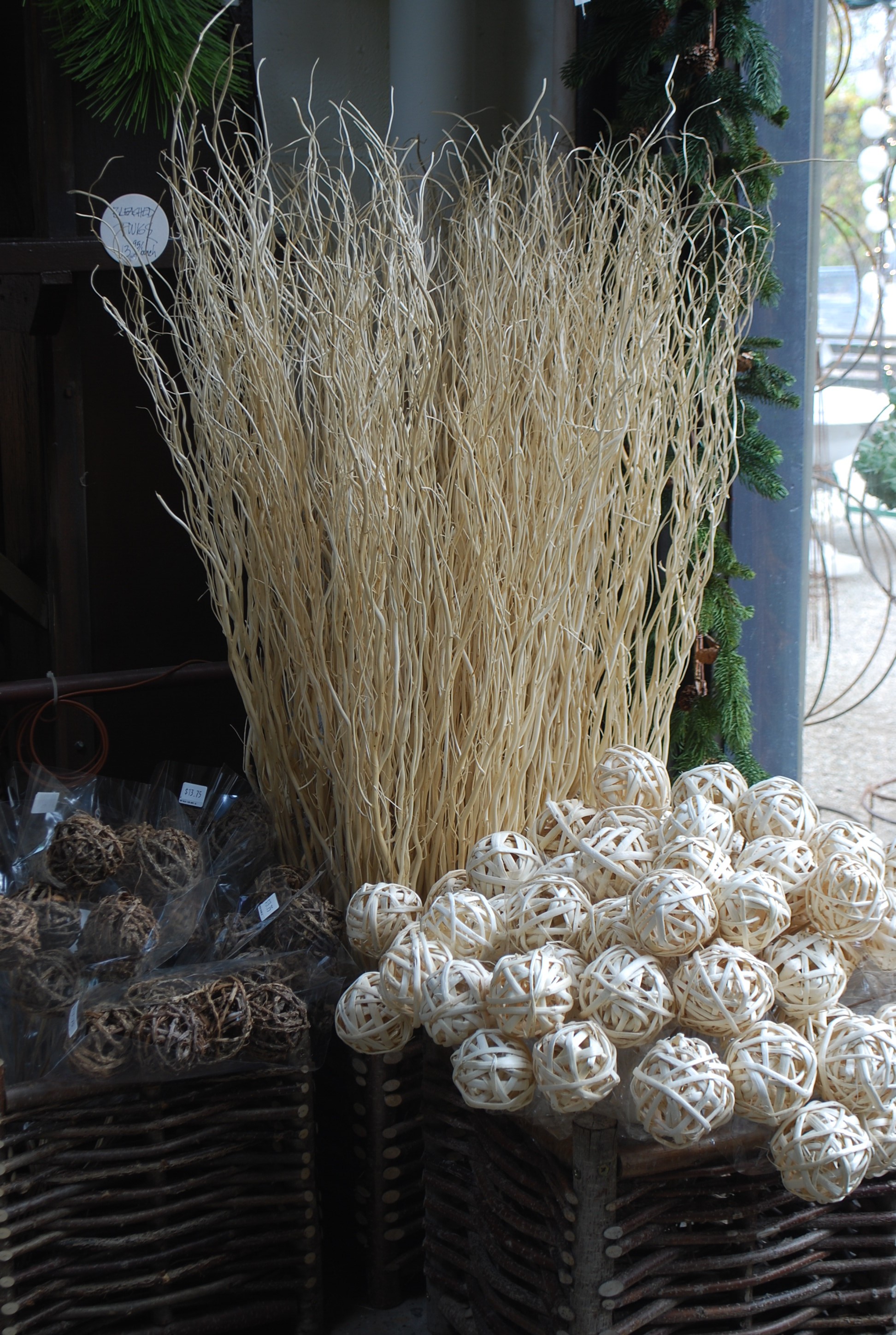
But there is a place for dry stems in winter containers.  Dead wood branches that have shed their bark can be beautiful in a winter arrangement.  Bleached natural branches are dramatically pale in color, and are visible from a great distance.  

The coppice wood-just one element of many that goes into a beautiful winter container arrangement.


100 Boxwood

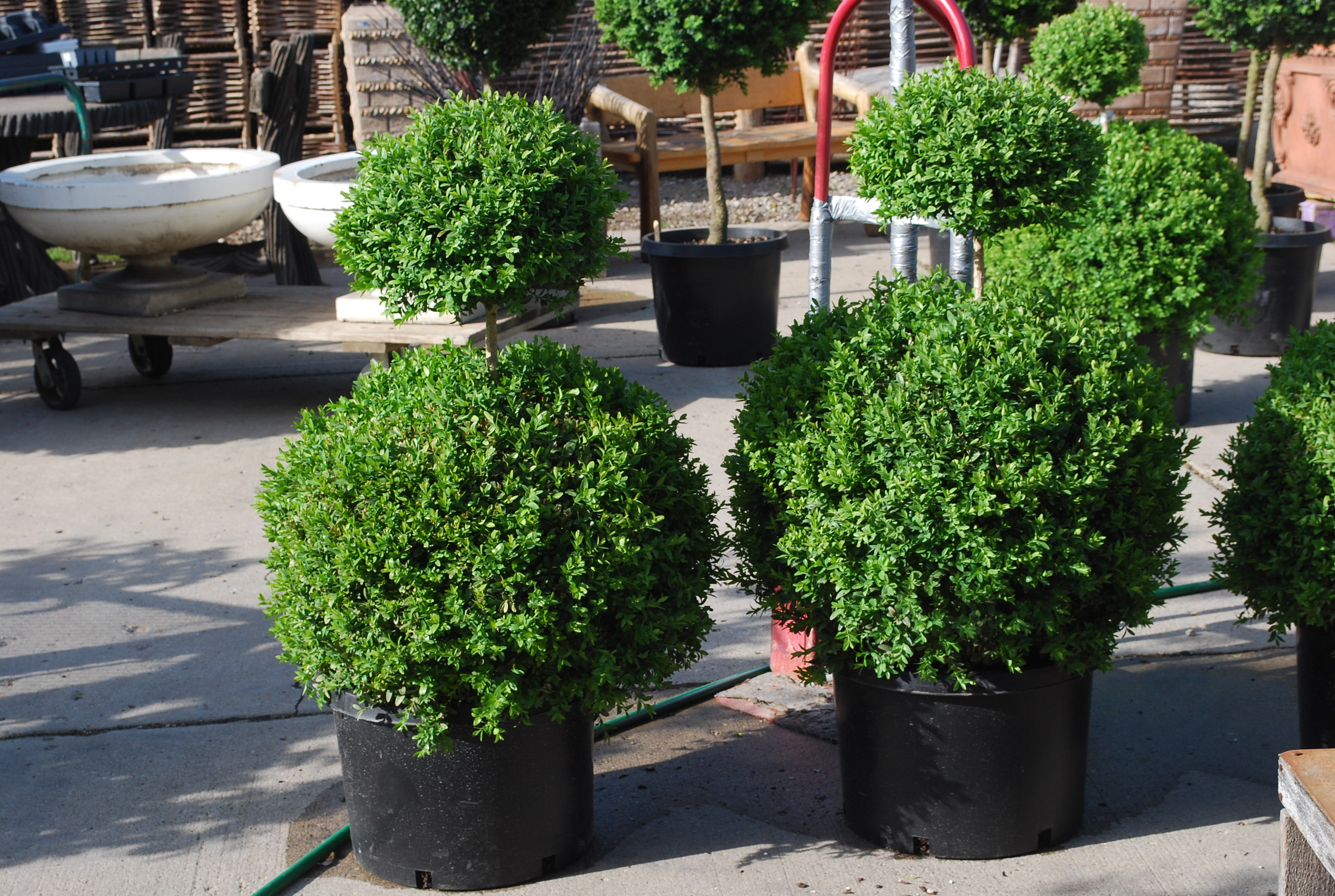
 Concerning my schematic plan from yesterday-my clients one comment was that I needed to add 100 boxwood.  All of said 100 boxwood will be in pots.  The placement and configuration of 100 pots of boxwood every spring will be the first work of their gardening season.  They will haul them out of storage on a huge dolly (which they have already purchased), and discuss and decide where to place them.  Boxwood in all different sizes, some of which are topiary plants with distinctive forms,  in a collection of gorgeous pots.  They are both adamant, and thrilled about the idea of 100 boxwood in pots.  Far be it for me to deter their enthusiasm.   I did amend the schematic plan with a lot of green dots-although I think all of my dots only add up to 72.  I have no doubt they will be able to place their 100 pots-and have a good bit of fun doing it.

topiary boxwood

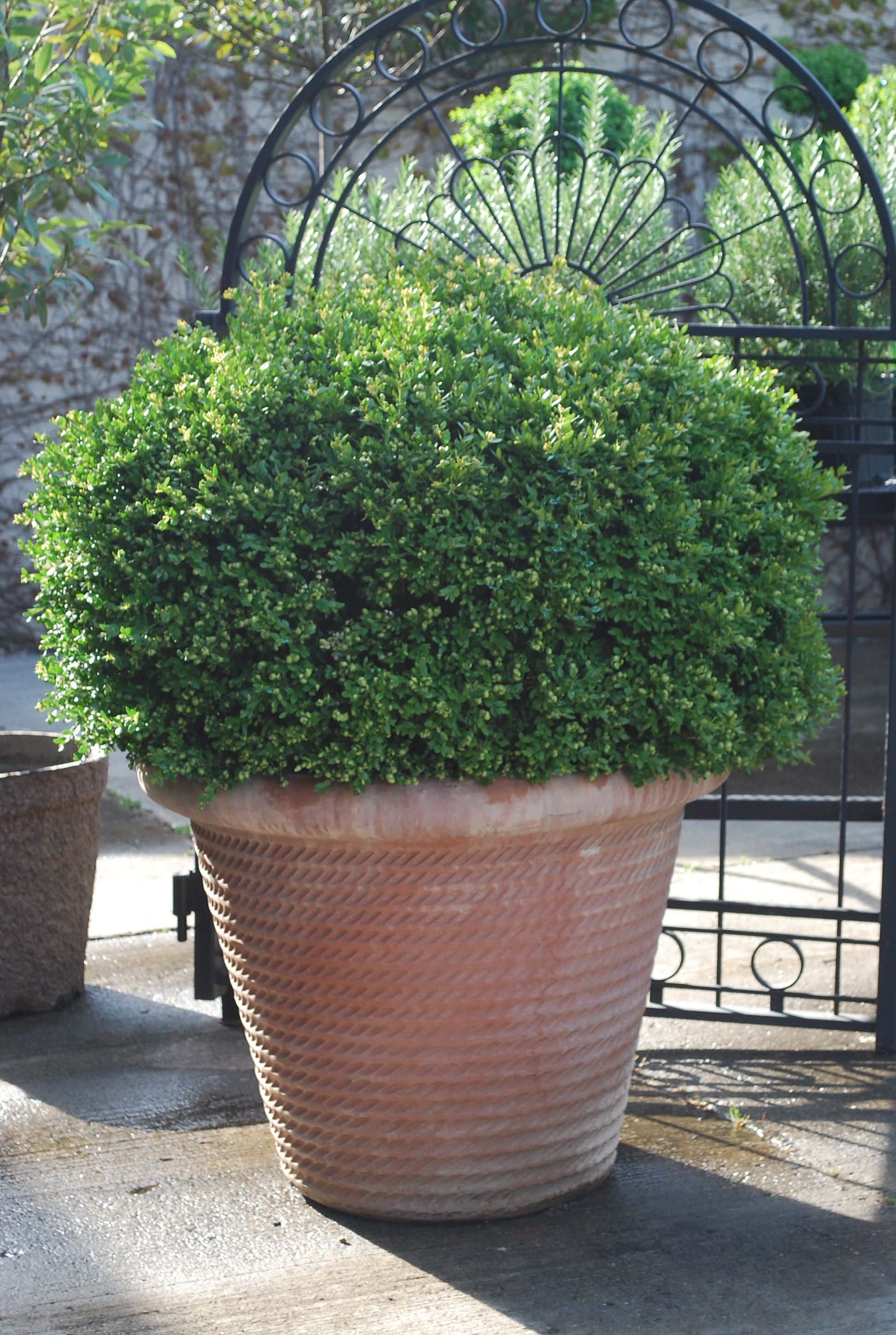
They already own a pair of these handmade French terra cotta pots planted with these boxwood.  The boxwood-buxus microphylla-was 52 inches in diameter when they acquired them.  They have been in these pots for 5 years.  I am not sure how many other boxwood they own, but they do have a substantial collection of plain handmade Italian terra cotta pots.

topiary boxwood

I will admit to a love for boxwood.  This plant speaks to no end of beautifully designed landscapes world wide.  This broadleafed evergreen graces landscapes all over this planet.  I love them pruned, wild, hedged, and in pots.  In my zone, they provide great shape, form, and color-year round.   

Growers all across the US grow boxwood in every form imaginable.  They are available 12 inches tall.  They are available 36 inches tall.  They are grown by some growers as a uniform crop.  Other growers grow them on, and trim them into spectacularly beautiful shapes. 

Clients who indicate they need to have 100 boxwood planted in  pots are clients of an unusual sort.  These are clients for whom the garden is all about romance.  What does their request mean to me?  A really good day. And a lot of thought about what a garden means.  Long after the end of the business day today, I am considering planting all of my pots next year with boxwood. Though I am unlikely to follow suit, their committment to such an extraordinary level of  romance has me thinking.  The story of a landscape dramatically colored by romance-love this.