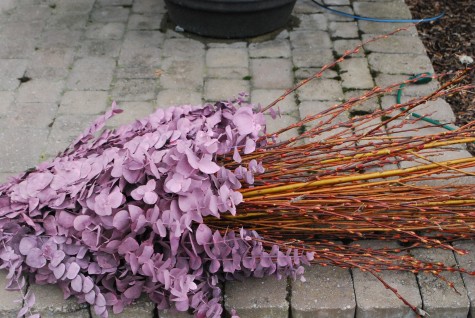
 Our winter greens finally arrived yesterday-today we began “planting” winter pots. I have clients that cannot bear to have their pots sit empty over the winter-I do not blame them. In some ways, a winter pot is more difficult to design and plant than a summer one. Of course the materials are more limited, but the toughest part is determining a proper scale and proportion. The winter pots do not grow; they cannot be trimmed or groomed into a finished shape. The shape and scale they have the day they go in will be the shape and scale they have throughout the season. I need to hold that thought from start to finish.
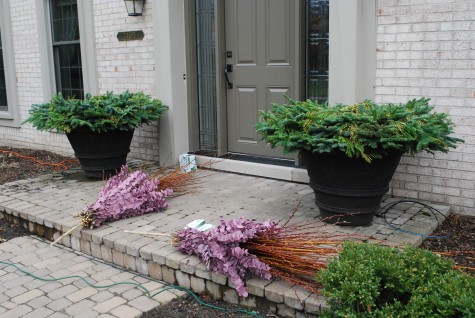 Most of the construction of what goes in my client’s pots goes on in the garage at the shop. A warm space makes the construction go faster. It is tough to clean up and hose down on site now. In Michigan, the water gets turned off to the outside spigots in anticipation of freezing weather. I like to leave the mess at home. I know the diameter of the pots I need to fill-I make a decision about the scale from my notes, photographs, measurements, and memory of the containers, and the space. This gets me close.
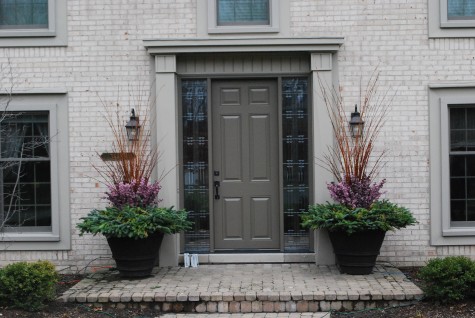 Proportions that are generous, and of proper scale are pleasing to the eye. Odd this-I almost never see anything outside that is overscaled to the point of asking for a redo. I routinely see landscape gestures that are too small. Plantings that are too small for the containers, pots too small for for the front porch, a single hydrangea when 5 are called for, 1 tree trying to hold down a space meant for a grove. The proper scale for a winter display-not so easy.
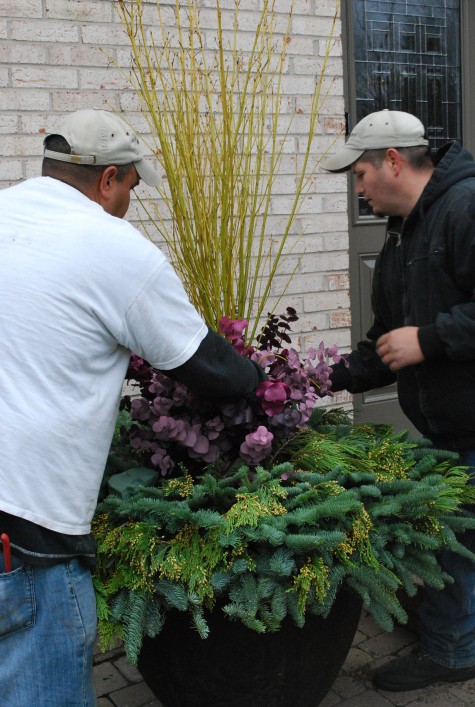 The construction of winter pots involves several issues. Design-this comes first. Color, texture, materials, scale-this comes second. The actual construction is all about a natural look that is invisibly sturdy enough to withstand a Michigan winter-start to finish. All of the elements of a winter pot designed and constructed in the studio go on to the installation phase on site. Tall heavy twigs need thorough anchoring. Though you cannot see it, the centerpiece in this pot has bamboo, steel and concrete wire-we like a stand up straight construction that endures. Every evergreen stem is sharpened at the base-a tight fit means a persistently long lasting fit. We have four to six winter months ahead. What I do today needs to last.
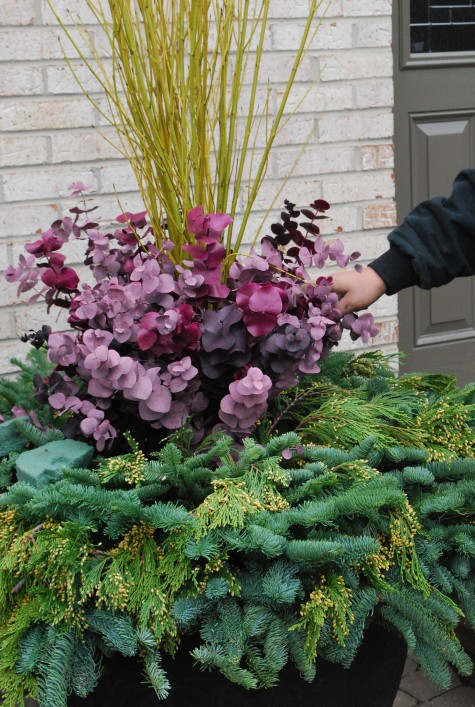 I really want to talk about the color and the texture here, but the real news-a scale assessment. Invariably I have to go back, and adjust; almost always, I have a need to add. The process is simple. Plan, aim and construct as best you can. Then step back, and look. I would advise that you look a second time. Then step back and see. Fill in. The gaps, the underscaled elements-it is all there for the seeing. The fill in stage-necessary.
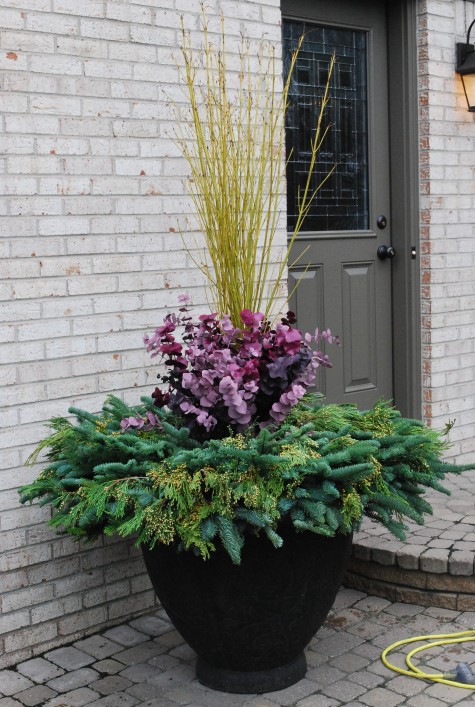 This giant pot needs 2 more bunches of yellow twig dogwood, and two more bunches of preserved eucalyptus-to get the proportions right. I wish I could get everything perfect the first go around, but frankly-I rarely deserve the spot on award. I usually need to go back. The big idea here? Any project worth doing deserves an energy at the end equal to the energy at the start. Start strong-finish stronger.
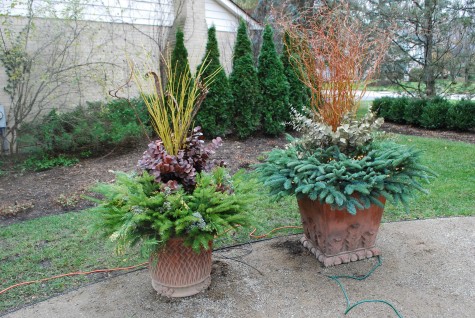 The summer pots dressed in their winter outfits-they look good. Every one of these pots have lights. For the dark hours. We hook up, we bury the extension cords-day and night-we have plans.
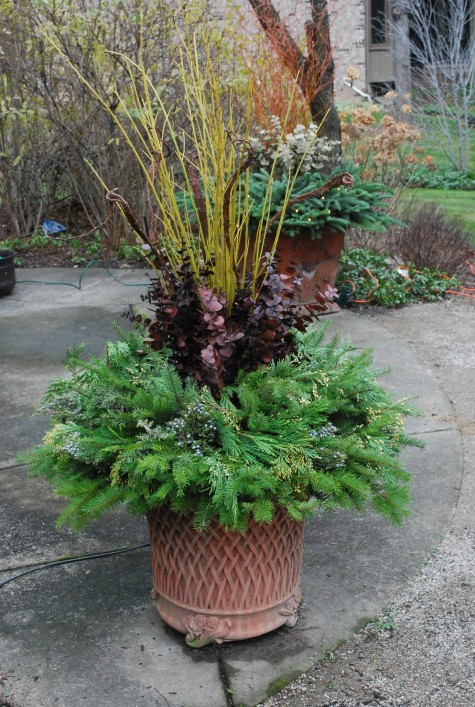 I am enchanted by the blue berries of the cut juniper against the brown eucalyptus in this pot. I so like the effort of a mix of greens. Douglas fir branches-graceful. Everything seems to be working here-the basket weave pot, the draping greens way wide-this winter pot has everything going for it.
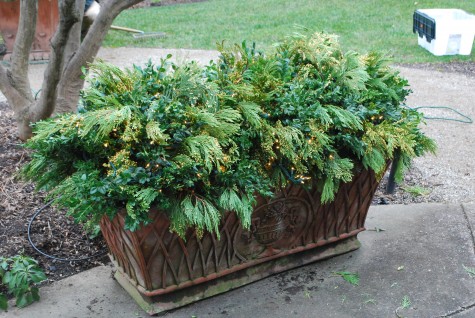
The long rectangle in view from the kitchen-the mixed greens include incense cedar, German boxwood, and southern boxwood. The effect is soft and swooping. drapy. The garland lights buried in these evergreens will make for some night life. The winter approaching-we are in the process of getting ready.