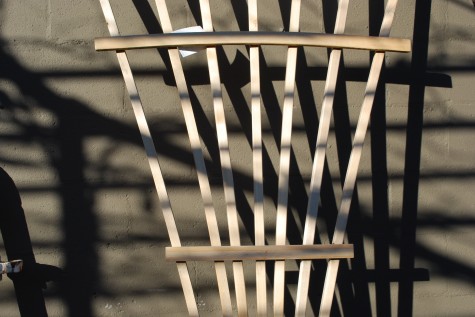
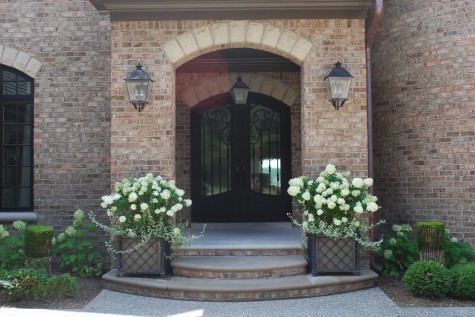
 When I first opened Detroit Garden Works in 1996, my only clients were my landscape clients; they were all so great about supporting my new venture. Fourteen years later, the shop has clients of its own, many of whom are not aware that I offer a full range of landscape services from design through installation. This client shopped the store this past spring, and invested in this pair of English lattice work boxes. Rob referred her to me; planting advice and installation comes from the landscape company. I have a concern that anyone who purchases containers from me gets coached such that their experience with the gardening part of their ownership is a good one. A beautiful pot does not necessarily imply a beautiful planting; I arranged to meet with her.
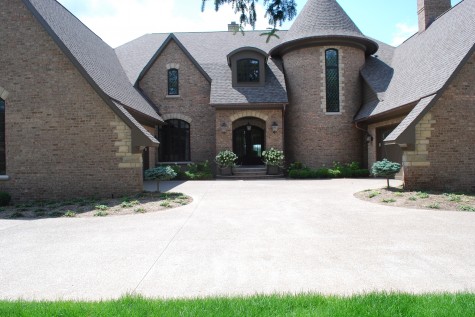 She told me she liked hydrangeas, simple plantings, and white, so we planted her new boxes with limelight hydrangea and lots of variegated licorice; they looked great. I accompanied the crew on the delivery, as she had several possible placements in mind. Once placed, I could see her landscape was struggling with what I call a distribution challenge. Her lakefront home had little flat land upon which to build a house, and a pair of garages necessitating a large drivecourt. What little land she had left over from all this hardscape dropped precipitously on each side. Properties where the hard surfaces dominate make it tough to design a landscape that can hold its own.
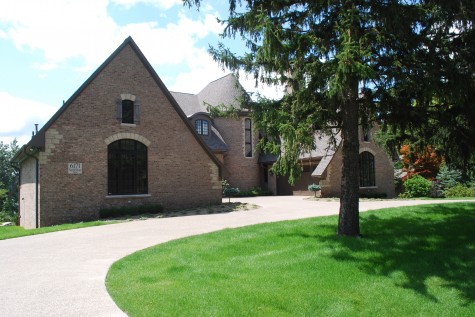 Uncertain about what to do, she had planted hydrangeas on either side of the front door, and groundcover in the narrow strips of land between the drivecourt and driveway. The house wanted for a more robust green companionship, but had little room to make that happen.
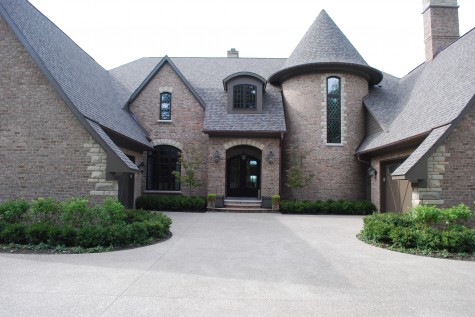 Her love of simple arrangements worked in her favor. In a very small space, using one plant in big numbers adds impact. I persuaded her to move the hydrangeas to outside the drivecourt; their eventual height would put them up over the ground floor entrance window near the front door in a not pretty way. Two beds planted solidly with the tall growing Green Mountain boxwood were punctuated with a pair of Venus dogwood. This airy growing large flowered dogwood would get some green into the airspace.
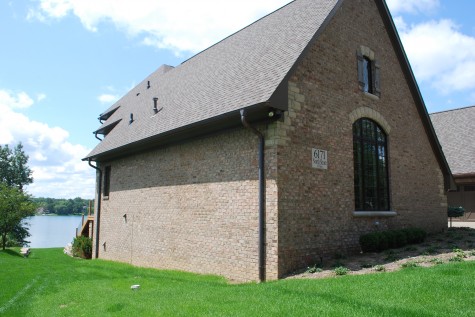 This wall was the first view of the house driving up the street; it needed a strong landscape element that would feature something about that wall other than its sheer size. The land dropping away at the corner of the house was awkward visually.
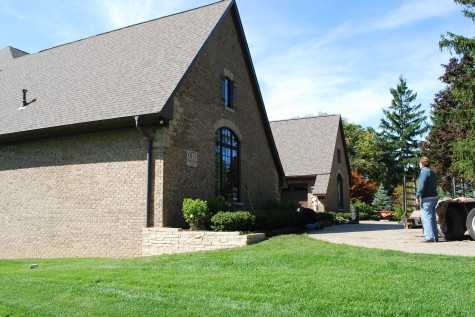
A dry laid L-shaped section of stone added the corner back to the front of the house; the hydrangeas and shorter growing Green Velvet boxwood made a long flat horizontal run, pleasingly counter to the strong vertical element of the house.
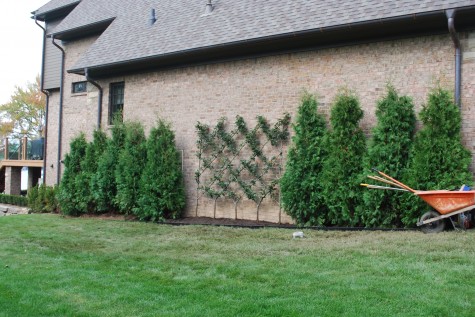 Five sections of Belgian fence, a style of espaliered trees, read in sharp green relief against the massive brick wall. The arborvitae will be pruned flat on both the top and the sides, as they grow in. We can grow both high on this wall. Once the boathouse is finished, we plan to plant a corresponding but free-standing run of arborvitae and Belgian fence on the lot line opposite the wall. These two plantings will frame the view to the lake, as in allee.
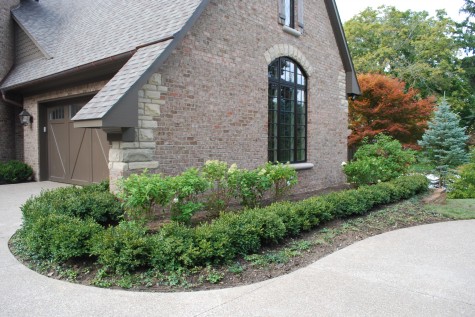 The limelight hydrangeas will grow fast, and billow out around the foundation of the house. As my client did want some flowers in front, we decided to construct window boxes that would sit at grade. Flowers at eye level would make them a more prominent part of the landscape.
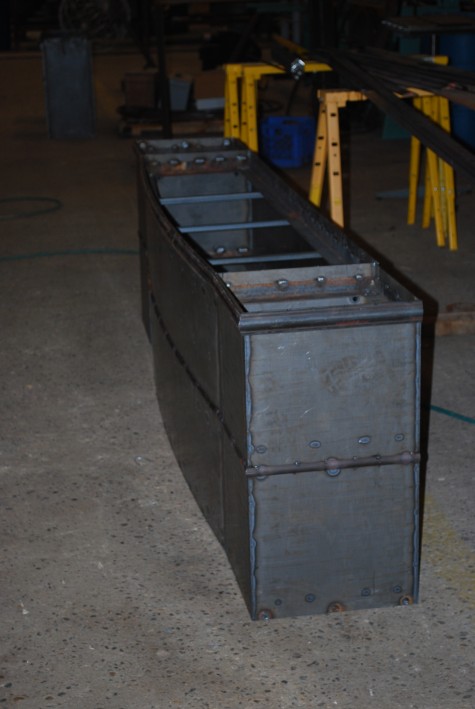 The opportunity and ability to construct garden ornament for a specific place gives me lots of options as a designer I would not otherwise have. These boxes were made specific to a length and height for her windows. These raw steel boxes would be galvanized, and acid washed, producing a virtually maintenance free finish reminiscent of the color of lead.
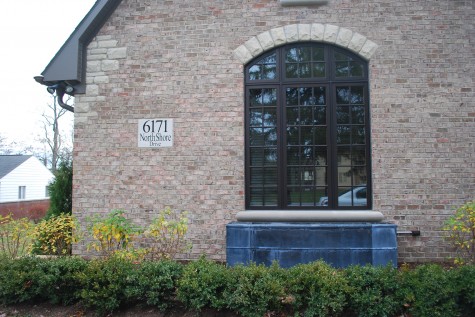
We will plant these boxes for the holiday/winter season; this will give a brand new landscape a welcome lift. There are better days to come, for this committed client, and her home.
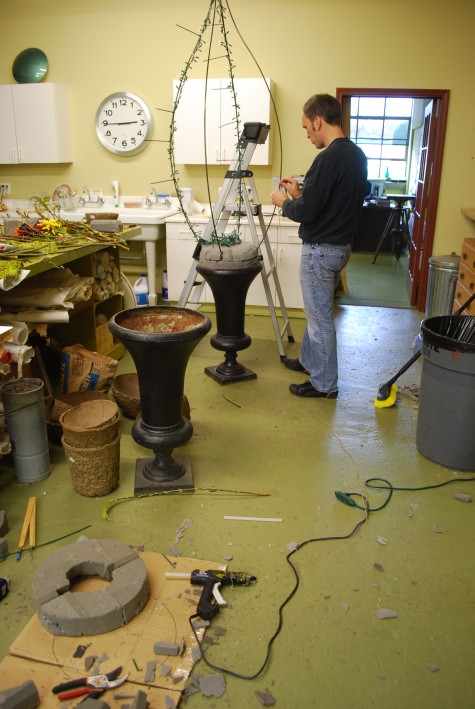 Our entire method of sturdily constructing an arrangement for a winter pot is predicated on one concept-you have to create the roots, and the trunk. I rarely worry about my summer pots going out of kilter. The roots of the plant secure them to the soil; plants grow upwards, towards the sun. I do not have that luxury in the winter, and Michigan has more than its fair share of stormy winter weather. So the mechanics of fastening all the materials is really important to the longevity and beauty of the piece. Tall skinny pots like these get lots of gravel in the bottom; a large centerpiece can be a big sail in disguise, just waiting for a decent wind to get airborne. We then construct a form in which to secure all the materials-glued up with industrial strength hot melt glue-that sits tight in the container. A loosely fitting form is just asking for trouble. If you have ever tried standing up in a pair of ice skates that do not lace up tight over your ankles, you know exactly what I am talking about.
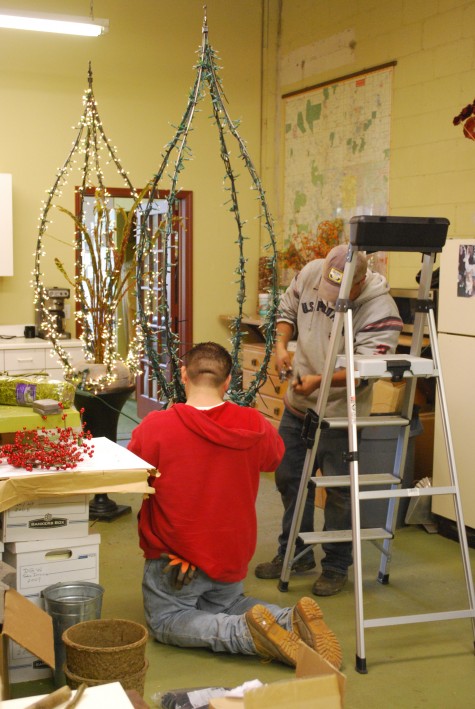 These pots will have lights in the vertical dimension; a steel form provides stability as light strings are heavy. They also make it possible to cleanly and crisply mimic a geometric form. As light strings shapes are governed by gravity, a rigid form insures they will be representing the form you choose for them today, next March.
 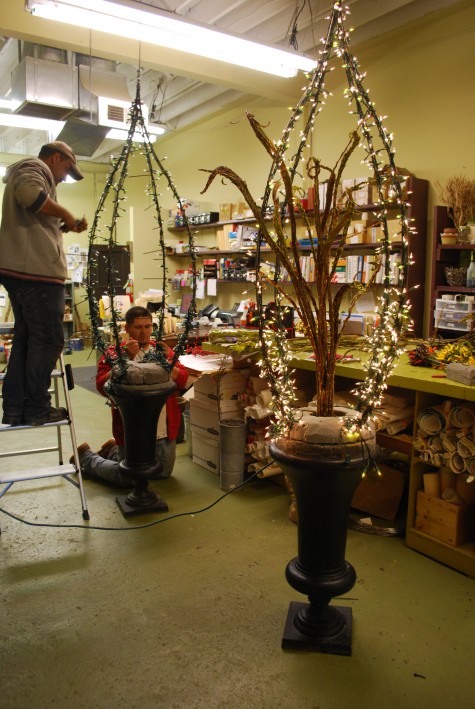 Winding the lights around a form is time consuming. It also makes the removal of the lights tedious. Zip ties make for an easy in and easy off. It’s also easy to spot in the above picture how close we space those zip ties; the closer, the better. Light string wires have strong kinks and curves when they come out of the package, but droop they will, given time. They do not hold a graceful curve on their own; we are generous with the fasteners. The centerpiece is set through a hole in the center of the form; a stout bamboo stake at the center of the arrangement goes far enough down into the pot to insure it stays vertical. There is something so wrenching about a listing centerpiece-who needs that in the winter?
 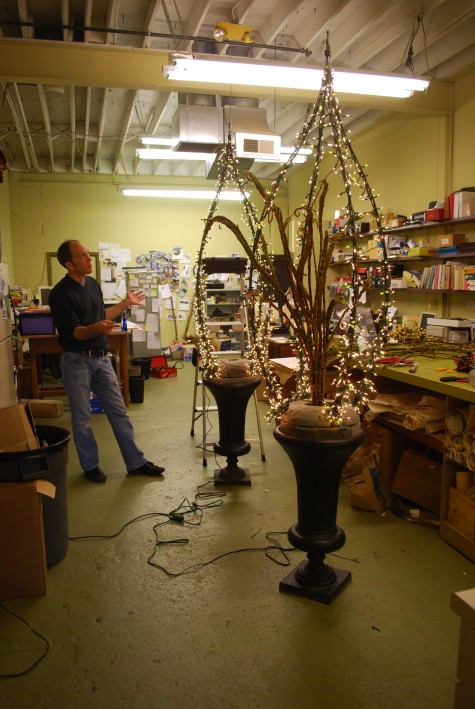 The fantail willow is set into the form based on a determination of the front elevation. When pots are placed such that they can be seen from all sides, we work in the round. As the form will be covered in a skin of lichen mat, the form is shaved into a rounded shape.
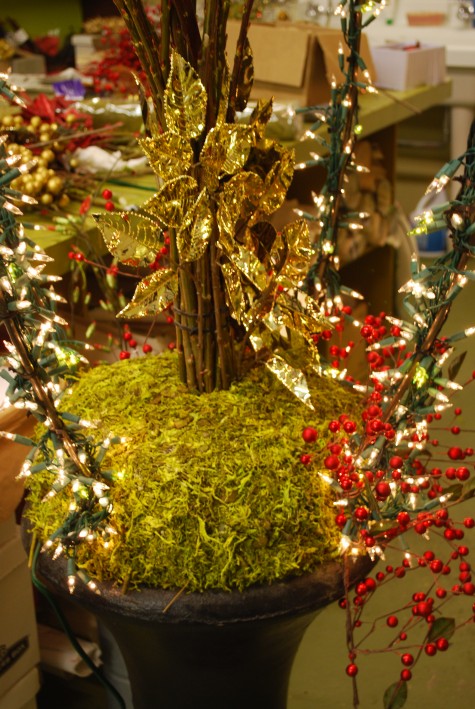 Once the form is covered in the lichen, we add a little icing to our lichen cake-just for the holidays. Gold leaves and a luminous red berry garland-yummy. These elements can be removed after the first of the year, so the pots look good throughout the winter. A client can use the lights in the winter-or not. The topiary form has a decidedly dressy look to it, with the added attraction of absolutely no maintenance. It will still look fine come next April, provided the construction is sound.
 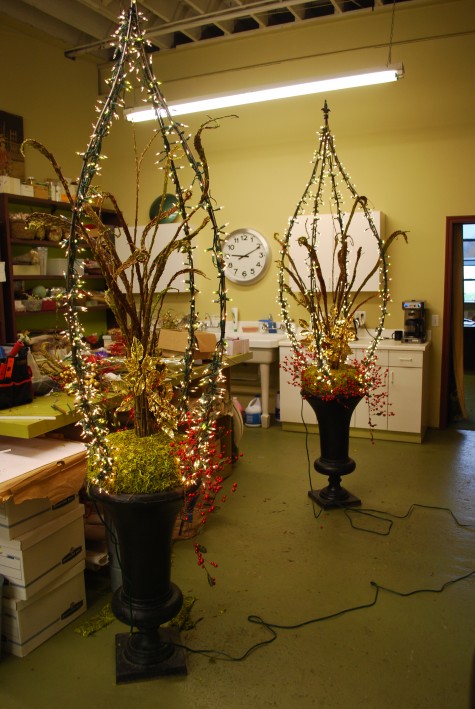 Getting the installation to match in a pair of pots is harder than you think. I try to work on pairs side by side. Some pairs of pots that demand a very formal arrangement, I make sure that one person does both. Everyone’s eye and hand is noticeably all their own. My rule of thumb-I work on the second pot, never taking my eyes off the first.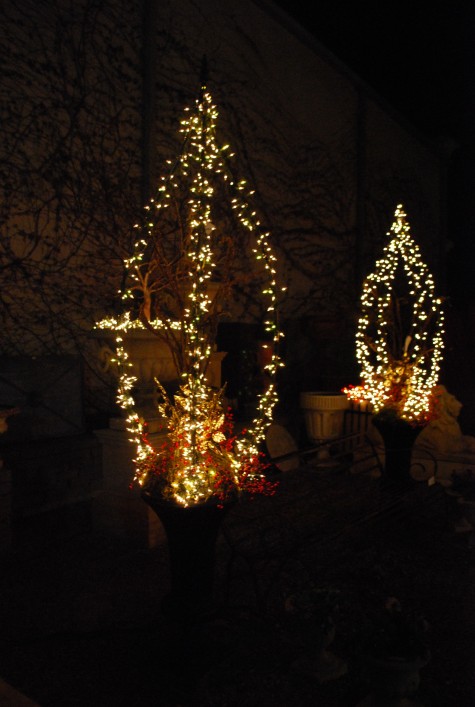
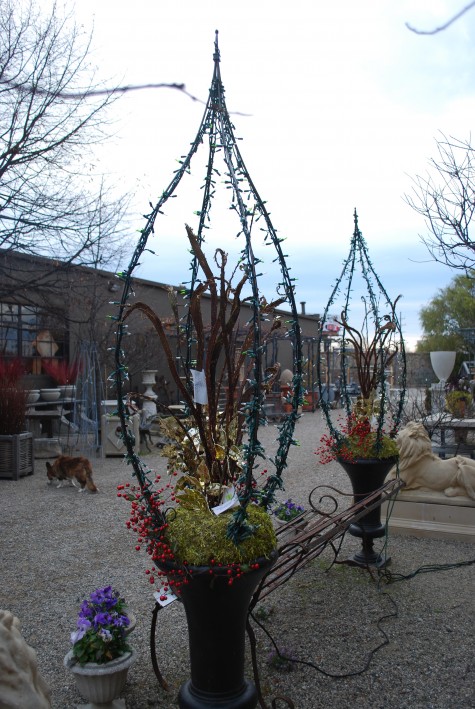 Your winter pots are the best they will ever be, the first day they are done. Unlike a landscape that fills out, and blossoms with age, there is no growing involved. They need to be constructed tall, wide, and robust from the beginning. The winter is a season that can handle a little unedited excess, with a dash of over the top sparkly, with aplomb.