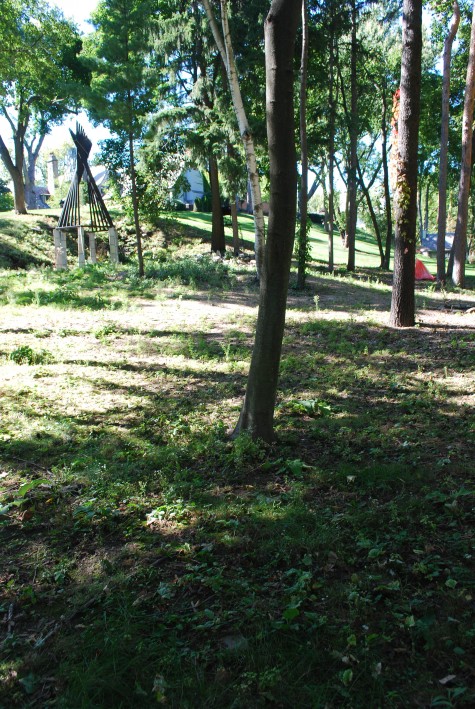
 For years my client and I had been looking at a certain giant blob of a thicket on her property. Lanky buckthorn, lilac and other unkempt and untended shrubs had made the space impenetrable. The fact that the area was on a steep slope made investigating what was there all the more difficult.Not knowing what was in there made it easy to just mow around it, and act like it was part of a landscape. Every so often she would talk about what might be in there; this went on for some years.
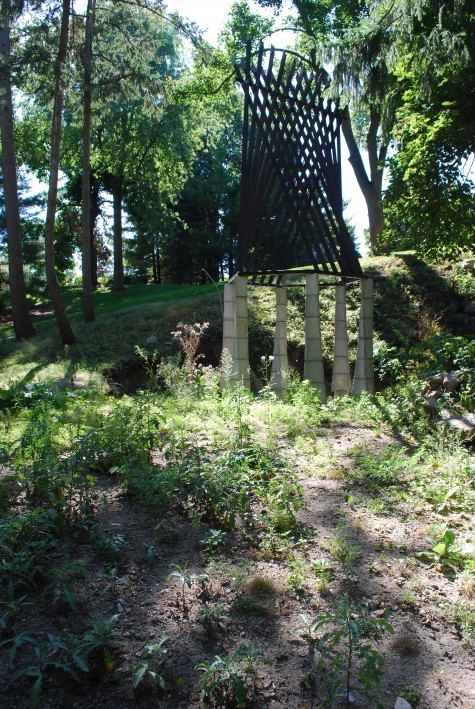 One day she called to say she had clear cut the entire spot, and discovered an old rock waterfall and pool. No doubt it dated back to the 1920’s. The precipitous drop, lined with giant rocks, was entirely stable. There was a lot of discussion about restoring the watefall and pool, which led to some discussion of a new fountain; more years went by. One day she called to say she wanted me to look at the space again-I thought as the thicket was threatening to grow back-we were being chased for a plan. How like her to install an enormous concrete and wood sculpture in the center of the old pool. This is so distinctively her way of working things out. Making a move like that was forcing everyone’s hand. I told her I thought a sculpture of this size and proportion needed its own park.
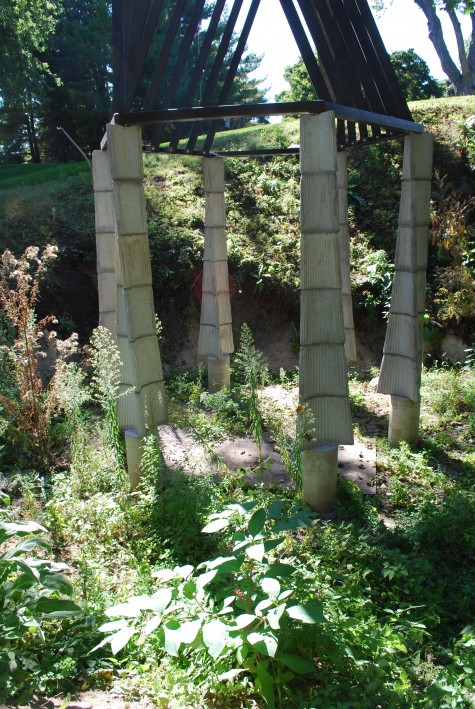 The sculptor had sunk concrete pilings in giant sonatubes. Still visible in the above picture, it was apparent no small amount of grading was needed. My client was concerned that the pool would hold water. The rim of outside soil needed to be taken down. A giant pile of rocks collected from the first clear cutting went into the hole first. Trapping water near the sculpture would not be a good idea.
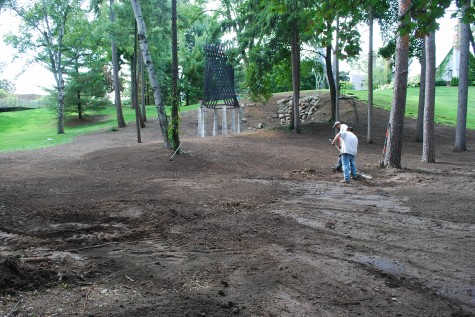 A skid steer made quick work of removing the weedy growth that had begun to take hold. I have watched the history channel television series called “Life After People” with great interest. It is astonishing how little time it takes for untended ground to go to rack and ruin. Nature abhors a vacuum; any bare dirt will have something going on in short order. Ignore a space, and nature will take over in your absence.
 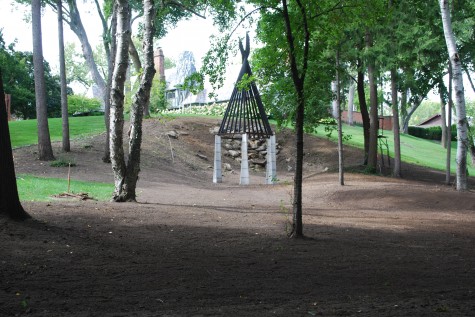 The front edge of the old pool was lowered to permit water to escape. I so love this point in a landscape project; bare sculpted dirt is incredibly beautiful. A landscape of evergreens planted in sculpted, cultivated soil-a landscape of my dreams. Barked areas in a garden leave me cold-I like to cover the ground with plants, or see dirt. I mulch strictly to conserve moisture in the soil. The pattern of light and dark on the ground here is telling. The old waterfall and pool were situated in a patch of sun. The sculpture benefits from this.
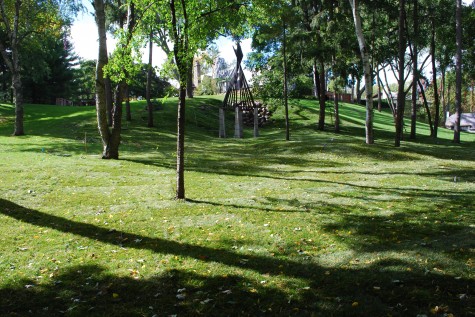 New lawn softens all the hard edges. The rolling, swelling and dipping of the ground makes for a big fluid situation for the starkly vertical sculpture on its big legs. They look good together.
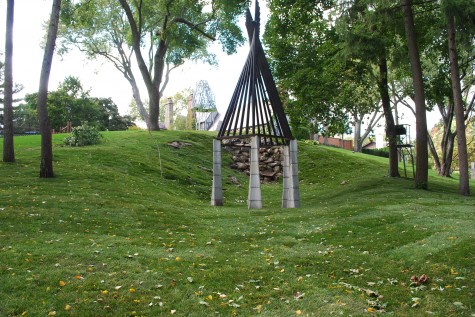 The fountain rockwork we left exposed. It is a part of the history of the property. Practically speaking, I would never have removed those giant stones; they have stabilized soil existing at a very steep angle. In the spring, my client will be able to pick and choose what she mows, and what she chooses to let be. There is a sculptural element yet to come-the decision about how and where to cut the lawn.
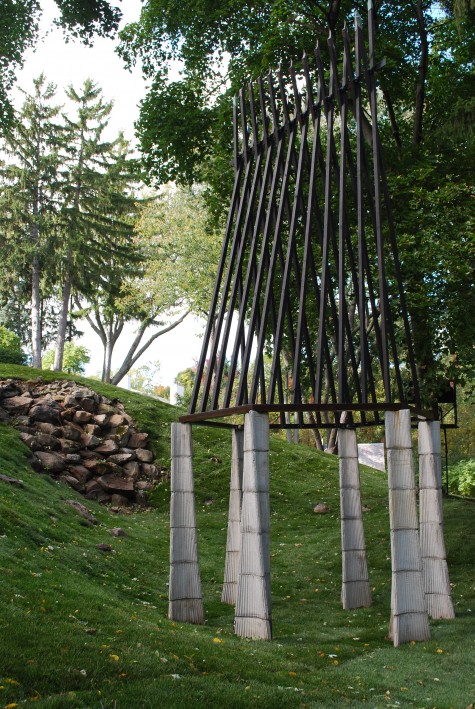
The old stones and the new concrete seem entirely compatible in their contrast. They wrangle with each other. The park is big enough to invite serious viewing. I am seeing that vaulted roof this morning as if for the first time. I need to write my client a thank you note for making a mark, and setting that sculpture amidst the weeds and the history, so as to say what now? Am I not lucky to have her?
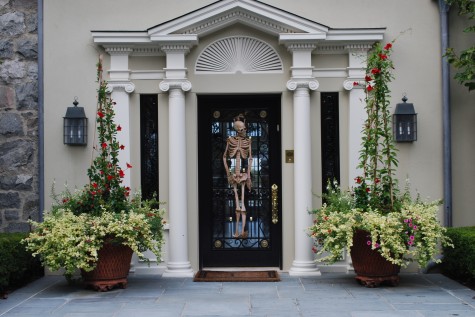 Our weather has taken a turn towards fall; today’s 47 degree temperature is all the more chilly for the 35 mile an hour winds. I was so sure I would have my summer flowers into next week. My clients are much more graceful about moving on to the next season than I am-especially those clients with children. The Halloween holiday-what child isn’t entranced by it? A request for fall pots came from a client with children ready to devote the entire month of October to some ghoulishness.
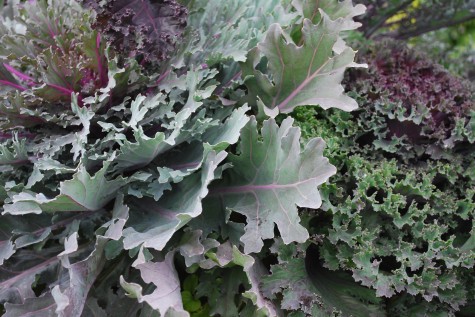 My favorite part of October is that group of leafy plants known as the Brassicas. They come into their own late in the gardening year. Though there is some disagreement about which plants belong to that group, cabbages, kales, cauliflower, and broccoli are prominent members. These cool season annuals are great to eat-but I love how they look. There are many hybrid cabbages and kale that are grown for the beauty of their leaves. As the weather cools, the color intensifies.
 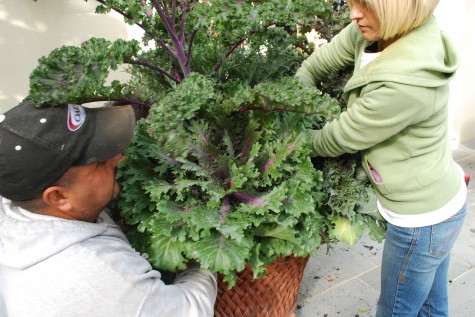 I am indebted to the Brassicas for their scale, mass and texture. Though many plants are tolerant of cold weather – the pansies, certain grasses and so forth-the cabbages and kales can be had of a good size. Our fall season is short, and not so much actual growing goes on. I like planting big right off the bat; some years the fall constitutes but a few weeks. They are not in the least bit fussy about planting depth. If I need to sink them in a pot for a better look, I do so.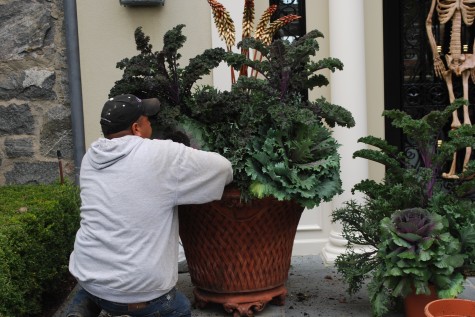
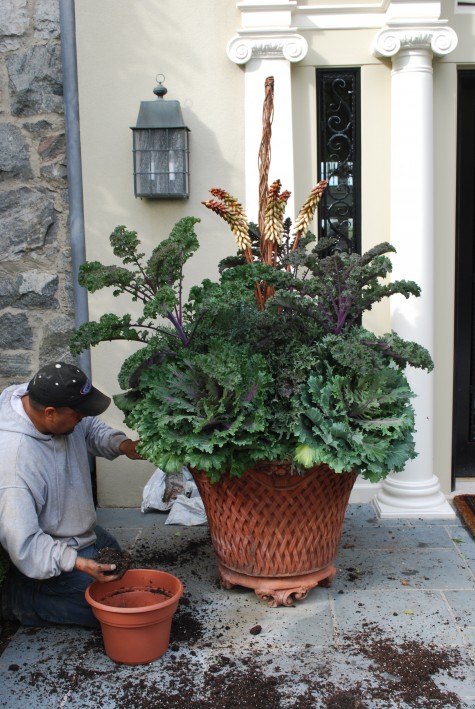 A hazelwood stick covered with grapevine is sunk deep in the soil of the pot. Since wind and rain are more than likely, anchoring any dry materials in a sturdy way is essential. The pod sticks resembling a tritoma have been constructed from overscaled seeds. The entire assemby is glued up on the stick, and sealed. I do make a special effort to find materials like this that can withstand blustery weather.
 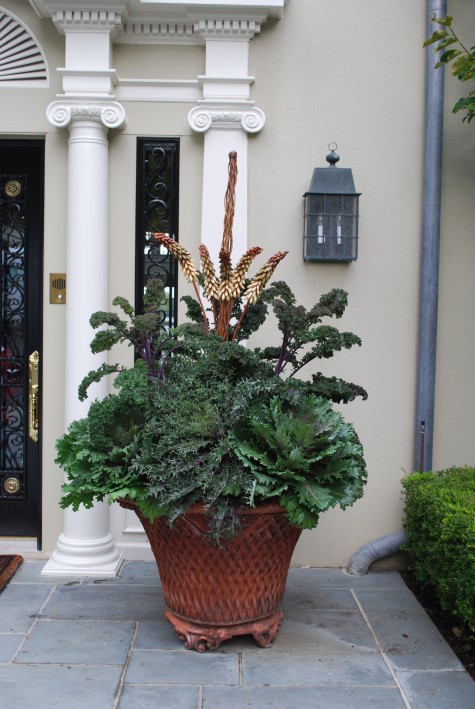 The finished planting is a great scale with a pot this size. The hazelwood stick repeats the basketweave pattern of the pot, and the light colored seed pod stems make reference to the garden gone to seed. The curvy pods echo the curve of the tall kale leaves. I like fall pots with all manner of things in them that refer to the natural world.
 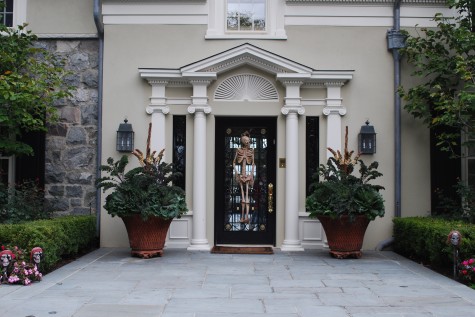 The happy accident of this planting-how great those pale pods repeat the color and texture of the skeleton.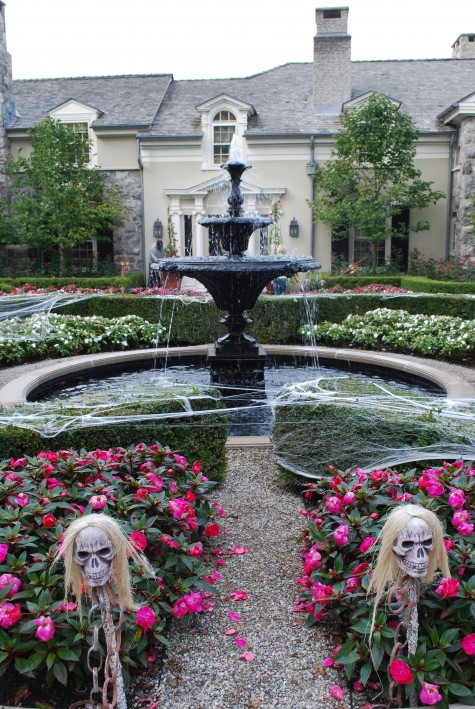
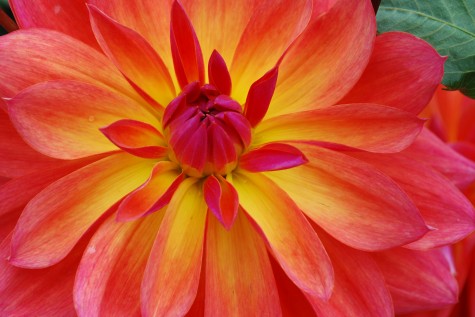 The cultivation of dahlias brings to mind the famed Longfellow little girl verse. “When she was good/She was very very good/But when she was bad she was horrid”. Even if you give them everything you’ve got in the way of rich soil, good sun, staking, fertilization, good air circulation and your utmost devotion, it may not be enough. You still need the blessing of the patron saint of all sulky, troublesome prima donna garden flowers-whomever she may be. Not that one could ask for that blessing; it must be bestowed. I do have one client for whom they perform on demand. He says its the soil-I say what he manages with them is magic.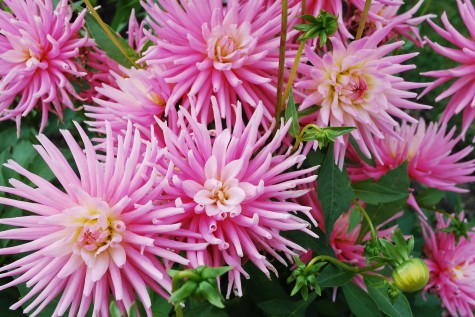
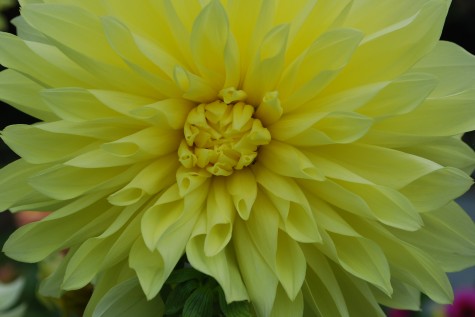 Some sport blooms so large the word vulgar comes to mind. Some “dinnerplate dahlias” have stems so weak the plant perpetually looks like someone spent the last hour giving them a thorough dressing down. Fungus spreads like crazy from the bottom up; I have grown plenty of dahlia stalks with a few anemic and forlorn flowers on top. When I grow them in pots, I face them down with something that has the decency to grow vigorously, and hide those ungainly dahlia legs.
 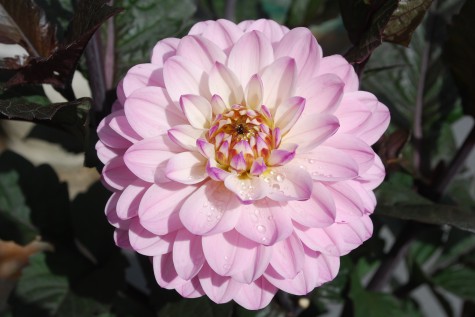 So why do I grow them? In a good year, they are magnificent. Loaded with flowers, they remind me of the 19th century flower paintings of Rachel Ruysch; they are supremely grand. The range of colors and forms is astonishing. This dahlia is a “formal decorative” type. Park Princess has petals shaped like quills; this form is known as a “cactus dahlia”.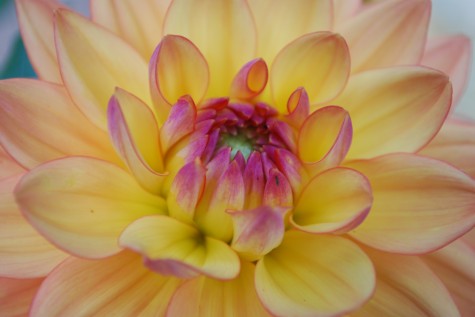
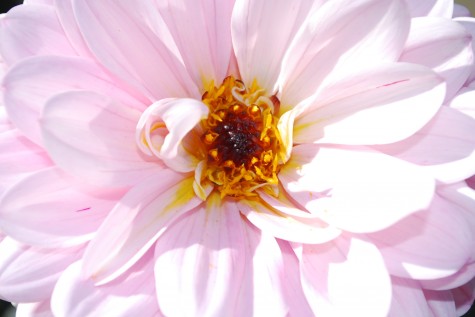 I am looking at these dahlias now as they have been at their peak this first week of October. There is something to recommend about how they last into the fall. They do hate cold weather; the best grown dahlias are those that have spent May and June in a greenhouse. They transition from that museum like setting to the Michigan outdoors poorly. It can take weeks before they loose that insulted look, and take hold.
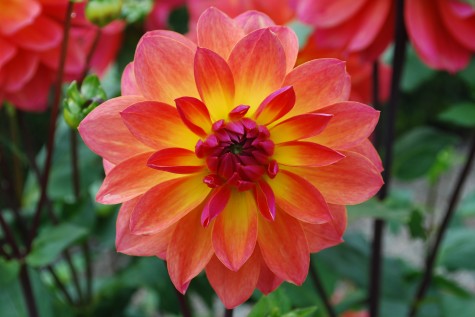 I think a too early planting can set them back such that they never recover. They thrive in that rarefied hothouse atmosphere where wind, bugs, cold soil, and various pathogens are simply not permitted. Dahlias are not great garden plants; they are an event you may wish to attend.
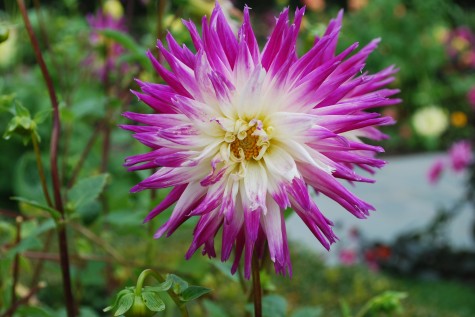 Some of these party girls dress in a way that’s just plain fun to look at. When they are at their overblown best, they make me smile.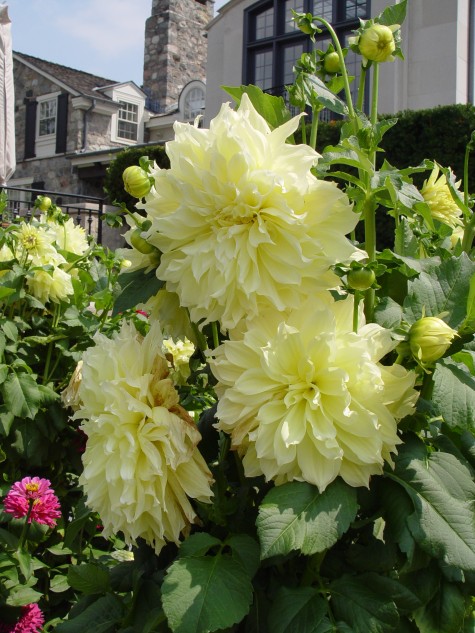
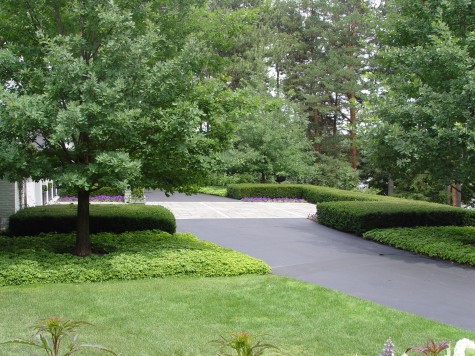 My idea of sheetcake has nothing to do with cooking batter in a pan. It has everything to do with the idea of planting shrubs in masses. There are those times and places where planting out in rows has its place. Field rows of corn, asparagus, peonies or cutting flowers can be an astonishing sight. Many years ago I designed just such a garden for a client who tithed the use of the land surrounding his house to his church. This, the intersection of agriculture and landscape. Some years later I dicovered the work of the Spanish landscape architect, Fernando Caruncho. His gardens explore the idea of agrarian based landscape design on a grand scale. His landscape, Mas De Les Voltes, I admire as much as any landscape I have ever seen. But my intent with the above pictured landscape was to suggest that a drivecourt had been carved out of a mass of taxus. Though most of the mass is actually drivecourt, the suggestion of great mass remains. Shrubs planted formally en mass-I call this a sheetcake.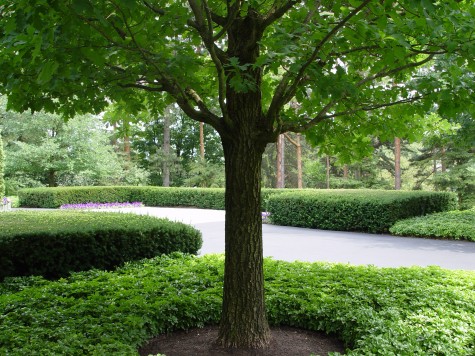
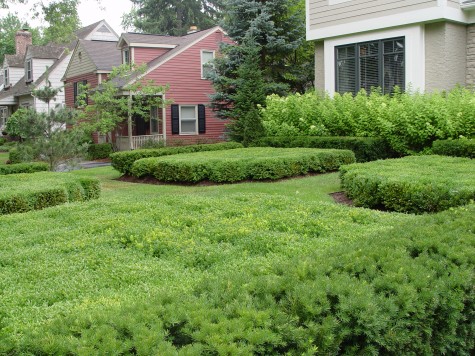 Very small urban properties can be sheetcaked to good success. One has to choose as few gestures from many possibilities, given a small space. Too much going on in a small space dilutes the impact of the landscape. In this case saying less truly is more.
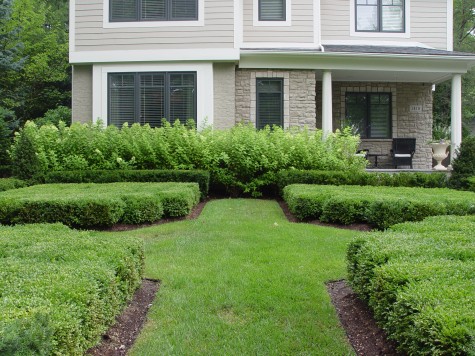 A very flat piece of land achieves a change of level with the interaction of two plant materials of different heights.
 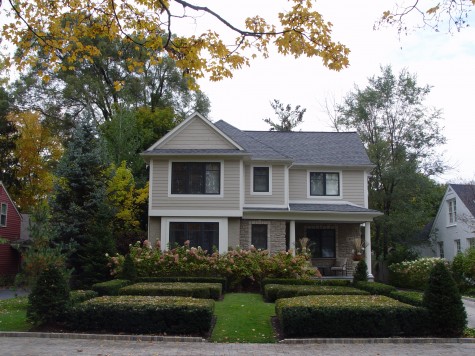 The dusting of fall leaves provides another dimension as the limelights are fading.
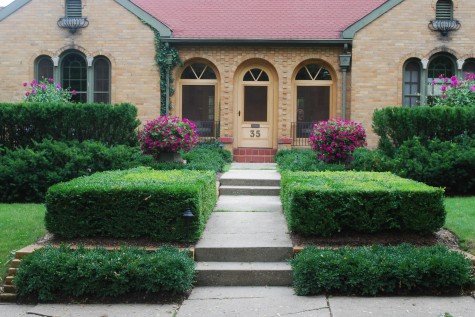 A sheetcake garden is an effective way to showcase abrupt changes in grade. I am all for celebrating any unusual characteristic of the land. One client had a low lying front yard, and an active artesian spring. I dug the ground deeper, and created a pond. The sidewalk to the front door was actually a boardwalk over the pond; you get the idea. The artesian spring was treated as an asset, rather than a nuisance. Accommodating nature helps produce a successful project.
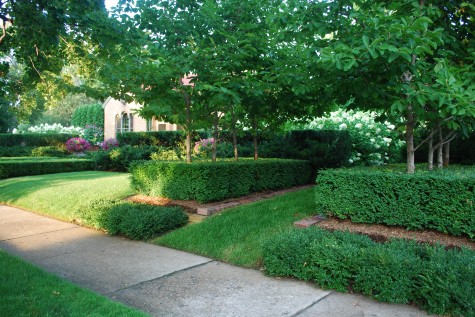 A tree inset into a sheetcake provides another layer of interest. I have talked about the spent magnolia petals on these boxwood in the spring-it is a sight for my gardening eyes.