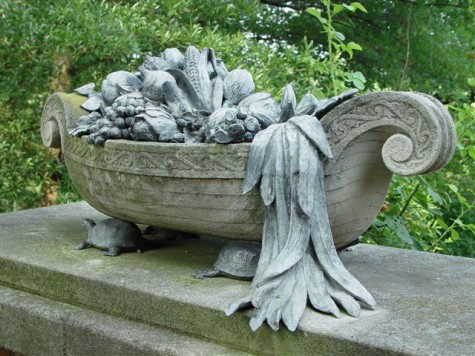
The manufacture of garden ornament, vases and sculpture in many ways was a revolution of sorts. Most garden ornaments of antiquity were created at great expense and time, as in hand carved, or sculpted, one piece at a time. This meant great garden ornament was restricted to just a few patrons of the garden arts. As lead is quite malleable, and melts readily, it can be cast. This meant ornament could be cast in multiples, and a favorite stone ornament could be reproduced at much less expense than hand-carved stone. Imaginative manufacturing techniques made lead ornament of all kinds readily available. This drop dead gorgeous stone and lead garden ornament pictured above was designed by, and executed under the direction of Beatrix Farrand, and installed at one of her best known landscape projects, Dunbarton Oaks, in Washington DC, in the 1920’s.
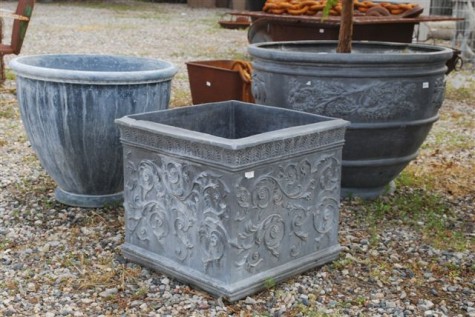
The Bulbeck foundry in England produces some of the finest lead garden sculpture, ornament and pots available anywhere in the world. The giant egg cup with acorn, oak, grape and rose motifs is astonishingly beautiful. It is a modern interpretation of an old lead planter from the National Trust gardens at Anglesey Abby. The Bulbeck square planter, with its delicate Florentine scrollwork decoration, clearly illustrates the degree of detail possible with lead casting. Bulbeck lead is what I call the midnight blue four-door Ferrari coupe of garden ornament. Lead panels out of the mold are rough beyond belief; the art here is in the hammering and finishing which produces the fine ornament you see here. The people who make these pots are artists; they literally sculpt these pots from a rough approximation of the finished piece. Of more modest provenance and finish , the small plain lead egg cup pictured here is the work of the noted Canadian lead manufacturer, Richard Davies. His lead has some steel content; the difference in surface and color between the two manufacturers is evident. Any or all of these pots would make much of a planting.
 This lead running fox is the work of HCrowther Ltd, which has been manufacturing lead garden ornament in London since 1908. Their sculpture is particularly fine. This very appealing sculpture is as at home in a stone trough as it would be in the lawn. My personal choice-set in a bed of European ginger.
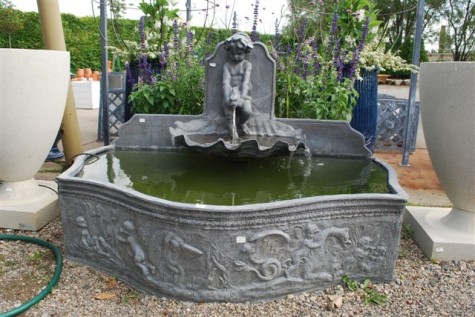
This Crowther fountain is equally as striking. An entire garden could be designed around it. This fountain design has been in production many many years. Lead, and classic lead design, weathers and ages in a garden so gracefully.
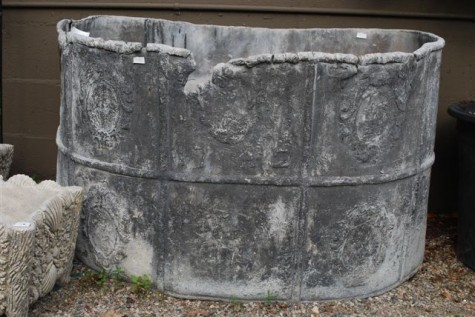 This very old lead cistern carries the evidence of its age. The dealer in England from whom this piece was purchased thought it likely was at least two hundred years old. Wave the history card in my face, and I am done in.
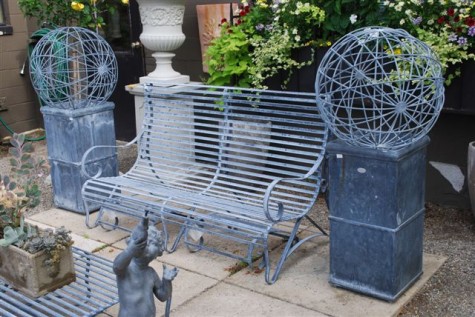
Lead garden ornament has become incredibly expensive. The lead itself has doubled in price in a very short time, and the process is dirty, dangerous, and laborious. The steel furniture, spheres, and boxes pictured above have a finish very reminiscent of lead. This finish has the added advantage of protecting the steel from rust. Steel is strong enough for furniture. Boxes and pots made of steel do not collapse from their own weight, as lead is prone to do. But best of all, this beautiful look can be had for much less than lead.
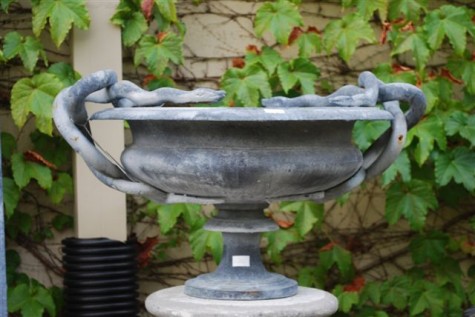
This old French iron snake urn has a new life, and a vastly different feeling than the rusty original. Rarely would I touch the surface of an antique piece, but this piece was rusted beyond charming. Removing the rust brought the snakes, and the beautiful shape of the urn, back to life.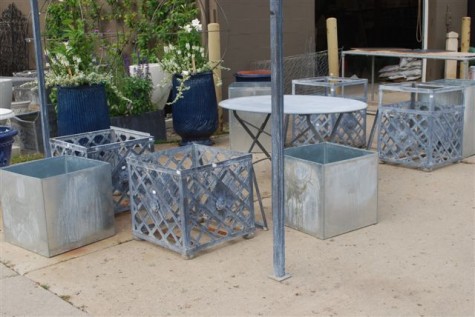
These acid washed steel boxes and galvanized planters are awaiting painted liners in the color of the client’s choice. Steel combines well with other materials.
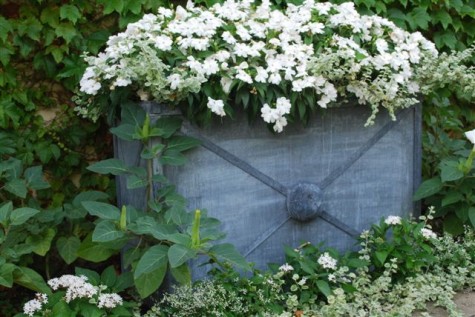
The galvanized sheet metal liner of this steel box has also been acid washed. We can manufacture this large box very reasonably. I like good quality garden ornaments being available to lots of people. Manufacturing in multiples, with less expensive materials, makes this possible.
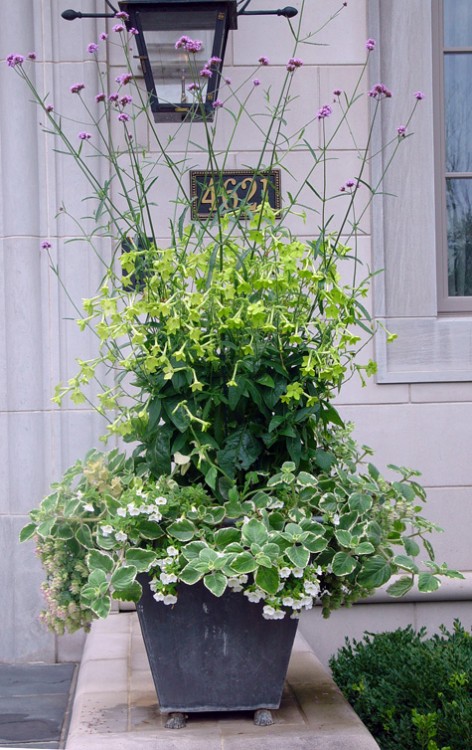
Whether you choose lead or acid treated steel, it is indeed a very handsome look.
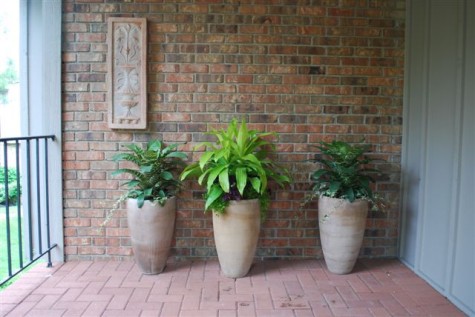
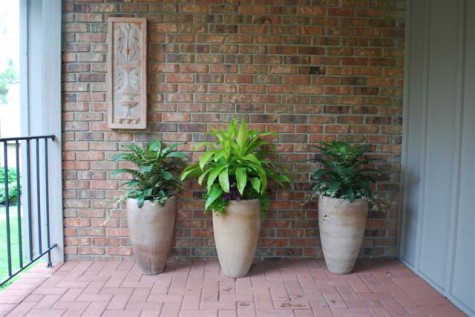
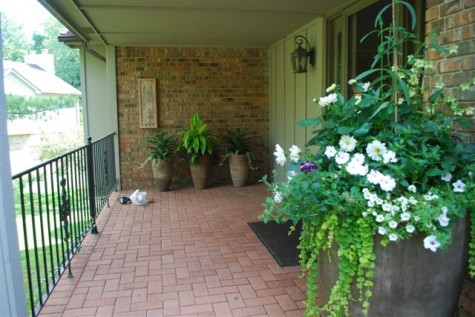 The walk culminates in a covered porch; the front door is at right angles to the walk, and not visible until you are right up there. All of this makes the brick wall they see coming up the walk an important element in their landscape. We started with pots, as there is no ground to plant in; this part looks great. But I thought that wall needed what all walls seem to need-a sculpture, a painting, a mirror?
 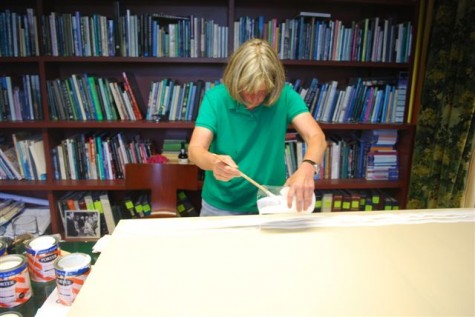 As my clients have quite a collection of art, they were receptive to the idea of a painting. Paintings that survive the weather need to be made of different materials that what an artist ordinarily would choose. I paint on extira board, which is used for making exterior signs. It does not absorb water, nor does it deteriorate outdoors. Porter Paint is a 100% acrylic paint; it is color fast, very tough and hard, and sheds any weather. As this paint is actually exterior house paint, and does not have the body of artist’s colors, I decided I would pour the painting. A beaker was the perfect tool.
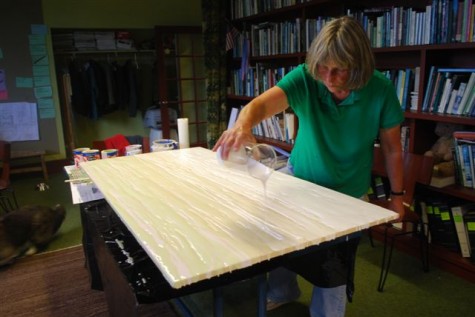 I poured the painting over the course of about 4 hours. Some areas I wanted to blend colors. In other areas, I wanted colors to sit distinctly side by side. All in all, I poured one and a quarter gallons of paint-a big fluid situation, to say the least. I supported the extira board underneath on 8 quart cans of paint, so if the board sagged from the weight of the paint, it would be evenly supported.
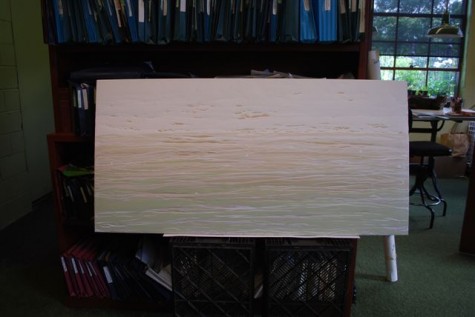 Within 3 days, the surface of the paint had skinned over sufficiently that I could stand it up to take a look. While I was happy with the color and the shapes, I wanted more texture. The painting would be viewed from some distance coming up the walk. The near view, on the porch, would present a different look. I wanted to address both views.
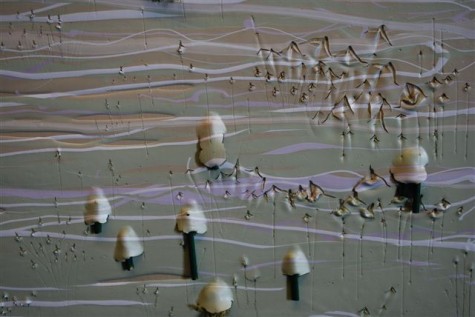 Using a carpenter’s awl, I poked, scratched, lifted up and pushed around that partially dry paint. The areas of paint I lifted off the surface, I stuffed with pieces of bamboo. At this fairly wet stage, I needed to support the paint until it dried. Once the paint was thoroughly dry, I stuffed those shapes with preserved reindeer moss.
 �
�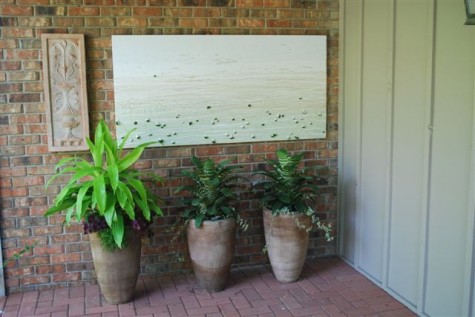 The close view I like. All the elements are different, but they look good together. The Italian terra cotta plaque is so much more important visually than when it had no company.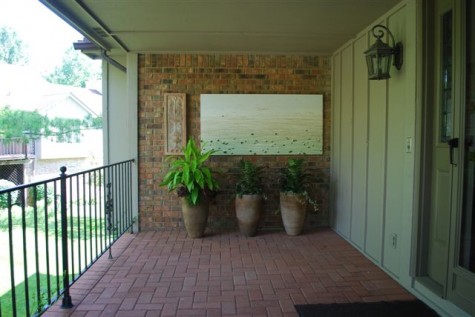
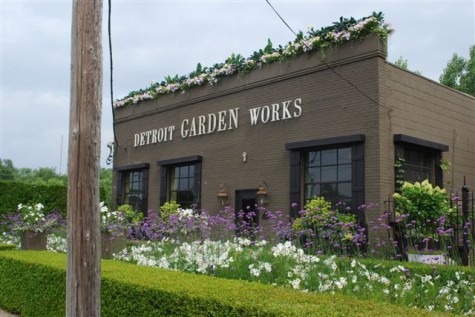 Every year I plant the front of the store differently; this year I wanted the planting to feel like a meadow. The big bed of violet colored verbena bonariensis and white cosmos is almost always in motion. The marguerite daisies and petunias in the roof boxes are thriving, sheltered by a hedge of Nero di Toscano kale that will be the star of the show by fall. The kale does for the daisies what the boxwood does for the verbena; their respective relationships are good ones.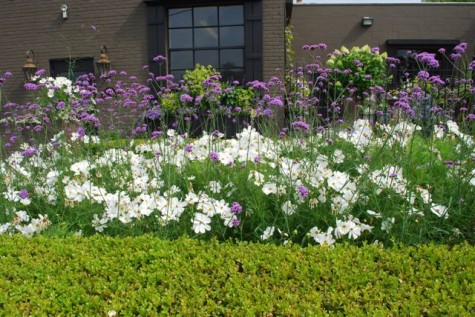
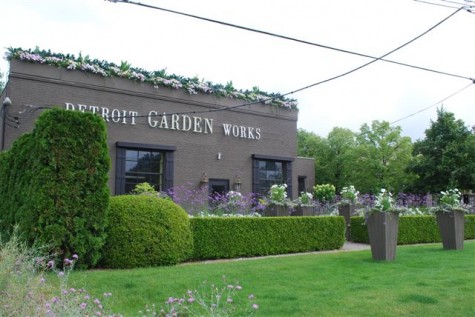
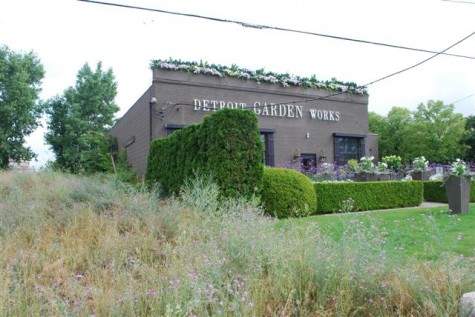 However, as any gardener knows, nature never sits. Someone once put it to me like so-nature abhors a vacuum. So this property is in phase one of its ecological evolution; disturbed ground is first colonized by grasses and other tenacious and vigorous plants, popularly known as weeds.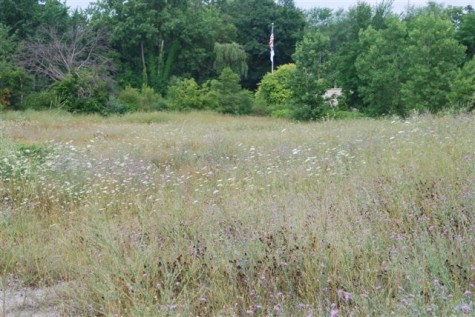
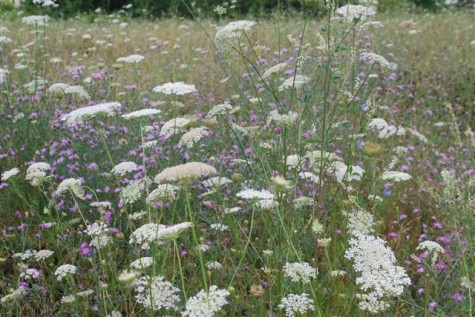 Queen Anne’s Lace is one of my favorite flowers. I buy bunches of it at market this time of year. Its tap-rooted vigor makes it a poor choice for a cultivated garden, but it vastly dignifies the look of vacant lots like this one. Its more civilized cousin, amni majus, can be grown in a garden to great effect; it is grown routinely for the cut flower trade. However, I am perfectly happy with this distant and unruly relative.
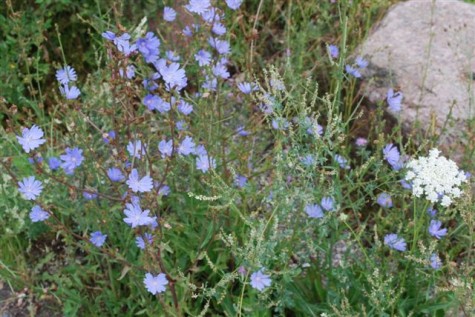 Chicory is the devil to get rid of; it is perfectly capable of worming its way through a crack in a concrete road. It is the most beautiful blue, a color not often seen in Michigan gardens.
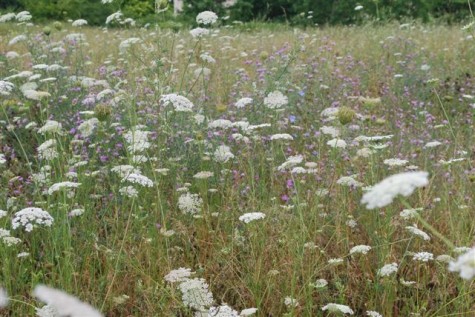 The mix of colors, the uniformly wispy textures, the motion of it all – breathtaking. There are garden flowers that have a meadow-like habit-panic grass, hyssop, bee balm, boltonia and so on-but there is no scripted garden that looks quite like this one.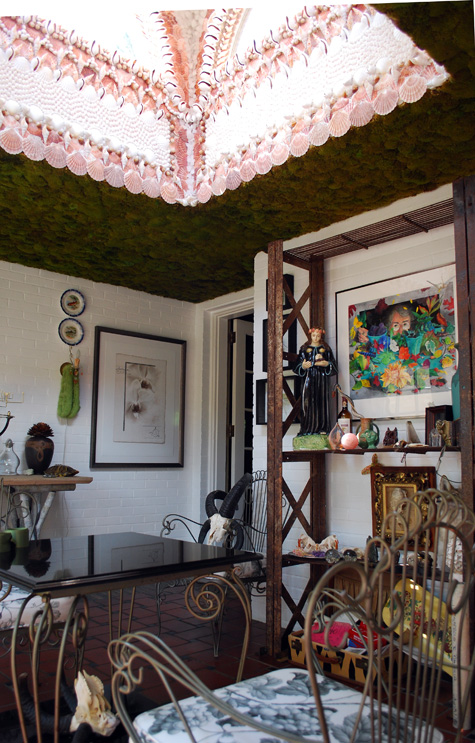
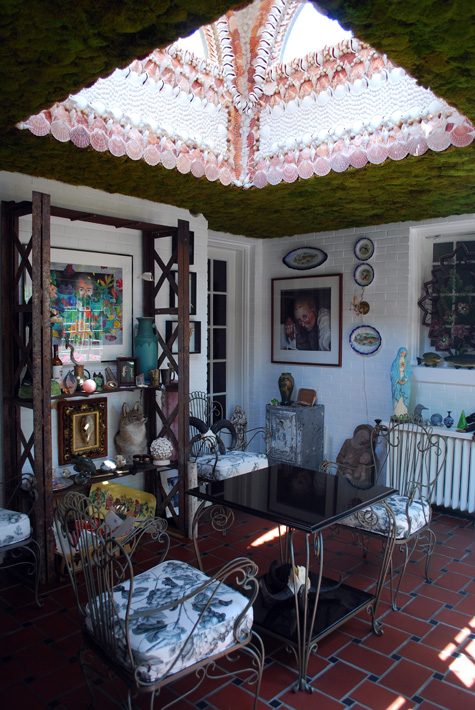 An old French wire garden table and chairs provide seating. A pastel self- portrait I did 30 years ago shares the wall space with specimens of butterflies, bugs and moths. Objects of meaning to me – as in, the clay bust I made of Julius Caesar in the third grade, letters from my Mom while I was in college, a collection of early twentieth century American fish plates-all the quirky things that have held my interest or been significant to me at one time or another, have a home together. The souvenirs of my life. Though the word souvenir now brings to mind postcards or paperweights from some tourist attraction, that was not always the case. The word souvenir, translated literally from the French, means “the act of remembering”, or “that which serves as a reminder”. There are times in my garden when the season or the light or the rain is just right such that memories will come strongly to mind.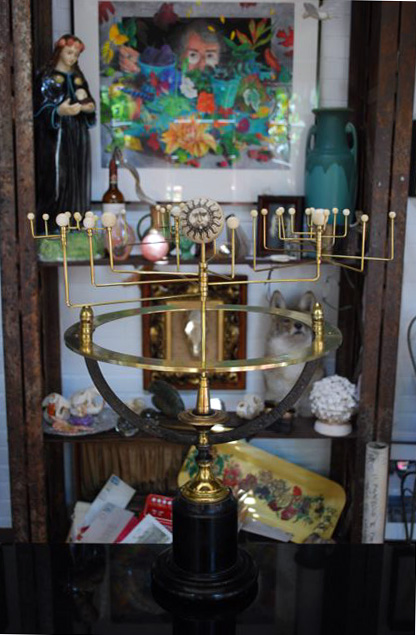
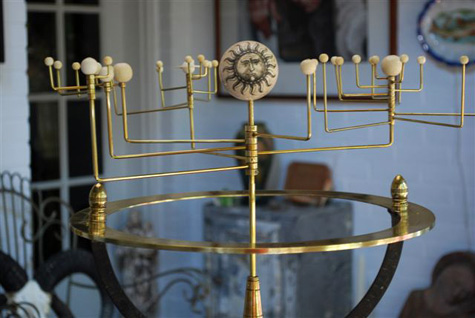 At the time of its making, only seven planets were known. Though it is a beautiful relic from a culture and time vastly different than mine, it is a reminder that one’s world is only as large as one sees to making it.
 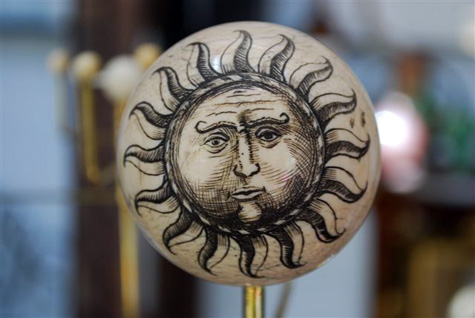 The sun, represented with a human face sporting a wry, quizzical , perhaps world weary expression, is as much a fine piece of art as it is some unknown person’s memory and concept of the natural world.