Home At Midday

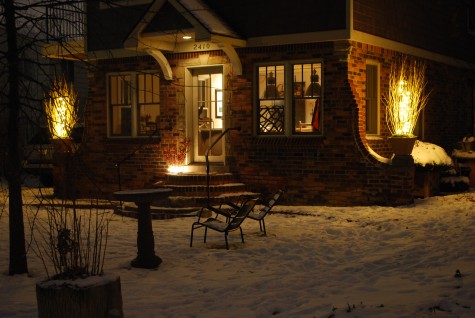
I had occasion to be home during the day today for the first time in weeks. This time of year, I usually leave for work in the dark, and come home in the dark.  My work for the season is finished. This means I have some time I can call my own.  While Steve was finishing up the very last of the landscape work, I went home to try to figure out what I would do for a Christmas tree.  Buck and I celebrate Christmas Eve, so I need to make a move fairly soon.  I was pleased to see my garden was holding its own, and hosting a little holiday display.   I am so happy for my evergreens in the winter. They mean I still have a garden, in late December.   
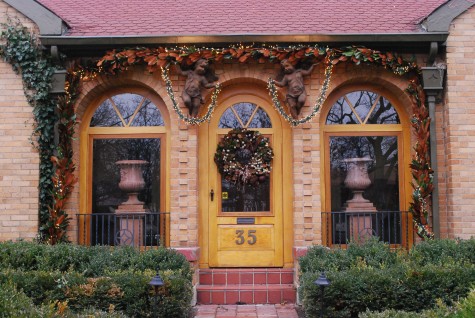
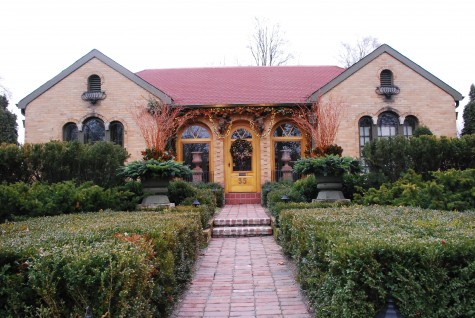
My home was built 81 years ago.  Vintage, it is.  I like a traditional holiday display that compliments the architecture-this I talked about yesterday.  Southern magnolia does a great job representing that feeling. I hang the garlands, leaf points up; magnolia curls as it dries.  These garlands will bulk up, the more they dry. The color and volume suits this old house. 
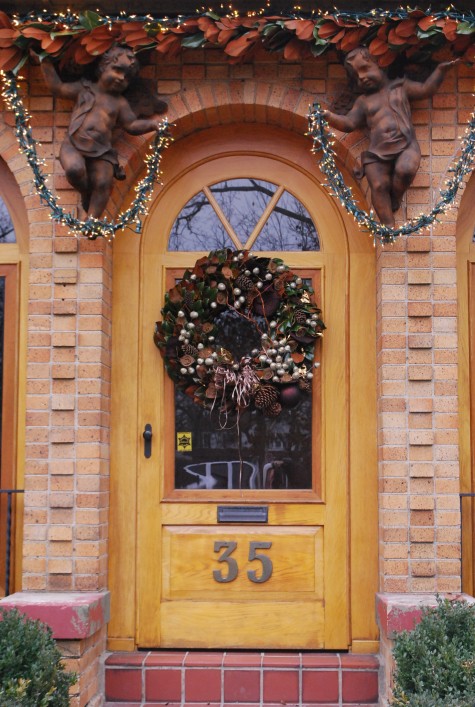

I do very little in the way of entertaining.  It is hard enough to find friends that understand and are willing to work around my work schedule.   My good friends come to the back door, or come through the garden gate at the back.  Those friendships are serious enough to welcome them to the back of the house.  But I still want my front door to look dressed properly for company. 
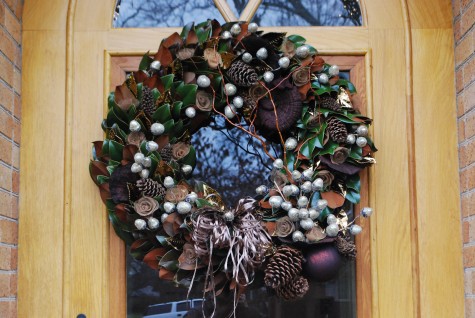
A magnolia wreath is a joy to decorate.  My wreath is decorated with bits and pieces left over from other projects, a stem of curly flame willow, some brown dyed bracket fungus, some pine cones, and a string bow in chocolate. Not so fancy, my materials list.       
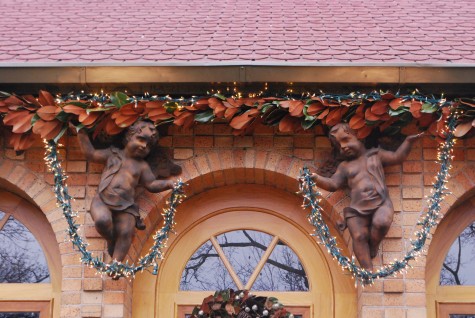
My resin cherubs are not such a fancy material, but their shape and expression recalls lots of classical garden ornament I have seen over the years.  The detail and color is amazingly convincing.  Not everyone is a fan of the putti, the cherubs, and the angels, but I fell hard for this pair. 
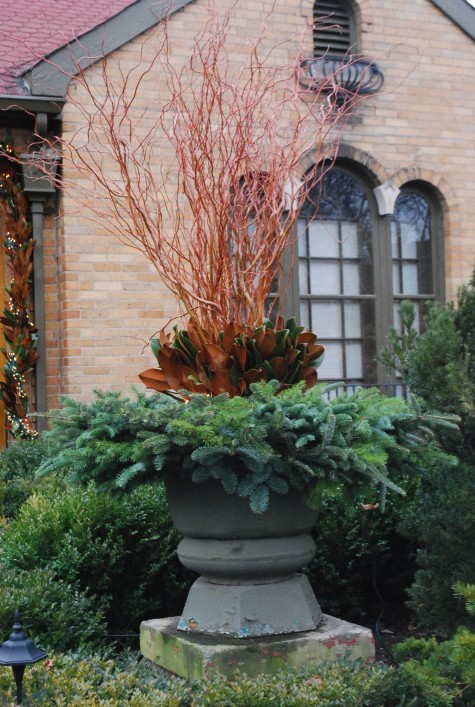
My winter pots have lights-this is their holiday moment. I will run those lights much longer than I really should, and enjoy every minute of it.  I am just glad to see that the arrangement looks good at midday. 
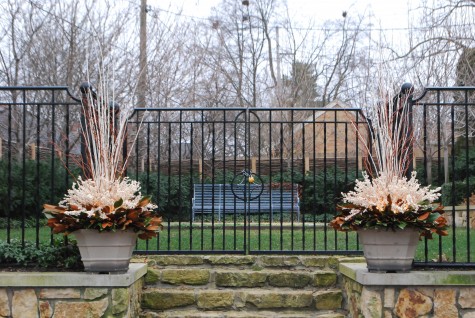
Rob fixes a pair of pots for me in his own inimitable style that sit on the wall at the end of the driveway.  They are the first thing I see, when I pull into the drive during the winter.  These cream beaded picks are ablaze with light at night, thanks to a few strings of C-7 lights placed underneath them.  During the day, they still look great.  Bleached willow sticks, a few sprigs of flame curly willow, the cream picks and a ruffly skirt of magnolia-this looks as good at midday as it does when I come home after work.  I cannot really explain this, but these Galway stoneware pots beautifully dressed for winter mean all the world to me.  What fun to see them at noon time.
The Glamorous Bits

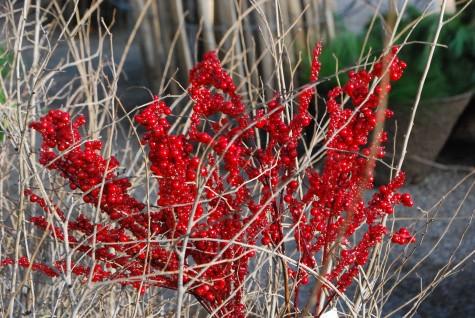
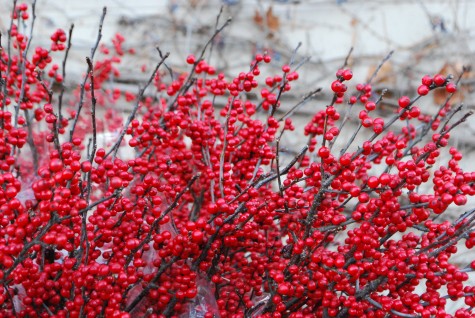
I had a comment some days ago from a reader named Carol.  She wondered if I could talk about some ideas for adding some glamorous bits to winter containers.  Ilex verticillata, or Michigan holly, is my first choice for a glamorous addition to a winter container or garland.  That said, I find the berries on the holly will wither and fall like crazy, unless they are treated with Vaporguard.  Vaporguard is an antidessicant, much stronger and more effective than Wiltpruf.  I have some first hand experience with this.  Holly we sprayed with vaporguard was effective on those berries through February of last year.   

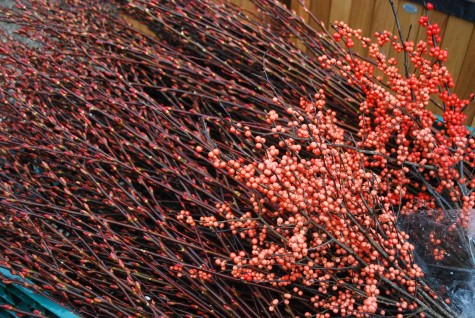
Without an antidessicant spray, holly berries will drop, and drop early.  These orange holly berries are new to me; we sprayed them upon delivery.  Paired with red bud pussy willow, there is a lot going on here visually.  The color is beautiful.  If you live in Michigan, you know that our winter color palette is about grey, more grey, and a dry brown.  This color is juicy, and saturated.  Glamorous.  Crabapples can fruit heavily, but even the “fruit persistent” varieites will drop, or be raided by birds early in the winter.  I would recommend seeking a little glam from other sources.  


Rob collects materials, and takes them outside to look at them.  He may revise his choices 5 times, before he commits to anything.  The big idea here-hold all of your materials in your arms, and decide if you are crazy about what you see.  If a combination seems to fall flat, keep looking. 

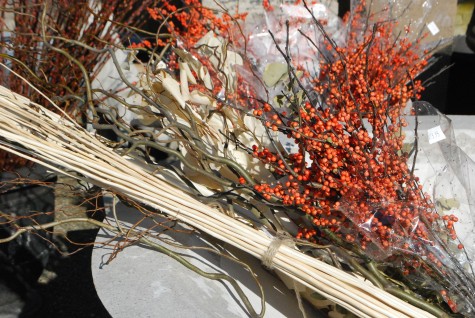
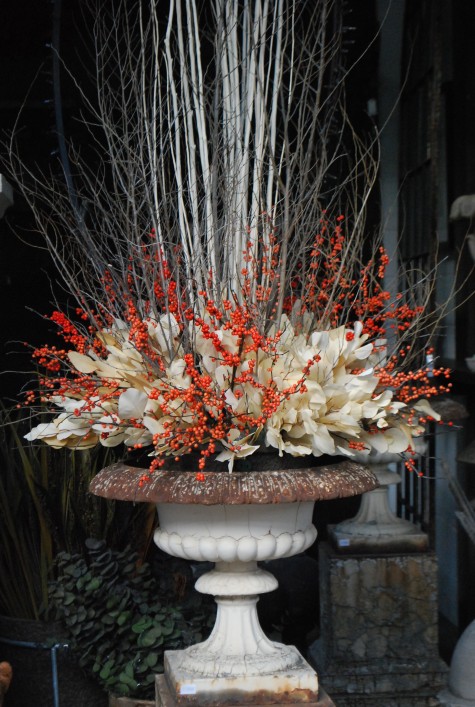
Rob finally decided on the following-the orange berries and bleached leaves contrast dramatically. Breathtaking, this.  The tall bleached sticks strongly contrast in form with the grey branched hackberry stems.  The combination of colors and forms here is truly beautiful.  


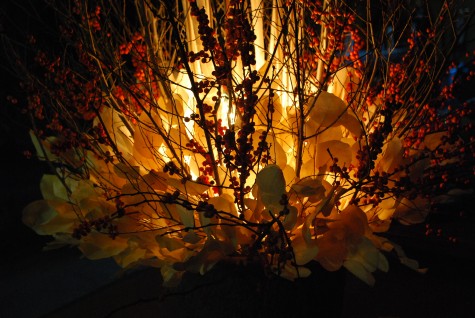
 This combination of materials lit from within by a string of garland lights-garden evening wear.  Garland lights?  We stock strands of lights that have 300 bulbs set in a 17 foot length.  This makes for lots of fire power, and not so much cord.  This is my light string of choice for winter containers.   For the holiday or winter season, turn up the heat.  Make a plan to light up the night.  It may be your most glamorous gesture comes at night.  I encourage all of my clients to light their winter pots, and keep the lights on all winter.  Why not?  That light is cheery, hopeful- dramatic.      

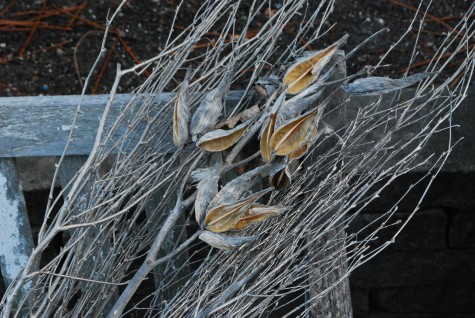
I am having a milkweed seed pod year-that grey and honey brown coloration is beautiful; the shapes of the pods on the stems-even more beautiful.  Were I to glam up these dry stems, I might choose platinum branches.  These are birch branches, sprayed a subtle silvery grey.  These branches can add a little sparkle to a milkweed winter arrangement. 

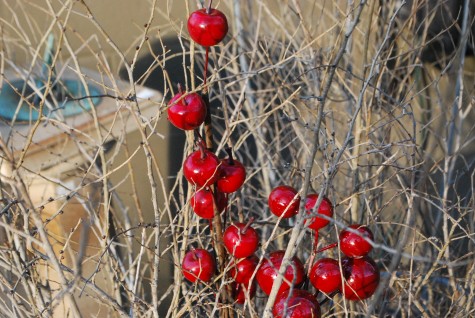
Faux red berries-every gardener hates them.  Until they take them outdoors.  Nested into a centerpiece of branches, they are jewel-like.  No bird will make off with them.  No winter storm will destroy them.  Make no mistake-faux berry stems look their age at the end of the winter season.  They age, as the winter goes on.  This aging is a good look.  They look so much more natural, in that dulled-down state.  But over the holidays to come, they sparkle.  Bright red at the holiday-everyone notices.  

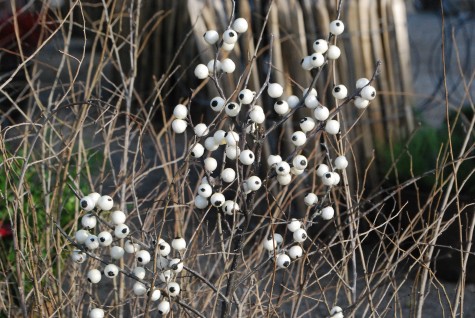
These faux white berries are spaced sparsely on the branches-they have a natural look.  From a distance, they are entirely believable.  Each stem is individually wired.  Move them around.  To insert a branched faux stem into an arrangement without putting your hand to arranging each arm is what makes them look fake, and out of place.  Arrange those faux stems.  

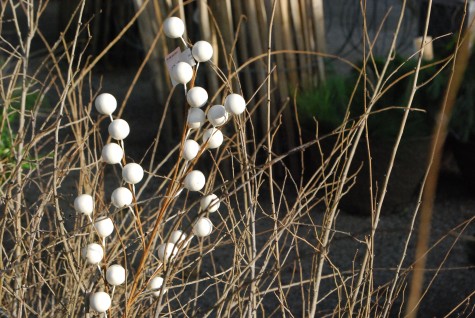
These white berry stems make no effort to copy any real berry stems-but I still like them.  They look great in contemporary arrangements.  They add scale to a more sparse berry stem.  Working several stems together that are the same color can be very effective.  Effective?  Any expression that brings a smile to your face, or warms your heart-effective.  Winter sustenance-decide how you plan to represent this. 

Faux berry stems with sparkling crystal bits can add considerable glamour to you winter arrangements.  The degree to which you want to dress up-this is up to you.  If what the garden leaves behind is enough, there are materials.  If materials suitable for a cocktail party is enough-there are other materials. If a floor length sequinned gown is your idea of celebrating the holiday and winter, there are materials out there.  The materials are out there, for you to choose.  Choose.

Hello Yellow

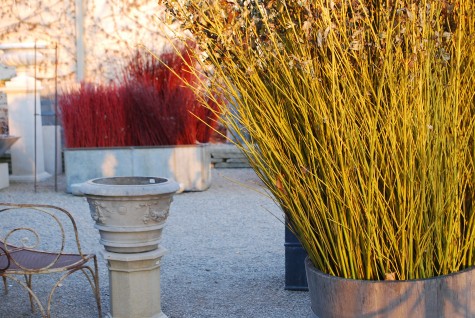
It is no accident that school buses are yellow. Though a school bus is a very large object, that yellow color is what you notice first.  National School Bus Glossy Yellow paint was formulated, and adopted for every school bus on the road in the United States in 1939. The black lettering on a school bus read the best in the early morning pickup hours-against this particular color of yellow.  Yellow twig dogwood branches are just about that bright-set in a winter landscape.

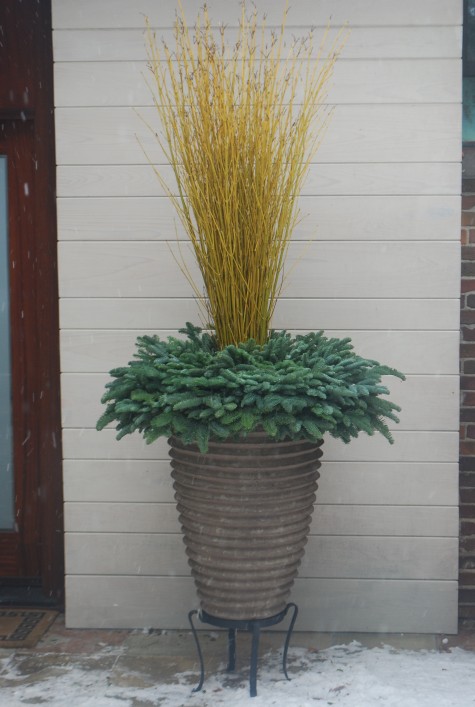
My kitchen is painted a happily intense and rich yellow.  The yellow fall color on gingko trees-extraordinary.  Yellow twig dogwood-the summer plant is nothing to celebrate, but its bare yellow twigs are visually compelling.  A thick bunch of those stiffly vertical twigs say stop, and look at me.  My winters may be grey on grey, but I have a few alternatives.      

This client’s clapboard house is painted grey.  The yellow twig in her pots jump off that grey page. During the summer, I have plenty of yellow; those mostly sunny days happily enrich my garden with a warm yellow light.  The winter brings a blue bruised and very cold light. Michigan ranks right up there with big numbers of grey days in the course of a year. My readers in much colder climates-like Minnesota and Wisconsin and Colorado-how I admire how they deal with their cold winters.  But friends of mine out west say their winters are by and large sunny. This helps so much to make the cold more tolerable. Their yellow comes regularly from the sky. Ours need come from another source.     

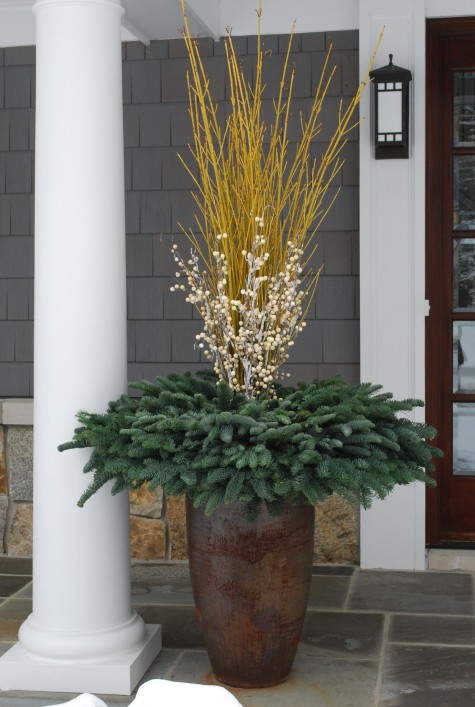
This yellow twig centerpiece has help banishing the winter greys.  The white faux berries brighten and heighten that yellow. The yellow in the stone, the grey clapboard-the grey stone porch surface-the contrasting color combinations here engage the eye in a lively way.Yellow twigs do a great job of backing up a dark element in a pot. These fan willow stems read so much better, given their yellow backdrop.   

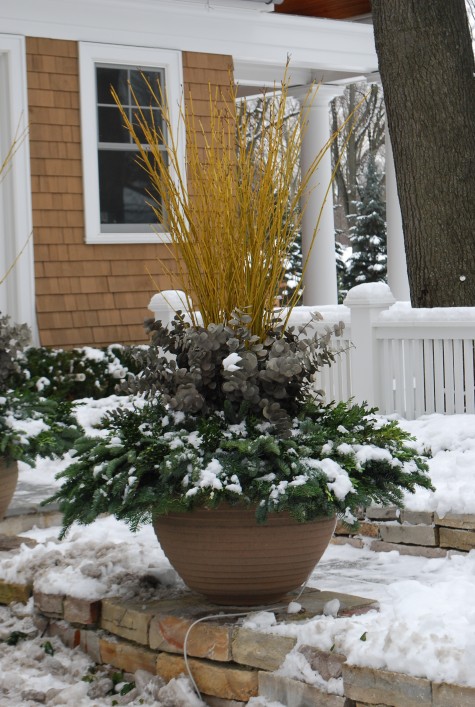
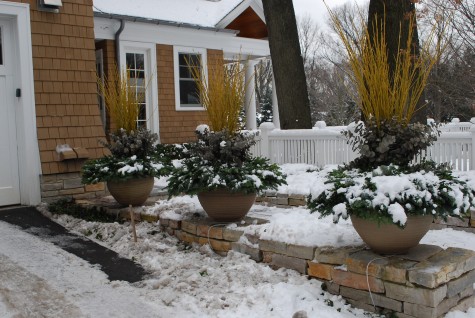
The cinnamon brown siding on this house-beautiful.  A pair of teak pots flanking the front door repeat that color. The bunches of yellow twig, the white frost eucalyptus, and the low greens are just plain pretty to look at. 

This sage-grey colored eucalyptus is a more unusual color combination, but I chose it as this container is but one of three.  Rowdy color combinations can be a bit too much if repeated in close proximity. 


This more subtle composition scheme finds its strength in the repetition.  These pots will look amazingly good yet in April, when I plant these pots for spring.  These pots would be empty, or in storage for 5 months, barring a winter “planting”.

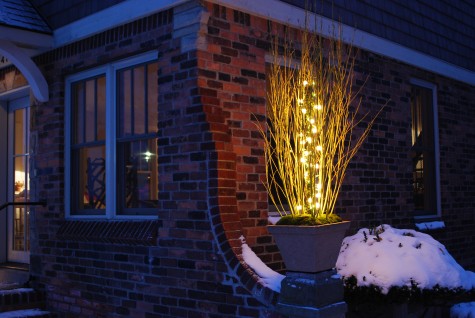
There yellow twig stems are placed in the pot singly, rather that as a bunch.  Space was left in the center for a stout mossed stick that was covered in lights.  The warm C-7 light string brings that yellow to life after hours.  The moss treatment at the bottom is in simple contrast to all the fireworks going on up top.    


I like these lit yellow twig landscape lighting fixtures.  Handsome.

Winter White

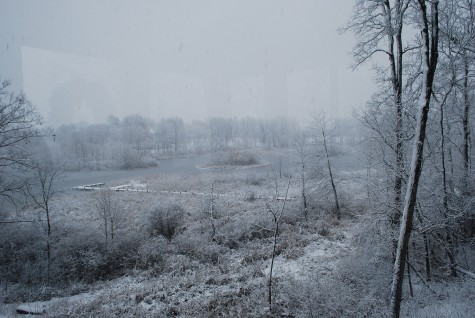
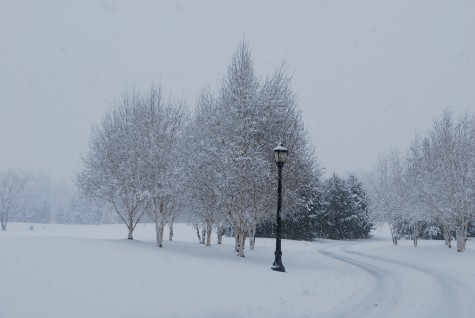
If you live in Michigan, white figures prominently in your winter landscape. On sunny days, this is a blinding white; on gloomy days, a blue/grey white.  Chilly.  White in the spring or summer landscape can be fresh and crisp; this is a white of a different sort.  Our first snow fell fast and hard.  The temperatures were actually above freezing; that snow stuck to everything it touched.    


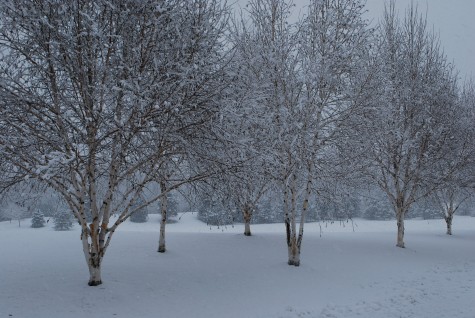
Driving was a challenge, but I am so glad I got to see these Himalayan white barked birch in a winter setting. I landscaped the common areas of this community a good many years ago.  The birch planted in irregular drifts are paired with scotch pine, placed in a similar fashion.  I like these two trees planted together.  The stout long needled evergreens are a beautiful foil for the wispy birch.  A green and white landscape.  This day, the white clearly had the upper hand. 

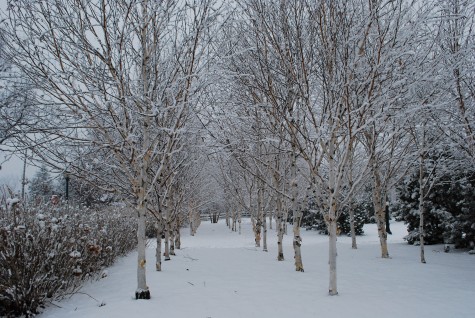
The birch are planted in a large square picture frame around the entrance building-three trees wide.  Planted on 12 foot centers, the lacy branches are beginning to meet overhead. My favorite part of the winter landscape is the ability to see the structure of woody plants.  Though I am unhappy to see burning bush and the like pruned into artificial shapes, the winter look of this style of pruning is interesting.  The overall shapes that many branches make can be be quite striking.     

These birch were planted in a loose grove, and left unpruned. The landscape is quietly beautiful on a snowy day. 

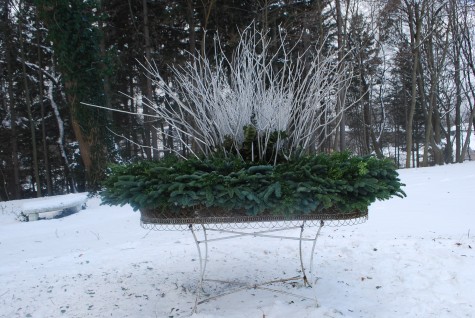
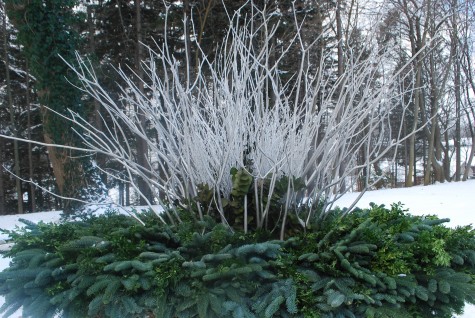
I use lots of birch branches in winter containers.  Their graceful and very twiggy appearance is in sharp contrast to the pole like stems of the willows. I am able to buy them from a farm in their natural state, and as lacquered natural branches.  That shine is useful in some places.  The branches are also available in a variety of colors-including white.  For the holidays, they are available in platinum, silver and gold.  This English antique oval wirework planter is 5 feet long, by about 30 inches wide-large.  A long and dense centerpiece of white birch branches and green eucalyptus was good with the length of the planter, but this composition needed much more in the way of height and scale.    

The long smooth branches-silver painted manzanita.  These thick and sculptural branches were individually set around and over the inner centerpiece.  Silver in a snowy setting such as this reads much like white.  A planter of this size benefits from a mix of greens.  Boxwood and noble fir contrast in color and texture.  This mix helps keep the surface of this container lively looking. 

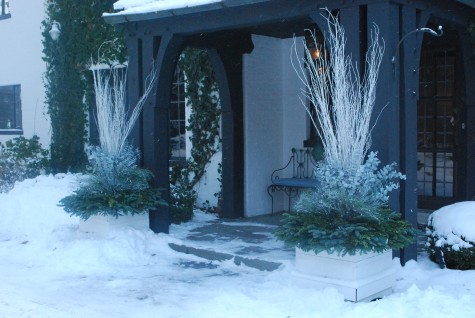
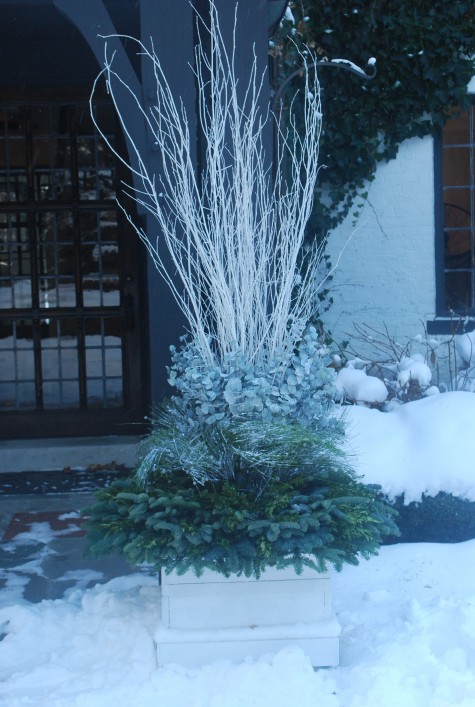
Tall white birch branches and white frosted eucalyptus make a substantial statement in these square white wood boxes.  A layer of faux snowy white pine picks add another layer to the centerpiece.  A wide and low planter asks for some bulk around the middle.  

The faux branches have a windswept look that takes readily to a placement outdoors; they are convincing.  Low and layered evergreens in the same mix finish the composition.  Even on a very grey day like today these boxes have a festive winter look.


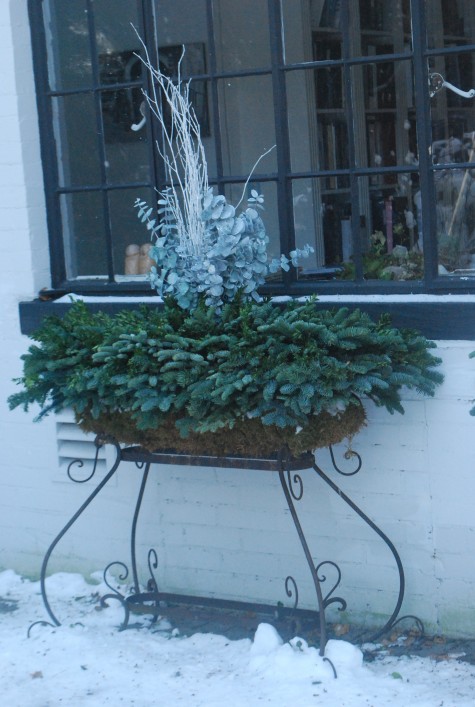
A small wire work planter gets a similar treatment, but in a wispy and scaled down way appropriate to the style and size of the planter. My client likes green and white, summer and winter.    


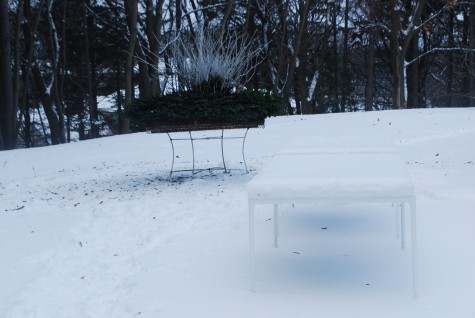
White will be the predominant color of the landscape here for months to come; this white wirework planter needs the green as much as it needs a large scale white element.  The white dining table overed in snow on this terrace- barely visible today.