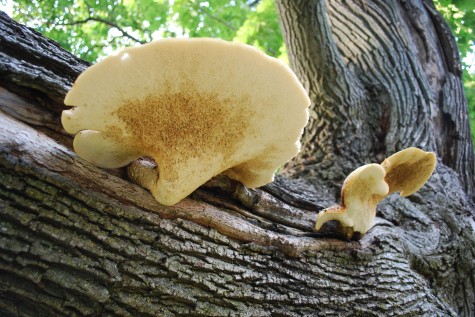
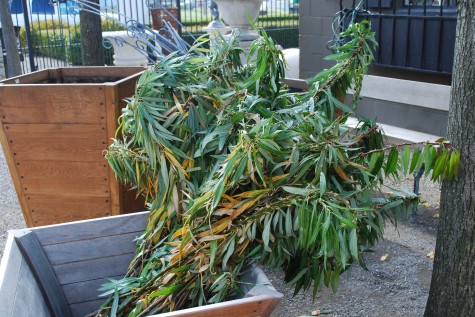
 My November garden is radically different and edited in character from what I see in the summer-but characters there are. The willows are coming into their own. I wouldn’t give a nickel for a willow in the summer-save the dwarf blue artic willow. Its graceful branches almost always in motion can recreate the feeling of a meadow in a small space. Other willows are coarse in leaf and ungainly in habit-in a word, park-grade. Should you have acres such that the willows can be planted comfortably far away in your park, fine. There are too many other more civilized choices for my small garden to give over space to this group. In November, I rue my rule. The cut branches of salix sachaliensis “sekka” pictured above would not make you rush to your local nursery to buy one, but as with most willows, their bold branches shine now. When the willow leaves finally drop, I kick myself for not having an entire hedge of it in the ground.
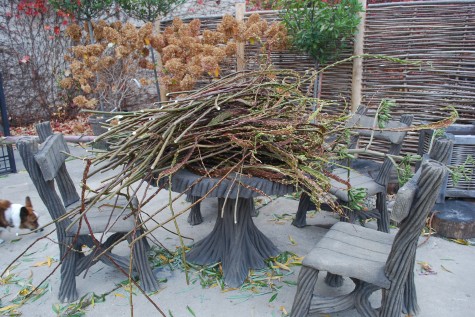 Commonly known as fantail willow, this shrubby plant is known for its fasciated stems. OK-I will cover the science as fast as I can. Meristem cells, from whence all parts of the plant grow, are dome shaped; they produce the cylindrical shapes we know as branches. Either from mutation, or some other force not clearly understood, some meristem cells flatten out, and elongate, producing wide flat stems that may curl in a most unusual way. These bold branches are gorgeous in the garden, and in fall and winter arrangements.
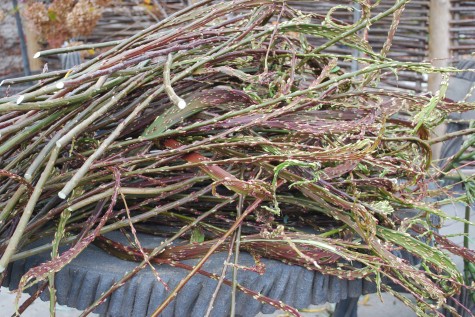 Some floral supply places carry dried fantail willow, but I prize the the fresh cut stems. Each branch colors up individually in the fall in shades of red, green and brown. The cut branches retain their color outdoors in cold weather a very long time; they make a striking centerpiece in holiday and winter pots, in wreaths and door swags.
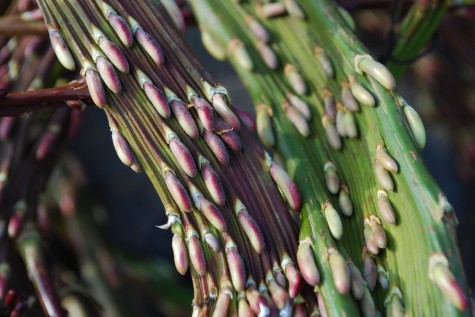 The grooves and furrows, a direct result of the process of fasciation, make for a very bold texture. Note the elongated the leaf buds set for spring. Fasciation can occur in many plants-I have seen two-headed dandelions, and thick flat stems of bulb lilies with their bouffant hairdo of flowers clustered at the top. Some plants may produce stems like this intermittently-these are called witches brooms, after the look of that proliferation of branches. Some witches brooms are cut, and propagated from cuttings. Certain dwarf conifers with very congested and odd branching patterns of questionable appeal come to market via a chance fasciation.
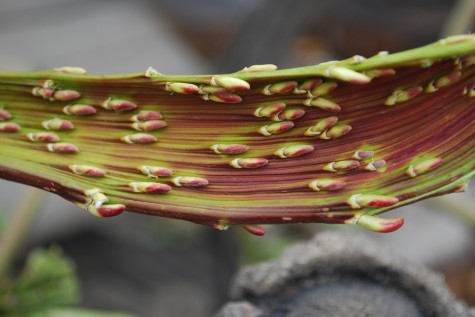 Color can be tough to come by this time of year where I live. I love the natural greys, browns and blacks common to the season, but I so appreciate robust color in a landscape that has by and large gone dormant.
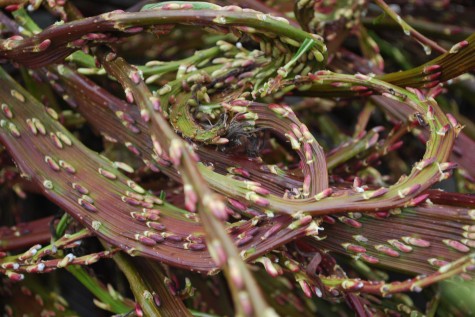
How these branches curl, swirl and swoop are as striking as their color. The remains of my ornamental grasses and beech ferns are rigidly spiky. Everywhere I look, I see sticks and more sticks.
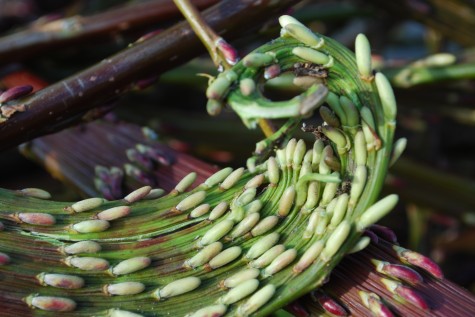
Their sculptural appeal aside, they are visually so lively. I have trouble keeping them in stock this time of year; these bold branches are a celebration of the late fall season.
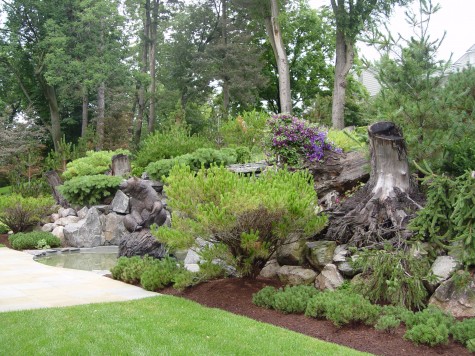
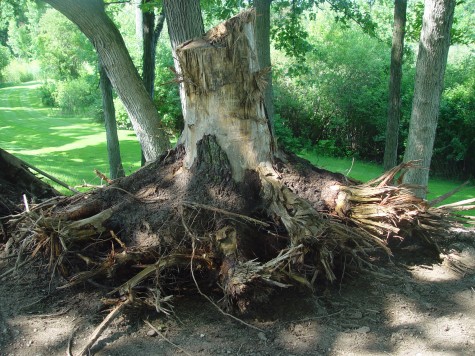 Some months ago I wrote an essay about designing a landscape for a sculpture, but perhaps equally as sculptural were the tree trunks that played such a critical role in the realization of that design. I do not think I ever physically understood what a tree was all about until I was face to face with these stumps. Farmers need to clear land to plant their crops; this means digging out the stumps. The microorganisms that decompose wood work at a snail’s pace. In farm areas in Michigan it is common to see fences made from these stumps. For this project, I persuaded a farmer to part with 150 feet of his fence. The experience would provide me with a graphic understanding of what goes on inside the bark of a tree.
 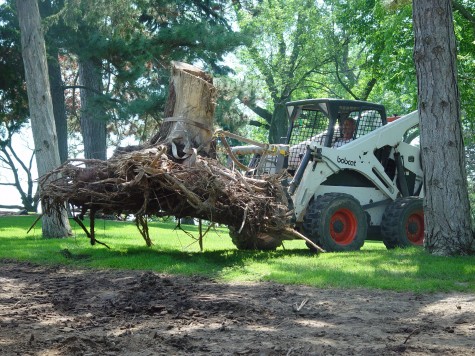 What arrived by flatbed was vastly more than I had bargained for. They stood eight feet tall and were much better than that in width. Though the fence had been in place for 10 years, handling the size and weight of them was a strain both for my crew, and my bobcat skid steer. The thick wiry roots were as unyielding as steel. It is so easy to stop truly seeing those things one sees every day. A lifetime of seeing these giant living things rising out of the ground to incredible heights had apparently dulled my sense of them.
 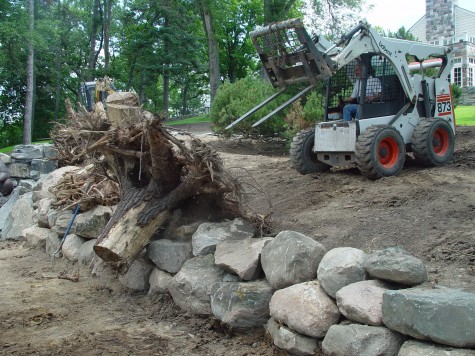 I was so struck by how the heart of a tree lives on long after its green life has gone down. The heartwood is transformed by an internal chemical process into a material of great strength. The wood of a tree enables nutrients to travel from the roots to the leaves, its core function is to keep the plant upright. This exposure to wood is much different than looking at planks, or plywood, porch furniture, or fuel for my fireplace. Processed wood is obviously a material that few could do without, but these raw forms are incredibly beautiful.
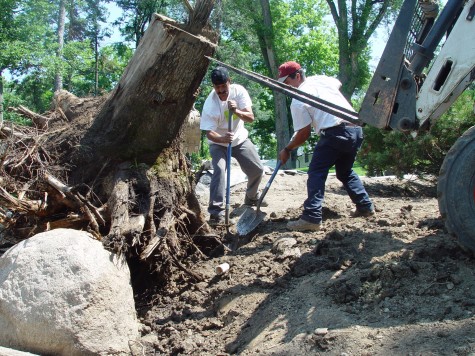 Setting them in place took days. Placing them close to the final location was done by machine. This was just the beginning; as I wanted them to look as though they might had always been there, we dug them in. The forks on the skid steer held the stumps in place, as it would have taken an army to do that by hand. Though this group of trees was no longer living, the story of how the network of feeder and support roots broadly rise out of the ground and grow to support these very large plants is there to read.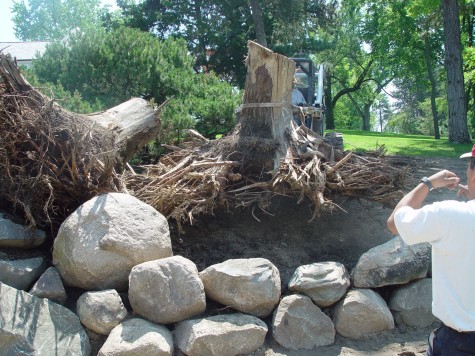
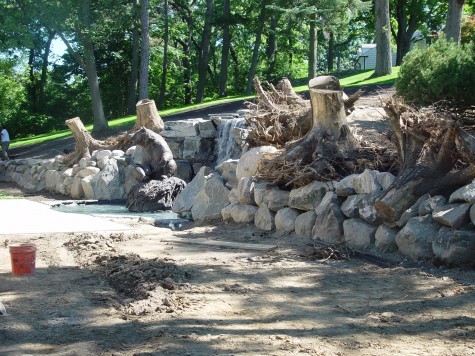 It is a very good idea to consider what will need to go on below ground, and what will eventually be-before planting a large growing tree. I have had occasion to tell clients that their silver maples were an excellent example of God’s biggest weeds. Urban lots and tree lawns are poor locations for giant trees. They suffer from restricted space and rootzones. Given that it takes a long time to grow a tree, imagining the eventual size at the beginning only makes good sense.
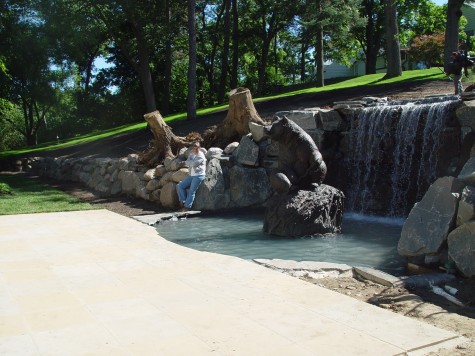 This nine foot tall bronze bear seated on his beaver’s nest is getting some company of a similar scale. The rain to come will wash the stumps. The digging in will deposit soil in pockets, enabling plants to grow. A collection of dwarf conifers would cover the ground.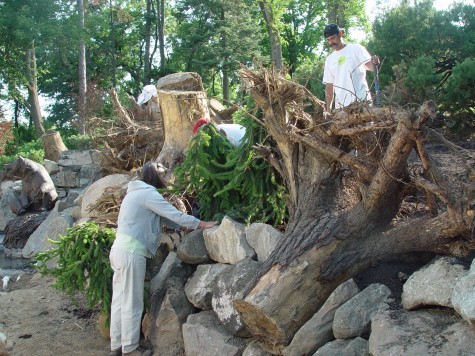
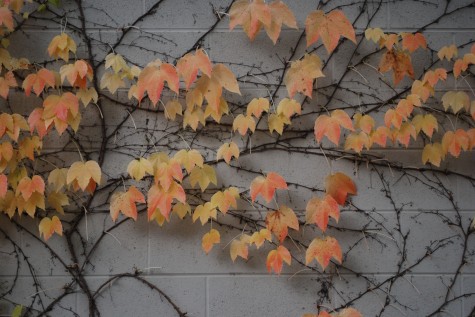 Fierce winds that went on for several days blew most of all the leaves on the trees to the ground. Yesterday what few leaves on my big maple that survived the initial blow, gave up, floated down, and landed on my drive with an audible sigh. I sighed too; November in Michigan is cold, blustery and unfriendly. My leaves usually fall over a period of weeks; this helps to get used to the idea that winter is not far off. But that all at once drop got me to looking at what is left behind. Tree bark-such beautiful skin.
 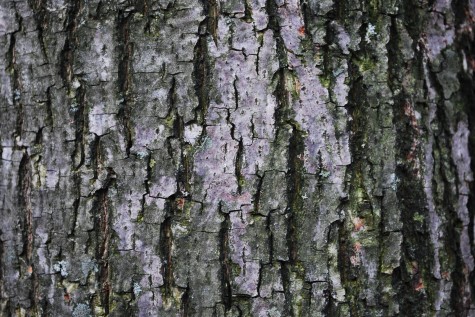 The bark of this linden is comprised of a number of layers-the outermost layer, or cork, is comprised of cells that are no longer living. This cork protects a tree in much the same way that skin protects people. The bark slows the loss of water from the interior living layers of bark. It is a deterrent to insect invasions, fungal and bacterial infection, and damage from animals.
  My skin surely reveals the amount of time I have spent outdoors; the trees are heir to all manner of insult from the environment that goes on non-stop. My corgi Milo has been trying to chase our resident squirrel up the trunk of my maple for three years now. His toenails have grooved the bark, but not damaged the tree. The variation in the appearance of tree bark makes it possible to identify trees by the bark alone; the diversity in plant forms is amazing. Old bark is beautiful in its texture and color. Rough, smooth, patchy, furrowed, scaly, exfoliating-we have so many words to describe the characteristics of bark.
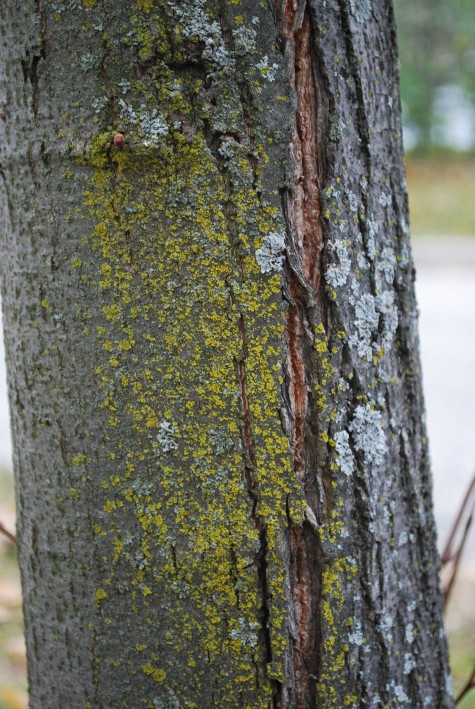 The bark of a tree can be a host to all manner of mosses and lichens; some relationships are symbiotic. Other plants such as mistletoe, are parasites. Bark also protects a tree from sun scald, and frost cracks. In the summer, the horizontally held leaves of my maples protect its bark from sunburn. Lacking leaves, freezing and thawing in the winter can crack the part, and expose the inner living layers to pathogens. This big leaf linden conditions has many frost cracks which have just begun to heal.
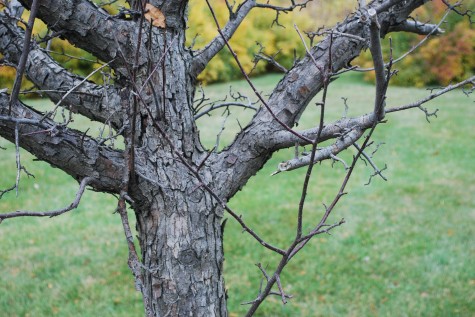
 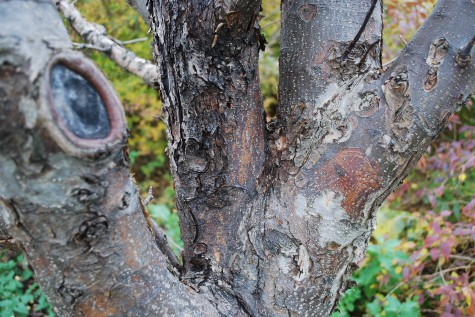 This old crabapple reveals many scars-some from pruning, some from insects-some just a result of age. The appearance of the bark is an important element in the selection of trees for the landscape. In Michigan, bark is the prominent visual feature of a tree for the better part of six months. The climax beech maple forests in the upper peninsula of Michigan are breathtakingly beautiful-as are the old cedars, and birches. The trees are so old, large and tall, most of what you see is all that gorgeous bark.
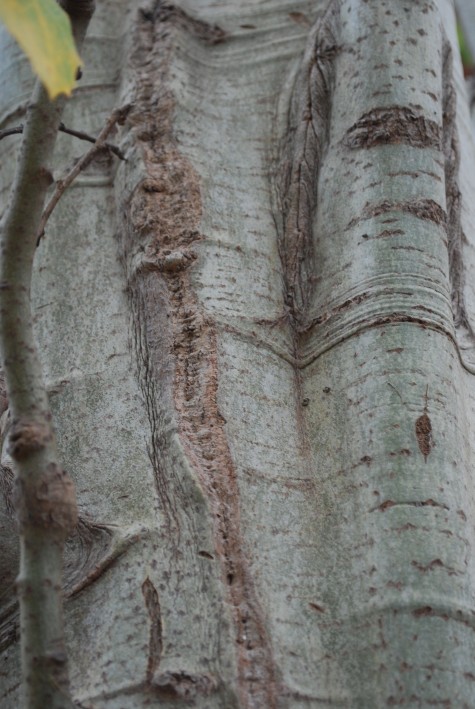 The Popples, also known as Aspens, have very beautiful smooth bark that has a decidedly greenish cast. Its sepia colored ridges and furrows are equally as attractive. The stands of poplar trees on the slopes in Aspen are my favorite part of that landscape. Bungeana pines, old Kousa dogwoods, and London Plane trees shed their old bark; this process known as exfoliation is incredibly beautiful.
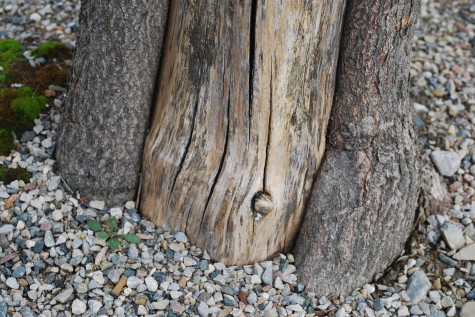 The bark of a tree will callus in response to a grave injury. This linden was struck hard by a careless driver; five years later it is still alive and thriving, though its woody interior is exposed on over one half of its trunk. The thickened bark is a healing response. Some bark grows thick enough such that it can be carefully harvested from a living tree use; this we call cork. The bark of the sequoia tree can grow as much as two feet thick-a proper scale for a tree of such great size.
 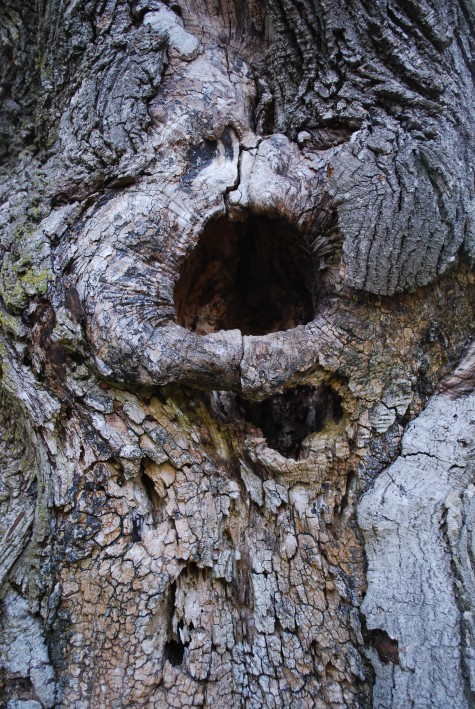 Though the bark protects the life of a tree, it does not protect forever. Like people, trees have a lifespan. This very old maple is in serious decline, partially from age. Trees with limited life spans may not be a good choice for a landscape you hope to have a long time.