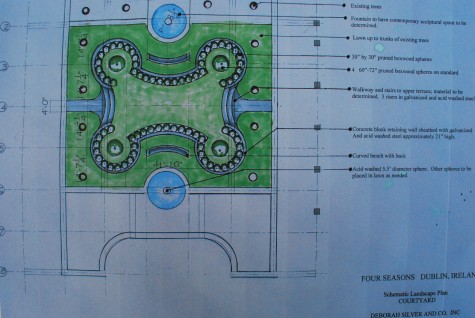
Deborah Silver is an accomplished and experienced landscape and garden designer whose firm first opened its doors in 1986.
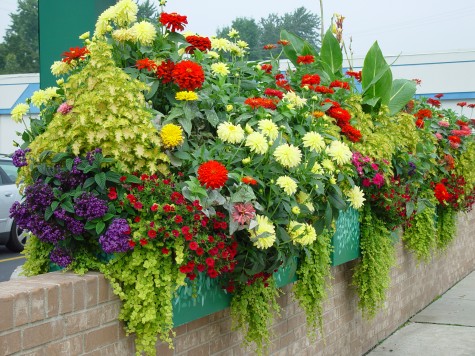 Airy and wispy container plantings are not for everyone. Furthermore, there are some places that they simply don’t work. These planter boxes sit on the wall enclosing a parking lot of a restaurant only a median away from a busy four-lane road. The speed limit is 45mph; the noise is deafening. In the 2.5 seconds it takes to zip past this wall, there is an impression that will register with even the most garden-deaf driver. The combination of colors is ebullient, enthusiastic, splashy-friendly. The boxes are overflowing; the plants all look healthy. My client takes great care of them-just like she takes care of her restaurant. That message is loud and clear.
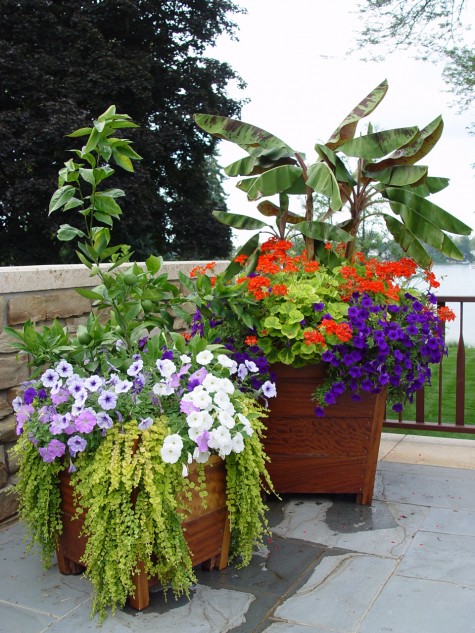
These large Belgian boxes are visual stoppers at the corner of this terrace. They ask for a robust planting. Plants with large leaves and substantial size go a long way to capture the eye. Bananas, calocasias, alocasias, cannas, farfugium, tibouchina grandiflora-there is a long list of tropicals that can easily handle holding down the fort. Vigorously growing plants in bright colors will chime in. The smaller planting of a lemon tree, and a pastel mix of petunias, though robust, would be lost without the big backup.
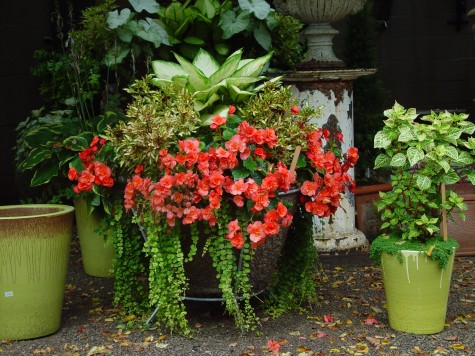 A solidly robust planting has much to do with the choice of plants. The three plants comprising this pot have grown together in a shape that is dense and low overall. Just try to get by it without looking. Chartreuse makes every other color pop all the more; creeping jenny is a vigorous perennial that loves some shade, and will grow in a bog. There is nothing subtle or airy about this planting-this is by design.
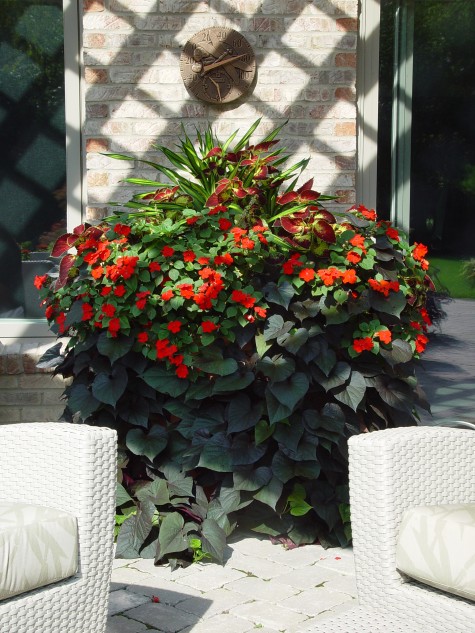 I can say the same for this pot. It has grown so vigorously that the pot is no longer part of the composition. Black and red; red and green-these color combinations are dramatic. The contrast with the off white wicker furniture is all the more dramatic. This modern furniture is very chunky and overscaled. These two chairs have some planted company that is even larger, and more chunky. The topknot comprised of a dwarf yellow variegated dracaena and a coleus-that look is in no way planned. Just natural.
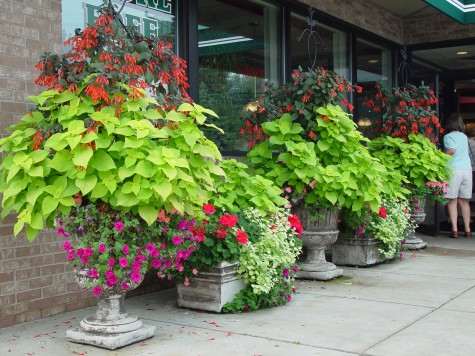 Gartenmeister fuchsia is an upright variety that handles hot weather like a pro. It can grow to a substantial size, and can easily be wintered over. However, the dark foliage and small tubular dark orange flowers are rather subdued. A tutu of lime green coleus turns up the heat. The red geraniums,magenta petunias and lime licorice don’t hurt. This fuchsia is naturally very airy growing; its woody shoots grow every which way. The colues masks all of those wild hairs; these plants grew together densely in a cone shape.
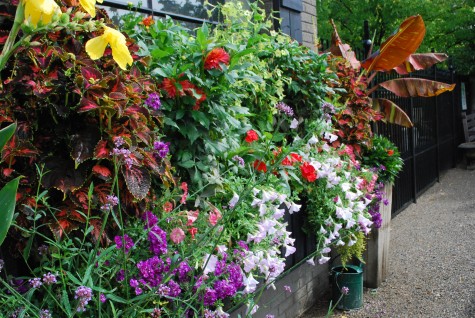 Big growing plants are accompanied by lot of leaves. The leaves of the trailing verbena and petunias are barely visible in this picture, but there is no mistaking the coleus and dahlia leaves. My office is dark, given this window box planting. Any container design warrants some study. Do I need this planting to block an untoward view? Do I want a container to stand out, or integrate into the large landscape? Right now is a very good time to be looking over your container designs; I take notes.
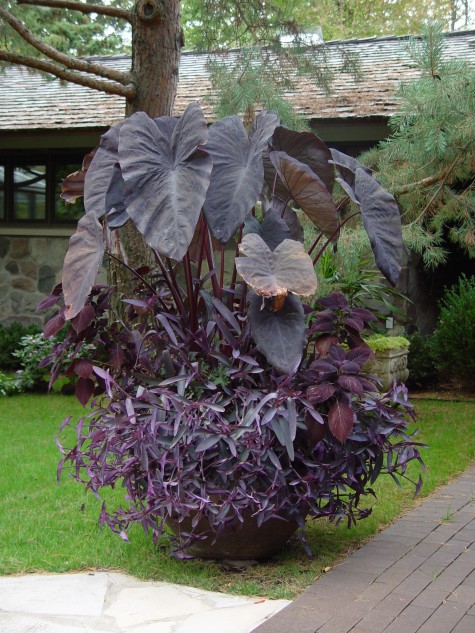 A very large terra cotta pot with a purple chocolate glaze is home to this monochromatic planting. Black calocasia, a purple black leaved coleus, and moses in the cradle, makes a sizeable statement about volume and texture. Calocasia ia a very obliging tropical, in that it will grow as big as the container into which it is planted. This planting is the better part of 8 feet tall. This discussion of texture anf form-loud and clear.
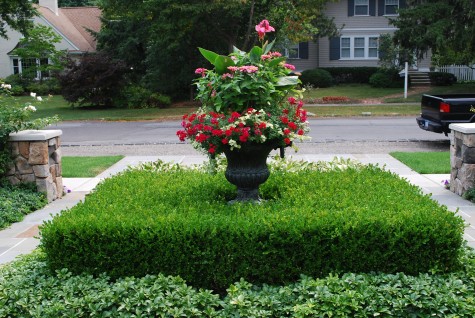 Cannas and zinnias-they both are big growing and leafy. A skirt of trailing geraniums and lime licorice add lots of color at the base. A neighbor standing behind this pot on the sidewalk would not be seen. Sometimes a blocky and solid planting can organize a space-in this case, it presides over a densely growing square of boxwood. Solid, dense and visually clear-this is how I would describe this spot in the landscape.
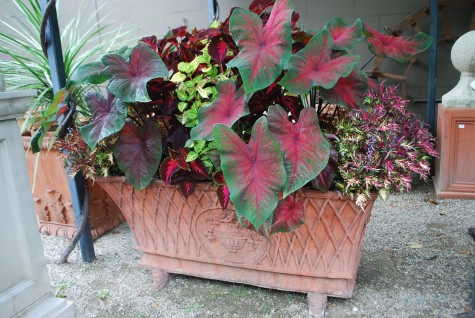 Large leaved caladiums depend on their size and shape to make a statement. I like how lush a well grown plant looks. I am leaning towards planting a lot of them next year. Loud and clear is much about vigor. I would much rather work to keep a growing fool of a plant in line, than every day have to convince a prima donna of a plant to choose life. This is a personal preference. Even the subtle and wispy growing plants that I favor are strong growers.
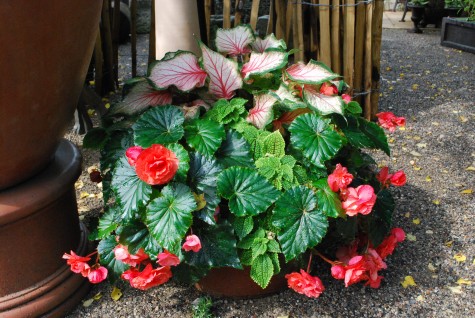 But back to loud and clear. On that list of plants that can deliver that for you-big growers, dense growers, robust growers, large leaved plants, large growing plants, brilliantly colored flowers. Brilliantly colored leaves; leaves with great shape and texture. It is up to you to put them all together in a way that enchants your eye.
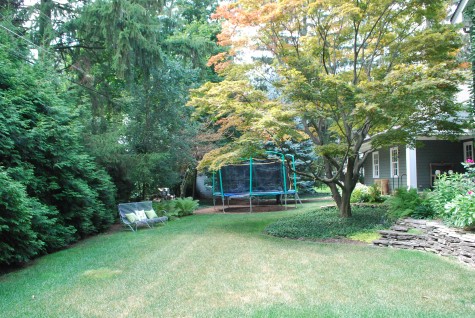 People make changes in their landscapes for lots of reasons. For some, it may be the end of the trampoline era. Kids need space to play, and entertain friends. This need can be the organizing metaphor of a landscape. I have lots of clients with mini-soccer fields, trampolines, play sets, tree houses, picnic tables, basketball hoops, bike racks, mud rooms, shed sized doll houses, badminton nets, ice rinks-you get the idea. This client had just accompanied her youngest child to her college orientation. It was time for a change in the landscape. She thought a firepit would be a good substitute feature for the trampoline-that part was easy to visualize.
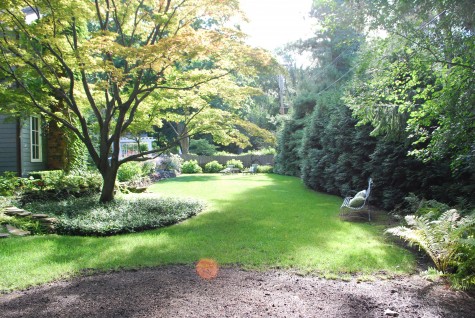 The rear yard was very shallow and long, and dominated by grass. Even the bed of euonymus under this aging Japanese maple had a big flat spot in its curve out into the yard. She did not want to intrude on any flat grassy space. This is child friendly. Old arborvitae hedges screened most of the rear lot line. Every landscape move was immediately apparent-from one end to the other.
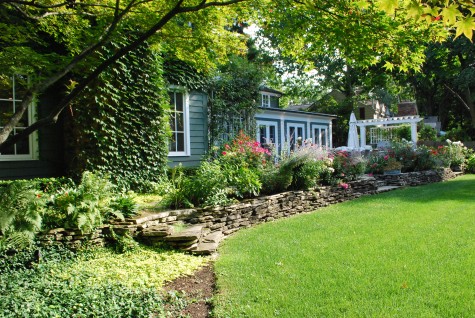 Small perennial borders were planted on top of a series of dry stack stone walls, laid at the grade of a big bluestone terrace. This places the shasta daisies out of range of the soccer ball, and rightly so. Lawn ran right up to those walls. A large upper level bluestone terrace set at the grade of the floor of the house provided a place to have guests, and large table, and a built in barbeque. On this terrace, a small fountain and fountain pool, set on top of the bluestone.
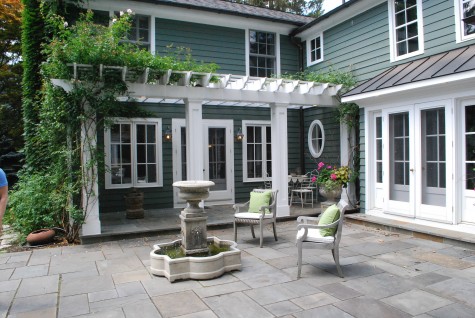 The fountain dominated a fairly large space on the terrace, and proved difficult to integrate into a seating area. A group seated here would be looking into the pedestal of a fountain. After a resolution of the trampoline issue, where would the fountain look best? This space would be great for a couch, coffee table and chairs-for adult events. An adult experience of the garden and landscape meant the fountain would need a new home.
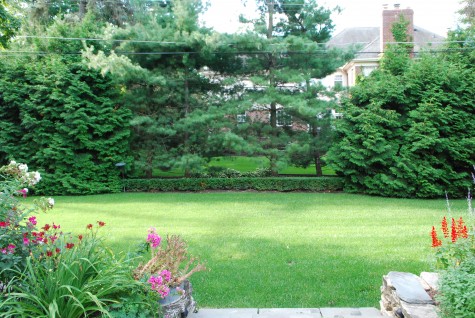 Directly opposite the terrace, a small hedge of boxwood faced down some large and open growing white pines belonging to a neighbor. Though the stairs did not come off the terrace centered on this space, that was the least of the troubles. The problem here-a view to no where. A way too good of a view to a neighboring house.
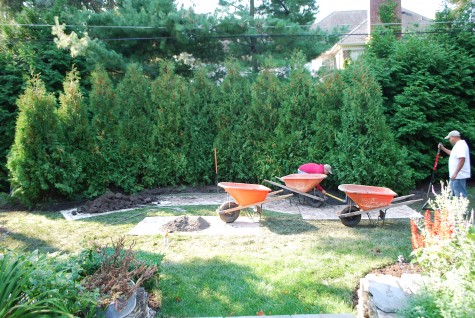 We planted 11 12 foot thuja nigra-these are a match for the existing arborvitaes. This screened the neighbor’s house from view. These evergreens were planted in a shallow arc-what need would there be to continue the long straight line of cedars down the lot line? The idea here-create a space, shelter, for that fountain.
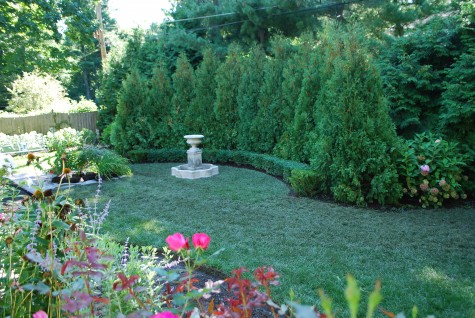 The existing boxwood were dug out, and replanted in front of the arbs. This gives a very crisp green edge to the cedars. The fountain and its basin were relocated into the grass. The gap between the first arb on the arc, and the first arb on the lot line-we filled that with an existing hydrangea. This landscape is starting to look much more interesting. The fountain looks much stronger, given this placement.
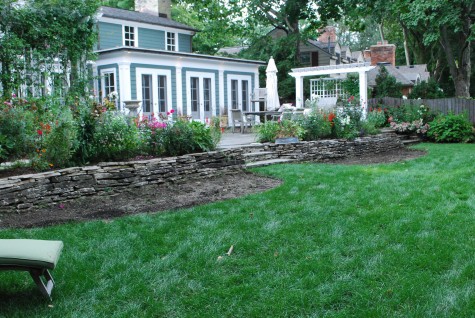 The dry stack stone wall whose function for many years was to keep the kids, dogs, and footballs out of the upper level perennial garden and terrace-we cut curving beds in front of them. My idea was to link the upper level terrace with the lower level landscape. This meant I needed to move the very tall, and visually blocking, perennials on the top level, to the ground plane. This will give my client much more space for her herbs on the top level. And an integrating view of the lower level landscape. A clear view to the lower landscape, softened by roses, phlox, coneflower and daylilies would make the lower landscape part of the experience of entertaining on the terrace.
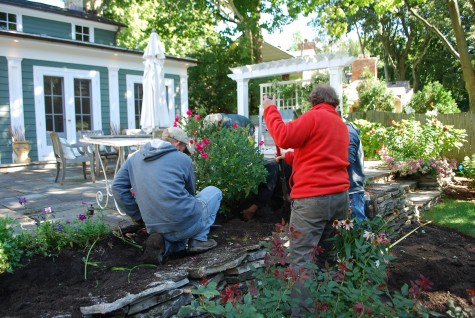 Moving perennials-right now is the perfect time. The nights are cool, the rains are regular. We did move some roses-with giant rootballs. Four of us handled the digging, lifting, and resetting of each rose. This will work, or it won’t. If it doesn’t, a new rose is easy to plant. The other perennials will move easily. This is the right time.
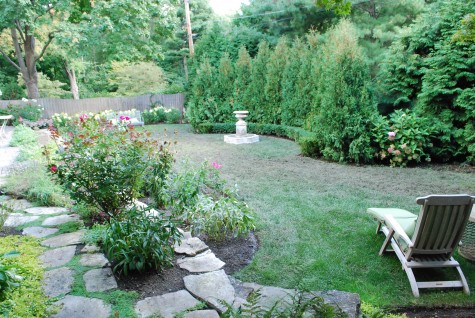 I am sorry for the state of the grass-we have had so much rain. Even though we put down plywood to travel across the lawn, it has taken a terrible beating. It will be back thriving within a week or so. This is an entirely different landscape look. The lawn has become a generously curving path from one part of the yard to another. There are distinctly different spaces; rooms, if you will. The curving beds are a great contrast to the rectilinear overall space.
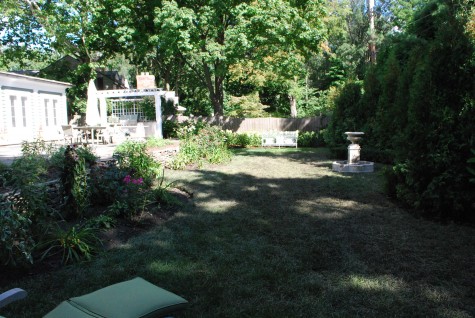 This picture is not the best, but it should be clear that the bluestone terrace has become a big part of the greater landscape.
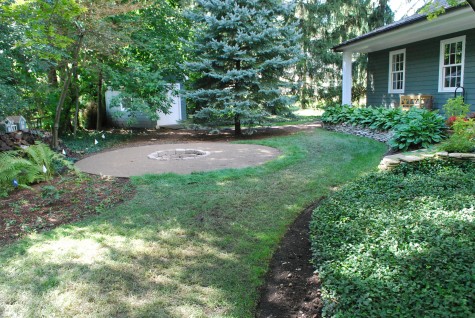 As for the trampoline-it is gone. In its place, a firepit surrounded by a decomposed granite terrace. There are some very good looking curves going on here. Any landscape can be transformed with a few fresh ideas. These fresh ideas-straight from my client. Her request? A new era, please.
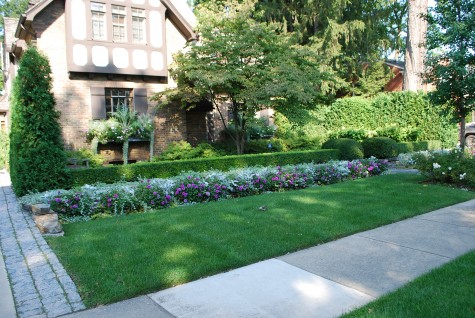 I have not kept up as well as I would like with my spring plantings, but I am happy to report that this planting has prospered, and seems to be handling the fall well. I have not been here since late June, so I know this planting has been looked after. I had the chance to stop by, given a landscape call in the area. None of the purple dahlias in this mixed annual bed have succumbed to the mildew I have seen everywhere. I expected nothing less; my client is an afficianado and expert grower of dahlias. I have no other client that I would saddle with the time and trouble in a planting this extensive with lots of dahlias. I did lend him a hand; the dahlias are companion planted with silver licorice, cirrus dusty miller, grey plectanthus and silver dichondra. This supporting cast can hide trouble.
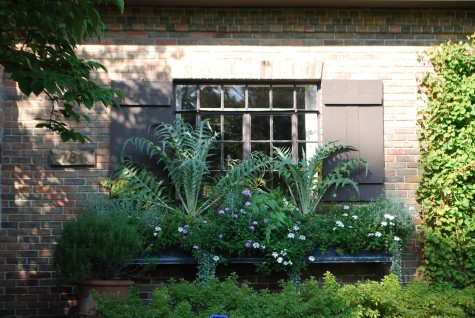 The windowbox cardoons have grown considerably. This box was planted with green and silver plants, punctuated by a few flowering plants. It still represents that intent, going on 4 months later.
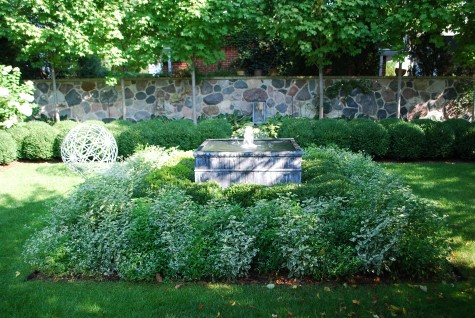 The rear yard fountain cistern is surrounded by boxwood-this will be a good look over our long winter. For the summer, a mix of Euphorbia diamond frost, and white polka dot plant has grown in around that boxwood like a warm stole. Both of these plants are so airy growing, they do not impact in any way the health of the boxwood. This is a place that a permanent fixture in this landscape has an interpretation particular to a given season. Next year, who knows what will take its place. Given that it is mid September, I am pleased with this healthy and billowy look.
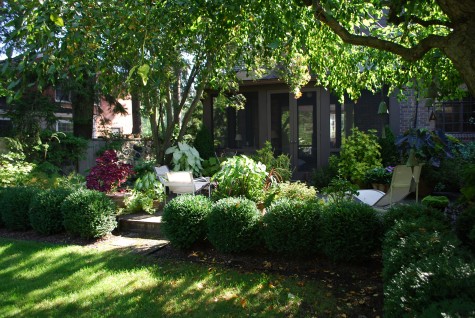 The rear terrace with a view to that fountain has lots of pots. The shade is fairly dense. I usually plant these pots with a green and white scheme. This year, a little dash of black/purple. A coleus, a black calocasia, and some wine purple spikes provide a little out of the ordinary interest.
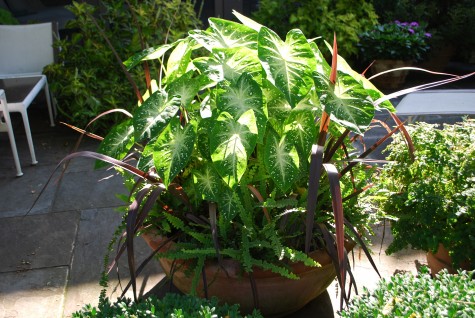 This was my favorite planting of the season. I knew this the second I finished it. The wine spikes usually tapped for the centerpiece of a planting-I planted them on the edge. The green and white caladiums I knew would round out. Between the black spikes-a spiky tropical button fern. It looked great today, with the morning sun filtering through the caladium leaves. In my opinion, this is a very good looking pot. The plants did all the work, you know.
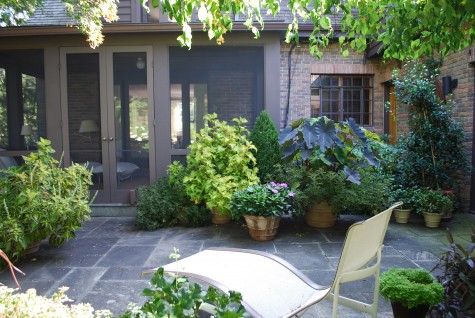 A grouping of pots with individual plantings have for all intents and purposes become a single entity. The entire group seems to be coexisting peaceably. I really like how the plants in wild places sort out their differences, and grow in to one another. The conical boxwood sandwiched in between an explosion of lime coleus and a black calocasia underplanted with inky fingers coleus-this is a good scene. There is a natural feeling here that contrasts with the stark lines and color of the vintage chaise.
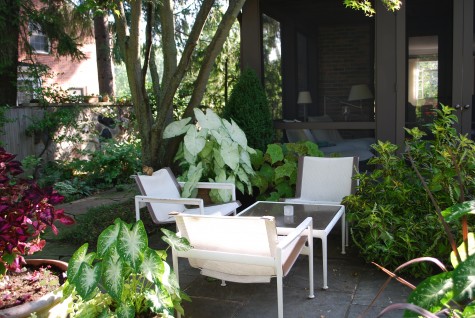 This intimate grouping of mid-century modern chairs designed by Richard Schultz has leafy company. I could live here.
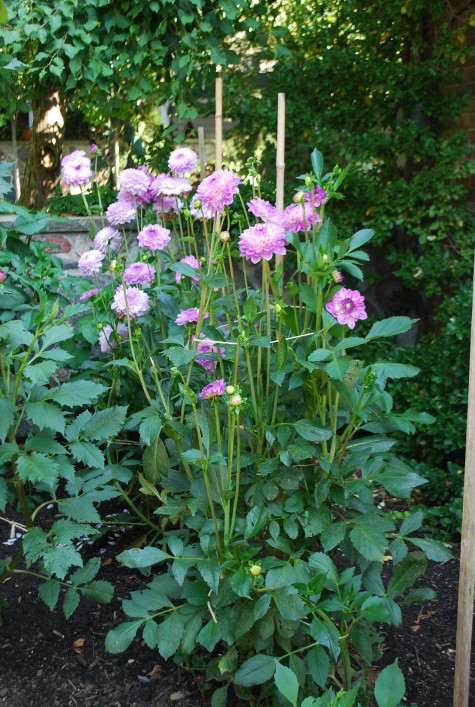 This post needs to acknowledge my client’s passion for dahlias. He winters over the tubers. He does not plant them out until late June. Every year I shrug, sure that they will never come to anything. Every year, in the late summer, they come roaring skyward. This very modest patch in a small garden is entirely devoted to dahlias.
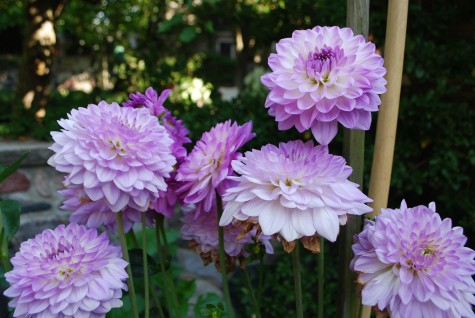
I will confess I buy giant dahlias for him when I see them looking good. As much as he loves growing them, I can’t resist bringing one home for him.
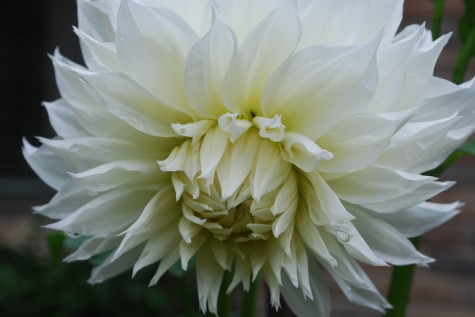 He grew this gift of a white dinnerplate dahlia to perfection. He knows what these showgirls require, and he delivers. The best part-how much he nurtures, respects, and enjoys his garden. Every inch of his property is taken care of. He has tomatoes and eggplants on the driveway-thriving in pots. He has rosemary plants-we winter them for him. He loves his European ginger, his snakeroot, his hydrangeas, and his hellebores. He is plain and simple-a gardener.
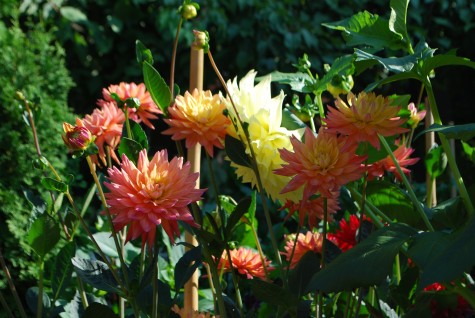 Green and white with a dash of purple-this years planting scheme. Does this mean the dahlia patch has only purple and white dahlias-absolutely not. The dahlia patch is not about a color scheme-it is about a love for dahlias. Mid September, that patch is thriving. Every place on his small urban property-thriving. What does this say to me? Gardener in residence.