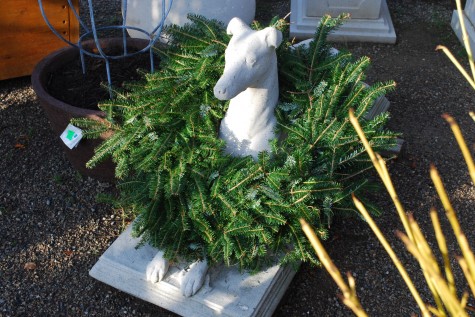
 Years ago Jonathon asked me to dream up a phrase that would describe my shop. As we are in a tiny industrial district way off the beaten path, I thought “dirty little secret” would both reference the foundation upon which all I do becomes possible-and furthermore would encourage people whose curiousity was sufficiently piqued, to seek me out. I try my best to have my three quarters of an acre ready for company every day. This wreath, a warm, plain, and beautiful Douglas Fir wrap around a cast limestone dog, is displayed in the front of the house. The back of my house, stuffed with holiday materials scattered all over the place, is another story. I know this is my second post about wreaths in a week, but these modest circles of green can so enliven your winter landscape-so bear with me. No need to confine your wreathing to your front door either-a sculpture, a pot, a gate can be dressed in a wreath.
 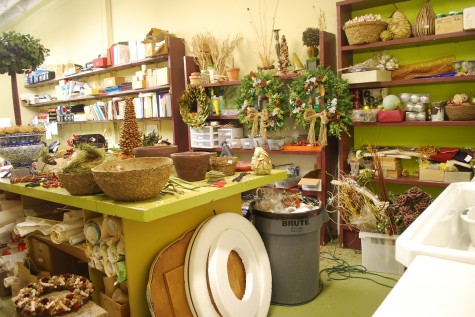 I am persisting with this discussion, as I think these modest circles based on green can endow a winter landscape with an impact vastly beyond their small size. They are a distinctly personal expression. My workroom is entirely given over at this moment to taking those green circles a few personal steps further-special orders. There are so many materials-both natural and not, that can be arranged, wired or glued on the surface. I have made a lot of them over the years; they are miniature gardens that go together fast. Rob meets with his clients; pictures of possible combinations follow via email. Helping people put things together that they like individually is a big part of the job.
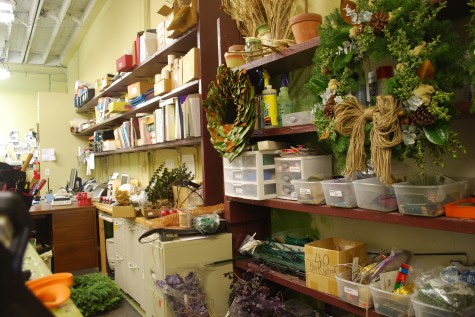 The workroom, my dirty little secret , is home to the tools, the good light, and the space necessary to make things. My only wish for my life-to be able to make, and go on making. Landscapes, gardens, topiary sculptures, flower arrangements, paintings, essays-specific to a person, a time, and a place. Everything I make inplies the person out there. These landscapes do not take weeks, or years to put in place. Even a complicated arrangement rarely takes longer than an hour. The trick is having all the materials and tools at hand, and ready. The rest-trying out whatever strikes your fancy.
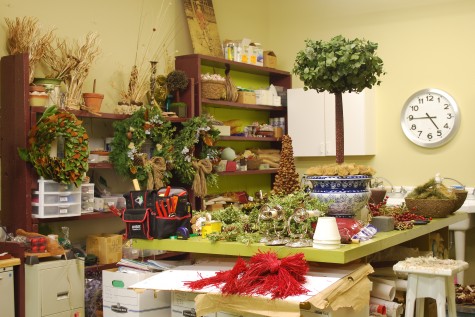 My workroom is not particularly fancy. A 4′ by 8′ painted plywood layout table holds all manner of materials and tools at a height that makes the work easy. Underneath the top is space for plans, rolled up and labelled with a client’s name, and date-some of which date back 20 years. Lots of flourescent lighting banishes shadows, and makes it easy for me to see the details. Every surface is put to use; if something is put away, I forget I have it available. I collect bits of this and that all year long, for the wreaths.
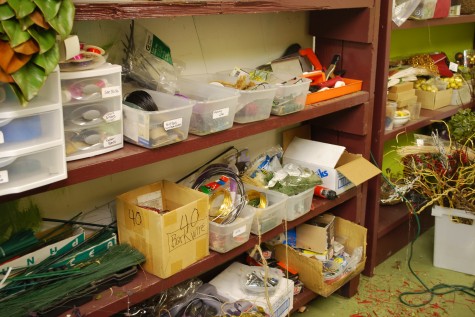 Shelves loaded with containers organize like materials-I need this level of organization, given that I am in progress with multiple projects. I hate searching for the ribbon scissors, so it has a home. Things have gotten a little out of control, but I resist the impulse to clean. I am so lucky to have a big space that needs no daily cleanup. At the end of the day, I just go home-the litter can wait until I have time to clean it up. This is MCat’s favorite time of year-so many things that have fallen to the floor to play with. Some days he finds a spot on the table to snooze.
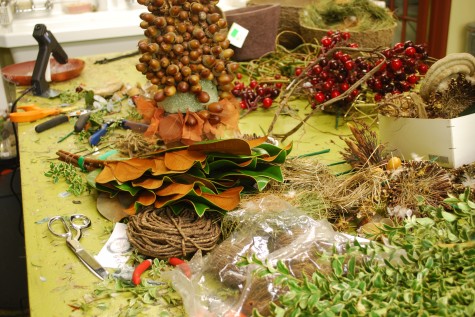 I like loading the layout table with materials that speak to each other. I move things around, I add and subtract until I get a mix that seems to work. This can take a lot of time. Once I come to some conclusion, the construction phase kicks in. My industrial grade glue gun-an invaluable tool. I cannot stitch, sew, or cook, but I can glue. I also take things apart before I use them. One half a seed pod might work better than a whole one. Garlands and picks cvan be unwired, and their elements used individually.
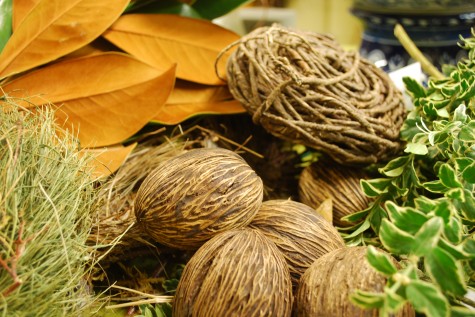 The dried grasses, the oregonia, the bahia pods, the magnolia stems, acorns, the bark wire-all of these materials seem just right for clients for whom I mail out a slew holiday wreaths the Monday after Thanksgiving. They love all manner of natural materials-they trust my mix, different every year. I photograph them, so they know what gets sent.
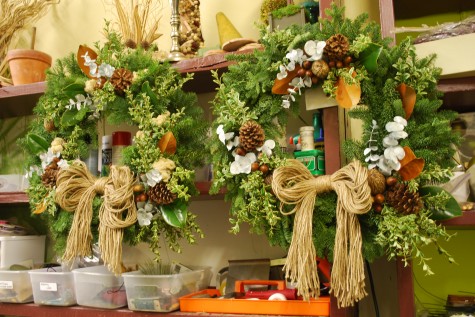
The eucalyptus, acorns, magnolia leaves, pine cones and oregonia say hello and happy holidays to their friends and family. The jute bows are a new thing. Rob is so good at seeing the beauty of a raw material beyond its ordinary use. This workroom is a gardener’s junk drawer on a big scale. Once these wreaths are hanging on a door, who would suspect the happy mess from whence they came?
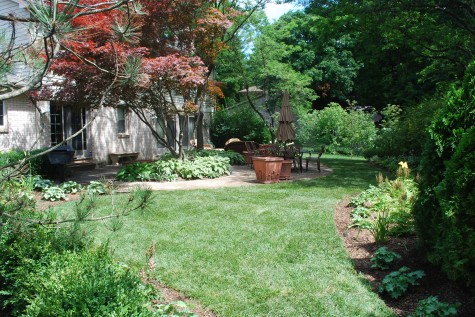 We spent over a week tearing apart a thirty year old landscape for this client. They had decided that though their kids were grown and gone, they would stay, and renovate both the inside and out of their family home. They had not ever spent much time outdoors; a very small back yard with no privacy from neighboring terrraces and play structures kept them indoors. New screening, and an enlarged gravel addition to their terrace opened the door to a new living space for them. The finishing touch-a collection of Italian style, English made concrete planters.
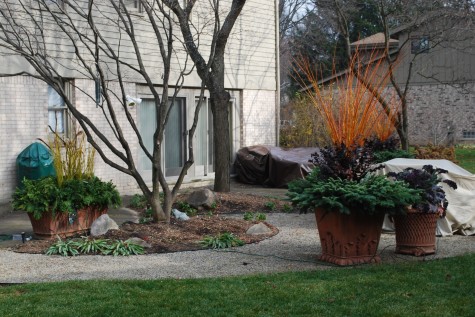 Their children are all coming home for Thanksgiving; they asked if I could dress the pots in their winter coats in time. They are very excited at the prospect of their kids seeing how their home has been transformed in the past 3 months, and the landscape is part of that. Four of the five pots on the rear terrace would be planted for winter. As they have little in the way of outdoor lighting in the back, we installed lights in every pot. The electrician just installed outdoor plugs for them yesterday, in time for the holiday gathering.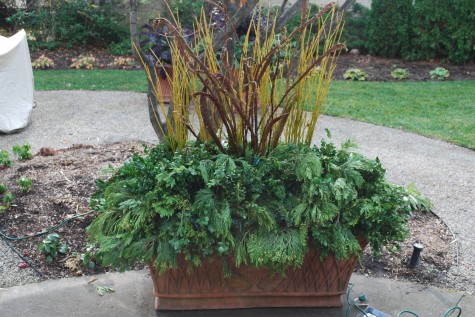
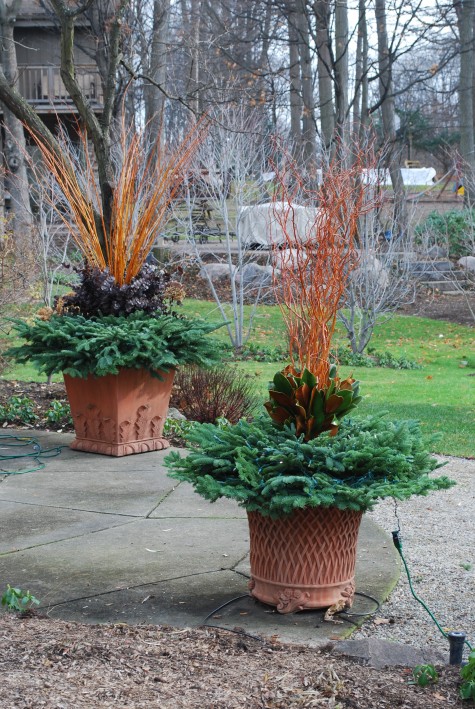
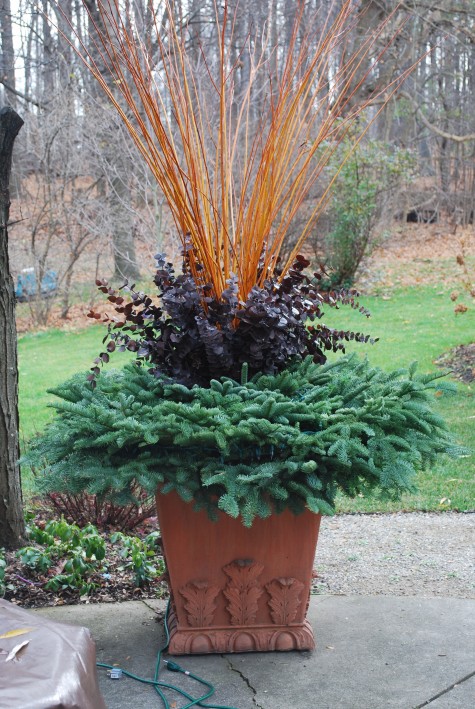 Preserved and dyed eucalyptus provdes a leafy texture much like the magnolia. The chocolate brown color is surprisingly lightfast outdoors. The container looks dreesed for the weather; the colors perfect for the Thanksgiving holiday will go on looking good as winter settles in.
 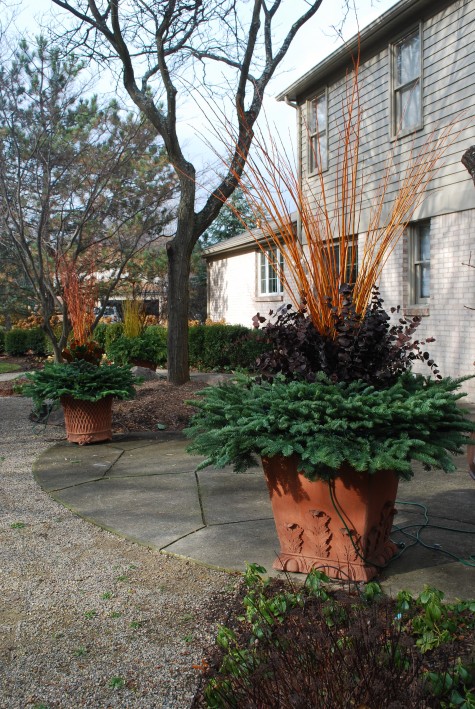 The pots are positioned to provide good views of the outdoors from the inside. I will move pots from a summer location to a winter one, if need be. I spend a lot more time looking at my garden in the winter from indoors; I am outdoors as much as possible in the summer. These pots can help alleviate that cooped up feeling invariably creeps up on any northern gardener.
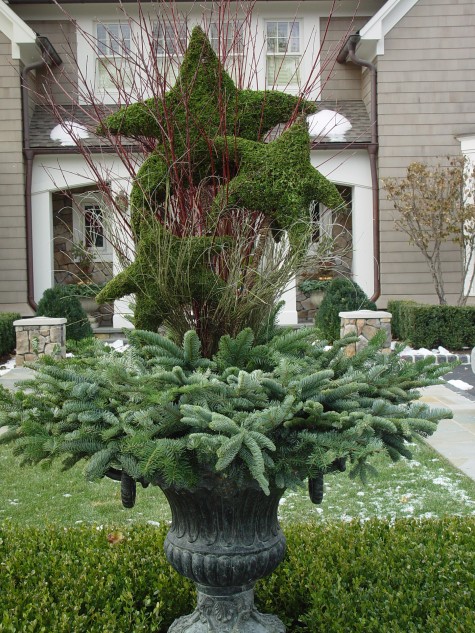
 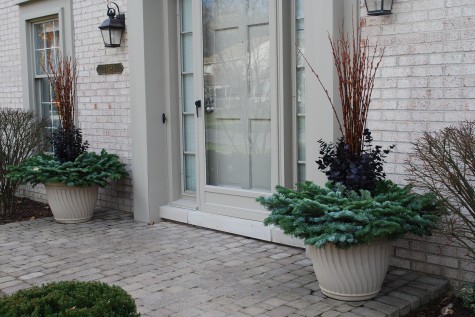 After the rear terrace pots were installed, they called-could I please do three more. Though they plan to replace these front door pots in the spring, they are not the center of attention here. Red bud pussy willow and dark purple eucalyptus make a formal and quietly beautiful statement at the door. My landscape crews construct and install all of this work; they do such a beautiful job. Clients who have winter pots done for the first time are surprised at what a difference they make. I hear about how nice it feels to have something beautiful to look at outdoors at this time.
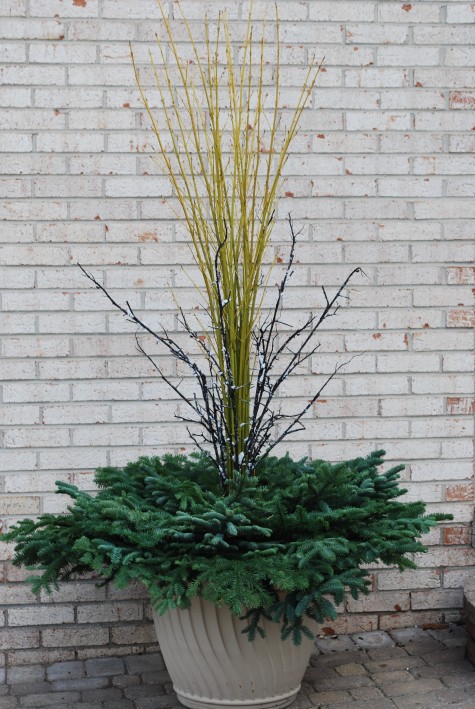 The side door has the same pot as the front, but a different treatment. As variety is a very precious commodity this time of year, I avoid repeating the same materials everywhere. These snow branches are all plastic; they look just as good up close, as they do in this picture. I try to include a third, mid-level element in all the winter pots; just sticks and greens is a little too spare for my taste.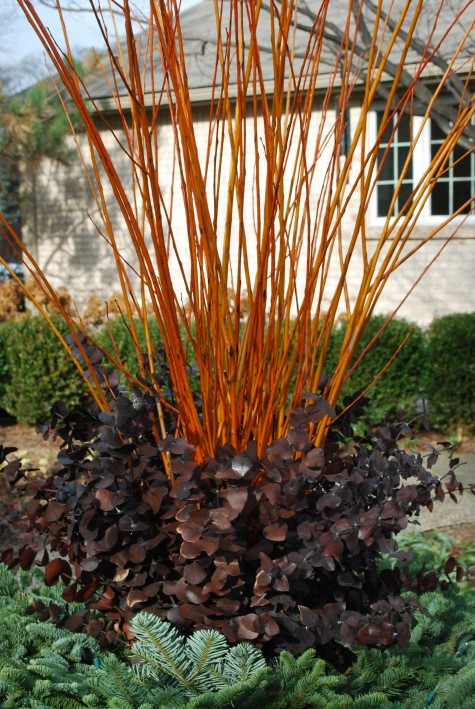
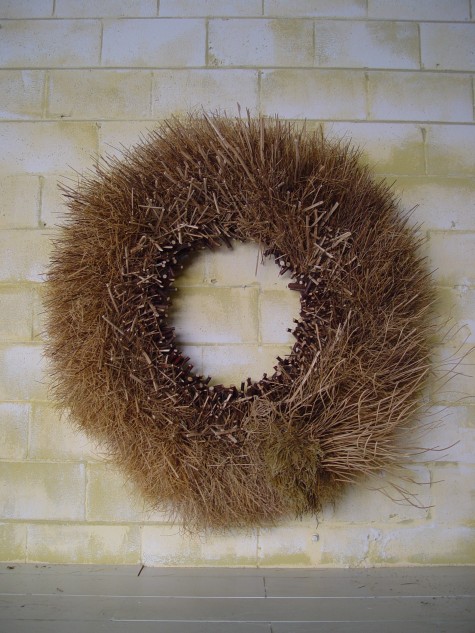
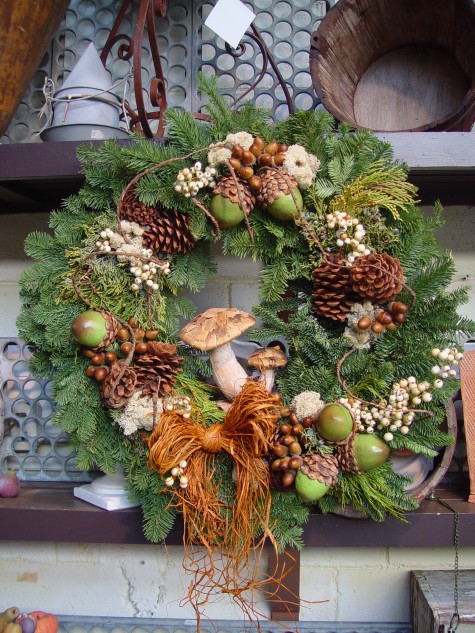
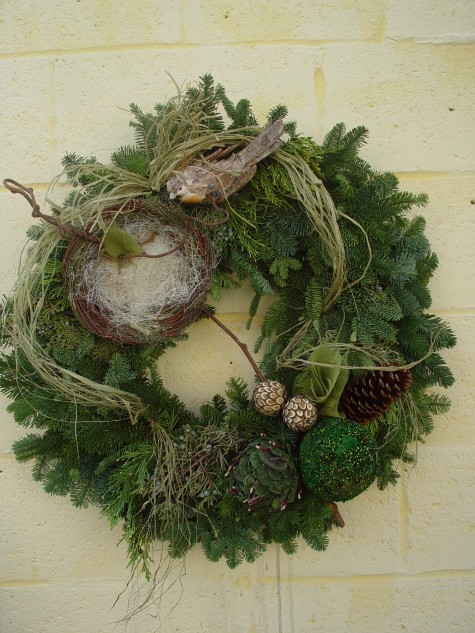
 The grocery store is a great source for natural materials; you can find cinnamon sticks this time of year in the spice department. Nuts and dried fruits, sprigs of fresh rosemary-all these things look great. Artichokes and pomogranites are easy to wire and attach fresh, and dry just fine. I avoid piercing any fresh material if I can; there is no need to invite rot. Forest floor litter can be a good source of materials as well-bracket fungus, cones, moss bits and twigs-all these things endow a wreath with a garden feeling.
 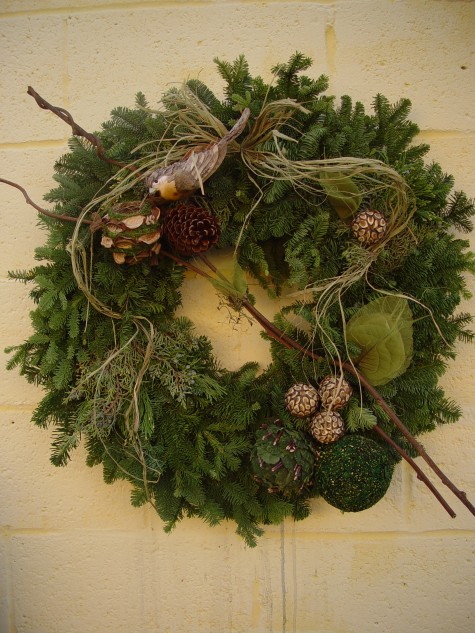 Some faux material is too awkward to wire. In the case of this nest, and the bark birds, I pierce the back of the object, and glue in a florist’s skewer; kitchen skewers would work just as well. Transparent materials, such as these skeletal leaves, gain visual weight when used in numbers. I can wedge the skewer into the woody branches of the evergreens. I try not to push the skewer in too far; avoid making your birds look pasted on the greens. Transparent materials, such as these skeletel leaves, gain visual weight when used in numbers; these are wired and glued on a short skewer. Loose and airy looks good.
 Any faux berry stem needs to be tested for water resistance before it is used. I learned this the hard way; five window boxes full of white styrofoam berries, gel coated in a clear red acetate, dissolved all over the greens and pavement in front of the store of one of my commercial clients. What a mess. A short piece of dried kiwi vine chosen for its curl as a loose element to the mix.
 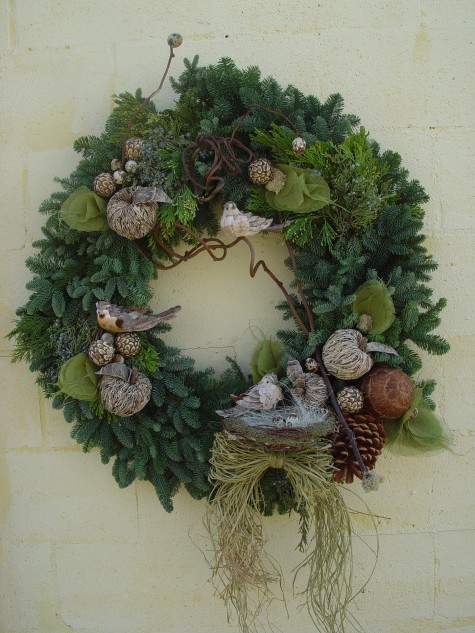 Ornaments made from natural materials are readily available. As with any ornament or stem, I deconstruct some things so the proportions are good with the size of the wreath. Sometimes I only need a wedge cut from a ball, or a portion of a stem. A wreath is a little world that needs to be built accordingly.
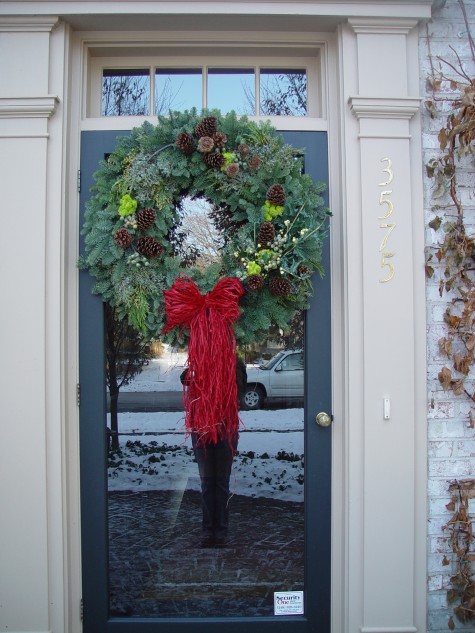 When the front door is a long way from the street, a shot of bright red makes a cheery statement from a distance. Raffia bows have great texture and resilience to the weather. The worst enemy of any wreath is not snow-it is rain. A wreath subjected to a lot of rain can have a good bit of its original shape restored. Take the wreath to a dry place, and dry up side down, and face down; gravity will do wonders.

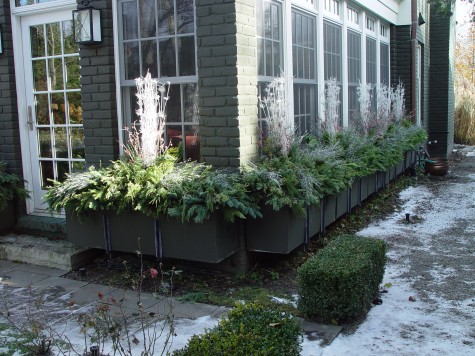 Mixing greens makes it possible to hedge your bet. Cut evergreens are best in cold temperatures; the cold further slows the rate of water evaporation. Though all the cedar species have attractive flat scaly needles, they are the first to dessicate if the late fall takes a warm turn. Their loss of color from evaporation is less noticeable when they have more lively companionship. Mixed greens add textural interest interest in volume. This mix of Douglas fir, white pine, cedar and silver fir illustrates clearly how variable a natural green color can be.
 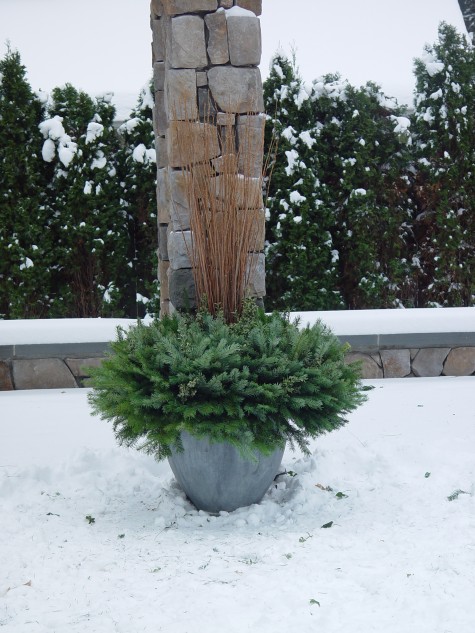 Fir species are instantly identifiable. The needles are arranged in the half round; the branches are flat on their undersides. Douglas fir is one of my favorite evrgreen plants. They will tolerate a little shade, and they are very disease and insect resistant. They are commonly available as Christmas trees; their soft needles make trimming a tree easy on the hands. As cut branches, they are remarkably long lasting. Their bright medium green makes them a good choice for arrangements viewed from far away. It is not unusual for me to clean out winter pots in April where the Douglas fir branches are still green.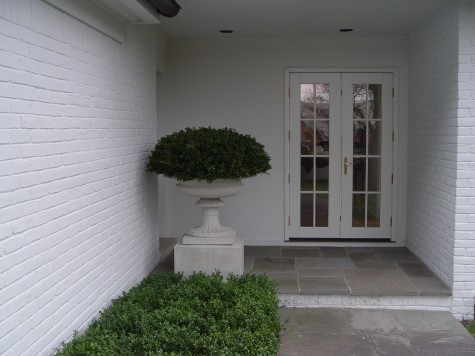
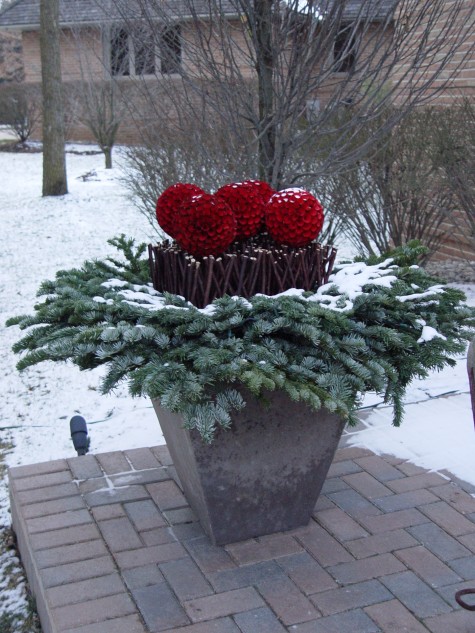 Silver fir branches are an icy blue color; it is all the more attractive paired with red. These spheres are made from giant wood shavings that are dyed red. The color is remarkable stable outdoors; there is little in the way of fading even in full sun. We test any materials we think might go outdoors, to be sure they can withstand wet weather.
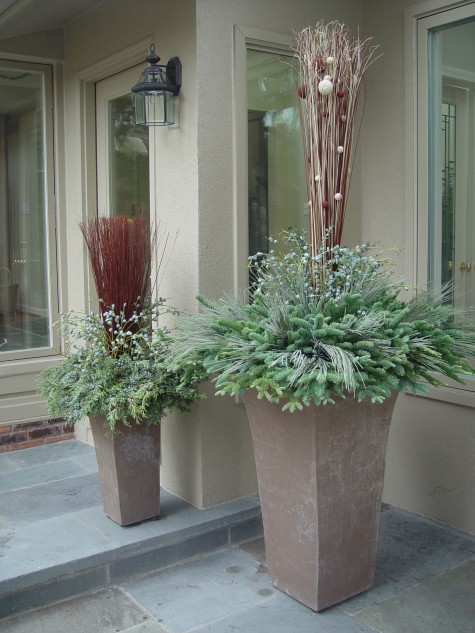 Berried juniper, and noble fir contrast in texture, and compliment one another in color. Natural eucalyptus pods are quite blue, and weather to a soft grey. Chocolate and cream ting stacks complete the ensemble.
 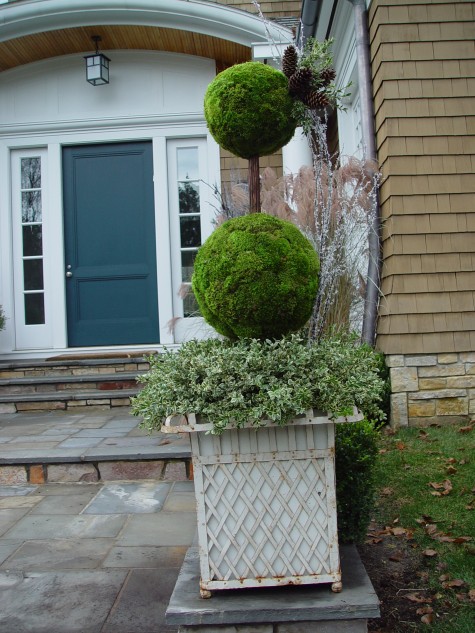 This dried mood moss is soaked with a spray of moss dye before it goes outdoors. In full sun, this treatment may need to be repeated during the course of the season. The wood dowel trunk of this winter topiary is covered in mountain reed of a color similar to the rusty age on these vintage English painted steel boxes. The top of the box is stuffed with a variegated boxwood known in the florist’s trade as oregonia.