A Pedestrian Bridge

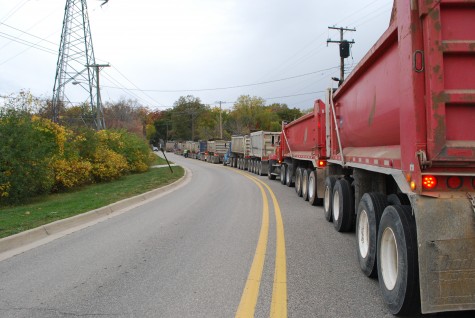
This was the scene on Pontiac Drive at 7am yesterday. Tractor trailer after tractor trailer-every one filled with dirt.  Down the street from us, a bridge is under construction. The bridge will cross over 6 lanes of Telegraph road.  2 spans, totalling 315 feet.  The Clinton River trail system, built primarily over a section of railroad which was closed in 1998, is a pedestrian path friendly to bike riders, runners and walking folk, stretching from from South Lyon to Rochester.  Current users of the trail have to detour around Telegraph some 5 miles before they are able to hook up to it again on the other side. The bridge will link the Sylvan Lake portion of the trail to the Pontiac portion.  
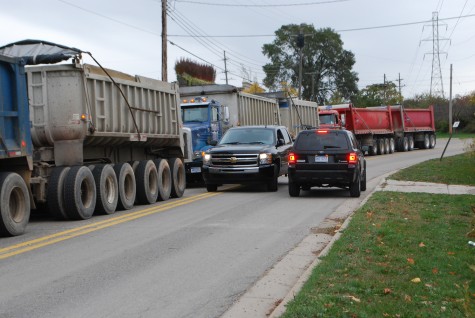

Building the bridge will cost something over 2 million dollars; quite a project.  We have been privy to the pounding and trucking for weeks now. Needless to say, traffic on this sleepy street has been congested. I was mesmerized by the sight of all of those trucks. There s something about earth work that fascinates me.   
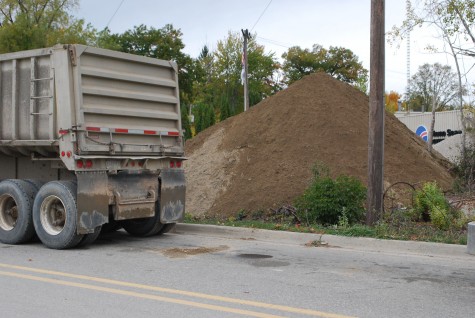
The project is at a stage where they need soil-and lots of it. I had to ask, and was told-each truck hauled in 44 yards of dirt.  By my estimation, close to 900 yards of soil arrived in a two hour period yesterday morning.  You can tell from the photo above the dirt was very sandy. I have no idea how it is being used-the bridge approach is off limits. 
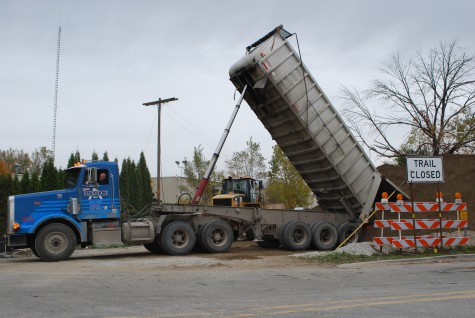
It took about 10 minutes for each trucker to dump one load, detach the trailer, dump the next, and hook the trailer back up.  All the while, another 10 trucks were waiting in line.  One of the drivers told me that once he fires his diesel powered truck up in the morning, it stays running all day.  Apparently it is very hard on the engine to turn them on and off.  
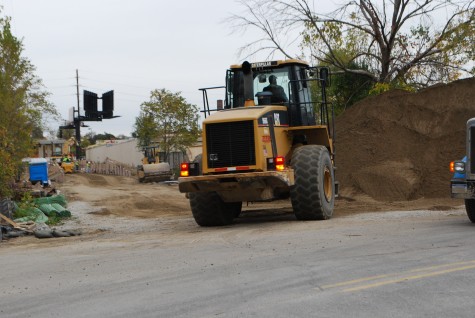
The wheels on this bull dozer are taller than I am. The operator ran loads of dirt from the street down to the Telegraph side of the trail all day long.  When I left work at 6pm, the dozer was still running back and forth.    

I like everything assciated with the landscape, and that includes the trucks that makes the work possible.  They brought my espaliers to me, under refrigeration, from the west coast. They haul soil, plants people and machines for me.  They deliver the many pallets of soil mix that we have formulated for our container plantings.  Every container that comes from Europe is trucked to the shop for unloading.    

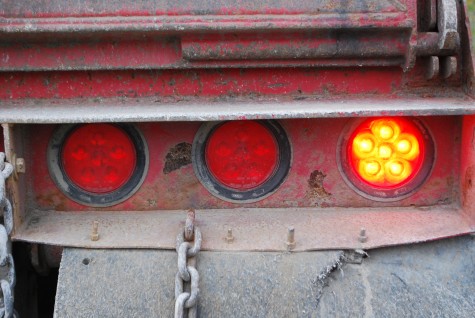
Each one of these trucks has 44 tires.  I cannot imagine the maintenance associated with a vehicle of this size.  No doubt this company has a full time mechanic on staff.  I have gardened in places where vehicles were not permitted.  Even the most simple job took a lot of time.  This in no small part accounts for my great admiration for people who do their own landscaping-and their own trucking.   

I have no idea how long it will be before bikers and walkers can take the bridge over Telegraph, but it seems like it will be a while yet.  I doubt I will ever ride a bike over Telegraph, but it has been an interesting experience to observe a bridge being built.
Kousa Dogwoods


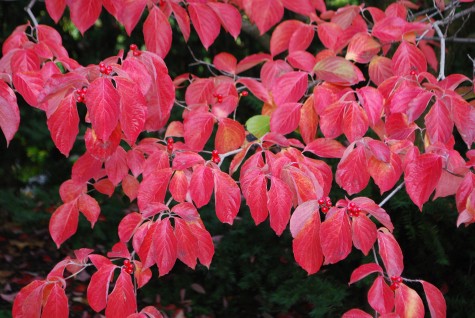
Cornus kousa, or kousa dogwood, has an impressive list of outstanding characteristics.  Since few properties are large enough for an arboretum, choices have to be made. Trees with year round interest draw my attention.  The kousa dogwood has outstanding exfoliating bark when it is of sufficient age.  Like the sycamore or London plane, a old kousa dogwood will randomly shed bark, revealing new bark of a paler color, from underneath.  As a result, an old trunk is multi-colored, and highly textural.  As much as I like bark, I like the kousa dogwood.  This tree furthermore sets brilliant red fruit in September.  That shiny fire engine red is my idea of fall fireworks.  


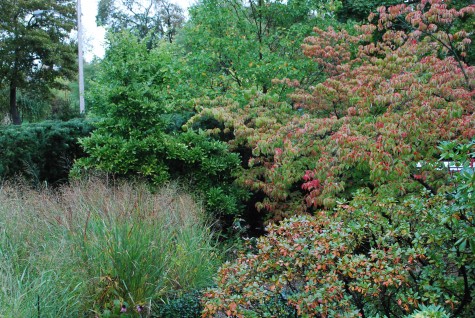
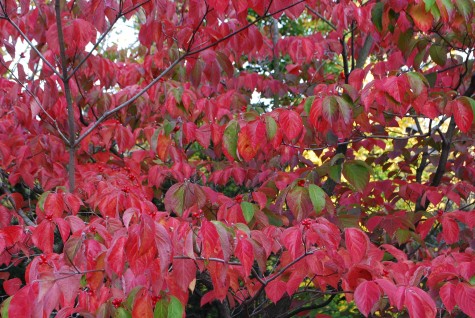
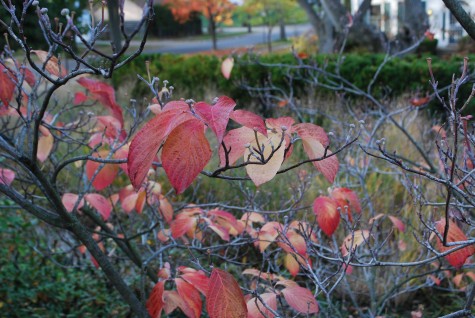
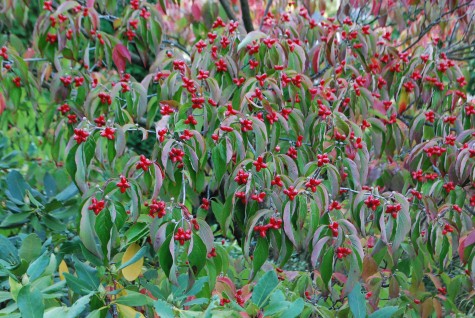
Notice I have made no mention of the beautiful white flowers that mature in my yard in June.  In a good year, those flowers may last 3 weeks; my gardening season lasts 7-8 months. I need more interest than what great flowers provide before I am moved to dig the the hole required to plant a tree.  Even my beloved magnolias whose bloom is so fleeting have great bark and branching, and large luscious leaves all season.  A long season of interest-I look for this. My Kousa dogwoods are next to invisible after they bloom.  You can only spot it in this picture, as the leaves are beginning to turn. 

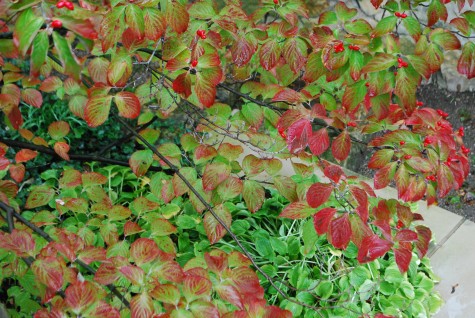
Their green leaves fire up slowly, come the beginning of fall.  The contrast of that red, and that green is riveting.  The shape of the leaves and the pattern of the veins are never more showy than they are in September.  The changing of the guard from the summer foliage to the fall display is an event I follow closely.   

The late September Kousa color is peach; that peach will deepen and mature.  I do not know the science well enough to state the evolution of the color depends on night temperatures that are steadily dropping.  So many times I research my instincts about nature to find out my notions have no basis in fact.  Suffice it to say, the fall color on the kousa changes dramatically over the course of the fall.

I have four kousa dogwoods on the north side of my house.  All four have grown steadily over the past 15 years.  This kousa planted at the front corner of my Romeo and Juliet balcony has grown such that the branches have come up and over the deck; they are at my eye level now.  One branch of that dogwood grows over the driveway far below.  I never notice that branch until the fall colors up the leaves. The garage lights make those leaves glow an orangy red. 

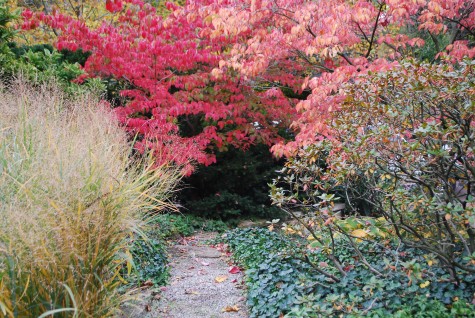
The vibrant red kousa leaves, underpainted and glowing from inside with that early orangy peach color, are the star of my north side garden show for weeks. The fall is all about the evolution of the leaves.  How they grow and photosynthesize over the summer, then turn, how they fade-how they drop-a gorgeous visual lesson in the process that is nature.  The process I am writing about takes the better part of 3 months.  That three month spectacular leaf turn and drop makes a kousa dogwood a tree I would not do without.
There comes that brief time when the red leaves of my dogwoods are just about as intense as the red fruit. That spectacular fall color is one of many reasons why a Kousa dogwood is worth any gardener’s consideration.  I have considered no end of plants for my own garden, and for the gardens of clients.  Decisions get made; trees get planted and take hold.  A good choice matters much. 

A tree is one of nature’s biggest plants.  I think about every tree I plant, and its location, long and hard-given the space it will occupy, and what conditions on the ground it will influence.  I additionally hope any tree I plant will outlive me. That given, I choose which tree for where with great care.  Today I am delighted to have a foursome of Kousa dogwoods thriving in my garden.  Their fall leaves in color delights me.  The summer season has no end of visual delight.  I have three other seasons besides the summer; I have interest in some off-season delight. 


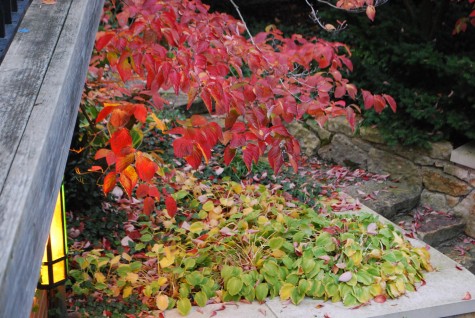
That congested thicket of red-orange kousa leaves peak, thin, and fall.  Those last few dogwood leaves holding on today speak eloquently to the end of the season.  Consider cornus kousa for your garden.  Should you already have one, consider more.  The fall color-enjoy every bit of it.

What’s Possible.

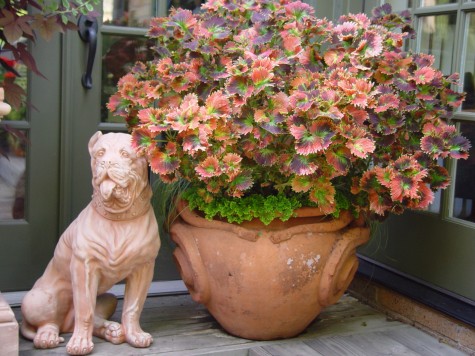
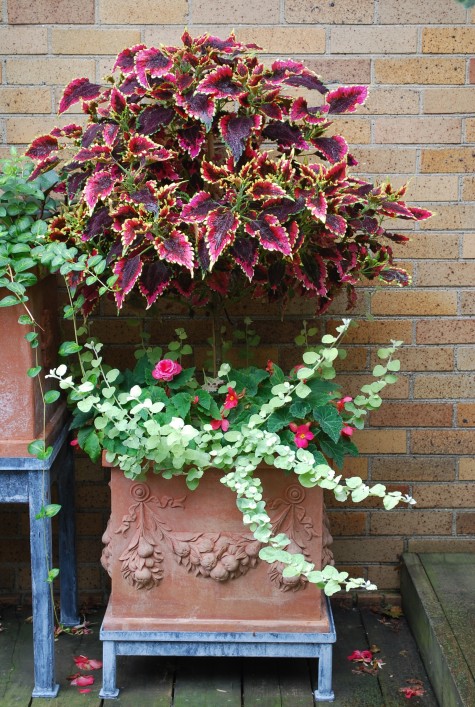
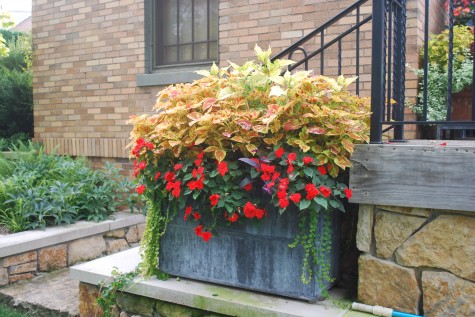
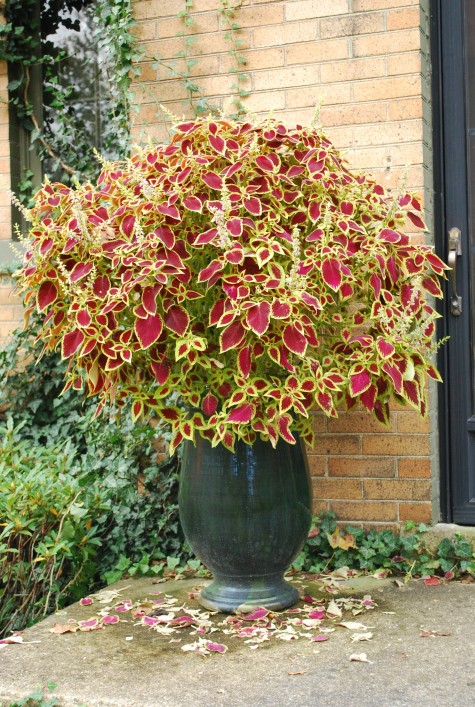
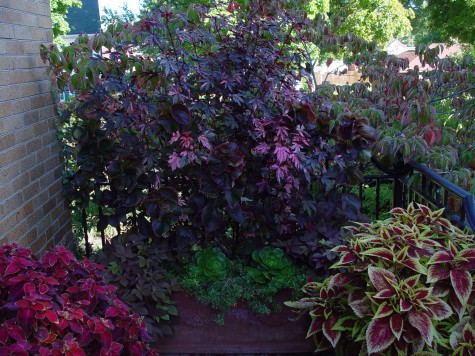
Some things happen very slowly in a garden.  I once scarified some gingko tree seeds, stratified them in my refrigerator for 10 weeks, and planted them out in pots in the spring-with the help of a parent. I probably was 11. Who knows how long it was before I could plant the seedling in the ground-it could be my Mom did that part for me.  5 years ago I went to see the house where I grew up-that gingko tree had become a substantial tree.  Last year I made another visit-the gingko had been cut down.  45 years to grow a substantial and handsome tree from seed.  Other things happen very fast in a garden; I am sure it took less that four hours to get that gingko down and hauled away.  A vision of a climbing rose redolent and weighted down with thousands of blooms in June takes years to realize.  It takes plenty of additional time to feed and prune, deal with the blackspot and the Japanese beetles, encouraging a plant to stay the course long enough to make that vision a reality.  A tomato seed can become a ten foot tall rangy plant loaded with fruit in the blink of a season.  For a gardener, a season is a measure of time.  Not short, but not very long either.  It seems like my coleus just got good when it started dropping leaves from cold.

A landscape or garden plan can slowly consume what seems like an endless amount of time. Any amount of time accompanied by the wringing of hands and indecision can becomes an interminably long slow time. One can stubbornly hold out for the perfect plan, and suddenly find themselves out of time-I am a guilty party in this regard.  I had the good sense to plant some small evergreens, thinking it would buy me some time to get the rest of a scheme together.  At fifty I awoke from my working every waking moment stupor to maturing evergreens and weeds in their early twenties; obviously my time to make the garden of my dreams was running out. I needed to step on the gas.

When I design for a client, my first act is to stew.  I stew over what a client has told me about what they would like to see happen.  I stew even more over the site plan or mortgage survey.  The stewing takes a lot more time, compared to the drawing.  Once I sit down to draw, I have an idea in mind-a concept.  The drawing has to work within the confines of a lot of givens.  The lot lines.  The physical distance from the home to the street.  The location of the driveway may or may not be a given.  In the drawing stage, I see how much more time it will take to make what I conceptualize work. The drawing goes slow at first. Maybe the concept doesn’t work very well at all; it takes strength to ignore the clock and start over.  Should everything be working, the drawing goes fast.

Once a design is in place and set to go, slow sets in like the project is coming down with a cold.  Projects need to be organized, and staged.  Plant material needs to be located and shipped.  The stone mason needs to see the job and quote the work, and set a tentative date to start. There is a chain of events which is bound to get tangled up.  A client approaching me in September about a project needing to be finished the following June-one would think that would be enough time for just about anything.  The project will finally get underway Monday October 18, some 48 days post the decision to proceed.  Who knows what lies ahead that could slow things down even further.

Pine Knot Farms is one of my favorite sources for hellebores.  I was looking at the plants I bought from them two years ago just the other day.  I am hoping this coming spring I will see my first flowers.  Nothing happens very fast with baby hellebores.  I have a fruiting olive tree in a pot which spends the winter in the green house; it has not grown an inch in the past two years-well maybe, an inch.  What the hold up is, I have no idea.  Neither a garden nor a landscape happens overnight.

But plenty can happen overnight.  A client may have a garden that needs a new dress and a good hair do in time for an unexpected event.  A tree can be blown over, or struck by lightening; I have had both of these things happen. Some people fall in love with gardening very fast, and fall out of love even faster.  Some warm up to the idea very slowly, and then presto- the warm feeling becomes a fire burning.  All manner of circumstances can change in an instant.  It is easy to recognize an instant when it happens.  It is harder to keep that possibility in mind every day, and garden accordingly.

At A Glance: A Last Look